Ethereum OG Sitting On 630,000% Gain Wakes Up After 10 Years

bitcoinistPubblicato 2026-05-27Pubblicato ultima volta 2026-05-27

Introduzione

On-chain data reveals a long-dormant Ethereum wallet from 2015, containing 2,000 ETH, has been reactivated after 10.8 years. Classified as a "pre-mine address," it belonged to an early participant from Ethereum's 2014 presale. The wallet's initial $620 investment, untouched for over a decade, is now worth over $4.2 million—a gain of nearly 630,000%. The activity began with a small test transfer of 1 ETH, followed by a near-complete movement of the remaining 1,997.9 ETH. While the funds have not been sent to a centralized exchange, the sudden activity suggests the owner may have recently regained access to lost or forgotten keys.

On-chain data shows an ancient Ethereum wallet containing 2,000 ETH that had been inactive for nearly 11 years has suddenly come back to life.

Ethereum OG Wallet Has Turned $620 Into $4.2 Million

According to data from cryptocurrency transaction tracker service Whale Alert, an old Ethereum wallet has just broken a 10.8-year phase of dormancy. The address in question held a total of 2,000 ETH, worth $620 back in 2015.

The wallet is so old that Whale Alert classifies it as a pre-mine address. In the context of ETH, a “pre-mine address” refers to one that received its tokens before mining began on the network with its public launch in 2015. Such wallets were allocated these coins because they belonged to early contributors and participants of the presale in 2014.

Interestingly, despite getting in early on the cryptocurrency, this particular investor just never participated in activity, with their only transaction in over 10 years being the deposit that they received at the blockchain’s genesis.

Now, the pre-mine address has suddenly been reactivated. Below are the details related to the transaction that broke the long spell of dormancy for the wallet.
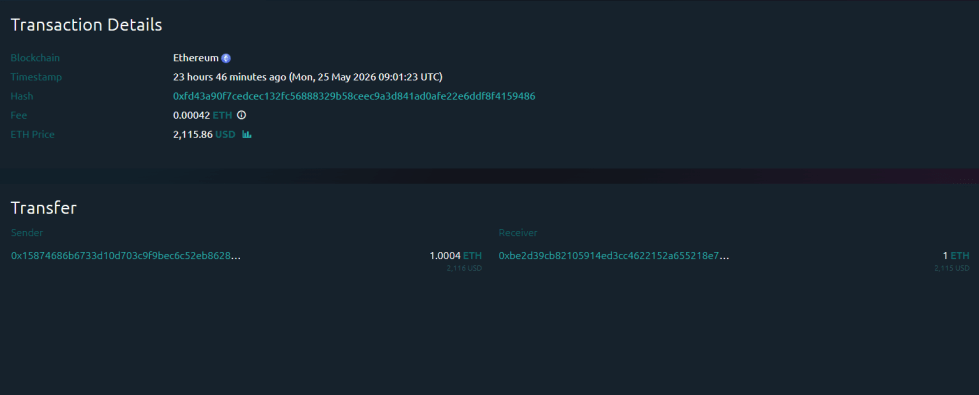
Looks like the investor moved a small amount with this transfer | Source: Whale Alert

As is visible, the move involved a sum of just 1 ETH, suggesting that it was likely a test transaction. After this transfer, the wallet followed up with a few more transactions, including a 1,997.9 ETH shift that nearly completely emptied out its balance. So far, these coins haven’t made their way to a centralized exchange, so it’s hard to say whether the investor is looking to sell them.

As mentioned before, the Ethereum stack held by the address was worth just $620 back in 2015. Today, the same amount converts to more than $4.2 million, representing a gain of nearly 630,000%.

What could be the reason behind the OG making a sudden return? Well, the answer to that would lie in what happened to the wallet after it fell silent. Often, addresses that are this old get to their age not via resolute HODLing, but by being lost or forgotten. As such, it’s possible that this address was simply inaccessible during its dormancy and just recently had its keys rediscovered.

A less probable, but not impossible, scenario is that the Ethereum balance indeed reached its age by long-term holding. If so, the investor would be among the most stalwart of diamonds in the digital asset sector.

ETH Price

Ethereum declined toward the $2,000 level a few days ago, but the cryptocurrency has managed to claw its way back up as its price is now trading around $2,130.

The price of the coin seems to have overall been following a sideways trajectory in recent days | Source: ETHUSDT on TradingView


Domande pertinenti

QWhat is the total value of the Ethereum holdings in the rediscovered pre-mine wallet today, and what was its approximate value in 2015?

AThe wallet held 2,000 ETH, which was worth about $620 in 2015. As of the article's writing, the same amount is valued at over $4.2 million.

QAfter how many years of dormancy did the old Ethereum wallet become active again?

AThe wallet became active again after a dormancy period of 10.8 years.

QWhat is a likely reason, suggested in the article, for the wallet's sudden reactivation after such a long time?

AA likely reason suggested is that the wallet's private keys were lost or forgotten and have only recently been rediscovered, making the funds accessible again.

QWhat initial transaction did the wallet make upon reactivating, and what does this suggest about the owner's intent?

AThe initial transaction was a transfer of just 1 ETH. This suggests it was likely a test transaction to ensure the wallet was functioning correctly before moving larger sums.

QAccording to the article, has the investor sold their Ethereum by sending it to a centralized exchange?

ANo, the article states that the coins haven't made their way to a centralized exchange yet, so it's hard to say if the investor is looking to sell them.

Letture associate

Agentized OS: It's Not About AI, It's About the Foundation

The Agentic OS: Beyond AI, It's About the Foundational Stack In 2026, major operating systems like Android, iOS, HarmonyOS, and Windows are entering the "Agentic" era, integrating proactive AI assistants deeply into the system layer. However, the real competition lies not in the flashy AI features showcased at events, but in the three-layer foundational stack that enables them: the system-level AI Runtime, proprietary/controllable chips, and the on-device/cloud model matrix. The AI Runtime acts as the central scheduler, managing model inference, resource allocation, and exposing capabilities to apps. Controllable chips (e.g., Apple Silicon, Google Tensor, Huawei Kirin) are crucial for deep hardware-software co-optimization, determining the efficiency and experience limits of on-device Agents. The on-device/cloud model matrix provides the "intelligence," with proprietary, chip-optimized small models (like Gemini Nano, Apple's ~3B model) handling daily tasks locally for low latency, privacy, and reliability, while cloud models tackle complex requests. Deep synergy between these three layers enables key Agent differentiators: ultra-low latency and power efficiency, genuine "on-device first" privacy, access to system-level personal context across apps, and reliable performance as a system service even offline. OS vendors with strong integration across this stack (like Apple, Google, and Huawei) build a deeper moat. Beyond this core stack, long-term competitiveness depends on variables like structured App integration (e.g., App Intents/AppFunctions) for reliable multi-step workflows, and robust privacy frameworks that build user trust. This shift towards Agentic OS extends beyond phones and PCs to IoT, cars, and XR glasses via existing multi-device ecosystems. The race is won not in a keynote, but through generations of meticulously co-developed chips, models, and system software.

marsbit57 min fa

Agentized OS: It's Not About AI, It's About the Foundation

marsbit57 min fa

Why Sam Altman's 'Water and Electricity Theory' Sparks Copyright Controversy

OpenAI CEO Sam Altman's recent statement that "intelligence will become a utility like electricity or water" has sparked significant controversy, primarily around copyright issues and the nature of AI development. While positioning AI as a utility serves as a compelling narrative for infrastructure investors, critics argue the analogy is flawed in three key areas. First, there's a fundamental "property gap." Traditional utilities like water and power create new, physical infrastructure from scratch. In contrast, major AI models are trained by reorganizing vast amounts of existing human-created content—books, articles, code, etc.—often scraped from the web without explicit permission or compensation to creators. This "free acquisition, paid resale" model is seen by many as ethically problematic. Second, there's a "pricing gap." True public utilities are typically regulated to ensure universal service with non-discriminatory, cost-plus pricing. AI's token-based pricing, however, involves significant price discrimination (e.g., output tokens costing much more than input tokens) and is designed for revenue maximization, not equitable access. Third, a "governance gap" exists. Utilities operate under public oversight, while AI pricing and development are currently controlled by a few private companies. Furthermore, the industry's own shift toward buying licensed training data (e.g., deals with Reddit or news publishers) undermines its previous legal reliance on "fair use" for freely scraped data. In conclusion, while AI is indeed becoming a foundational technology, calling it a public utility remains contentious. The title requires not just scale and a pay-per-use model, but also credible solutions for data provenance, equitable pricing, and public governance.

marsbit1 h fa

Why Sam Altman's 'Water and Electricity Theory' Sparks Copyright Controversy

marsbit1 h fa

From ZEC's Surge to Vitalik's Support: Will the Privacy Narrative Resurface?

From ZEC's surge to Vitalik's endorsement, is privacy making a comeback? The recent rally in ZEC has refocused attention on the crypto privacy sector. This resurgence stems from a growing market realization: while blockchain transparency builds trust, full exposure of user balances, trading strategies, and risk positions can become a vulnerability, especially for large traders and institutions on platforms like Hyperliquid. The privacy landscape has evolved beyond classic anonymity coins like ZEC, XMR, and DASH. It now encompasses privacy infrastructure projects such as Railgun (bringing privacy to DeFi) and Aztec (a privacy-focused L2), as well as newer entrants like Genius Terminal, SilentSwap, and 0xBow that emphasize transaction privacy while attempting to balance compliance. Industry trends confirm privacy is becoming integrated, not a niche feature. Perp DEX Aster has introduced a "Shield Mode," and Vitalik has discussed the need for native privacy at the Ethereum protocol level, including proposals like EIP-8182 for standardized private transfers. In conclusion, this revival is more than a simple sector rotation. It reflects a critical reassessment of transparency's limits. As on-chain finance matures, the challenge is finding a sustainable balance between necessary transparency for trust and essential privacy for protecting assets and strategies, making privacy a potential cornerstone of next-generation infrastructure.

marsbit1 h fa

From ZEC's Surge to Vitalik's Support: Will the Privacy Narrative Resurface?

marsbit1 h fa

Trading

Spot
Futures

Articoli Popolari

Come comprare GAIN

Benvenuto in HTX.com! Abbiamo reso l'acquisto di GriffinAI (GAIN) semplice e conveniente. Segui la nostra guida passo passo per intraprendere il tuo viaggio nel mondo delle criptovalute.Step 1: Crea il tuo Account HTXUsa la tua email o numero di telefono per registrarti il tuo account gratuito su HTX. Vivi un'esperienza facile e sblocca tutte le funzionalità,Crea il mio accountStep 2: Vai in Acquista crypto e seleziona il tuo metodo di pagamentoCarta di credito/debito: utilizza la tua Visa o Mastercard per acquistare immediatamente GriffinAIGAIN.Bilancio: Usa i fondi dal bilancio del tuo account HTX per fare trading senza problemi.Terze parti: abbiamo aggiunto metodi di pagamento molto utilizzati come Google Pay e Apple Pay per maggiore comodità.P2P: Fai trading direttamente con altri utenti HTX.Over-the-Counter (OTC): Offriamo servizi su misura e tassi di cambio competitivi per i trader.Step 3: Conserva GriffinAI (GAIN)Dopo aver acquistato GriffinAI (GAIN), conserva nel tuo account HTX. In alternativa, puoi inviare tramite trasferimento blockchain o scambiare per altre criptovalute.Step 4: Scambia GriffinAI (GAIN)Scambia facilmente GriffinAI (GAIN) nel mercato spot di HTX. Accedi al tuo account, seleziona la tua coppia di trading, esegui le tue operazioni e monitora in tempo reale. Offriamo un'esperienza user-friendly sia per chi ha appena iniziato che per i trader più esperti.

316 Totale visualizzazioniPubblicato il 2025.09.24Aggiornato il 2025.09.24

Come comprare GAIN

Discussioni

Benvenuto nella Community HTX. Qui puoi rimanere informato sugli ultimi sviluppi della piattaforma e accedere ad approfondimenti esperti sul mercato. Le opinioni degli utenti sul prezzo di GAIN GAIN sono presentate come di seguito.

活动图片