Ethereum Net Taker Volume Bottoms Rise: A Repeat Of The 2025 Pre-Rally Setup?

bitcoinistPubblicato 2025-12-12Pubblicato ultima volta 2025-12-12

Introduzione

Ethereum has declined below $3,200 after the Fed's rate cut, yet on-chain data suggests a potential market structure improvement. According to CryptoQuant, Ethereum’s Net Taker Volume (30-day MA) shows rising lows, indicating weakening aggressive selling pressure. This pattern mirrors early 2025, when a similar setup preceded a 3x rally after the metric turned positive. Currently, the market has absorbed sell flows for nearly three months, with each negative low forming higher than the last. If this trend continues, Net Taker Volume may flip positive in about a month, potentially signaling the start of a new bullish phase toward all-time highs.

Ethereum has retraced below the $3,200 level following the Federal Reserve’s decision to cut interest rates by 25 basis points, a move that initially sparked volatility across the crypto market. While many expected a stronger reaction from Ethereum, the asset instead slipped lower as traders reassessed the macro environment and the implications of a potential shift toward stagflation. Despite this pullback, on-chain data suggests that the underlying market structure may be quietly improving.

According to new insights from CryptoQuant, Ethereum’s Net Taker Volume (30-day moving average) is showing a clear upward trend in its lows. This metric tracks the balance between aggressive buyers and sellers in the derivatives market. Although ETH remains under selling pressure, the data reveals that the intensity of aggressive selling has been weakening steadily over the past several weeks. Each subsequent negative low is forming higher than the previous one, signaling that sellers are losing dominance.

While the broader sentiment remains cautious, subtle improvements in Net Taker Volume suggest that ETH’s current weakness may be masking the early stage of a larger structural shift.

Net Taker Volume Signals a Potential Structural Shift

According to CryptoQuant’s CoinCare, Ethereum may once again be approaching a pivotal turning point. The report highlights that a similar Net Taker Volume structure appeared earlier this year. After forming a clear bottom in January 2025, the metric began to trend upward—even while remaining in the negative zone—indicating that aggressive sellers were gradually losing strength.
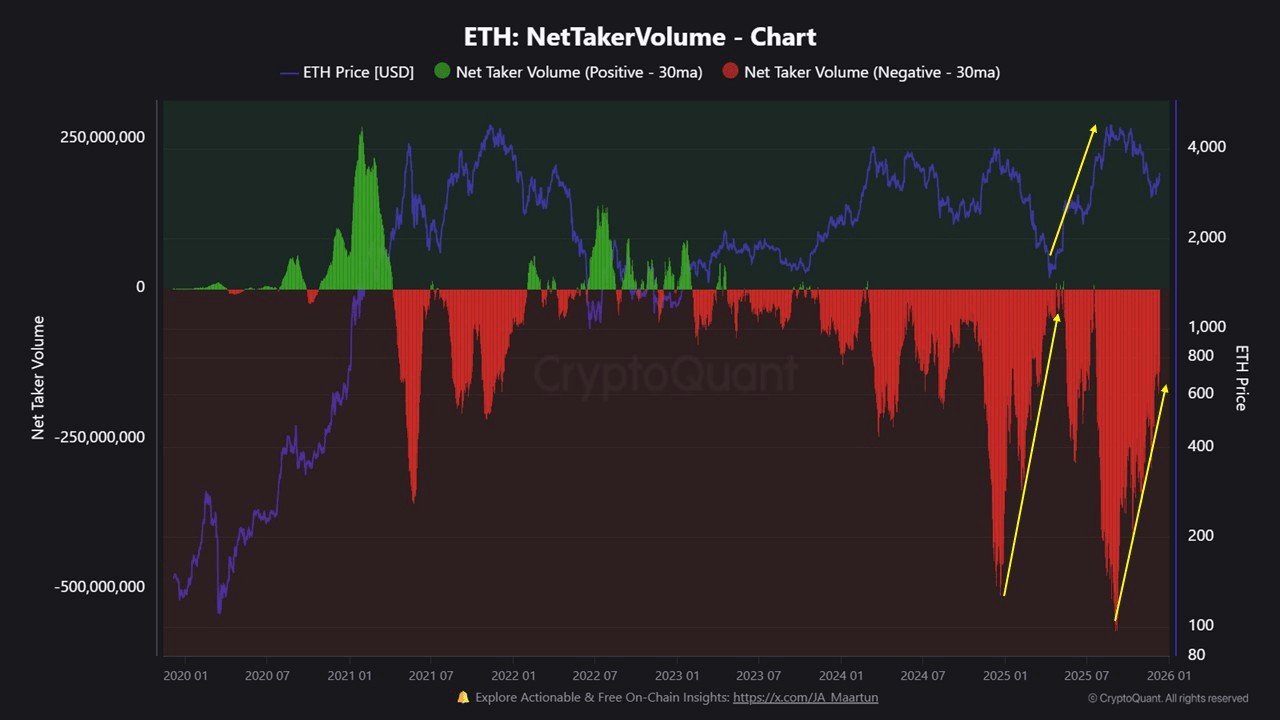
Ethereum Net Taker Volume | Source: CryptoQuant

By April, Net Taker Volume flipped decisively into positive territory. From that exact moment, Ethereum entered one of its strongest rallies of the cycle, surging more than 3x and printing a new all-time high.

Current conditions echo that same pattern. Since the peak of selling pressure in September, the market has continuously absorbed sell flows for nearly three months. Each negative low in Net Taker Volume has formed higher than the previous one, revealing improving market resilience despite the broader downtrend. If this trajectory holds, CoinCare estimates that a positive flip in Net Taker Volume may be only about a month away.

Historically, this transition from negative to positive has marked the beginning of Ethereum’s most explosive breakout phases. A confirmed move into positive territory would represent a high-probability trigger for the next expansion toward new all-time highs, signaling that momentum is quietly rebuilding beneath the surface.


Crypto di tendenza

Letture associate

Will History Repeat Itself? Fidelity Lists Five Catalysts to End the Crypto Winter

Fidelity's new report suggests that the current crypto winter for Bitcoin may be nearing its end, identifying five potential catalysts that could drive a market turnaround based on historical patterns. First, Bitcoin's approximately four-year cycle, driven by its halving mechanism, historically marks peaks and troughs. The last bottom was in November 2022, potentially pointing to the next around November 2026, though cycle length can vary. Second, clearer regulation has often preceded past bull markets. The focus is now on the CLARITY Act, which aims to clarify US digital asset oversight between the SEC and CFTC. Its passage could unlock domestic activity currently held back by legal uncertainty. Third, Federal Reserve monetary policy plays a role. A shift to lower interest rates tends to correlate with rising crypto prices by reducing borrowing costs and boosting risk appetite, though markets may price this in well ahead of any official change. Fourth, the emergence of breakthrough applications can fuel investor interest. Current trends like real-world asset tokenization, AI-related crypto infrastructure, and stablecoins are being watched, but history shows the biggest catalysts are often unexpected. Fifth, a new wave of institutional adoption could be a trigger. While ongoing adoption in 2026 hasn't sparked a new bull run, a major unexpected move—like a significant purchase by a tech giant or adoption as a hedge in a global crisis—could create a powerful new narrative. Fidelity concludes that while the market is in a downturn, historical turning points have often resulted from a combination of such factors, and the next phase for Bitcoin may depend on which of these catalysts materializes first.

Foresight News9 min fa

Will History Repeat Itself? Fidelity Lists Five Catalysts to End the Crypto Winter

Foresight News9 min fa

US CFTC Launches Broad Investigation into Polymarket, Is the Prediction Market Party Coming to an End?

The U.S. Commodity Futures Trading Commission (CFTC) is conducting a broad investigation into the prediction market platform Polymarket, focusing on its business practices including social media promotions. This follows a bipartisan letter from U.S. senators urging the CFTC to probe alleged fraudulent marketing tactics used to promote gambling-like products. The action coincides with a period of explosive growth for the prediction market sector, driven by events like the World Cup, with platforms like Kalshi and Robinhood reporting record trading volumes and revenue. The investigation signals a potential end to the sector's unregulated expansion and may lead to clearer federal oversight, particularly regarding investor protection and distinguishing prediction markets from traditional sports betting. The CFTC's move has also intensified a jurisdictional conflict with multiple U.S. states (including Kentucky and New York), which have sued platforms like Polymarket and Kalshi, accusing them of operating illegal sports betting and threatening state gambling tax revenues. Furthermore, the CME Group has sued the CFTC, challenging its approval of certain prediction market products. The report also highlights the political and capital interests intertwined with the industry. Donald Trump Jr. holds advisory and investment roles in both Kalshi and Polymarket, and the Trump administration has previously emphasized federal regulatory authority over these markets. The CFTC's investigation into Polymarket is framed as a step towards formalizing the industry's regulatory landscape, moving it from a phase of "wild growth" towards a more structured future.

marsbit2 h fa

US CFTC Launches Broad Investigation into Polymarket, Is the Prediction Market Party Coming to an End?

marsbit2 h fa

U.S. CFTC Launches Extensive Investigation into Polymarket, Is the Prediction Market Frenzy Season Cooling Down?

The U.S. Commodity Futures Trading Commission (CFTC) has launched a broad investigation into the prediction market platform Polymarket, focusing on its business practices including social media activities. This follows a bipartisan letter from U.S. senators urging the CFTC to probe allegations of paid influencer false marketing and fraudulent promotion of gambling-like products to American users. The investigation comes as the prediction market sector experiences explosive growth, largely driven by the World Cup. Weekly trading volumes have hit record highs, exceeding $14.4 billion, with platforms like Kalshi and Robinhood's new venture seeing significant activity. Major firms like Meta are also showing interest in the space. This regulatory scrutiny signals a potential end to the sector's "wild growth" phase. The CFTC's move also highlights an escalating jurisdictional conflict between federal regulators and state authorities. Over a dozen states, including Kentucky and New York, have sued platforms like Polymarket and Kalshi, accusing them of operating illegal sports betting, which threatens state gambling tax revenues. The CFTC is countersuing to assert its exclusive federal jurisdiction over these "event contracts" as derivatives. Furthermore, the CFTC's approval of Kalshi's Bitcoin perpetual futures contract has sparked a lawsuit from traditional exchange CME, alleging regulatory overreach. The political and capital landscape is intricate, with Donald Trump Jr. holding advisory roles and investments in both Kalshi and Polymarket. This connects capital, political influence, and regulatory bodies, suggesting the current investigation may be a step toward formalizing the industry's rules rather than halting its progress.

Odaily星球日报2 h fa

U.S. CFTC Launches Extensive Investigation into Polymarket, Is the Prediction Market Frenzy Season Cooling Down?

Odaily星球日报2 h fa

Trading

Spot

Articoli Popolari

Come comprare NASDAQ100

Benvenuto in HTX.com! Abbiamo reso l'acquisto di Nasdaq-100 Index (NASDAQ100) semplice e conveniente. Segui la nostra guida passo passo per intraprendere il tuo viaggio nel mondo delle criptovalute.Step 1: Crea il tuo Account HTXUsa la tua email o numero di telefono per registrarti il tuo account gratuito su HTX. Vivi un'esperienza facile e sblocca tutte le funzionalità,Crea il mio accountStep 2: Vai in Acquista crypto e seleziona il tuo metodo di pagamentoCarta di credito/debito: utilizza la tua Visa o Mastercard per acquistare immediatamente Nasdaq-100 IndexNASDAQ100.Bilancio: Usa i fondi dal bilancio del tuo account HTX per fare trading senza problemi.Terze parti: abbiamo aggiunto metodi di pagamento molto utilizzati come Google Pay e Apple Pay per maggiore comodità.P2P: Fai trading direttamente con altri utenti HTX.Over-the-Counter (OTC): Offriamo servizi su misura e tassi di cambio competitivi per i trader.Step 3: Conserva Nasdaq-100 Index (NASDAQ100)Dopo aver acquistato Nasdaq-100 Index (NASDAQ100), conserva nel tuo account HTX. In alternativa, puoi inviare tramite trasferimento blockchain o scambiare per altre criptovalute.Step 4: Scambia Nasdaq-100 Index (NASDAQ100)Scambia facilmente Nasdaq-100 Index (NASDAQ100) nel mercato spot di HTX. Accedi al tuo account, seleziona la tua coppia di trading, esegui le tue operazioni e monitora in tempo reale. Offriamo un'esperienza user-friendly sia per chi ha appena iniziato che per i trader più esperti.

17 Totale visualizzazioniPubblicato il 2026.06.18Aggiornato il 2026.06.18

Come comprare NASDAQ100

Cosa è RE

I. Introduzione al Progetto1. Che cos'è il Re Protocol?Il Re Protocol è un protocollo di riassicurazione decentralizzato che collega il capitale in stablecoin ai mercati di riassicurazione regolamentati del mondo reale. Gli utenti depositano stablecoin nel contratto intelligente dell'Insurance Capital Layer (ICL). I fondi depositati vengono utilizzati per supportare contratti di riassicurazione completamente collateralizzati, e i depositanti guadagnano ricompense in cambio. Il rendimento deriva sia da fonti on-chain che off-chain, oltre a spread specifici per token. Il protocollo opera su più catene, tra cui Ethereum, Avalanche e Arbitrum.2. Come funziona il Re Protocol?Gli utenti depositano asset approvati (come USDC, USDe, sUSDe) nei contratti intelligenti ICL per coniare uno dei due token che generano rendimento. I fondi vengono aggregati quotidianamente in una cassaforte di custodia Fireblocks, detenuta sotto controllo multi-firma, con i saldi pubblicati quotidianamente agli oracoli di Chainlink. Quando i riassicuratori autorizzati prelevano fondi ai sensi di una Surplus Note, una parte del capitale viene trasferita ai conti fiduciari di riassicurazione §114 domiciliati negli Stati Uniti, fungendo da garanzia conforme per le polizze del riassicuratore. Man mano che i contratti di riassicurazione maturano e il team attuariale rilascia capitale, la liquidità torna al protocollo, supportando i rimborsi di reUSD e accumulando rendimento per entrambi i token.Il protocollo offre due token corrispondenti a diverse tranche nella struttura del capitale:reUSD (Basis-Plus, Tranche Senior): Il rendimento è un tasso misto (media ponderata del SOFR e del tasso sUSDe degli ultimi 7 giorni) più uno spread di 250 punti base. Offre maggiore liquidità e supporta il rimborso istantaneo quando è disponibile capacità.reUSDe (Insurance Alpha, Tranche Junior): Il rendimento è lo stesso tasso misto più uno spread di 850 punti base, in cambio dell'assorbimento delle perdite prima della tranche senior. I rimborsi sono trimestrali. reUSDe ha un periodo minimo di detenzione di almeno 40 giorni.Stratificazione della Protezione del Capitale: Il capitale proprio del riassicuratore assorbe prima le perdite, seguito da reUSDe, con reUSD come tranche più senior protetta dalle due tranche sottostanti.3. Chi ha fondato il Re Protocol?Karn Saroya, Co-fondatore e CEO, si è laureato al MIT. In precedenza ha fondato la piattaforma insurtech supportata da venture capital Cover (una brokerage autorizzata, successivamente cessata) e ha fondato in precedenza l'app di moda Stylekick (acquisita da Shopify nel 2015). Ha anche lavorato in precedenza nella consulenza per i servizi finanziari.Dettagli sul finanziamento:Settembre 2022: Re ha completato un round di Seed da 14 milioni di dollari guidato da Tribe Capital (incubato attraverso i suoi Tribe Crypto Labs), con la partecipazione di Framework Ventures, Morgan Creek Digital, Defy VC, Stratos, Exor, SiriusPoint e altri.Maggio 2024: Completato un round di finanziamento da 7 milioni di dollari guidato da Electric Capital.4. Tokenomics del Re ProtocolRE è il token di governance del Re Protocol con un'offerta totale fissa di 1 miliardo di token, senza meccanismo inflazionistico e senza piano di conio continuo. Il token viene utilizzato per la governance tramite un modello di stake-to-vote, coprendo accesso al mercato, budget di incentivazione, staking e delega, comitati, aggiornamenti del protocollo e capitale di resilienza condiviso.Distribuzione dei token:Ecosistema (50%): Utilizzato per ricompense di staking, partecipazione alla governance, liquidità, integrazioni, sovvenzioni, espansione del mercato e crescita dell'ecosistema. 159,6 milioni di token sono in circolazione al TGE, con il resto soggetto a vesting lineare su 48 mesi.Contributori Core (20%): Include i contributori core e i consulenti che costruiscono il protocollo, i sistemi di governance, le integrazioni, i framework di rischio e le infrastrutture di mercato; cliff di 12 mesi più vesting lineare di 36 mesi.Investitori (17%): Sostenitori strategici; cliff di 12 mesi più vesting lineare di 36 mesi.Riserva per lo Sviluppo dell'Ecosistema (13%): Riserva a lungo termine per future contribuzioni e contributori.5. Cronologia delle Pietre Miliari ChiaveSettembre 2022: Re ha completato un round di Seed da 14 milioni di dollari, ha debuttato pubblicamente e si è posizionato come il primo protocollo di riassicurazione alimentato dalla blockchain, inizialmente costruito su Avalanche.Maggio 2024: Completato un round di finanziamento da 7 milioni di dollari guidato da Electric Capital.18 Giugno 2026: Il token $RE è stato ufficialmente lanciato.​II. Informazioni sul TokenNome del token: RE(Re)III. Link CorrelatiSito web:https://re.xyz/Esploratori:https://etherscan.io/token/0x526526528f35ac738177003b8773b402b8df8143Twitter:https://twitter.com/reNota: L'introduzione al progetto proviene dai materiali pubblicati o forniti dal team ufficiale del progetto, che è solo a scopo di riferimento e non costituisce consulenza per investimenti. HTX non si assume responsabilità per eventuali perdite dirette o indirette risultanti.

259 Totale visualizzazioniPubblicato il 2026.06.18Aggiornato il 2026.06.29

Cosa è RE

Come comprare RE

Benvenuto in HTX.com! Abbiamo reso l'acquisto di Re (RE) semplice e conveniente. Segui la nostra guida passo passo per intraprendere il tuo viaggio nel mondo delle criptovalute.Step 1: Crea il tuo Account HTXUsa la tua email o numero di telefono per registrarti il tuo account gratuito su HTX. Vivi un'esperienza facile e sblocca tutte le funzionalità,Crea il mio accountStep 2: Vai in Acquista crypto e seleziona il tuo metodo di pagamentoCarta di credito/debito: utilizza la tua Visa o Mastercard per acquistare immediatamente ReRE.Bilancio: Usa i fondi dal bilancio del tuo account HTX per fare trading senza problemi.Terze parti: abbiamo aggiunto metodi di pagamento molto utilizzati come Google Pay e Apple Pay per maggiore comodità.P2P: Fai trading direttamente con altri utenti HTX.Over-the-Counter (OTC): Offriamo servizi su misura e tassi di cambio competitivi per i trader.Step 3: Conserva Re (RE)Dopo aver acquistato Re (RE), conserva nel tuo account HTX. In alternativa, puoi inviare tramite trasferimento blockchain o scambiare per altre criptovalute.Step 4: Scambia Re (RE)Scambia facilmente Re (RE) nel mercato spot di HTX. Accedi al tuo account, seleziona la tua coppia di trading, esegui le tue operazioni e monitora in tempo reale. Offriamo un'esperienza user-friendly sia per chi ha appena iniziato che per i trader più esperti.

48 Totale visualizzazioniPubblicato il 2026.06.18Aggiornato il 2026.06.29

Come comprare RE

Discussioni

Benvenuto nella Community HTX. Qui puoi rimanere informato sugli ultimi sviluppi della piattaforma e accedere ad approfondimenti esperti sul mercato. Le opinioni degli utenti sul prezzo di A A sono presentate come di seguito.

活动图片