Ethereum Derivatives See Heavy Unwind As Open Interest Falls Hard – A Leveraged Flush?

bitcoinistPubblicato 2025-12-22Pubblicato ultima volta 2025-12-22

Introduzione

Amidst a volatile market, Ethereum's price briefly reclaimed $3,000, but its derivatives market is signaling a significant shift. Open Interest (OI) has plummeted by 50% since August, indicating a massive unwind of leveraged positions and a sharp decline in trader risk appetite. This drop, observed across major exchanges like Binance (-31%), suggests robust market deleveraging and a lower probability of explosive short-term price moves. Concurrently, ETH withdrawals from exchanges have spiked to multi-year lows, reducing immediate sell pressure. While this points to a more cautious, consolidating market, such a flush of leverage has historically preceded major structural shifts.

On Sunday, the Ethereum price retested the $3,000 mark after trading below the level for the past few days due to a volatile market environment. ETH’s price may be gradually regaining upside momentum, but other aspects are still experiencing downward pressure, such as the Open Interest (OI).

Sharp Drop In Ethereum Open Interest

In the current volatile state of the cryptocurrency landscape, the Ethereum derivatives market is signaling a key indicator. This crucial signal is coming from the ETH Open interest, which has witnessed a significant pullback in the past few months. According to the research from the advanced investment and on-chain data analytics platform Alphractal, the metric has dropped by half or 50% since August this year.

A significant drop in this metric is a clear indication that trader positioning and risk appetite have shifted notably. Following a period of high leverage and aggressive speculation, the sharp collapse indicates that positions are being unwound, exposure is being decreased, and momentum is cooling across futures markets.

Alphractal highlighted that the Ethereum open interest is valued at roughly half of what it was in August 2025, suggesting a drastic decline in market risk. Such a move points to institutions and large whale holders who have closed leveraged ETH positions. The exiting of positions by big investors shows that they are reducing exposure and speculative pressure.
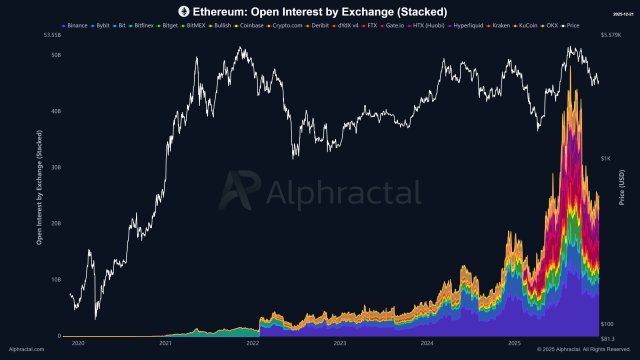
Source: Chart from Alphractal on X

ETH’s open interest has also fallen sharply on cryptocurrency exchanges. After examining the Ethereum Open Interest distribution by exchange, Alphractal unveiled a 31% decline to $7.64 billion on the world’s largest exchange, Binance.

On Gateio, open interest is at $3.72 billion, indicating a 15% decrease, while HTX (formerly known as House) has fallen by 12.65% to $3.12 million. Furthermore, Bybit has $2.53 billion with a 10.25% drop, HyperLiquid has $2.51 billion with a 10.18%, and Bitget has $1.79 billion with a 7.25% decline.

With exchanges’ open interest dropping, this tells a compelling story of the current market structure. This outlines robust deleveraging across the Ethereum market and a lower probability of explosive moves in the short term.

Typically, an atmosphere that is more cautious and protective implies stages of consolidation or preparation for the next trend leg. However, deep declines in open interest have historically frequently preceded significant structural changes, either a healthier reversal or a downward continuation with less leverage.

ETH Withdrawals From Crypto Exchanges Have Spiked

Ethereum’s open interest drop comes at a time of a massive drop in ETH supply on crypto exchanges. Currently, ETH withdrawals have reached their lowest levels since 2016, reflecting growing trader caution and dampened short-term sell pressure.

As more ETH is taken out of exchanges and placed in long-term holding locations, the liquid supply keeps decreasing. While the supply decrease bolsters ETH’s volatility, it also encourages price pressure to rise.

ETH trading at $3,048 on the 1D chart | Source: ETHUSDT on Tradingview.com

Crypto di tendenza

Domande pertinenti

QWhat has happened to Ethereum's Open Interest (OI) since August this year, according to the article?

AEthereum's Open Interest has dropped by 50% since August this year, indicating a significant unwind of leveraged positions and a decrease in market risk.

QWhich cryptocurrency exchange saw the largest decline in Ethereum Open Interest, and by how much?

ABinance, the world's largest exchange, saw the largest decline in Ethereum Open Interest, with a 31% drop to $7.64 billion.

QWhat does a sharp drop in Open Interest typically signal about trader behavior and market conditions?

AA sharp drop in Open Interest signals that traders are unwinding positions, decreasing their exposure, and reducing leverage. It indicates a shift to a more cautious and protective atmosphere, often leading to market consolidation or preparation for the next trend.

QAlongside the drop in Open Interest, what other on-chain activity suggests growing trader caution?

AAlongside the drop in Open Interest, the supply of ETH on cryptocurrency exchanges has reached its lowest level since 2016, as more ETH is being withdrawn to long-term holding locations, which dampens short-term sell pressure.

QWhat is the potential implication of a decreasing liquid supply of ETH on exchanges for its price?

AA decreasing liquid supply of ETH on exchanges reduces the available coins for immediate selling, which can bolster ETH's volatility and create upward price pressure.

Letture associate

From Gold to Bitcoin: Fixed Supply + Institutional Frenzy, Might It Repeat the 'Explosive' Price Trend?

"From Gold to Bitcoin: Fixed Supply and Institutional Frenzy May Lead to 'Explosive' Price Rally Analysts suggest Bitcoin's price action could mirror gold's over the past two decades, following the launch of spot Bitcoin ETFs. Gold ETFs, introduced in 2004, drove gold's price surge to a current market cap near $28 trillion. Both gold and Bitcoin are non-yielding stores of value, with prices driven purely by investor sentiment rather than cash flows or credit. Gold ETFs experienced dramatic cycles: explosive growth, painful drawdowns, and slow recoveries, with each cycle reaching higher peaks. Bitcoin ETFs, approved in early 2024, saw rapid institutional adoption but are now facing similar volatility. Recent warnings highlight the risk of significant ETF outflows disrupting the current rebound. BlackRock's IBIT, a leading Bitcoin ETF, has sold nearly 100,000 BTC to meet redemptions while still holding over 733,000. The core parallel is fixed supply: when demand surges, prices explode, but demand is often volatile and wave-like, not steady. Institutional interest, through ETFs and corporate adoption, remains a key support pillar, helping to cushion sell-offs. If Bitcoin captures even a fraction of gold's role as a store of value, its upside potential is immense, though the path will be marked by high volatility. For investors, focusing on long-term trends and managing risk is crucial as this 'price explosion' narrative unfolds."

Foresight News22 min fa

From Gold to Bitcoin: Fixed Supply + Institutional Frenzy, Might It Repeat the 'Explosive' Price Trend?

Foresight News22 min fa

Why Is AI Agent Shopping Hard to Popularize?

The article argues that the popular narrative of "AI agent shopping" – equipping AI with a wallet to autonomously handle purchases – is fundamentally flawed and oversimplifies the complexity of shopping. It deconstructs shopping into two core actions: **information retrieval** (standardized, easily automated) and **value judgment** (deeply subjective and human-centric). The narrative mistakenly assumes AI can fully handle both. Value judgment itself has two layers: **evaluation** (assessing options against criteria) and **demand definition** (setting the criteria, weights, and values). The latter is inherently human and dynamic, as preferences are not fixed but constructed during the decision-making process ("constructive preferences"). The real dividing line for automation is not product standardization, but whether the **act of choosing** itself holds experiential value. For mundane purchases (e.g., printer paper), full AI delegation works. For experiential goods (e.g., wine, furniture), the joy of selection is core to consumption, so AI should act as an assistant that narrows options, leaving the final choice to humans. The "AI wallet" concept confuses three separate elements: decision-making, execution, and fund custody. Current payment industry solutions (e.g., from Stripe, Mastercard, Google, Visa) show that limited, scoped payment authorization tokens are sufficient for most consumer scenarios, not full fund custody. The true use case for autonomous AI wallets is in **B2B procurement** and **machine-to-machine (M2M) settlements** for standardized, high-frequency, low-value transactions. The real bottlenecks for AI shopping are not payment technology, but **1) the lack of trusted data sources** (e.g., fake reviews, counterfeit goods) and **2) the impossibility of automating human demand definition**. The conclusion is that the focus should be on safely automating the assessment and filtering process while reserving for humans the rights to define their criteria and enjoy the final act of choice. For experiential goods, the platform's competitive advantage shifts to providing a superior selection experience.

Foresight News1 h fa

Why Is AI Agent Shopping Hard to Popularize?

Foresight News1 h fa

After Nine Months of Shorting, a Full Turn to Long: Renowned Trader Opens Bitcoin Positions Around 64K, Crypto Market Long-Short Divergence Intensifies

After nine months of being short, prominent crypto trader Doctor Profit has closed all his bearish positions and started buying Bitcoin near $64,000, signaling a complete bullish reversal. He argues that structural market changes—such as impending U.S. regulation (CLARITY Act) and institutional adoption via securities tokenization—are rewriting the traditional four-year cycle script, potentially bringing the market bottom forward from the widely expected September/October timeframe. This view finds some technical support from on-chain analyst gumsays, who notes a bullish divergence on Bitcoin's weekly chart has persisted for 147 days, nearing the 161-day duration seen before the 2022 cycle low. However, cycle researcher Jake Pahor presents a counter-argument based on historical data. Analyzing patterns since 2014, he identifies three common features of past bear market bottoms: a ~12-month duration from peak to trough, a sustained period of extreme fear (with a proprietary risk score below 20), and the price falling below Bitcoin's realized price (~$53,000 currently). The current cycle, only nine months from its October 2025 peak, meets none of these conditions. The debate highlights a market torn between "front-running" a potential early bottom driven by new fundamentals and waiting for confirmation through traditional on-chain and sentiment metrics. While Doctor Profit opts for aggressive buying, Pahor maintains a disciplined, tiered accumulation strategy, continuing weekly buys at current risk levels but reserving larger orders for if more extreme fear emerges.

marsbit1 h fa

After Nine Months of Shorting, a Full Turn to Long: Renowned Trader Opens Bitcoin Positions Around 64K, Crypto Market Long-Short Divergence Intensifies

marsbit1 h fa

Trading

Spot

Articoli Popolari

Come comprare O

Benvenuto in HTX.com! Abbiamo reso l'acquisto di O1 exchange (O) semplice e conveniente. Segui la nostra guida passo passo per intraprendere il tuo viaggio nel mondo delle criptovalute.Step 1: Crea il tuo Account HTXUsa la tua email o numero di telefono per registrarti il tuo account gratuito su HTX. Vivi un'esperienza facile e sblocca tutte le funzionalità,Crea il mio accountStep 2: Vai in Acquista crypto e seleziona il tuo metodo di pagamentoCarta di credito/debito: utilizza la tua Visa o Mastercard per acquistare immediatamente O1 exchangeO.Bilancio: Usa i fondi dal bilancio del tuo account HTX per fare trading senza problemi.Terze parti: abbiamo aggiunto metodi di pagamento molto utilizzati come Google Pay e Apple Pay per maggiore comodità.P2P: Fai trading direttamente con altri utenti HTX.Over-the-Counter (OTC): Offriamo servizi su misura e tassi di cambio competitivi per i trader.Step 3: Conserva O1 exchange (O)Dopo aver acquistato O1 exchange (O), conserva nel tuo account HTX. In alternativa, puoi inviare tramite trasferimento blockchain o scambiare per altre criptovalute.Step 4: Scambia O1 exchange (O)Scambia facilmente O1 exchange (O) nel mercato spot di HTX. Accedi al tuo account, seleziona la tua coppia di trading, esegui le tue operazioni e monitora in tempo reale. Offriamo un'esperienza user-friendly sia per chi ha appena iniziato che per i trader più esperti.

150 Totale visualizzazioniPubblicato il 2026.06.19Aggiornato il 2026.06.29

Come comprare O

Come comprare PROS

Benvenuto in HTX.com! Abbiamo reso l'acquisto di Pharos (PROS) semplice e conveniente. Segui la nostra guida passo passo per intraprendere il tuo viaggio nel mondo delle criptovalute.Step 1: Crea il tuo Account HTXUsa la tua email o numero di telefono per registrarti il tuo account gratuito su HTX. Vivi un'esperienza facile e sblocca tutte le funzionalità,Crea il mio accountStep 2: Vai in Acquista crypto e seleziona il tuo metodo di pagamentoCarta di credito/debito: utilizza la tua Visa o Mastercard per acquistare immediatamente PharosPROS.Bilancio: Usa i fondi dal bilancio del tuo account HTX per fare trading senza problemi.Terze parti: abbiamo aggiunto metodi di pagamento molto utilizzati come Google Pay e Apple Pay per maggiore comodità.P2P: Fai trading direttamente con altri utenti HTX.Over-the-Counter (OTC): Offriamo servizi su misura e tassi di cambio competitivi per i trader.Step 3: Conserva Pharos (PROS)Dopo aver acquistato Pharos (PROS), conserva nel tuo account HTX. In alternativa, puoi inviare tramite trasferimento blockchain o scambiare per altre criptovalute.Step 4: Scambia Pharos (PROS)Scambia facilmente Pharos (PROS) nel mercato spot di HTX. Accedi al tuo account, seleziona la tua coppia di trading, esegui le tue operazioni e monitora in tempo reale. Offriamo un'esperienza user-friendly sia per chi ha appena iniziato che per i trader più esperti.

144 Totale visualizzazioniPubblicato il 2026.06.22Aggiornato il 2026.06.29

Come comprare PROS

Cosa è VERONA

I. Introduzione al Progetto VERONA è una blockchain costruita per tutti, ovunque attraverso l'astrazione della catena. Utilizzando il suo livello di astrazione generalizzato, VERONA si distingue integrando funzionalità blockchain complesse, come conti, firme e interoperabilità, direttamente a livello di protocollo. Questo approccio consente di interagire con le applicazioni blockchain senza la necessità di comprendere le tecnologie sottostanti.1) Informazioni di Base Nome:VERONA(VERONA)III. Link Correlati Link al sito ufficiale:https://xion.burnt.com/ Whitepaper:https://xion.burnt.com/whitepaper.pdf Esploratori:https://explorer.burnt.com/ Social Media: https://x.com/burnt_xion Nota: L'introduzione al progetto proviene dai materiali pubblicati o forniti dal team ufficiale del progetto, che è solo a scopo di riferimento e non costituisce consulenza per investimenti. HTX non si assume responsabilità per eventuali perdite dirette o indirette risultanti.

160 Totale visualizzazioniPubblicato il 2026.06.22Aggiornato il 2026.06.22

Cosa è VERONA

Discussioni

Benvenuto nella Community HTX. Qui puoi rimanere informato sugli ultimi sviluppi della piattaforma e accedere ad approfondimenti esperti sul mercato. Le opinioni degli utenti sul prezzo di A A sono presentate come di seguito.

活动图片