Ethereum Community in Uproar! Whose Cake is EIP-8363 Cutting Into?

marsbitPubblicato 2026-08-06Pubblicato ultima volta 2026-08-06

Introduzione

**Ethereum Community Debates Controversial Staking Proposal EIP-8363** A new Ethereum proposal, EIP-8363, dubbed "Tapered Issuance Burn," has ignited heated debate within the community. The core idea is to reduce and eventually eliminate new issuance rewards for validators as the total amount of staked ETH approaches 50% of the total supply (around 60.25 million ETH). The authors, including EthCC founder Jérôme de Tychey and Ethereum Foundation researcher Justin Drake, argue the current system perpetually incentivizes more staking, potentially leading to centralization as stake flows to large custodians and liquid staking tokens (LSTs). They also aim to reduce dilution pressure on non-staking ETH holders. Under the proposal, validator rewards from consensus-layer issuance would be partially burned based on a formula tied to the total staked amount. Net rewards would gradually approach zero as staking nears the 50% threshold. Notably, execution-layer rewards (tips, MEV) are unaffected. A proposed 18-month transition period would soften the initial impact. The community reaction has been predominantly critical. Key concerns include: * **Centralization Risk:** Critics like Obol's Oisín Kyne argue very low rewards could drive out solo stakers and smaller operators, leaving only large, cost-insensitive institutions, thus increasing validator centralization. * **Ecosystem Impact:** Aave's Stani Kulechov warns it could hurt ETH's predictable yield appeal for institutions and...

Author: KarenZ, Foresight News

Intuitively, the more ETH staked, the higher the economic cost to attack the network.

However, an expansion in staking scale does not necessarily bring a proportional increase in security gains; if the new staking primarily flows to a few large service providers, the validator ecosystem could become more centralized instead.

On August 4th, EthCC founder Jérôme de Tychey, Ethereum Foundation's Justin Drake, and four other researchers jointly submitted a "Tapered Issuance Burn" proposal, attempting to install a "profit downgrade path" for the ever-increasing staking rate. When the staked amount approaches 50% of the total ETH supply, the consensus layer issuance rewards obtained by validators will be entirely offset.

This proposal was initially released under the number EIP-8361, but was later changed to EIP-8363 after that number was reassigned to another proposal. Although it is still in an early draft stage, it has quickly become one of the most hotly debated topics within the Ethereum community.

What exactly is this proposal trying to do?

Currently, Ethereum consensus layer rewards decrease as the total staked amount increases, but even if all ETH were staked, there remains a theoretical lower bound of about 1.5% for the nominal consensus yield of a single validator.

The authors of EIP-8363 argue that this means the protocol always provides positive incentives for more staking, lacking a real "stop button," potentially driving ETH towards concentration among large custodians, exchanges, and staking derivatives.

Additionally, unstaked ETH is continuously diluted by new issuance. Liquid Staking Tokens (LSTs), because they inherently carry yield, can more easily replace native ETH as collateral and savings assets in DeFi. The proposal authors hope to reduce this dilution pressure, making native ETH a more competitive neutral asset again.

The solution given by the proposal is not to prohibit new validators from entering or to rigidly lock the staking rate at 50%, but to deduct and burn a portion of the validator rewards after their normal calculation. The burn ratio depends on the total network effective staked balance: calculated as "1.5 times the power of the ratio of the total network effective staked balance to 60.25 million ETH," capped at 100%, i.e.:
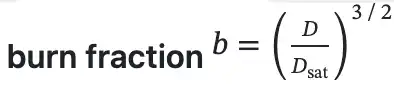
60.25 million ETH is approximately half of the current total ETH supply. As the staked amount approaches this value, the net consensus layer earnings for validators gradually approach zero; when reaching or exceeding this value, the consensus layer issuance rewards earned by normally, fully-functioning validators will be completely offset by the newly added burn deduction. It is worth adding that 60.25 million ETH is a fixed value proposed to be written into the protocol at the time of the hard fork.

There are two points easily misunderstood:

First, 50% is not a staking cap, nor is it a target staking rate. Validators can still continue to join; the proposal merely hopes the market will stop growing on its own before the yield is insufficient to cover liquidity, operational, slashing, and regulatory risks.

Second, so-called "zero earnings" refers only to the net consensus layer issuance reward. Execution layer income such as priority fees and MEV is unaffected by this proposal.
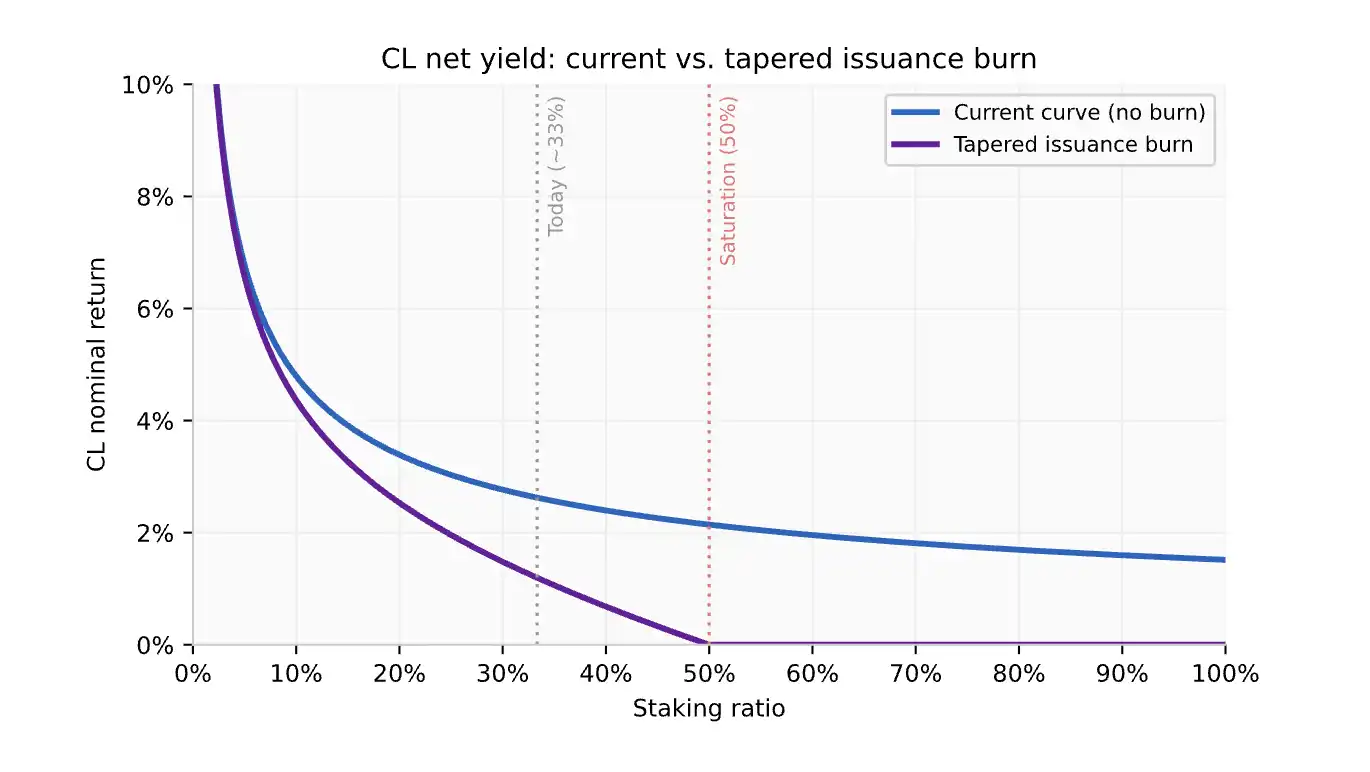
Net consensus layer earnings under the current issuance curve versus the EIP-8363 curve

According to the proposal's curve, the annual consensus layer issuance would peak near a staking rate of about 19.8%, then decline as the staking rate increases. Estimating with the current ~33% staking rate, if this curve were fully implemented at the time of a fork, the consensus layer yield would drop from about 2.6% to about 1.2%.
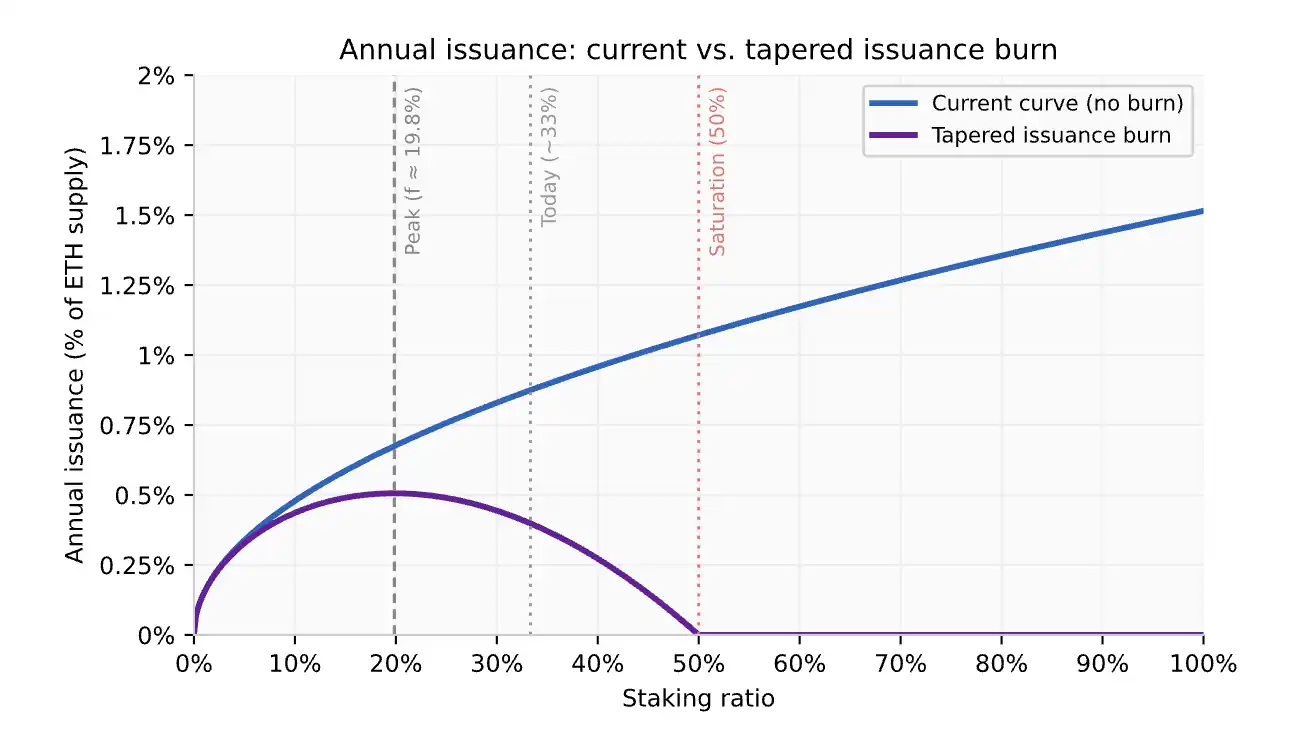
Annual issuance under the current issuance curve versus the EIP-8363 curve

To avoid a sudden halving of earnings, the proposal designs an 18-month transition period: upon activation, the base reward factor is temporarily increased from 64 to 128, then gradually reduced back to 64 over 65 steps, each lasting about 8.6 days. Therefore, net earnings near activation would be close to current levels, gradually declining afterward. However, the curve "providing no consensus layer issuance incentive after 50%" takes effect from the first day of activation and does not wait for 18 months.

Currently, this proposal remains an unmerged Core EIP draft, in the editing review and consensus evaluation stage. The authors have separately submitted PR #12087, hoping to list it as Proposed for Inclusion for the Hegotá upgrade, meaning "proposed for inclusion in discussion." This PR is also not yet merged; the current formal Hegotá Meta EIP does not include it.

Ethereum core developers plan to discuss the Hegotá proposal deadline items at the ACDC 184th meeting on August 6th. Even if it enters Proposed for Inclusion, it does not equal definite implementation; it would still need to go through subsequent steps like developer evaluation, client implementation, testing, and Scheduled for Inclusion.

Community reaction is clearly negative

One of the authors of EIP-8363, Jérôme de Tychey, believes this is a "minimalist, market-driven" change. He also stated in a forum response that the issuance debate started back in 2023, and this proposal merely opens a formal feedback window, not implying definite inclusion.

He also warned that if the validator entrance queue remains constantly full with few exits, by early 2028, the staked amount could exceed 70 million ETH, representing over 55% of the supply; reversing course then could involve larger exit volumes and market disruptions.

Supporters of reducing issuance mainly have three reasons:

  • Ethereum may be paying an excessively high cost for economic security that is already sufficiently ample;
  • Unstaked holders are continuously diluted, forced to choose between "accepting dilution" and "taking staking risks";
  • LSTs, ETFs, and custodial services continuously reduce staking friction, potentially allowing a few intermediaries to eventually control large amounts of ETH and validation rights simultaneously.

However, opposing voices are more concentrated in the public reactions so far.

Aave founder Stani Kulechov believes that consensus layer staking rewards fluctuating with the staking rate and eventually approaching zero would undermine the cash flow predictability valued by institutions when allocating ETH and compress positive interest rate strategies like ETH lending and LST restaking loops.

Obol co-founder Oisín Kyne pointed out that Ethereum's true security depends not only on how much ETH is staked but also on whether validation rights are sufficiently decentralized. If yields drop to extremely low levels, large institutions with low capital costs and insensitivity to yield might have the ability to stay in the game long-term and squeeze out high-cost independent operators.

ether.fi CEO Mike Silagadze criticized the proposal for being submitted just before the Hegotá deadline, leaving insufficient pre-discussion time for ecosystem developers; he worries that low yields would impact staking-related protocols and reduce institutional confidence in Ethereum's governance stability.

Ethereum community member Ryan Berckmans summarized that opponents at least include those worried about who would run validators at zero yield, those unwilling to reduce staking yields, those opposed to changing ETH monetary policy again, and those hoping to avoid controversy escalating and disrupting ecosystem growth. He personally supports moderately reducing issuance but opposes letting yields trend all the way to zero and also believes the current proposal is too divisive for the community.

A relatively neutral view comes from ARK Invest Director of Research Lorenzo Valente. He approached the debate from the perspective of ETH's asset positioning. If more emphasis is placed on ETH's "Internet bond" attribute, weakening staking yields would indeed harm the lending market and yield curve; if more emphasis is placed on ETH being neutral money and a store of value, then the base yield obtained from restaking primarily comes from protocol new issuance, at the cost of unstaked holders being diluted. Reducing issuance means decreasing this transfer of yield—borne by unstaked holders and flowing to stakers and their leverage strategies.

Who benefits, who bears pressure?

If this proposal passes, Solo Stakers would be the first affected.

The 18-month transition period can spread out the earnings decline but will not reduce fixed costs like hardware, electricity, and maintenance. The proposal maintains the current offline penalty intensity while lowering net earnings, meaning it would take longer for a single failure to be compensated by subsequent earnings. The proposal's own estimate suggests that at the current ~33% staking rate, the time needed to compensate for downtime losses could increase to about 3.8 times the current duration.

For large operators with backup power, remote disaster recovery, and 24/7 operations, such changes are relatively easier to absorb; for home validators, a few internet outages or equipment failures could significantly erode annual returns.

Tax treatment might also amplify this disparity. The EIP-8363 proposal notes that in some jurisdictions, it's not yet clear whether tax authorities would recognize income based on the pre-deduction reward. If the burn portion can only be recognized as a capital loss, the after-tax income of solo stakers could be lower than the apparent net yield.

The impact would further transmit to LSTs. The base yield of products like stETH and rETH comes from the underlying validators. When consensus layer issuance declines, the yield gap between LSTs and native ETH will also narrow. Whether users are still willing to bear smart contract, governance, custodial, and depeg risks for an extra one or two percentage points of yield will become a new pricing question.

Loop strategies relying on LST yields would feel the pressure earlier. A common practice is to borrow ETH, buy or mint LST, then use the LST as collateral to borrow more ETH. As staking yield gradually approaches the borrowing cost, the positive spread of such trades will gradually disappear, and leveraged positions might actively unwind. Protocols like Aave, Morpho, Pendle, and products built around LST yields might therefore face decreased ETH borrowing demand, capital utilization, and liquidity.

The impact would ultimately land on the entire DeFi interest rate system. Staking yield is a crucial base rate for the ETH-denominated market; LST lending, fixed income, yield splitting, and leverage loops all price around this benchmark.

Of course, LSTs wouldn't lose all utility because of this. What might truly change is LST's advantage relative to native ETH.

Looking further upstream, the staking income of ETFs, exchanges, custodians, and ETH treasury companies would also decline. For institutions relying on staking yield to improve asset returns, the predictability of ETH's cash flow would weaken, potentially affecting their willingness for new allocations. This is why Aave founder Stani Kulechov believes the proposal would increase the difficulty for institutions to evaluate ETH yields and weaken ETH's competitiveness relative to other yield-bearing assets.

The actual impact on institutions may not be uniform. When base yields fall, high-cost participants might exit first, while the largest institutions least dependent on staking yield might be more capable of staying. This is precisely the reason opponents worry about further validator centralization.

For ordinary ETH holders, the direction of impact is relatively clear. The issuance being burned doesn't go to a specific protocol or fund but benefits all ETH holders collectively by reducing dilution.

However, reduced issuance does not mean ETH will necessarily become deflationary, nor can one infer that the price will necessarily rise. The final supply change still depends on EIP-1559 fee burns, network usage, validator issuance, and market conditions. If lower yields simultaneously weaken institutional allocation, LST demand, and on-chain lending activity, demand-side changes could also offset some of the supply-side benefits.


Crypto di tendenza

Domande pertinenti

QWhat is the main goal of the EIP-8363 (Tapered Issuance Burn) proposal?

AThe main goal of the EIP-8363 proposal is to install a 'declining yield path' for staking rewards as the total amount of staked ETH grows. It aims to reduce and eventually cancel out the consensus-layer issuance rewards for validators when the effective staked balance approaches 50% of the total ETH supply. This is intended to prevent excessive dilution for non-stakers, reduce the systemic incentive for further staking concentration in large custodians, and enhance the competitiveness of native ETH as a neutral asset.

QHow does EIP-8363 plan to achieve its goal of reducing staking rewards?

AEIP-8363 plans to achieve its goal by calculating a validator's standard issuance reward and then deducting and burning a portion of it. The proportion burned depends on the total network's effective staked balance relative to 60.25 million ETH (roughly half the supply). The burn ratio increases as the staked amount approaches this threshold, eventually reaching 100%, which would fully offset the consensus-layer issuance reward for a properly functioning validator, effectively bringing the net issuance reward to zero at or above the 50% staking level.

QWhat are some of the main criticisms or concerns raised by the community against the EIP-8363 proposal?

AThe main criticisms include: 1) It could undermine the predictability of cash flows, which is important for institutional investment in ETH. 2) It might lead to further centralization, as low yields could push out high-cost solo stakers while low-cost, yield-insensitive large institutions remain. 3) It was submitted very close to the Hegotá upgrade deadline, leaving insufficient time for community discussion. 4) It could negatively impact protocols and strategies built around staking rewards and LSTs (Liquid Staking Tokens). 5) It represents another contentious change to Ethereum's monetary policy, potentially causing community division.

QAccording to the article, who would be most negatively impacted if EIP-8363 is implemented?

ASolo stakers (individual validators) would be the first and most negatively impacted. Their fixed costs (hardware, electricity, maintenance) remain, but their net rewards decrease. The extended time needed to recoup losses from penalties would disproportionately affect them compared to large operators with better infrastructure. Additionally, Liquid Staking Token (LST) providers, DeFi protocols relying on staking yield (like Aave, Pendle), and leveraged staking strategies would also face pressure as the yield spread narrows or disappears.

QWhat is the '18-month transition period' mentioned in the proposal, and what is its purpose?

AThe 18-month transition period is a design feature in EIP-8363 to avoid a sudden, sharp drop in validator rewards upon activation. It temporarily increases the base reward factor from 64 to 128 at the start and then gradually reduces it back to 64 over 65 steps, each lasting about 8.6 days. This means the net reward at activation would be close to current levels and then slowly decline over the transition period. However, the core rule of 'zero net issuance reward at 50% staking' takes effect from day one.

Letture associate

A Precedent for the Prediction Markets: CFTC Aims to Prove Authority Over Polymarket via Criminal Case

A U.S. Army soldier, Gannon Ken Van Dyke, who earned $400,000 using non-public information on the crypto event-prediction platform Polymarket, is contesting the U.S. Commodity Futures Trading Commission's (CFTC) attempt to intervene in his criminal case. The CFTC, which initiated a separate civil suit against Van Dyke but has not pursued it to trial, seeks to submit arguments in the ongoing criminal proceeding. Van Dyke's lawyers filed a motion opposing this, arguing the CFTC is improperly trying to influence the criminal case as an outside expert rather than through its own lawsuit. They contend that event contracts traded on platforms like Polymarket are not swaps and thus fall outside the CFTC's jurisdiction, calling the regulator's tactics a procedural maneuver. Van Dyke faces criminal fraud charges for allegedly trading based on confidential information about potential regime change in Venezuela. His civil case with the CFTC is stayed pending the criminal trial, expected in late 2026 or early 2027. The court's decision on whether to allow the CFTC's intervention could set a precedent for how such event contracts are regulated. An AI analysis notes inconsistency in the CFTC's approach compared to a similar case involving a Google employee, raising questions about the legal strategy for the prediction market industry, which includes platforms like Kalshi. The outcome may define future regulatory standards for the entire market.

cryptonews.ru7 min fa

A Precedent for the Prediction Markets: CFTC Aims to Prove Authority Over Polymarket via Criminal Case

cryptonews.ru7 min fa

Nvidia's Jensen Huang, Fei-Fei Li, and Bin Lin All Invest in the Same Robotics Company

Generalist, a San Francisco-based AI startup focused on developing a "universal brain" for robots, has rapidly raised significant funding, attracting high-profile investors including Nvidia, Jeff Bezos' Bezos Expeditions, AI pioneer Fei-Fei Li, and Xiaomi co-founder Bin Lin. Founded in 2024 by former Google DeepMind researchers Pete Florence, Andy Zeng, and former Boston Dynamics engineer Andrew Barry, the company has secured approximately $750 million across four rounds, reaching a valuation surpassing $2 billion. The company's core innovation is its GEN-1.5 model, which aims to give robots powerful generalization capabilities. Unlike traditional systems requiring extensive reprogramming for each new task, GEN-1.5 can learn from a single, brief human demonstration (3-12 seconds) without needing retraining or fine-tuning. This "physical prompting" allows a robot to perform tasks like opening jars or using new tools after seeing them done once. While current single-demo success rates average 59% on simple tasks (improving to 83% with minor fine-tuning), the technology promises to drastically reduce robot deployment time from months to seconds. Generalist's strategy is to provide the AI intelligence layer that can run on various robotic hardware, rather than building robots themselves. The founding team combines DeepMind's expertise in AI model generalization with Boston Dynamics' practical robotics experience, targeting the industry bottleneck where robot "brains" lag behind advanced "bodies." Capital sees potential in this approach for creating a versatile, low-margin-cost robotic base applicable across factories, warehouses, and labs. However, GEN-1.5 remains a work in progress. Its capabilities are currently demonstrated on short, simple tasks, and significant challenges remain for reliable, long-term operation in complex, unpredictable real-world environments. Commercial viability also depends on hardware costs, maintenance, and system integration. Nevertheless, Generalist represents a shift toward "generalist" robots that can quickly adapt to new tasks, potentially redefining the robotics landscape and posing future questions about the role of human labor.

marsbit13 min fa

Nvidia's Jensen Huang, Fei-Fei Li, and Bin Lin All Invest in the Same Robotics Company

marsbit13 min fa

Bitcoin above $81K and altcoin surge. The top crypto news this morning

**Bitcoin Surpasses $81,000 as Altcoins Rally: Key Crypto Market Summary for the Morning** Bitcoin (BTC) traded above $80,500, briefly exceeding $81,300, its highest level since early May. Over the past 24 hours, BTC gained nearly 5%, while Ethereum (ETH) rose 3% to trade above $2,500. The total crypto market capitalization stands above $2.71 trillion. Market sentiment is bullish, with the crypto fear and greed index reaching 74 points, indicating "greed" and the highest reading since late last year. Among the top 100 cryptocurrencies, Aerodrome Finance (AERO) posted the largest gain (+18%), while Aave (AAVE) saw the biggest drop (-8%). Bitcoin ETFs recorded a net inflow of over $337 million on August 24, and Ethereum ETFs saw nearly $115 million in inflows. Analysts have turned positive, with some calling the current cycle potentially the "strongest in history." Corporate buying also continued, with mining company Lonic Digital and fintech firm Strive adding to their BTC reserves. Interest has shifted to altcoins and more speculative segments. Memecoins like CASHCAT, Dogecoin (DOGE), and Shiba Inu (SHIB) showed strong gains. Institutional interest in alts is evident, with Bitwise reporting record trading volumes for its Solana ETF. Data from Glassnode shows 85% of non-Bitcoin perpetual futures now have positive funding rates, a level last seen during previous market peaks.

cryptonews.ru17 min fa

Bitcoin above $81K and altcoin surge. The top crypto news this morning

cryptonews.ru17 min fa

Trading

Spot

Articoli Popolari

Come comprare CAKE

Benvenuto in HTX.com! Abbiamo reso l'acquisto di PancakeSwap (CAKE) semplice e conveniente. Segui la nostra guida passo passo per intraprendere il tuo viaggio nel mondo delle criptovalute.Step 1: Crea il tuo Account HTXUsa la tua email o numero di telefono per registrarti il tuo account gratuito su HTX. Vivi un'esperienza facile e sblocca tutte le funzionalità,Crea il mio accountStep 2: Vai in Acquista crypto e seleziona il tuo metodo di pagamentoCarta di credito/debito: utilizza la tua Visa o Mastercard per acquistare immediatamente PancakeSwapCAKE.Bilancio: Usa i fondi dal bilancio del tuo account HTX per fare trading senza problemi.Terze parti: abbiamo aggiunto metodi di pagamento molto utilizzati come Google Pay e Apple Pay per maggiore comodità.P2P: Fai trading direttamente con altri utenti HTX.Over-the-Counter (OTC): Offriamo servizi su misura e tassi di cambio competitivi per i trader.Step 3: Conserva PancakeSwap (CAKE)Dopo aver acquistato PancakeSwap (CAKE), conserva nel tuo account HTX. In alternativa, puoi inviare tramite trasferimento blockchain o scambiare per altre criptovalute.Step 4: Scambia PancakeSwap (CAKE)Scambia facilmente PancakeSwap (CAKE) nel mercato spot di HTX. Accedi al tuo account, seleziona la tua coppia di trading, esegui le tue operazioni e monitora in tempo reale. Offriamo un'esperienza user-friendly sia per chi ha appena iniziato che per i trader più esperti.

572 Totale visualizzazioniPubblicato il 2024.12.11Aggiornato il 2025.03.21

Come comprare CAKE

Discussioni

Benvenuto nella Community HTX. Qui puoi rimanere informato sugli ultimi sviluppi della piattaforma e accedere ad approfondimenti esperti sul mercato. Le opinioni degli utenti sul prezzo di CAKE CAKE sono presentate come di seguito.

活动图片