Ethereum: Buterin Revives ‘Milady’ For A World Computer Push

bitcoinistPubblicato 2026-01-02Pubblicato ultima volta 2026-01-02

Introduzione

Ethereum co-founder Vitalik Buterin marked the start of 2026 by switching his profile picture to a Milady-style avatar and publishing a post refocusing Ethereum’s mission on its original ambition: becoming a "world computer" for an open internet. He highlighted 2025 progress such as higher gas limits, improved node software, and zkEVM advancements, but emphasized that Ethereum ecosystem must prioritize its core mission over short-term trends like memecoins or transaction fee-driven incentives. Buterin defined the "world computer" as a platform for decentralized applications resistant to censorship, fraud, and third-party interference—capable of operating even if developers abandon them or centralized services fail. He stressed that scalability, usability, and genuine decentralization are non-negotiable requirements for both base and application layers. The post served as a call to action, urging the community to aggressively improve infrastructure, client diversity, and dapp resilience to fulfill Ethereum’s foundational vision.

Ethereum co-founder Vitalik Buterin rang in 2026 by switching his X profile image back to a Milady-style avatar and pairing it with a manifesto-like post that re-centers Ethereum’s identity around a single, old-school ambition: becoming “the world computer” for an open internet.

“Welcome to 2026! Milady is back,” Buterin wrote, before ticking through what he framed as Ethereum’s 2025 progress: higher gas limits, a larger blob count, better node software quality, and zkEVMs hitting major performance milestones. He also argued that “with zkEVMs and PeerDAS ethereum made its largest step toward being a fundamentally new and more powerful kind of blockchain.”

Ethereum Must Deliver The World Computer

But the post’s center of gravity wasn’t a victory lap. It was a warning that the network is still falling short of its own stated goals and that chasing whatever narrative is currently printing attention is not the point.

Buterin drew a bright line between Ethereum’s long-term mission and trend-driven incentives that often dominate crypto cycles. “Ethereum needs to do more to meet its own stated goals,” he wrote. “Not the quest of ‘winning the next meta’ regardless of whether it’s tokenized dollars or political memecoins, not arbitrarily convincing people to help us fill up blockspace to make ETH ultrasound again, but the mission: To build the world computer that serves as a central infrastructure piece of a more free and open internet.”

From there, he offered a description of what “world computer” should mean in practice: decentralized applications that can’t be quietly altered or shut off, and that remain usable even when the companies and infrastructure most users take for granted fail.

“We’re building decentralized applications. Applications that run without fraud, censorship or third-party interference,” he wrote. “Applications that pass the walkaway test: they keep running even if the original developers disappear. Applications where if you’re a user, you don’t even notice if Cloudflare goes down — or even if all of Cloudflare gets hacked by North Korea.”

Buterin extended that same set of expectations beyond finance, explicitly name-checking identity, governance, and “whatever other civilizational infrastructure people want to build,” and he emphasized privacy as a core property rather than a nice-to-have.

A notable thread in the post is that Buterin refuses to treat usability-at-scale and decentralization as a trade-off Ethereum can punt on. “To achieve this, it needs to be (i) usable, and usable at scale, and (ii) actually decentralized,” he wrote, arguing those requirements apply both to the base layer—“including the software we use to run and talk to the blockchain” and to the application layer.

That framing implicitly puts pressure on multiple constituencies at once: core protocol work, client diversity and quality, infrastructure that doesn’t centralize around a few providers, and dapp architectures that can survive developer abandonment while still meeting user expectations.

Buterin closed on a note of resolve rather than specifics, saying Ethereum has “powerful tools” but needs to apply them more aggressively. “All of these pieces must be improved — they are already being improved, but they must be improved more,” he wrote. “Fortunately, we have powerful tools on our side — but we need to apply them, and we will.”

At press time, ETH traded at $3,030.
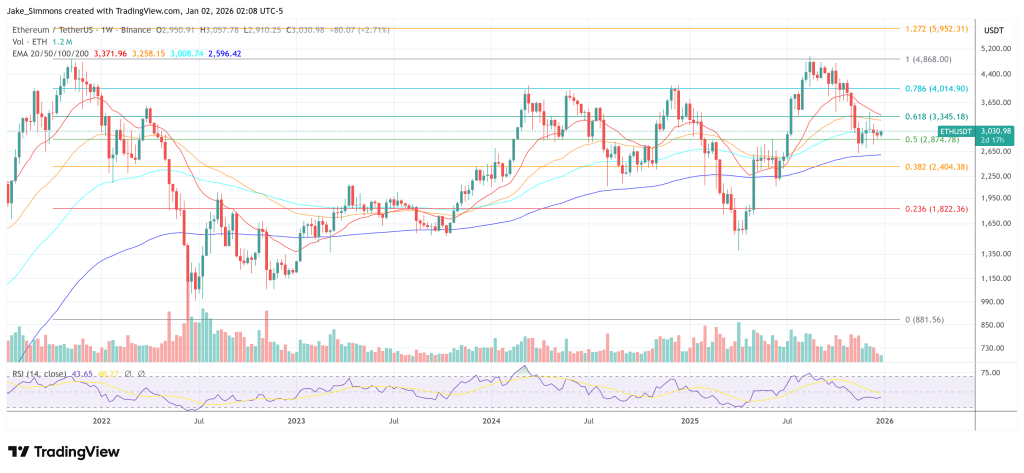
ETH holds above the 0.5 Fib, 1-week chart | Source: ETHUSDT on TradingView.com

Domande pertinenti

QWhat is the main ambition that Vitalik Buterin re-centers Ethereum's identity around in his 2026 post?

ABecoming 'the world computer' for an open internet.

QAccording to Buterin, what are the two key requirements Ethereum needs to meet to achieve its 'world computer' goal?

AIt needs to be (i) usable, and usable at scale, and (ii) actually decentralized.

QWhat does Buterin mean by applications that 'pass the walkaway test'?

AApplications that keep running even if the original developers disappear.

QBeyond finance, what other areas does Buterin suggest the 'world computer' infrastructure should serve?

AIdentity, governance, and 'whatever other civilizational infrastructure people want to build'.

QWhat does Buterin warn against, emphasizing it is not Ethereum's true mission?

AChasing whatever narrative is currently printing attention, such as 'winning the next meta' regardless of whether it's tokenized dollars or political memecoins, or arbitrarily convincing people to fill up blockspace to make ETH 'ultrasound' again.

Letture associate

The Value Distribution of Stablecoins

**Summary: The Value Distribution of Stablecoins** The article argues that stablecoins are evolving from mere trading tools into broader channels for dollar access. It divides the stablecoin ecosystem into four layers to analyze how value is distributed: 1. **Issuance Layer:** Mints stablecoins, holds reserve assets, and captures the spread between reserve yield and user costs (e.g., Tether, Circle). This layer currently earns the largest profit margin. 2. **Infrastructure Layer:** Connects stablecoins to the traditional financial system, handling fiat on/off-ramps, banking integration, compliance (KYC/AML), and asset management (e.g., Bridge, BVNK). This is the "unglamorous" but critical work, building the essential bridges between crypto and real-world finance. 3. **Acquiring/Distribution Layer:** Integrates stablecoins into merchant systems, manages payment flows, and provides enterprise financial software (e.g., Stripe, Coinbase). They act as the access point for businesses. 4. **Application Layer:** The end-users and businesses that ultimately use stablecoins for payments, settlements, or as a store of value. They benefit from convenience but have little pricing power. The core thesis is that while the issuance layer currently dominates profits, the often-overlooked **infrastructure layer holds significant long-term potential**. The real challenge and barrier to mass adoption is not the on-chain transfer of stablecoins (which is simple), but the complex "last mile" integration into existing business workflows, banking systems, and regulatory frameworks across different countries. Companies in this layer are currently in a "land grab" phase, investing heavily to build networks, secure bank partnerships, and establish compliance pathways. While their position is currently pressured by the profitable issuers above and distribution platforms below, the article suggests that if stablecoins become a default financial rail for businesses, the infrastructure providers who have done the hard work of integration will ultimately gain strong pricing power and become entrenched, essential players.

marsbit59 min fa

The Value Distribution of Stablecoins

marsbit59 min fa

The Value Distribution of Stablecoins

The Value Distribution of Stablecoins The article argues that stablecoins are evolving from a mere trading tool into a broad "dollar channel." It analyzes the industry's value chain through four layers: 1. **Issuance Layer (e.g., Tether, Circle):** The top layer that mints stablecoins, holds reserve assets, and captures the thickest interest rate spread. 2. **Infrastructure Layer (e.g., Bridge, BVNK):** Connects stablecoins to the traditional financial system, handling critical but complex "dirty work" like fiat on/off-ramps, banking integration, compliance (KYC/AML), and cross-border settlement. 3. **Acquiring/Distribution Layer (e.g., Stripe, Coinbase):** Embeds stablecoins into merchant systems, manages payment flows, and integrates with enterprise software. 4. **Application Layer:** End-users and businesses that ultimately use stablecoins for payments, settlement, or storing value. The author posits that while the issuance layer currently captures the most profit, the most overlooked and potentially critical layer is infrastructure. The core challenge for stablecoin adoption isn't the on-chain transfer (which is simple), but bridging the gap between blockchain and the real-world financial system. This involves solving practical problems for businesses: fiat conversion, reconciliation, tax handling, and user onboarding. Infrastructure companies are currently in a difficult "land-grab" phase—building networks, securing banking relationships, and achieving compliance country-by-country. They face pressure from both the profitable issuance layer above and distribution platforms below. However, the author suggests this layer is building a crucial moat. Once stablecoins become a default business rail, the infrastructure players who have done the hard work of integration may gain significant, durable value and pricing power.

链捕手1 h fa

The Value Distribution of Stablecoins

链捕手1 h fa

How to Do Research Well: Deliberately Practice the Real Skills That Matter

No one truly teaches you how to do research. You're often given a desk, a pre-selected problem, and vague instructions to "create something new." Consequently, many people reverse-engineer the job based on visible outputs—papers, posts, announcements—learning only how to *appear* like a researcher rather than how to *become* one. True research capability is built from stacking small, trainable skills, nearly all of which can be developed through deliberate practice. **Pick Your Own Problem:** Most researchers absorb problems from advisors or trends, lacking the underlying reasoning. Choosing a problem you genuinely care about, as John Schulman advises, leads to original work. Develop "taste" like a muscle: predict experiment outcomes, guess paper results from methods, and track which findings remain important over time. **Upgrade Your Inputs:** Relying on shared reading lists (arXiv hot lists, filtered group chats) leads to unoriginal conclusions. Undervalued old literature often holds crucial insights (e.g., MoE, LSTM, backpropagation). Richard Sutton's "The Bitter Lesson" or Claude Shannon's 1952 talk on creative thinking are more predictive than lengthy modern surveys. Breadth matters as much as depth: draw from neuroscience, mechanism design, hardware knowledge, and honest statistics. Read papers directly, especially appendices and limitations sections. **Write Everything Down:** As Paul Graham noted, writing exposes flaws in seemingly mature ideas. Writing is the cheapest defense against self-deception. Following Feynman's principle, Darwin programmatically wrote down facts contradicting his theory to combat memory bias. Maintain a detailed log of hypotheses, setups, predictions, results, and updated understandings. Reviewing past logs fosters essential humility.

marsbit3 h fa

How to Do Research Well: Deliberately Practice the Real Skills That Matter

marsbit3 h fa

Trading

Spot
Futures

Articoli Popolari

Cosa è ATWO

I. Introduzione al ProgettoArena Two è una piattaforma interattiva decentralizzata che consente ai fan di svolgere un ruolo attivo e tokenizzato nei risultati degli eventi in tempo reale. A differenza dei modelli di trasmissione tradizionali che riducono i fan a spettatori passivi, Arena Two sfrutta la tecnologia blockchain per consentire ai fan di votare direttamente in tempo reale e influenzare i risultati sul campo.II. Informazioni sul TokenNome del token: ATWO(Arena Two)III. Link CorrelatiSito web:https://arenatwo.com/Esploratori:https://basescan.org/token/0x499D35eBE6cEe9B2Ac35Fd003fcBbeeB9CFc7B32Twitter:https://x.com/arenatwoXNota: L'introduzione al progetto proviene dai materiali pubblicati o forniti dal team ufficiale del progetto, che è solo a scopo di riferimento e non costituisce consulenza sugli investimenti. HTX non si assume responsabilità per eventuali perdite dirette o indirette derivanti.

214 Totale visualizzazioniPubblicato il 2026.05.18Aggiornato il 2026.06.02

Cosa è ATWO

Come comprare ATWO

Benvenuto in HTX.com! Abbiamo reso l'acquisto di Arena Two (ATWO) semplice e conveniente. Segui la nostra guida passo passo per intraprendere il tuo viaggio nel mondo delle criptovalute.Step 1: Crea il tuo Account HTXUsa la tua email o numero di telefono per registrarti il tuo account gratuito su HTX. Vivi un'esperienza facile e sblocca tutte le funzionalità,Crea il mio accountStep 2: Vai in Acquista crypto e seleziona il tuo metodo di pagamentoCarta di credito/debito: utilizza la tua Visa o Mastercard per acquistare immediatamente Arena TwoATWO.Bilancio: Usa i fondi dal bilancio del tuo account HTX per fare trading senza problemi.Terze parti: abbiamo aggiunto metodi di pagamento molto utilizzati come Google Pay e Apple Pay per maggiore comodità.P2P: Fai trading direttamente con altri utenti HTX.Over-the-Counter (OTC): Offriamo servizi su misura e tassi di cambio competitivi per i trader.Step 3: Conserva Arena Two (ATWO)Dopo aver acquistato Arena Two (ATWO), conserva nel tuo account HTX. In alternativa, puoi inviare tramite trasferimento blockchain o scambiare per altre criptovalute.Step 4: Scambia Arena Two (ATWO)Scambia facilmente Arena Two (ATWO) nel mercato spot di HTX. Accedi al tuo account, seleziona la tua coppia di trading, esegui le tue operazioni e monitora in tempo reale. Offriamo un'esperienza user-friendly sia per chi ha appena iniziato che per i trader più esperti.

121 Totale visualizzazioniPubblicato il 2026.05.18Aggiornato il 2026.06.02

Come comprare ATWO

Cosa è ZEST

I. Introduzione al Progetto1. Cos'è Zest Protocol?Zest Protocol è un protocollo di prestito nativo di Bitcoin costruito su Stacks Layer 2 che consente agli utenti di guadagnare rendimento con BTC o di prendere in prestito asset collaterizzando BTC. I contratti intelligenti del protocollo sono scritti nel linguaggio Clarity, operano interamente on-chain e sono open-source, con un design ispirato a Aave v3. Zest è attualmente il più grande protocollo DeFi su Stacks, con oltre 800 BTC depositati e un TVL massimo che supera i 100 milioni di dollari. Nel maggio 2026, il protocollo ha ulteriormente introdotto i Bitcoin Collateral Vaults, estendendo le capacità di prestito da Stacks alla rete principale di Bitcoin. Questo consente agli utenti di prendere in prestito stablecoin senza spostare BTC dalla rete Bitcoin, abilitando prestiti in custodia autonoma.2. Come Funziona Zest Protocol?Zest Protocol è composto da due mercati. Il mercato di Stacks è costruito su Aave v3, consentendo agli utenti di depositare asset come sBTC, STX e USDC per guadagnare rendimento o prendere prestiti sovra-collaterizzati. Il LTV massimo predefinito è del 50% (70% per sBTC). Il mercato di Bitcoin opera attraverso i recentemente lanciati Bitcoin Collateral Vaults. Gli utenti prendono in prestito stablecoin bloccando BTC in vaults di custodia autonoma sulla catena di Bitcoin. Il collaterale rimane sulla rete principale di Bitcoin durante l'intero processo, e gli utenti mantengono la custodia a meno che la posizione non venga liquidata.3. Chi Ha Fondato Zest Protocol?Tycho Onnasch (Co-Fondatore): Laureato all'Università di Oxford. Coinvolto nella ricerca e nei finanziamenti per la Stacks Open Internet Foundation. Ex Manager presso Trust Machines e Fondatore di Deedmob. Profilo LinkedIn: https://www.linkedin.com/in/tychokoonnasch/.Fernando Foy (Co-Fondatore): Ha precedentemente lavorato nella consulenza IT presso Objectif Emploi. Profilo LinkedIn: https://www.linkedin.com/in/fernando-foy/.Emil E. (Co-Fondatore): Ha un Master in Fisica dall'Università di Warwick. Ex Partner Ingegneristico presso Trust Machines, Sviluppatore Full-Stack per progetti Web3 e Data Scientist presso HSBC. Profilo LinkedIn: https://www.linkedin.com/in/emil-e-49771a145/.Dettagli sul Finanziamento: Nel maggio 2024, Zest Protocol ha annunciato il completamento di un round di finanziamento seed da 3,5 milioni di dollari guidato da Tim Draper, con la partecipazione di Binance Labs, Flow Traders, Trust Machines e altri.4. Tokenomics di $ZEST$ZEST è il token nativo di Zest Protocol con un'offerta totale fissa di 1 miliardo di token e senza meccanismo inflazionistico.Comunità (27,83%): Utilizzato per airdrop e incentivi per gli utenti;Sviluppo dell'Ecosistema (24,82%): Utilizzato per liquidità, partnership, marketing, listing su exchange, ecc.;Investitori (22,35%): Sostegno alle parti investitrici che hanno supportato lo sviluppo iniziale di Zest Protocol;Team (25%): Allocato per i contributori principali.Piano di Vesting: I token del Team e degli Investitori sono soggetti a un periodo di lock-up di 1 anno seguito da 3 anni di sblocco lineare.5. Cronologia delle Pietre Miliari Chiave2022: Zest Protocol è ufficialmente fondato.Marzo 2024: Completato l'audit di sicurezza e lanciato il mercato di prestiti di Stacks sulla mainnet.Nel febbraio 2026, viene lanciato il Mercato Stacks V2, introducendo i Gruppi di Rischio.Nel maggio 2026, sono stati introdotti i Bitcoin Collateral Vaults e un prototipo operativo della mainnet è ora disponibile. Questo consente agli utenti di utilizzare BTC in custodia autonoma sulla L1 di Bitcoin come collaterale per prendere in prestito stablecoin su catene EVM, ponendo fine a bridging, wrapping e custodia di terze parti. Questo rollout è diviso in due fasi. Fase 1: Utilizza transazioni pre-firmate per limitare il movimento di BTC; Fase 2: Utilizza BitVM per la verifica. II. Informazioni sul TokenNome del token: ZEST (Zest Protocol)III. Link CorrelatiSito web: https://www.zestprotocol.com/Esploratori: https://bscscan.com/token/0x5506599c722389a60580b5213ea1da60d64754a1Twitter: https://twitter.com/ZestProtocolNota: L'introduzione del progetto proviene dai materiali pubblicati o forniti dal team ufficiale del progetto, che è solo a scopo di riferimento e non costituisce consulenza per gli investimenti. HTX non si assume responsabilità per eventuali perdite dirette o indirette risultanti.

114 Totale visualizzazioniPubblicato il 2026.05.19Aggiornato il 2026.06.02

Cosa è ZEST

Discussioni

Benvenuto nella Community HTX. Qui puoi rimanere informato sugli ultimi sviluppi della piattaforma e accedere ad approfondimenti esperti sul mercato. Le opinioni degli utenti sul prezzo di A A sono presentate come di seguito.

活动图片














