Written by: etherscan.eth
Compiled by: AididiaoJP, Foresight News
A few weeks ago, an Etherscan user named Nima shared an unpleasant experience. After completing just two stablecoin transfers, he received over 89 address monitoring alert emails in a short period.
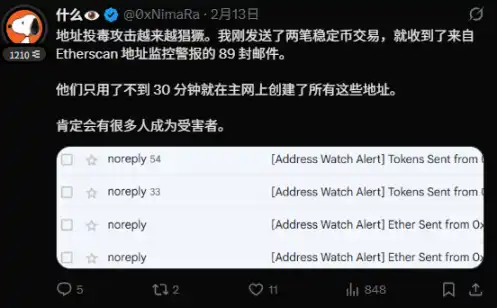
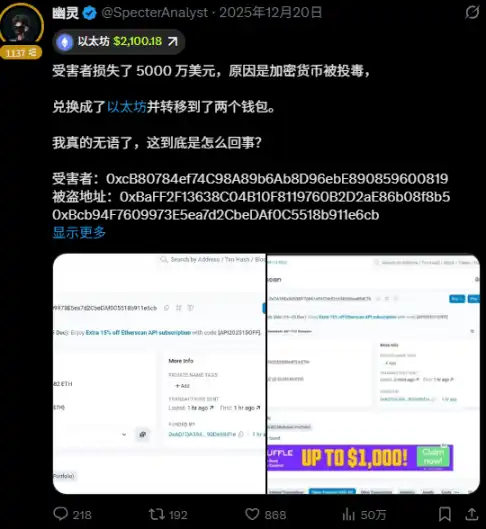
As Nima pointed out, these alerts were triggered by address poisoning transactions. The sole purpose of these transactions, created by attackers, is to implant highly similar fake addresses into the user's transaction history, intending to trick the user into mistakenly using these fake addresses when copying for their next transfer.
Address poisoning has existed on Ethereum for years. However, such incidents highlight that these attack campaigns have become highly automated and scaled. What was once sporadic spam is now executed on a massive scale, with attackers often implanting poisoning transfers within minutes of a legitimate transaction occurring.
To understand why such attacks have become more prevalent, we need to analyze two dimensions: the evolution of address poisoning attack methods, and the fundamental reasons why they can be easily operated at scale.
Additionally, this article will focus on explaining a core prevention principle to help users effectively defend against such attacks.
I. The Industrialization of Address Poisoning
Address poisoning was once considered a niche fraudulent tactic used by opportunistic attackers. However, today, its operational model increasingly exhibits industrial characteristics.
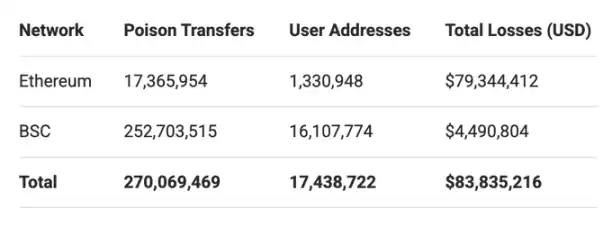
A study published in 2025, analyzing address poisoning activities between July 2022 and June 2024 (i.e., before the Fusaka upgrade), showed that there were approximately 17 million poisoning attempts on Ethereum, involving about 1.3 million users, with confirmed losses of at least $79.3 million.
The table below, based on results from the "Blockchain Address Poisoning Research," shows the scale of address poisoning activities on Ethereum and BSC between July 2022 and June 2024. The data indicates that on the BSC chain, where transaction fees are significantly lower, the frequency of poisoning transfers was 1355% higher.
Attackers typically identify potential targets by monitoring blockchain activity. Once a target user's transaction is detected, automated systems generate highly similar addresses that share the same starting and ending characters as the legitimate addresses the user has interacted with. The attackers then send poisoning transfers containing these fake addresses to the target address, causing them to appear in the user's transaction history.
Attackers tend to target addresses with higher profit potential. Addresses that frequently make transfers, hold large token balances, or participate in large-value transfers typically receive more poisoning attempts.
Competition Mechanism Enhances Attack Efficiency
The 2025 study revealed a noteworthy phenomenon: different attack groups often compete with each other. In many poisoning campaigns, multiple attackers send poisoning transfers to the same target address almost simultaneously.
Each attack group attempts to be the first to implant their fake address into the user's transaction history, hoping that their address will be selected first when the user copies an address later. The one who successfully implants first has an increased probability of having their fake address mistakenly copied by the user.
The case of the following address fully demonstrates the intensity of this competition. In this case, within minutes of a legitimate USDT transfer being completed, 13 poisoning transactions were implanted.
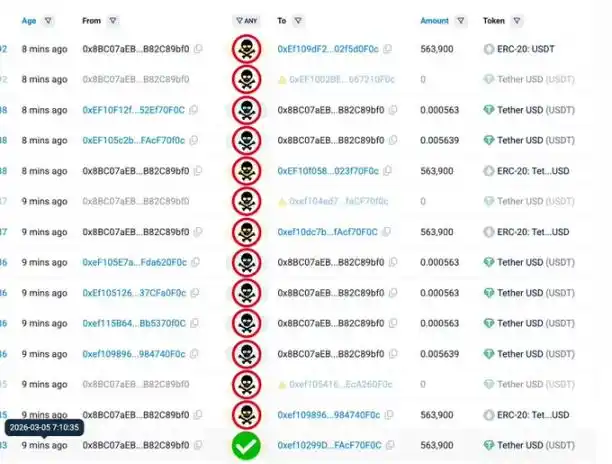
Note: Etherscan hides zero-value transfers by default; hidden items have been unhidden here for demonstration purposes
Common methods used in address poisoning attacks include: dust transfers, fake token transfers, and zero-value token transfers.
II. Reasons Why Address Poisoning Attacks Are Easy to Scale
At first glance, the success rate of address poisoning seems low. After all, most users are not fooled. However, from an economic perspective, the logic of such attacks is quite different.
The Logic of a Probability Game
Researchers found that the success rate of a single poisoning attempt on Ethereum is approximately 0.01%. In other words, out of every 10,000 poisoning transfers, only about 1 might lead to a user mistakenly sending funds to the attacker.
Given this, poisoning campaigns are no longer limited to a few addresses but tend to send thousands or even millions of poisoning transfers. When the attempt base is large enough, even a tiny success rate can accumulate to generate considerable illegal profits.
A single successful large-value transfer fraud can easily cover the costs of thousands of failed attempts.
Lower Transaction Costs Stimulate Increase in Poisoning Attempts
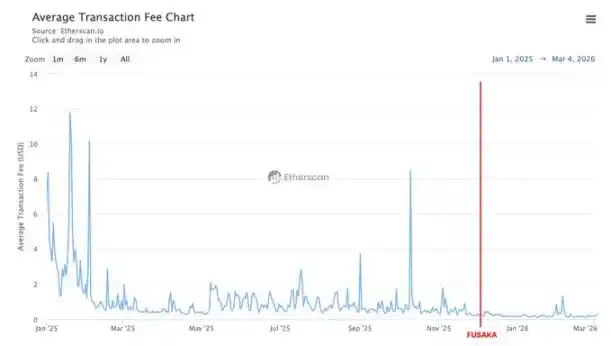
The Fusaka upgrade, activated on December 3, 2025, introduced scalability optimizations that effectively reduced transaction costs on Ethereum. While benefiting ordinary users and developers, this change also significantly lowered the cost for attackers to initiate a single poisoning transfer, enabling them to send poisoning attempts on an unprecedented scale.
After the Fusaka upgrade, Ethereum network activity increased markedly. In the 90 days post-upgrade, the average daily transaction processing volume increased by 30% compared to the 90 days pre-upgrade. During the same period, the average daily number of newly created addresses increased by about 78%.
Furthermore, we observed a significant increase in dust transfer activity. In these transfers, attackers send transactions involving the same token as in the user's history but for a very small amount.
The data below compares dust transfer activity for several major assets in the 90 days before and after the Fusaka upgrade. For stablecoins like USDT, USDC, and DAI, dust transfers refer to transactions below $0.01; for ETH, it refers to transfers below 0.00001 ETH.
USDT
- Pre-upgrade: 4.2 million
- Post-upgrade: 29.9 million
- Increase: +25.7 million (+612%)
USDC
- Pre-upgrade: 2.6 million
- Post-upgrade: 14.9 million
- Increase: +12.3 million (+473%)
DAI
- Pre-upgrade: 142,405
- Post-upgrade: 811,029
- Increase: +668,624 (+470%)
ETH
- Pre-upgrade: 104.5 million
- Post-upgrade: 169.7 million
- Increase: +65.2 million (+62%)
The data indicates that shortly after the Fusaka upgrade, dust transfer activity (below $0.01) surged sharply, peaked, and then declined somewhat, but remained significantly higher than pre-upgrade levels. In contrast, transfer activity above $0.01 remained relatively stable during the same period.
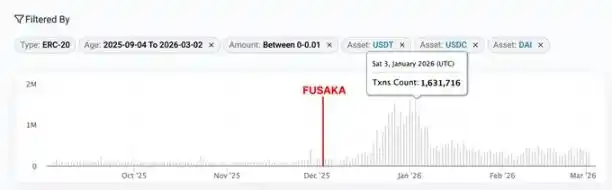
Chart: Comparison of dust transfer trends (<$0.01) for USDT, USDC, and DAI in the 90 days before and after the Fusaka upgrade
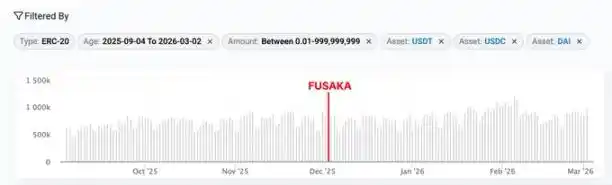
Chart: Comparison of regular transfer trends (>$0.01) for USDT, USDC, and DAI in the 90 days before and after the Fusaka upgrade
In many attack campaigns, attackers first bulk-send tokens and ETH to newly generated fake addresses, which then send dust transfers one by one to the target addresses. Since dust transfers involve extremely low amounts, with lower transaction costs, attackers can operate on a massive scale at very low cost.

Illustration: Address Fake_Phishing1688433 bulk-sending tokens and ETH to multiple different fake addresses in one transaction
It is important to clarify that not all dust transfers are poisoning acts. Dust transfers can also originate from legitimate activities, such as token airdrops or小额 interactions between addresses. However, after reviewing a large number of dust transfer records, it can be judged that a significant portion of them are highly likely to be poisoning attempts.
III. Core Prevention Principle
Always carefully verify the destination address before sending any funds.
Here are some practical suggestions for reducing risk when using Etherscan:
Use Identifiable Address Labels

For addresses you frequently interact with, set private name tags on Etherscan. This helps make legitimate addresses clearly distinguishable among many similar addresses.
Using domain name services like ENS can also improve the recognizability of addresses throughout the browser.
It is also recommended to use the wallet's address book feature to whitelist commonly used addresses, ensuring funds are always sent to the intended target.
Enable Address Highlighting
Etherscan's address highlighting feature helps users visually distinguish between visually similar addresses. If two addresses look almost identical but are highlighted differently, one is highly likely to be a poisoning address.
Always Double-Check Before Copying an Address
Etherscan proactively pops up提醒 windows when users copy addresses that may be associated with suspicious activity. This suspicious activity includes:
- Low-value token transfers
- Fake token transfers
- Tokens with poor reputation
- Tokens with outdated information
When you see such a reminder, be sure to pause and carefully verify whether the address you are copying is the target address you真正 intend to interact with.

Remember, there is no "undo" button in the crypto world. Once funds are sent to the wrong address, the possibility of recovery is minimal.
Summary
As lower costs make high-volume attack strategies more economical, address poisoning attacks on Ethereum are becoming increasingly rampant. Such attacks also negatively impact the user experience, with大量 poisoning spam cluttering transaction history interfaces面向 users.
Effectively preventing address poisoning attacks requires both users to improve their own security awareness and better interface design support. For users, the most crucial habit to develop is: always carefully verify the destination address before sending funds.
At the same time, related tools and user interfaces should play a greater role in helping users quickly identify suspicious activity.
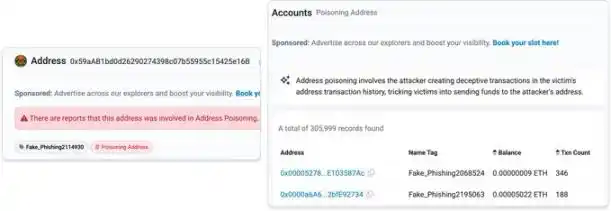
Poisoning address label on Etherscan (https://etherscan.io/accounts/label/poisoning-address)
Etherscan is continuously committed to improving the browser interface and API services to help users more easily identify such attacks. We proactively label fake addresses, identify and hide zero-value token transfers, and label fake tokens. By providing this curated data, users can more easily spot potential address poisoning attempts without manually sifting through massive transaction records.
As poisoning attacks escalate with automation and high-volume dust transfer methods, clearly presenting these risk signals is crucial to helping users distinguish between suspicious activity and legitimate transactions.
Crypto di tendenza













Domande pertinenti
QWhat is address poisoning in the context of Ethereum, and how does it work?
AAddress poisoning is a scam where attackers send transactions to a user's address using a fake address that looks very similar to a legitimate one the user has previously interacted with. The goal is to implant this fake address into the user's transaction history, hoping the user will mistakenly copy and send funds to it in the future.
QAccording to the article, how has the Fusaka upgrade on Ethereum impacted address poisoning attacks?
AThe Fusaka upgrade, which lowered transaction costs on Ethereum, made it significantly cheaper for attackers to launch address poisoning attempts. This led to a massive increase in dust transactions (transfers of tiny amounts of tokens), which are often used in these attacks, as attackers could operate on a much larger scale.
QWhat is the estimated success rate of an address poisoning attack on Ethereum, and why do attackers still pursue it?
AThe estimated success rate of a single address poisoning attempt on Ethereum is about 0.01%. Attackers still pursue it because it is a numbers game. By sending thousands or millions of attempts, the small success rate can accumulate into substantial illegal profits, as one successful large transfer can easily cover the cost of thousands of failed attempts.
QWhat is the single most important principle for users to protect themselves from address poisoning?
AThe single most important principle is to always carefully verify the destination address before sending any funds. Users should double-check the full address and not rely solely on the first and last few characters.
QWhat are some specific tools or features on Etherscan that can help users identify and avoid poisoned addresses?
AEtherscan offers several features to help users: Address Highlighting to visually distinguish between similar-looking addresses, Private Name Tags and ENS names to make legitimate addresses easily identifiable, an Address Book for whitelisting trusted addresses, and Warning Pop-ups that appear when a user attempts to copy an address associated with suspicious activity like low-value token transfers.
Letture associate





Trading
Articoli Popolari
Cosa è ETH 3.0
ETH3.0 e $eth 3.0: Un'Analisi Approfondita del Futuro di Ethereum Introduzione Nel panorama in rapida evoluzione delle criptovalute e della tecnologia blockchain, ETH3.0, spesso indicato come $eth 3.0, è emerso come un argomento di considerevole interesse e speculazione. Il termine comprende due concetti principali che warrantono chiarimenti: Ethereum 3.0: Questo rappresenta un potenziale futuro aggiornamento volto ad aumentare le capacità dell'attuale blockchain di Ethereum, concentrandosi principalmente sul miglioramento della scalabilità e delle prestazioni. ETH3.0 Meme Token: Questo progetto di criptovaluta distinto cerca di sfruttare la blockchain di Ethereum per creare un ecosistema incentrato sui meme, promuovendo il coinvolgimento all'interno della comunità delle criptovalute. Comprendere questi aspetti di ETH3.0 è essenziale non solo per gli appassionati di criptovalute, ma anche per coloro che osservano tendenze tecnologiche più ampie nello spazio digitale. Che cos'è ETH3.0? Ethereum 3.0 Ethereum 3.0 è pubblicizzato come un aggiornamento proposto per la rete Ethereum già stabilita, che è stata la spina dorsale di molte applicazioni decentralizzate (dApps) e contratti smart sin dalla sua nascita. I miglioramenti previsti si concentrano principalmente sulla scalabilità, integrando tecnologie avanzate come lo sharding e le prove a conoscenza zero (zk-proofs). Queste innovazioni tecnologiche mirano a facilitare un numero senza precedenti di transazioni al secondo (TPS), potenzialmente raggiungendo milioni, affrontando così una delle limitazioni più significative della tecnologia blockchain attuale. Il miglioramento non è meramente tecnico, ma anche strategico; è volto a preparare la rete Ethereum per un'adozione e un'utilità diffuse in un futuro contrassegnato da un aumento della domanda di soluzioni decentralizzate. ETH3.0 Meme Token Al contrario di Ethereum 3.0, l'ETH3.0 Meme Token si avventura in un dominio più leggero e giocoso, combinando la cultura dei meme di internet con la dinamica delle criptovalute. Questo progetto consente agli utenti di acquistare, vendere e scambiare meme sulla blockchain di Ethereum, fornendo una piattaforma che promuove il coinvolgimento della comunità attraverso la creatività e interessi condivisi. L'ETH3.0 Meme Token mira a dimostrare come la tecnologia blockchain possa intersecarsi con la cultura digitale, creando casi d'uso che siano sia divertenti che finanziariamente praticabili. Chi è il Creatore di ETH3.0? Ethereum 3.0 L'iniziativa verso Ethereum 3.0 è principalmente propulsa da un consorzio di sviluppatori e ricercatori all'interno della comunità di Ethereum, tra cui Justin Drake. Conosciuto per le sue intuizioni e contributi all'evoluzione di Ethereum, Drake è stato una figura di spicco nelle discussioni riguardanti la transizione di Ethereum verso un nuovo livello di consenso, chiamato “Beam Chain.” Questo approccio collaborativo allo sviluppo significa che Ethereum 3.0 non è il prodotto di un creatore singolo, ma piuttosto una manifestazione di ingegno collettivo focalizzato sul progresso della tecnologia blockchain. ETH3.0 Meme Token I dettagli riguardanti il creatore dell'ETH3.0 Meme Token sono attualmente non rintracciabili. La natura dei token meme conduce spesso a una struttura più decentralizzata e guidata dalla comunità, il che potrebbe spiegare la mancanza di attribuzione specifica. Questo si allinea con l'etica della comunità crypto più ampia, dove l'innovazione spesso nasce da sforzi collaborativi piuttosto che individuali. Chi sono gli Investitori di ETH3.0? Ethereum 3.0 Il supporto per Ethereum 3.0 proviene principalmente dalla Ethereum Foundation insieme a una comunità entusiasta di sviluppatori e investitori. Questa associazione fondamentale fornisce un considerevole grado di legittimità e migliora le prospettive di implementazione di successo poiché sfrutta la fiducia e la credibilità costruite nel corso degli anni di operazioni della rete. Nel clima in rapida evoluzione delle criptovalute, il supporto della comunità gioca un ruolo cruciale nello sviluppo e nell'adozione, posizionando Ethereum 3.0 come un serio contenditore per i futuri progressi della blockchain. ETH3.0 Meme Token Sebbene le fonti attualmente disponibili non forniscano informazioni esplicite riguardo ai fondamenti o alle organizzazioni di investimento che sostengono l'ETH3.0 Meme Token, ciò è indicativo del modello di finanziamento tipico per i token meme, che spesso si basa sul supporto di base e sul coinvolgimento della comunità. Gli investitori in tali progetti sono tipicamente individui motivati dal potenziale per innovazioni guidate dalla comunità e dallo spirito di cooperazione trovato all'interno della comunità crypto. Come Funziona ETH3.0? Ethereum 3.0 Le caratteristiche distintive dell'Ethereum 3.0 risiedono nella sua proposta di implementazione della tecnologia di sharding e zk-proof. Lo sharding è un metodo di partizionamento della blockchain in pezzi più piccoli e gestibili o “shard,” che possono elaborare transazioni in modo concorrente piuttosto che sequenziale. Questa decentralizzazione dell'elaborazione aiuta a prevenire la congestione e garantisce che la rete rimanga reattiva anche sotto un carico pesante. La tecnologia delle prove a conoscenza zero (zk-proof) contribuisce con un ulteriore livello di sofisticazione consentendo la validazione delle transazioni senza rivelare i dati sottostanti coinvolti. Questo aspetto non solo migliora la privacy, ma aumenta anche l'efficienza complessiva della rete. Si parla anche di incorporare una macchina virtuale Ethereum a conoscenza zero (zkEVM) in questo aggiornamento, amplificando ulteriormente le capacità e l'utilità della rete. ETH3.0 Meme Token L'ETH3.0 Meme Token si distingue capitalizzando sulla popolarità della cultura dei meme. Stabilisce un mercato per gli utenti che desiderano partecipare al trading di meme, non solo per divertimento, ma anche per potenziale guadagno economico. Integrando funzioni come lo staking, la fornitura di liquidità e meccanismi di governance, il progetto promuove un ambiente che incentiva l'interazione e la partecipazione della comunità. Offrendo una miscela unica di intrattenimento e opportunità economica, l'ETH3.0 Meme Token mira ad attrarre un pubblico variegato, che va dagli appassionati di crypto ai semplici intenditori di meme. Timeline di ETH3.0 Ethereum 3.0 11 Novembre 2024: Justin Drake accenna al prossimo aggiornamento ETH 3.0, incentrato sui miglioramenti della scalabilità. Questo annuncio segna l'inizio delle discussioni formali riguardo l'architettura futura di Ethereum. 12 Novembre 2024: La proposta attesa per Ethereum 3.0 dovrebbe essere svelata a Devcon a Bangkok, preparando il terreno per un feedback più ampio della comunità e potenziali passi successivi nello sviluppo. ETH3.0 Meme Token 21 Marzo 2024: L'ETH3.0 Meme Token viene ufficialmente elencato su CoinMarketCap, segnando il suo ingresso nel dominio pubblico delle criptovalute e aumentando la visibilità per il suo ecosistema basato sui meme. Punti Chiave In conclusione, Ethereum 3.0 rappresenta una significativa evoluzione all'interno della rete Ethereum, concentrandosi sul superamento delle limitazioni riguardanti scalabilità e prestazioni attraverso tecnologie avanzate. I suoi aggiornamenti proposti riflettono un approccio proattivo alle future esigenze e usabilità. D'altra parte, l'ETH3.0 Meme Token incarna l'essenza della cultura guidata dalla comunità nello spazio delle criptovalute, sfruttando la cultura dei meme per creare piattaforme coinvolgenti che incoraggiano la creatività e la partecipazione degli utenti. Comprendere gli scopi e le funzionalità distinte di ETH3.0 e $eth 3.0 è fondamentale per chiunque sia interessato ai continui sviluppi nello spazio crypto. Con entrambe le iniziative che tracciano percorsi unici, esse sottolineano collettivamente la natura dinamica e multifacetica dell'innovazione blockchain.
237 Totale visualizzazioniPubblicato il 2024.04.04Aggiornato il 2024.12.03

Cosa è ETHEREUM
HarryPotterTrumpHomerSimpson777Inu: Panoramica di un Progetto Crypto Web3 Introduzione Nel mondo in rapida evoluzione delle criptovalute e della finanza decentralizzata, progetti innovativi emergono frequentemente, catturando l'interesse della comunità degli investitori e degli appassionati di crypto. Uno di questi progetti è HarryPotterTrumpHomerSimpson777Inu, una criptovaluta che si trova all'incrocio tra cultura popolare e tecnologia blockchain. Questo token guidato dalla comunità mescola personaggi e figure politiche ben noti, con l'obiettivo di creare una piattaforma coinvolgente e promuovere un'adozione diffusa. Che cos'è HarryPotterTrumpHomerSimpson777Inu? HarryPotterTrumpHomerSimpson777Inu è un token costruito sulla blockchain di Ethereum, progettato per essere accessibile e divertente per un pubblico diversificato. L'unicità di questo progetto deriva dal suo approccio tematico, che intreccia elementi di fantasia, politica e intrattenimento. Sfruttando il fascino nostalgico di personaggi amati, il progetto cerca di creare un'esperienza di criptovaluta coinvolgente, incoraggiando il coinvolgimento e la partecipazione della comunità. L'obiettivo principale di HarryPotterTrumpHomerSimpson777Inu è stabilire un token che risuoni con gli utenti a livello personale, promuovendo sia il divertimento che il coinvolgimento nell'ambito crypto. Questo branding distintivo mira ad attrarre individui che in precedenza potrebbero non essersi interessati alle criptovalute, facilitando un nuovo punto di ingresso per utenti potenziali. Creatore di HarryPotterTrumpHomerSimpson777Inu L'identità del creatore dietro HarryPotterTrumpHomerSimpson777Inu rimane sconosciuta. Questa non è una pratica rara nel dominio delle criptovalute, dove l'anonimato è spesso preferito dai fondatori come mezzo di protezione della privacy e promozione di un ethos decentralizzato. Questa oscurità non diminuisce il valore del progetto; al contrario, riflette una tendenza più ampia all'interno del settore, dove molti progetti di successo sono emersi da origini anonime. Investitori di HarryPotterTrumpHomerSimpson777Inu Le informazioni pubbliche riguardo agli investitori di HarryPotterTrumpHomerSimpson777Inu sono limitate. La natura del progetto, incentrata sul coinvolgimento della comunità, suggerisce una dipendenza da investimenti di piccole dimensioni da parte di singoli appassionati piuttosto che da sostegni sostanziali da fondazioni di investimento consolidate o corporation. Questo livello di trasparenza nel finanziamento è tipico di molti progetti di criptovaluta guidati dalla comunità, dove il supporto spesso proviene da movimenti di base piuttosto che da investitori istituzionali. Come Funziona HarryPotterTrumpHomerSimpson777Inu? Operando sulla blockchain di Ethereum, HarryPotterTrumpHomerSimpson777Inu sfrutta la sua solida infrastruttura per facilitare transazioni e promuovere interazioni tra gli utenti all'interno della comunità. Ciò che distingue questo progetto è il suo posizionamento tematico: canalizzando il carisma di personaggi iconici provenienti da diversi ambiti culturali, crea un'identità di marca distintiva. Questo approccio non solo attrae gli utenti, ma coltiva anche una comunità fedele attorno al token. Le meccaniche operative del progetto si concentrano sul coinvolgimento della comunità. Adotta un modello decentralizzato che incoraggia la partecipazione, consentendo agli utenti di interagire attraverso vari canali mentre promuovono lo scambio di idee e esperienze. Inoltre, il progetto abbraccia i principi del Web3, privilegiando la sovranità degli utenti e la decentralizzazione, che sono i pilastri del futuro di Internet. Timeline di HarryPotterTrumpHomerSimpson777Inu La storia di HarryPotterTrumpHomerSimpson777Inu è segnata da diversi eventi decisivi: 12 agosto 2023: L'inizio di HarryPotterTrumpHomerSimpson777Inu, segnando il suo ingresso nell'ecosistema delle criptovalute. Fase di Sviluppo: Un periodo focalizzato sulla costruzione di una strategia completa per stimolare la crescita guidata dalla comunità e il coinvolgimento degli utenti. Listing sugli Scambi: Sebbene i dettagli specifici di listing non siano stati divulgati, il progetto è stato reso accessibile su vari scambi di criptovalute, migliorando la sua visibilità nel mercato. Coinvolgimento della Comunità: Sforzi continui per coinvolgere attivamente la comunità, stabilendo canali di dialogo e promuovendo la partecipazione attraverso varie attività, tra cui concorsi, discussioni e votazioni comunitarie. Aspetti Chiave di HarryPotterTrumpHomerSimpson777Inu Focus sulla Comunità Un tratto distintivo di HarryPotterTrumpHomerSimpson777Inu è la sua forte enfasi sul coinvolgimento della comunità. Il progetto incoraggia attivamente gli utenti a partecipare a discussioni, condividere idee e contribuire all'evoluzione del progetto. Questa interazione coltiva un senso di appartenenza e di ownership tra i membri della comunità, essenziale per la sostenibilità a lungo termine del token. Utilizzo della Blockchain di Ethereum La scelta di costruire sulla blockchain di Ethereum consente a HarryPotterTrumpHomerSimpson777Inu di sfruttare le sue caratteristiche di sicurezza ben consolidate e architettura decentralizzata. Questa base garantisce affidabilità per le transazioni e fornisce un framework affidabile su cui sviluppare varie funzionalità. Approccio Tematico Unico Fusione di elementi della cultura pop nella sua identità, HarryPotterTrumpHomerSimpson777Inu crea una narrazione coinvolgente che lo differenzia da altre criptovalute. L'amalgama di personaggi e temi genera riconoscimento e intrigo immediati, rendendo il token relazionabile a un'ampia gamma di utenti potenziali. Anonimato nello Sviluppo Il creatore anonimo del progetto rimane una caratteristica ricorrente in molte iniziative di criptovaluta. Questo aspetto evidenzia un ethos di decentralizzazione, introducendo anche un livello di mistero che potrebbe affascinare un segmento della comunità crypto, attirando l'attenzione sul progetto e invitando l'impegno da parte di utenti che supportano l'idea di un'iniziativa decentralizzata e gestita dalla comunità. Conclusione HarryPotterTrumpHomerSimpson777Inu si presenta come un'aggiunta distintiva al panorama delle criptovalute, combinando il fascino della cultura popolare con le meccaniche innovative della tecnologia blockchain. Sebbene i dettagli riguardanti il creatore e gli investitori specifici rimangano non divulgati, il focus del progetto sulla comunità e il suo approccio tematico lo contraddistinguono come un potenziale attore influente nel contesto del Web3 e delle criptovalute. Man mano che l'ecosistema delle criptovalute continua ad espandersi, iniziative come HarryPotterTrumpHomerSimpson777Inu ci ricordano le molteplici modalità in cui la blockchain può connettere le comunità globali attraverso narrazioni e valori condivisi.
1.1k Totale visualizzazioniPubblicato il 2024.04.06Aggiornato il 2024.12.03
Come comprare ETH
Benvenuto in HTX.com! Abbiamo reso l'acquisto di Ethereum (ETH) semplice e conveniente. Segui la nostra guida passo passo per intraprendere il tuo viaggio nel mondo delle criptovalute.Step 1: Crea il tuo Account HTXUsa la tua email o numero di telefono per registrarti il tuo account gratuito su HTX. Vivi un'esperienza facile e sblocca tutte le funzionalità,Crea il mio accountStep 2: Vai in Acquista crypto e seleziona il tuo metodo di pagamentoCarta di credito/debito: utilizza la tua Visa o Mastercard per acquistare immediatamente EthereumETH.Bilancio: Usa i fondi dal bilancio del tuo account HTX per fare trading senza problemi.Terze parti: abbiamo aggiunto metodi di pagamento molto utilizzati come Google Pay e Apple Pay per maggiore comodità.P2P: Fai trading direttamente con altri utenti HTX.Over-the-Counter (OTC): Offriamo servizi su misura e tassi di cambio competitivi per i trader.Step 3: Conserva Ethereum (ETH)Dopo aver acquistato Ethereum (ETH), conserva nel tuo account HTX. In alternativa, puoi inviare tramite trasferimento blockchain o scambiare per altre criptovalute.Step 4: Scambia Ethereum (ETH)Scambia facilmente Ethereum (ETH) nel mercato spot di HTX. Accedi al tuo account, seleziona la tua coppia di trading, esegui le tue operazioni e monitora in tempo reale. Offriamo un'esperienza user-friendly sia per chi ha appena iniziato che per i trader più esperti.
3.1k Totale visualizzazioniPubblicato il 2024.12.10Aggiornato il 2026.06.02

