Ethena struggles as revenue falls 32% – Can demand save ENA at $0.089?

ambcryptoPubblicato 2026-03-28Pubblicato ultima volta 2026-03-28

Introduzione

Ethena's (ENA) financial performance weakened significantly in Q1 2026, with its price dropping to $0.089. Key metrics show a 32% decline in Gross Protocol Revenue to $65.06 million, attributed to reduced minting activity and staking rewards. Total Value Locked (TVL) also fell by approximately $130 million since March, indicating sustained capital outflows and declining user activity, which hit a low of around 1,200 daily active users. Despite a slight improvement in gross profit, it remains substantially lower than previous quarters. However, spot market data shows consistent accumulation, with $3.41 million in net inflows over three days, suggesting investor demand may provide some price support. Without a recovery in core fundamentals, significant upside potential remains limited.

Ethena’s [ENA] price now appears to be aligning with its weakening financial performance. Over the past 24 hours, the asset has recorded a double-digit decline, dropping to $0.089 at press time.

While the numbers reflect mounting pressure, a broader evaluation of market conditions is necessary to determine whether this decline marks the start of a deeper correction or a temporary adjustment.

Ethena’s momentum weakens across key metrics

On-chain data shows that ENA has underperformed across multiple fronts since the start of Q1 2026, particularly when compared to its performance in the previous two quarters.

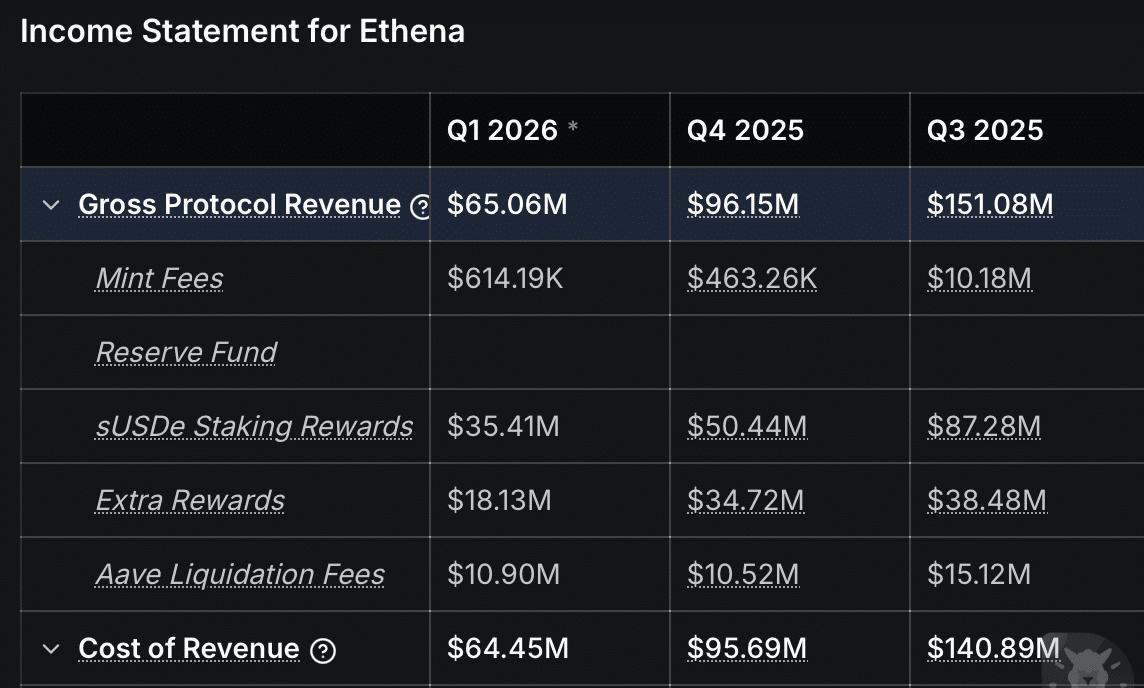
A key area of concern is revenue efficiency. Gross Protocol Revenue fell to $65.06 million, down from $96.15 million in Q4 2025, representing a 32% decline. The drop becomes even more pronounced when compared to Q3 2025.

This contraction points to weaker minting activity and reduced staking rewards, both of which suggest declining on-chain participation.
Source: DeFiLlama

In a market that has remained relatively stable compared to the October–December 2025 cycle, this underperformance raises concerns about weakening user demand rather than external pressure.

Liquidity conditions reinforce this trend. Total Value Locked (TVL), a core indicator of protocol health and user commitment, has continued to decline steadily.

Since the start of March 2026, TVL has fallen by approximately $130 million, bringing it to around $6.66 billion at the time of writing. Within the last 24 hours alone, roughly $16 million has been unstaked, signaling sustained capital exit from the protocol.

Can profit alone sustain user interest?

Despite the broader slowdown, Ethena has recorded a slight improvement in gross profitability.

In Q1 2026, the protocol has generated $614,190 in gross profit, compared to $463,200 in Q4 2025. While this reflects a marginal increase, it does little to offset the sharp decline from earlier performance levels.

For context, Q3 2025 saw $10.18 million in gross profit, roughly 16.5 times higher than current figures. This gap highlights a structural decline in earning potential, even as short-term profitability shows minor improvement.

The implication is clear, as modest profit growth alone may not be sufficient to retain users, especially in a competitive DeFi environment where capital quickly rotates toward higher-yield opportunities.

User activity data supports this view. According to Artemis, Daily Active Users have dropped to around 1,200, the lowest level recorded since December.

Spot demand offers a counter-signal

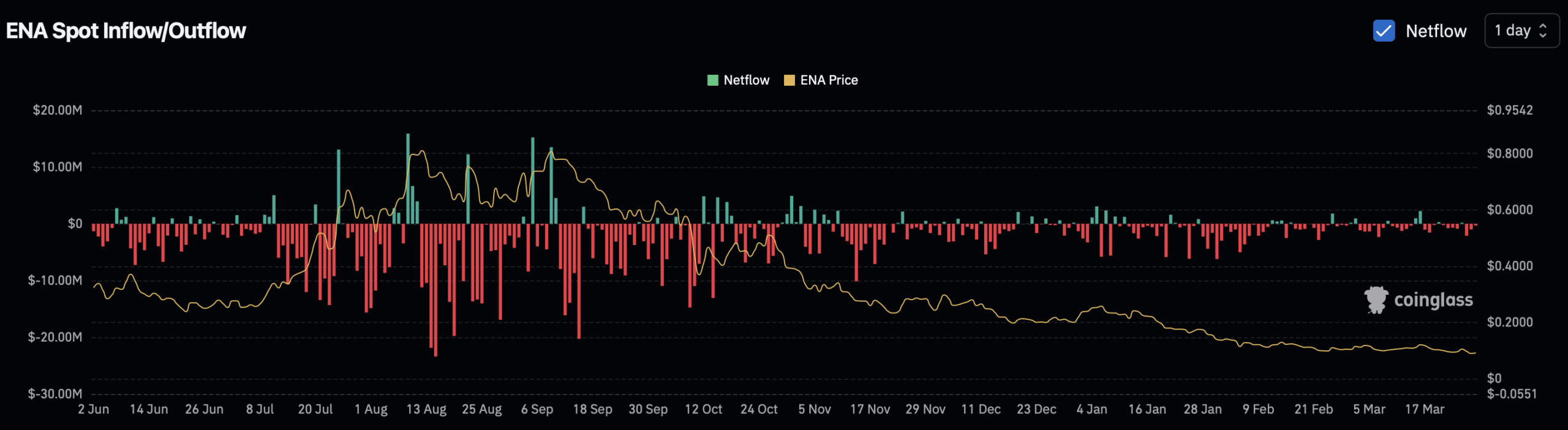
Despite weakening fundamentals and declining liquidity, spot market activity presents a more resilient picture. Exchange netflow data indicates that buying pressure has increased recently. Over the past 24 hours, net inflows into spot positions reached approximately $303,000.

More notably, this is not an isolated event. Over the past three days, cumulative purchases have climbed to around $3.41 million, suggesting consistent accumulation.
Source: CoinGlass

Such a sustained demand indicates that investors continue to absorb sell-side pressure, even as capital exits the protocol layer.

If this accumulation trend holds, it could limit further downside and support price stabilization. However, without a recovery in core fundamentals, particularly user activity and revenue generation, any upside may remain constrained within a narrow range.


Final Summary

  • Ethena’s protocol performance deteriorated in Q1 2026, even as broader market conditions remained relatively stable.
  • Spot investors continue to accumulate, despite rising liquidity outflows and declining TVL.

Crypto di tendenza

Domande pertinenti

QWhat is the current price of ENA and how much has it declined in the last 24 hours?

AThe current price of ENA is $0.089, and it has recorded a double-digit decline over the past 24 hours.

QBy what percentage did Ethena's Gross Protocol Revenue fall in Q1 2026 compared to Q4 2025?

AEthena's Gross Protocol Revenue fell by 32%, dropping from $96.15 million in Q4 2025 to $65.06 million in Q1 2026.

QWhat does the decline in Total Value Locked (TVL) and the unstaking of funds indicate about the Ethena protocol?

AThe decline in TVL, including $16 million unstaked in 24 hours, signals sustained capital exit from the protocol, indicating weakening user commitment and health.

QDespite the broader slowdown, which financial metric showed a marginal improvement for Ethena in Q1 2026?

AGross profitability showed a marginal improvement, increasing to $614,190 in Q1 2026 from $463,200 in Q4 2025.

QWhat counter-signal does spot market activity provide against the weakening fundamentals?

ASpot market activity shows increased buying pressure, with net inflows of $303,000 in 24 hours and cumulative purchases of $3.41 million over three days, suggesting consistent accumulation by investors.

Letture associate

Dialogue with Jia Hang | Looking Back at Two Decades of Chinese Payment Going Global

**Summary: A Conversation with Jia Hang on Two Decades of China's Payment Globalization** Jia Hang, a veteran with over twenty years in payments, reflects on China's attempts to build a global payment network through three key phases: UnionPay (card networks), Alipay+ (digital wallets), and now, stablecoins. His journey began at UnionPay International, aiming to establish China's card network abroad. While successful in following Chinese tourists ("where Chinese go, UnionPay goes"), it struggled to achieve true global scale. The core lesson: card networks like Visa/Mastercard's unassailable advantage isn't just technical standards, but their deeply entrenched **governance and profit-sharing models** that create powerful network effects. Competing as the "same species" is nearly impossible. At Ant Group, he led Alipay+, a strategy to bypass card networks by interconnecting local e-wallets worldwide. While innovative, it faced a similar ceiling. Mobile QR payments and card swipes were essentially **the same species competing for the same pie**, lacking a disruptive value proposition for users or a sustainable new incentive model to replace the card networks' established flywheel. Today, at Singapore's DCS, Jia focuses on stablecoin-based payments. He argues stablecoins represent a fundamental shift. They are not competing with Visa for consumer payments but challenging the **traditional banking and account system for value movement**. Products like "U Cards" (stablecoin-linked payment cards) are transitional, leveraging existing card networks for acceptance while building new rails. The real potential lies in stablecoins enabling seamless, low-cost global value transfer, potentially reorganizing the financial infrastructure around **accounts rather than cards**. Jia believes stablecoin adoption for local retail payments, cross-border transactions, and as high-yield savings vehicles is becoming irreversible. This could gradually reduce reliance on traditional fiat channels, especially in regions with weak currencies or capital controls. The quest for the "next global payment network" continues, now centered on whether stablecoins can successfully bridge Web2 and Web3, establish new governance, and create compelling user value beyond mere cost reduction.

marsbit24 min fa

Dialogue with Jia Hang | Looking Back at Two Decades of Chinese Payment Going Global

marsbit24 min fa

Circle's Stock Price Plunges 76%, Hong Kong Dollar Stablecoin Set to Launch Within Two Weeks

Circle's stock price has plunged approximately 76% from its 2023 peak, reflecting a major market revaluation. Despite this, Circle President Heath Tarbert emphasized the company's focus on long-term execution and its dominant position with USDC's $73 billion circulation across 34 blockchains. The competitive landscape is intensifying. A new consortium-backed stablecoin, Open USD, is attempting to challenge incumbents by sharing reserve yields with partners. More significantly, Visa's new stablecoin platform, initially supporting Open USD while also being compatible with USDC, could erode Circle's network effects. In response, Circle is expanding into real-world payments through partnerships like the one with Japan's JCB. Separately, Tether (USDT) faces a two-year compliance window under new U.S. regulations, requiring it to adjust its reserve composition away from assets like Bitcoin and loans towards cash and U.S. Treasuries. Meanwhile, in Hong Kong, Standard Chartered-backed fintech firm Dian Dian is poised to launch a licensed HKD-pegged stablecoin (HKDAP), moving the industry into a phase where the real test is integrating licensed stablecoins into actual payment flows and corporate treasury systems. The sharp decline in Circle's stock underscores a broader shift: the stablecoin market is moving from a winner-takes-all dynamic to a multi-player competitive arena where execution, compliance, and real-world utility are becoming paramount.

marsbit24 min fa

Circle's Stock Price Plunges 76%, Hong Kong Dollar Stablecoin Set to Launch Within Two Weeks

marsbit24 min fa

Amidst Capital's Encirclement, Decentralization is the Sole Defense for Public Blockchains

In a landscape dominated by power and profit motives, the author argues that decentralization is not merely one desirable feature among many in blockchain design—it is the singular, non-negotiable defense against corporate and capital capture. The article adopts a Machiavellian, realist perspective on human institutions, positing that businesses will inevitably attempt to co-opt any valuable network to protect their profits and dominance. While external attacks like 51% forks are often discussed, the greater existential risk is internal capture—the gradual erosion of a protocol’s neutrality by vested interests, as seen historically with platforms like Visa and Google. The piece critiques permissioned chains, highly centralized “permissionless” layer-1s, and layer-2s without sufficient decentralization (e.g., single sequencers) as inherently vulnerable. These compromised systems, promoted by established financial players, are framed as delaying tactics to stifle truly open networks that threaten existing high-fee, inefficient business models. Real-world examples, such as closed enterprise consortiums that exclude competitors, illustrate how such systems cement oligopolies rather than foster innovation. The author concludes that while decentralized protocols like Ethereum are imperfect and costly to operate, they represent the only viable long-term equilibrium. In a market where value naturally flows to the most secure and neutral settlement layer, only maximally decentralized public blockchains can resist being subsumed by capital and powerful incumbents.

Foresight News35 min fa

Amidst Capital's Encirclement, Decentralization is the Sole Defense for Public Blockchains

Foresight News35 min fa

Trading

Spot

Articoli Popolari

Come comprare ENA

Benvenuto in HTX.com! Abbiamo reso l'acquisto di Ethena (ENA) semplice e conveniente. Segui la nostra guida passo passo per intraprendere il tuo viaggio nel mondo delle criptovalute.Step 1: Crea il tuo Account HTXUsa la tua email o numero di telefono per registrarti il tuo account gratuito su HTX. Vivi un'esperienza facile e sblocca tutte le funzionalità,Crea il mio accountStep 2: Vai in Acquista crypto e seleziona il tuo metodo di pagamentoCarta di credito/debito: utilizza la tua Visa o Mastercard per acquistare immediatamente EthenaENA.Bilancio: Usa i fondi dal bilancio del tuo account HTX per fare trading senza problemi.Terze parti: abbiamo aggiunto metodi di pagamento molto utilizzati come Google Pay e Apple Pay per maggiore comodità.P2P: Fai trading direttamente con altri utenti HTX.Over-the-Counter (OTC): Offriamo servizi su misura e tassi di cambio competitivi per i trader.Step 3: Conserva Ethena (ENA)Dopo aver acquistato Ethena (ENA), conserva nel tuo account HTX. In alternativa, puoi inviare tramite trasferimento blockchain o scambiare per altre criptovalute.Step 4: Scambia Ethena (ENA)Scambia facilmente Ethena (ENA) nel mercato spot di HTX. Accedi al tuo account, seleziona la tua coppia di trading, esegui le tue operazioni e monitora in tempo reale. Offriamo un'esperienza user-friendly sia per chi ha appena iniziato che per i trader più esperti.

247 Totale visualizzazioniPubblicato il 2024.12.10Aggiornato il 2026.06.02

Come comprare ENA

Discussioni

Benvenuto nella Community HTX. Qui puoi rimanere informato sugli ultimi sviluppi della piattaforma e accedere ad approfondimenti esperti sul mercato. Le opinioni degli utenti sul prezzo di ENA ENA sono presentate come di seguito.

活动图片