Eric Trump Sets A “Beyond Catastrophic” Bar To Sell Bitcoin — How Far Are We From That?

bitcoinistPubblicato 2026-05-25Pubblicato ultima volta 2026-05-25

Introduzione

Eric Trump, Chief Strategy Officer of American Bitcoin Corp., has declared that the company would only sell its Bitcoin holdings under circumstances he describes as "beyond catastrophic." In an interview, he framed this as a strategic commitment to permanent accumulation, driven by the goal of increasing "satoshis per share" and competing in both the race for the largest Bitcoin holdings and the lowest acquisition cost. The company mines its Bitcoin at a claimed 53% below spot price and retains all coins, drawing a distinction from Michael Saylor's MicroStrategy, which has signaled some flexibility. Trump's stance sets a new benchmark for long-term commitment in the Bitcoin treasury sector. As of the report, Bitcoin trades near $82,000, with American Bitcoin's treasury holding over 7,000 BTC.

Eric Trump, co-founder and Chief Strategy Officer of American Bitcoin Corp., has revealed the conditions under which he would sell Bitcoin — and the threshold he has set is so extreme it amounts to a declaration that, under any foreseeable market scenario, he is not selling.

Speaking in an interview for the Bonnie Blockchain channel published on May 12, Trump was asked directly about the circumstances that could force American Bitcoin to liquidate its holdings. His answer was unambiguous.

Selling would require something “beyond catastrophic,” per the interview — a framing that places the sell threshold so far outside normal market volatility, regulatory pressure, or even prolonged bear markets that it functions less as a risk management policy and more as a philosophical commitment to permanent accumulation.

The Two Races — And Why Selling Bitcoin Loses Both

The broader context behind Trump’s sell-never posture is the dual competitive framework he laid out in the same interview. According to Trump, the Bitcoin treasury space is defined by two simultaneous races: one for the largest total Bitcoin holdings, and one for the lowest possible acquisition cost. American Bitcoin, he argued, is competing in both — and selling Bitcoin loses ground in the first race immediately while undermining the entire logic of the second.

The company’s north star metric, per Trump’s interview, is growing “satoshis per share” — a measurement of how much Bitcoin each outstanding share of ABTC represents. Every Bitcoin sold dilutes that figure. Every Bitcoin mined and retained compounds it. The accumulation model only works if the coins stay, which makes the “beyond catastrophic” sell threshold not a rhetorical flourish but a structural requirement of the strategy itself.

The Saylor Reference — And The Divergence

Trump acknowledged Michael Saylor’s role in building the Bitcoin treasury category, describing him as a visionary and praising Strategy’s approach, per the interview. But he drew a pointed distinction. Saylor recently suggested that Strategy could sell some Bitcoin to help fund dividend payments — a hint of flexibility in the accumulation model that Trump appears unwilling to replicate.

American Bitcoin, he made clear, is following a stricter retention framework. Where Strategy accumulates primarily through capital markets and has signaled some exit flexibility, ABTC accumulates through mining — at a cost it claims is approximately 53% below spot — and holds without exception, per the interview.

The distinction matters for how investors read both companies. A sell-never posture from a mining-integrated treasury firm is more operationally credible than the same posture from a pure accumulator, because the marginal cost of each new coin is structurally lower and the balance sheet pressure to monetize is reduced accordingly.

For the nascent sector’s growing cohort of Bitcoin treasury companies, Trump’s “beyond catastrophic” framing marks a pivotal benchmark — the most unambiguous long-term accumulation commitment any publicly listed executive has put on record this cycle. Whether the market rewards that conviction or punishes the rigidity will depend on where Bitcoin trades over the next several years.
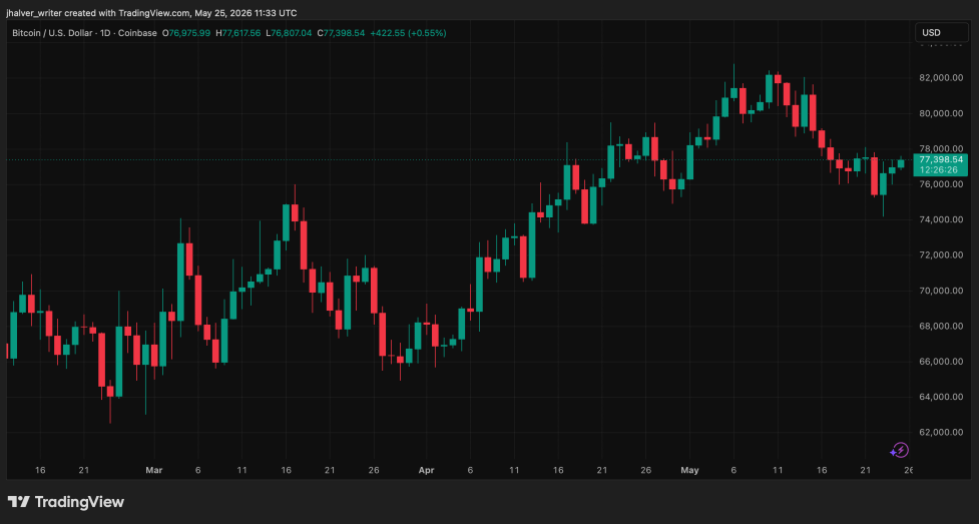
BTC's price trends to the upside, as seen on the daily chart. Source: BTCUSD on Tradingview

As of this writing, Bitcoin trades at around $82,000, with American Bitcoin’s treasury holding over 7,000 BTC as the company continues what its co-founder has now publicly described as an unconditional accumulation strategy.

Cover image from Grok, BTCUSD Chart from Tradingview

Domande pertinenti

QAccording to the article, what is the specific condition under which Eric Trump says he would sell Bitcoin?

AEric Trump would only sell Bitcoin under conditions he describes as "beyond catastrophic," a threshold so extreme it effectively amounts to a commitment to never sell under any foreseeable market scenario.

QWhat are the two key competitive races in the Bitcoin treasury space as outlined by Eric Trump in the interview?

AThe two key competitive races are: 1) the race for the largest total Bitcoin holdings, and 2) the race for the lowest possible acquisition cost for Bitcoin.

QWhat is the key metric American Bitcoin Corp. focuses on, and how does selling Bitcoin affect it?

AAmerican Bitcoin Corp.'s key metric is growing "satoshis per share," which measures how much Bitcoin each outstanding share represents. Selling Bitcoin immediately dilutes this figure.

QWhat is the main operational difference between American Bitcoin Corp.'s and MicroStrategy's Bitcoin accumulation strategies mentioned in the article?

AThe main difference is that American Bitcoin Corp. (ABTC) accumulates Bitcoin primarily through mining at a claimed low cost and follows a strict 'sell-never' policy, while MicroStrategy accumulates primarily through capital markets and has signaled some flexibility to potentially sell Bitcoin to fund dividends.

QHow does the article characterize the credibility of a 'sell-never' posture from a mining company compared to a pure accumulator?

AThe article states that a 'sell-never' posture from a mining-integrated treasury firm is more operationally credible than from a pure accumulator because the marginal cost of each new coin is structurally lower, reducing balance sheet pressure to monetize the holdings.

Letture associate

BIT Research: ETF Purchases Have Slowed, Strategy (MicroStrategy) Has Slowed, What Else Can Drive Bitcoin's Rise?

Market Refocus on Inflation and Rate Expectations Weighs on Bitcoin Currently, the market is in a phase of macro-repricing dominated by inflation and interest rate expectations. Bitcoin, which previously benefited from easy liquidity and low inflation, is seeing its core bullish drivers weaken. These drivers were market expectations for interest rate cuts and strong inflows from Bitcoin ETFs and institutions like MicroStrategy (referred to as "Strategy" in the text). The logic has shifted. Recent high inflation data (e.g., CPI hitting 3.8% in a May 2026 report) has caused the market to sharply reduce its rate cut expectations for 2025 and even price in potential hikes. This is a key constraint for Bitcoin, as it lacks cash flows and is highly sensitive to rate expectations. Concurrently, institutional capital flows have slowed significantly. Following the hot CPI data, Bitcoin ETFs saw accelerated outflows, with around $4.3 billion leaving over a period. MicroStrategy's ability to keep adding substantial Bitcoin to its balance sheet is also diminishing. Together, ETF and MicroStrategy holdings total roughly $110 billion, but their momentum as growth engines is cooling. In summary, Bitcoin's current pressure stems not from its own fundamentals but from a changing macro environment. As long as inflation stays elevated, Bitcoin is likely to remain in a consolidating phase. However, historically, inflation eventually peaks. Once it recedes and rate cut expectations rebuild, institutional capital could return, potentially fueling a new and more robust recovery phase for Bitcoin.

marsbit8 min fa

BIT Research: ETF Purchases Have Slowed, Strategy (MicroStrategy) Has Slowed, What Else Can Drive Bitcoin's Rise?

marsbit8 min fa

Earning 1000 Trillion in Half a Year, 'Pocketing' 20 Million per Capita: This Round of Wealth Creation in the Korean Stock Market is Unprecedented in Scale

The South Korean stock market is experiencing an unprecedented wealth surge in 2026, with household equity and fund asset values soaring by over 1,000 trillion KRW (~$730bn) year-to-date. This translates to an average per capita wealth increase of roughly 20 million KRW, fueled by a historic 109% rally in the KOSPI index. The boom is driven by three converging forces: an AI-driven semiconductor supercycle boosting giants like Samsung and SK Hynix; the government's "Value-Up" market reforms addressing long-standing corporate governance issues; and aggressive real estate regulations that have locked capital within financial markets, preventing profits from flowing back into property. This has triggered a wealth effect, boosting high-end consumption significantly. However, the gains are highly concentrated. The two semiconductor behemoths account for over half the index's value, but retail investors own relatively low stakes in them, systematically missing the biggest rallies. Wealth and consumption benefits are skewed towards luxury goods and imported cars, bypassing mainstream retail. Further risks stem from excessive leverage, with high trading volume in leveraged ETFs, and a market sentiment heavily reliant on the AI sector's fortunes and speculative rumors. While this cycle marks a potential shift from real estate to equities as a primary wealth generator for Koreans, its sustainability, amid structural imbalances and leverage, remains a critical test.

marsbit13 min fa

Earning 1000 Trillion in Half a Year, 'Pocketing' 20 Million per Capita: This Round of Wealth Creation in the Korean Stock Market is Unprecedented in Scale

marsbit13 min fa

imToken's 10th Anniversary Unveils Strategic Direction for the Next Decade: Evolving from a Trusted Main Wallet to a Personal Digital Hub

On its tenth anniversary, decentralized wallet imToken announced its strategic vision for the next decade: evolving from a "trusted main wallet" into a "personal control interface." This new direction aims to help users manage not only digital assets but also identity, permissions, and AI agent actions in an increasingly open and intelligent internet. imToken outlined that while the past decade focused on Store, Send, and Stake—securing assets, enabling transfers, and facilitating network participation—the future introduces a fourth core proposition: Sign. This expanded concept goes beyond transaction signing to encompass expressing intent, granting permissions, setting rules, delegating actions, and revoking authorizations. As AI agents gain autonomy, imToken emphasizes the need for clear, verifiable, and revocable user control over their actions. CEO Ben He stated that imToken's mission is shifting from enabling ownership of digital assets to ensuring user sovereignty over their entire digital world in the AI era. The company's core principle has been upgraded from "Digital Assets, Under Your Control" to "Your Digital World, Under Your Control." Future development will focus on three areas: upholding self-custody principles, extending security from transactions to authorizations and automated actions, and building product capabilities for managing permissions, delegations, policies, and revocations. imToken views the wallet's role as expanding into a trusted control interface for human-AI collaboration, where managing keys, signatures, and permissions forms the infrastructure for personal digital sovereignty. Founded in 2016, imToken serves millions of users across 150+ countries, providing non-custodial wallet services supporting over 50 blockchain networks.

marsbit16 min fa

imToken's 10th Anniversary Unveils Strategic Direction for the Next Decade: Evolving from a Trusted Main Wallet to a Personal Digital Hub

marsbit16 min fa

Trading

Spot
Futures
活动图片