ENI Officially Announces Completion of Strategic Brand Upgrade: Evolving from Underlying Protocol to Global Institutional-Grade Financial Infrastructure

marsbitPubblicato 2026-04-22Pubblicato ultima volta 2026-04-22

Introduzione

ENI Announces Strategic Brand Upgrade: Evolving from Underlying Protocol to Global Institutional-Grade Financial Infrastructure At the Hong Kong Web3 Festival on April 20, 2026, ENI founder and CEO Arion Ho announced the completion of a comprehensive brand, website, and visual system upgrade. This marks a significant shift from being an "underlying public chain" to an enterprise-grade Blockchain-as-a-Service (BaaS) platform, positioning ENI as a key infrastructure provider bridging traditional finance (TradFi) and Web3. The rebranding emphasizes precision and professionalism, reflected in a refined visual identity featuring a 25-degree tilt and a 1:4 golden ratio in its design elements. This aesthetic upgrade, led by a top-tier design team with experience from Hermès and ByteDance, underscores ENI’s commitment to institutional-grade trust and global sophistication. ENI now functions as a bridge between technological innovation and real-world business applications. It offers tailored architecture solutions for large institutions and standardized, low-friction BaaS tools for SMEs, enabling seamless integration of Web3 capabilities into existing business models. The announcement in Hong Kong, a global financial hub, signals ENI’s matured, global-ready approach to supporting the commercial adoption of Web3. By providing a stable, standardized platform, ENI aims to facilitate the secure migration of real-world assets and operations into the digital economy.

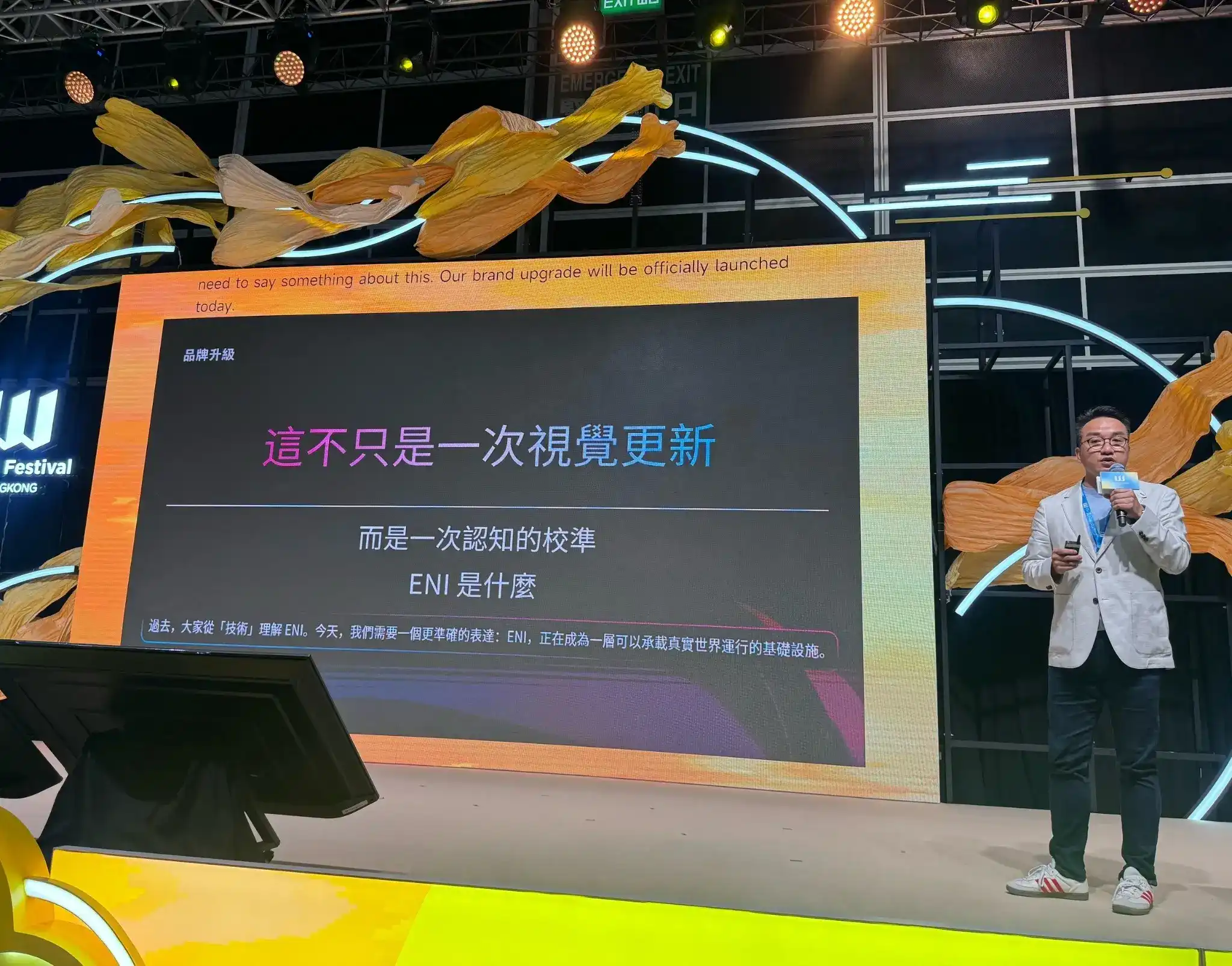
On April 20, 2026, at the Hong Kong Web3 Carnival venue, ENI founder and CEO Arion Ho delivered a keynote speech titled "Bridging Traditional Finance and Web3: Building the Infrastructure for the Real-World Financial System." During the speech, Arion officially announced that ENI has comprehensively completed the simultaneous update of its brand, official website, and visual system. This is not merely an aesthetic leap but also a milestone signaling ENI's transition from an "underlying technology public chain" to a "Blockchain-as-a-Service (BaaS) platform for enterprise onboarding." It signifies that ENI is redefining its role in the next phase of Web3 commercialization in a more mature and globalized manner.

The Beauty of Mathematics: Defining "Precision in Fine-Tuning" with a 25-Degree Obsession

In this brand upgrade, ENI exemplifies what it means to achieve "precision through fine-tuning." For infrastructure projects pursuing "institutional-grade" trust, this precision is not only a visual requirement but also the foundation of professionalism.

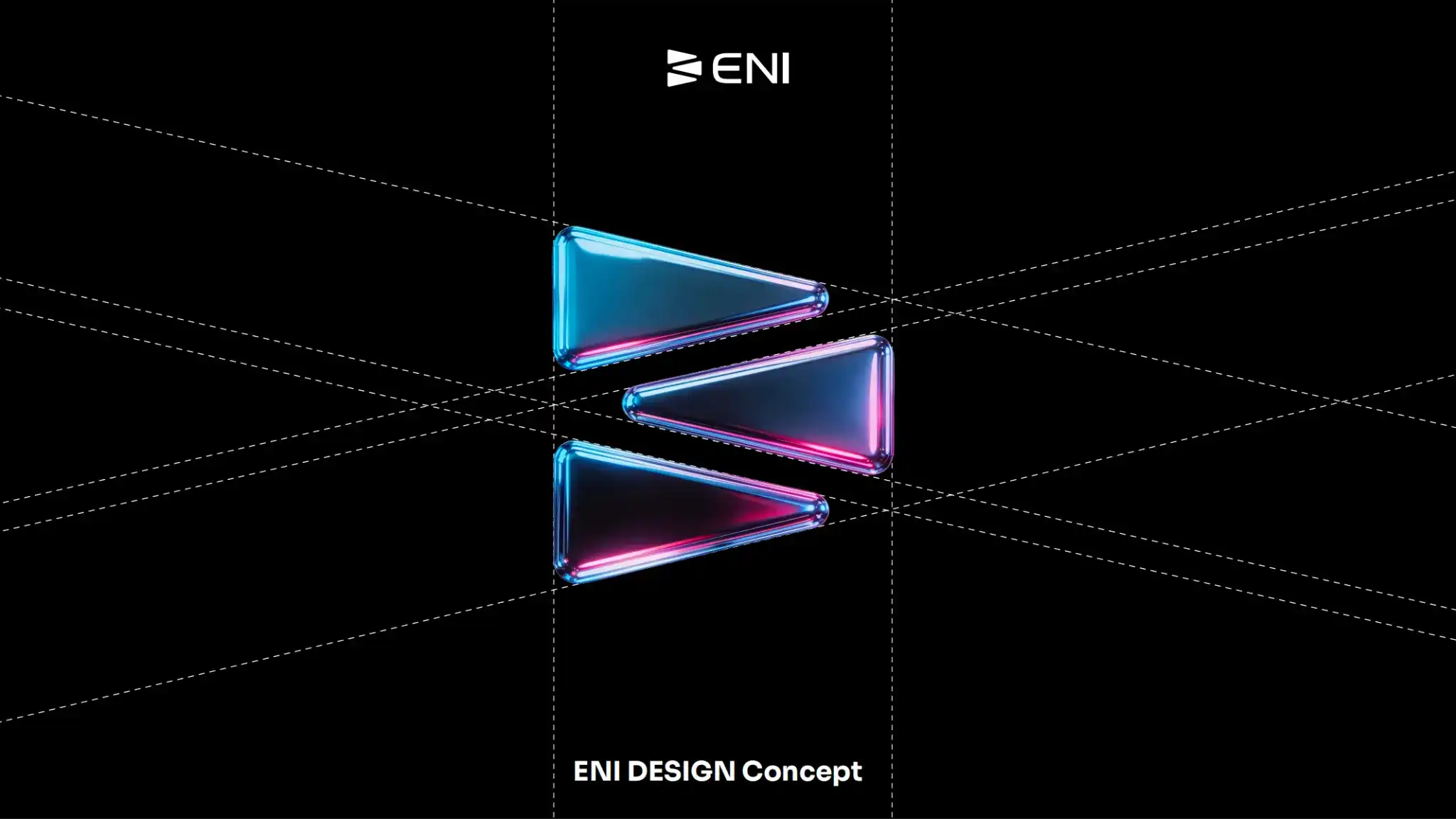
While retaining the basic triangular module, the design team created a more visually proportional symmetrical form by tilting the original straight lines by 25 degrees. The spacing and height between the main elements are strictly fixed at a golden ratio of 1:4. The numerical echo of 25% and the 25-degree angle together form a minimal modular order under advanced aesthetics. This extreme control over proportion and geometric logic is backed by a design team comprising top graduates from Harvard, the University of Pennsylvania, London College of Art, Parsons School of Design, and other prestigious institutions. These multinational talents, who have previously served international brands like Hermès and ByteDance, have infused ENI with an international and trustworthy visual foundation by merging elite global aesthetics with the logic of financial engineering.
From Public Chain to System: Building a Bridge Connecting Technology and Commercial Reality

The core of this transformation lies in ENI moving beyond the realm of a mere "underlying protocol" and evolving toward a comprehensive system standard. Arion emphasized that ENI is not just providing foundational technology but aims to become a bridge—a bridge connecting technological concepts with commercial reality, and a bridge linking traditional finance (TradFi) with Web3.

In practical implementation, ENI adopts differentiated approaches to bridge the gap in business adoption: For large institutions, ENI offers deeply customized architectural solutions, ensuring that Web3 capabilities can be precisely integrated into complex business logic and organizational processes, achieving a leap from point solutions to system-level operational structures; for small and medium-sized enterprises, standardized BaaS matrices and low-loss integration technologies enable "one-click" on-chain deployment and efficient collaboration. This model, which accurately maps to different business scales, is significantly reducing the friction for global enterprises entering Web3, allowing complex commercial realities to seamlessly migrate to efficient on-chain systems.
Global Signal: Leading Web3 Commercialization with a Mature Stance

Announcing the completion of the upgrade in Hong Kong, a financial hub connecting East and West, precisely signals ENI's entry into a globalized and institutionalized phase. As the Web3 industry shifts from technological fervor to commercial implementation, institutional users' requirements for infrastructure have evolved from "usable" to "stable and standardized."

ENI's simultaneous evolution of its brand and visual system is precisely aimed at meeting these institutional-grade standards. Through more logical design language and a comprehensive BaaS matrix, ENI is acting as the chief architect, providing reliable on-chain support for global enterprises. As Arion conveyed in his speech, ENI will serve as the standard bridge for enterprise onboarding, escorting the steady migration of real-world assets and businesses into the next-generation digital economic system.


Domande pertinenti

QWhat major announcement did ENI's founder and CEO Arion Ho make at the Hong Kong Web3 Carnival?

AArion Ho announced that ENI has completed a comprehensive strategic brand upgrade, transitioning from an underlying protocol to a global institutional-grade financial infrastructure, including updates to its official website and visual identity system.

QHow did ENI incorporate mathematical precision into its brand redesign?

AENI's design team applied a 25-degree tilt to the original straight lines, creating a more symmetrical visual form with intervals and heights strictly fixed at a 1:4 golden ratio. The 25-degree angle and 25% numerical echo together form a minimal modular order under advanced aesthetics.

QWhat is ENI's new strategic positioning after the brand upgrade?

AENI has evolved from being an underlying public chain to an enterprise blockchain-as-a-service (BaaS) platform, aiming to serve as a bridge connecting traditional finance (TradFi) with Web3 and enabling businesses to migrate seamlessly to efficient on-chain systems.

QHow does ENI tailor its services for different types of businesses?

AFor large institutions, ENI offers deeply customized architecture solutions to embed Web3 capabilities into complex business logic. For small and medium enterprises, it provides standardized BaaS matrices and low-loss integration technologies for one-click on-chain deployment.

QWhy did ENI choose Hong Kong as the location to announce its brand upgrade?

AHong Kong is a financial hub connecting East and West, making it an ideal location to signal ENI's entry into a new phase of globalization and institutionalization, aligning with the industry's shift from technological enthusiasm to commercial adoption.

Letture associate

AI Relay Stations Spark Heated Debate on Zhihu: Behind Cheap Tokens, What Are Users Really Worried About?

A discussion on Zhihu about "AI relay stations" shifted the niche developer topic of "cheap tokens" into broader user awareness. Users moved beyond simply questioning the legitimacy of these services to focus on practical concerns: Where do cheap tokens truly come from? Is the model being accessed the real one? Can relay stations see prompts, code, and API keys? For occasional users, are the risks worth it? The core debate centered less on price and more on trust. A primary worry is model authenticity—the risk of "model swapping," where users paying for a premium model might be routed to a cheaper one, creating an information asymmetry. Others argued that cost comparisons matter; while cheaper than official pay-as-you-go APIs, relay stations may not be the lowest-cost option versus subscriptions, domestic models, or free tiers, making user needs assessment crucial. Speculation about token sources ranged from legitimate bulk discounts to gray-area methods like account sharing or exploiting regional pricing. This opacity makes risk assessment difficult for users. Data security emerged as a critical concern, especially for enterprise use. When processing sensitive information like code, contracts, or client data, the inability to verify a relay station's data handling, retention, or access policies poses significant compliance and confidentiality risks. The evolving consensus suggests relay stations can be used cautiously for low-sensitivity, disposable tasks (e.g., summarizing public info, simple translation). However, they should not be the default for sensitive, professional, or production workflows involving proprietary data, Agents, or automated systems. Recommendations include avoiding large prepayments, not relying on a single service, using test prompts to monitor quality, anonymizing data where possible, and keeping official channels as backups. Ultimately, the discussion framed tokens not just as a billing unit but as a measure of real cost encompassing price, model integrity, data security, and service stability. The popularity of relay stations highlights user demand for affordable access, but the debate underscores a key trade-off: the savings from cheap tokens may come at the price of trust, transparency, and control over one's data and AI experience.

marsbit17 min fa

AI Relay Stations Spark Heated Debate on Zhihu: Behind Cheap Tokens, What Are Users Really Worried About?

marsbit17 min fa

In-Depth Research Report on TradFi: The Convergence Wave of Crypto and Traditional Finance

In 2026, the crypto industry is undergoing a profound infrastructure-level transformation—TradFi assets are migrating on-chain at an unprecedented pace. According to CoinGecko's Q1 2026 report, the total value locked (TVL) of tokenized real-world assets (RWA) has surpassed $31 billion, a nearly 4x increase from $7.8 billion at the beginning of 2025, with the sector’s aggregate market capitalization reaching $19.3 billion. Among these, the market cap of tokenized stocks surged from $2 million to $486 million, with Q1 spot trading volume reaching $15.1 billion—a single quarter already surpassing the entire second half of 2025. RWA perpetual contract Q1 trading volume reached a staggering $524.8 billion, far exceeding the $313 billion for all of 2025. Meanwhile, BlackRock's BUIDL fund has reached $2.3 billion in scale and has filed for two new tokenized funds, signaling that the world's largest asset manager's tokenization strategy is evolving from pilot to product suite expansion. HTX, as a core participant in the crypto exchange sector, officially launched TradFi perpetual futures products including NVDA, AAPL, MSFT, META, and SPY in 2026, enabling crypto users to gain 24/7 trading access to core U.S. equities. Boston Consulting Group predicts that global tokenized asset scale could reach $16 trillion by 2030, while McKinsey offers a conservative estimate of approximately $2 trillion. The on-chain migration of TradFi assets is no longer a "future narrative" but a structural transformation unfolding in real time, as crypto exchanges evolve from single crypto asset trading platforms toward "multi-asset-class trading infrastructure."

HTX Learn20 min fa

In-Depth Research Report on TradFi: The Convergence Wave of Crypto and Traditional Finance

HTX Learn20 min fa

Blocked Its Own Treasure, WeChat AI Steps Up

Tencent's stock surged over 10% on June 2nd amid reports that WeChat, with 1.43 billion monthly users, is finalizing tests for a native AI Agent. The reported feature, accessible by swiping right from the main interface, allows users to issue commands in natural language. The AI then decomposes tasks and automatically calls upon relevant Mini Programs within WeChat to complete actions like ordering food, booking tickets, or making payments, creating a closed-loop service execution system. This strategic shift follows the internal conflict and subsequent "blocking" of Tencent's standalone AI app, Yuanbao, by WeChat for violating sharing rules during a 2026 Spring Festival promotion. The incident highlighted a lack of internal consensus and exposed the weakness of competing in the standalone AI assistant arena against rivals like ByteDance's Doubao (345M MAU) and Alibaba's Qianwen. The new WeChat AI Agent aims to leverage WeChat's unique assets—its massive user base, standardized Mini Program APIs, WeChat Pay, and identity system—to move from simple content generation to actual task execution. Analysts note this changes the competitive landscape from model benchmarks to which AI can connect to more real-world services. However, success depends on key variables: the capability of Tencent's underlying Hunyuan model, managing massive inference costs, and redesigning incentives for Mini Program developers whose traffic might be bypassed. The move is seen as an attempt to keep user service intent within WeChat's ecosystem as AI begins to redefine how users access services.

marsbit1 h fa

Blocked Its Own Treasure, WeChat AI Steps Up

marsbit1 h fa

ByteDance Adopts Arm CPUs, Jensen Huang: So Sad I Didn't Buy Arm

**Summary:** At Computex 2026, Arm CEO Rene Haas announced that ByteDance and Oracle have adopted Arm's self-designed Arm AGI data center CPU. The company expects significant revenue growth from this product, projecting $20 billion in demand for the 2027/2028 fiscal years. Haas noted that restricting AI-capable CPUs from the US to China is nearly impossible due to their widespread applications. Arm's stock has surged dramatically this year, notably rising 16% after NVIDIA's Arm-based Vera CPU and RTX Spark announcements. A highlight was the informal, humorous on-stage conversation between Haas and NVIDIA CEO Jensen Huang. Huang joked about NVIDIA's failed attempt to acquire Arm and playfully lamented selling his Arm shares. Both executives showed a clear sense of camaraderie and shared regret over the missed merger. Key technical topics were discussed: 1. **AI PC Design:** Huang explained NVIDIA's RTX Spark superchip (with a 20-core Arm CPU) is designed for future AI agents that will autonomously run and use tools on PCs, blending local and cloud processing. 2. **Agent vs. OS:** Huang emphasized the operating system remains crucial, as AI agents rely on its APIs and tools to function. 3. **Growth Constraints:** He identified the shift to "useful AI" that generates profitable tokens as a primary driver for immense, almost limitless, computational demand. Haas outlined Arm's strategy across PC and data centers. For PCs, Arm collaborates with partners like NVIDIA and MediaTek, offering its compute subsystem (CSS) for custom SoCs. In data centers, its Arm AGI CPU (built on TSMC's 3nm process) has gained major partners including OpenAI, Meta, and now ByteDance and Oracle. Arm presented a multi-year roadmap for its in-house CPU line. The article concludes that while GPUs dominated the AI training race, the explosion of AI agents is shifting significant focus to CPUs for inference, state management, and tool orchestration. The industry is trending towards vertical integration, with companies like cloud providers designing chips and chip/IP firms offering full solutions, all competing to deliver more efficient computing per watt.

marsbit1 h fa

ByteDance Adopts Arm CPUs, Jensen Huang: So Sad I Didn't Buy Arm

marsbit1 h fa

Trading

Spot
Futures

Articoli Popolari

Come comprare AR

Benvenuto in HTX.com! Abbiamo reso l'acquisto di Arweave (AR) semplice e conveniente. Segui la nostra guida passo passo per intraprendere il tuo viaggio nel mondo delle criptovalute.Step 1: Crea il tuo Account HTXUsa la tua email o numero di telefono per registrarti il tuo account gratuito su HTX. Vivi un'esperienza facile e sblocca tutte le funzionalità,Crea il mio accountStep 2: Vai in Acquista crypto e seleziona il tuo metodo di pagamentoCarta di credito/debito: utilizza la tua Visa o Mastercard per acquistare immediatamente ArweaveAR.Bilancio: Usa i fondi dal bilancio del tuo account HTX per fare trading senza problemi.Terze parti: abbiamo aggiunto metodi di pagamento molto utilizzati come Google Pay e Apple Pay per maggiore comodità.P2P: Fai trading direttamente con altri utenti HTX.Over-the-Counter (OTC): Offriamo servizi su misura e tassi di cambio competitivi per i trader.Step 3: Conserva Arweave (AR)Dopo aver acquistato Arweave (AR), conserva nel tuo account HTX. In alternativa, puoi inviare tramite trasferimento blockchain o scambiare per altre criptovalute.Step 4: Scambia Arweave (AR)Scambia facilmente Arweave (AR) nel mercato spot di HTX. Accedi al tuo account, seleziona la tua coppia di trading, esegui le tue operazioni e monitora in tempo reale. Offriamo un'esperienza user-friendly sia per chi ha appena iniziato che per i trader più esperti.

641 Totale visualizzazioniPubblicato il 2024.12.11Aggiornato il 2026.06.02

Come comprare AR

Discussioni

Benvenuto nella Community HTX. Qui puoi rimanere informato sugli ultimi sviluppi della piattaforma e accedere ad approfondimenti esperti sul mercato. Le opinioni degli utenti sul prezzo di AR AR sono presentate come di seguito.

活动图片