ENI Officially Announces Completion of Strategic Brand Upgrade: Evolving from Underlying Protocol to Global Institutional-Grade Financial Infrastructure

marsbitPubblicato 2026-04-22Pubblicato ultima volta 2026-04-22

Introduzione

ENI Announces Strategic Brand Upgrade: Evolving from Underlying Protocol to Global Institutional-Grade Financial Infrastructure At the Hong Kong Web3 Festival on April 20, 2026, ENI founder and CEO Arion Ho announced the completion of a comprehensive brand, website, and visual system upgrade. This marks a significant shift from being an "underlying public chain" to an enterprise-grade Blockchain-as-a-Service (BaaS) platform, positioning ENI as a key infrastructure provider bridging traditional finance (TradFi) and Web3. The rebranding emphasizes precision and professionalism, reflected in a refined visual identity featuring a 25-degree tilt and a 1:4 golden ratio in its design elements. This aesthetic upgrade, led by a top-tier design team with experience from Hermès and ByteDance, underscores ENI’s commitment to institutional-grade trust and global sophistication. ENI now functions as a bridge between technological innovation and real-world business applications. It offers tailored architecture solutions for large institutions and standardized, low-friction BaaS tools for SMEs, enabling seamless integration of Web3 capabilities into existing business models. The announcement in Hong Kong, a global financial hub, signals ENI’s matured, global-ready approach to supporting the commercial adoption of Web3. By providing a stable, standardized platform, ENI aims to facilitate the secure migration of real-world assets and operations into the digital economy.

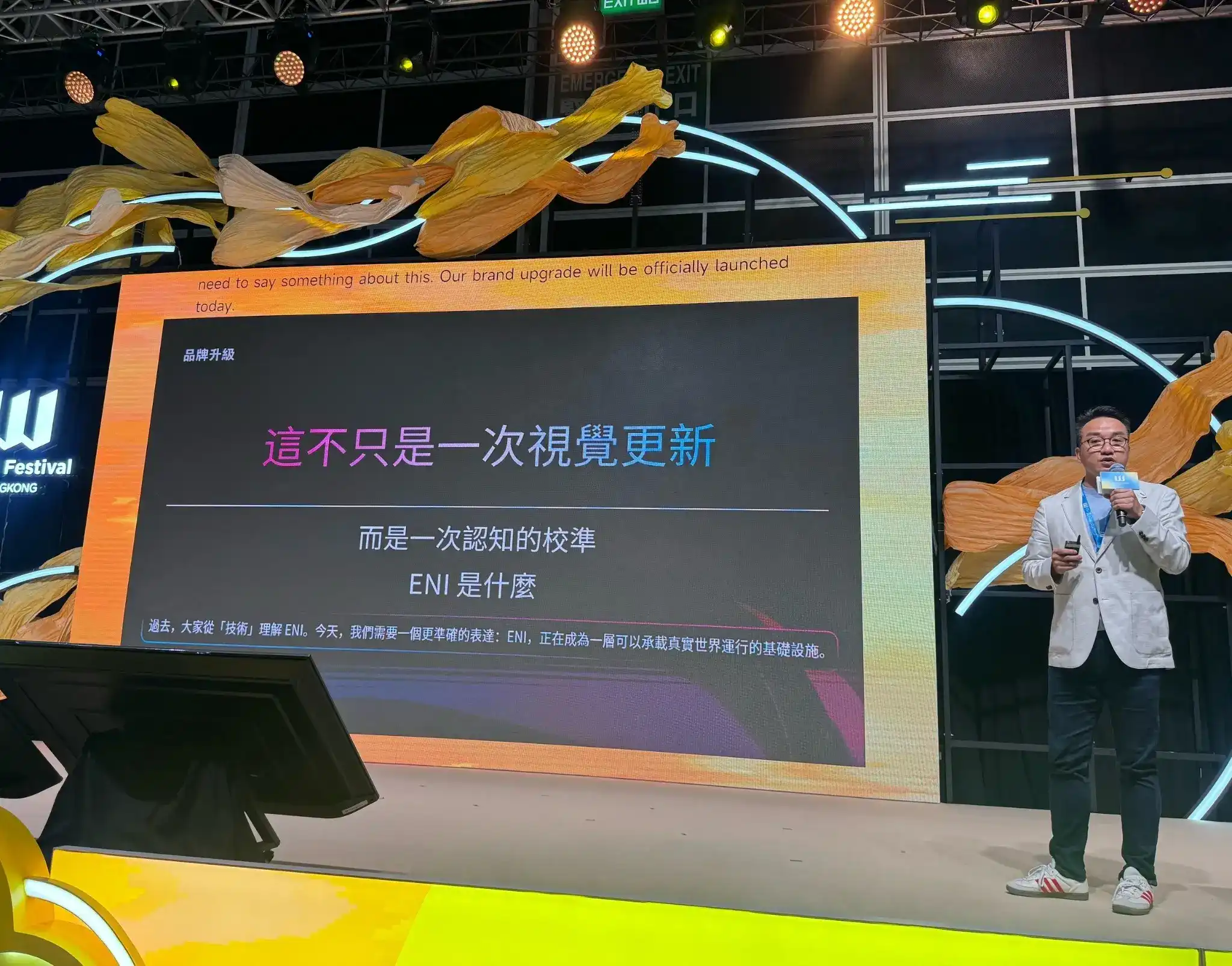
On April 20, 2026, at the Hong Kong Web3 Carnival venue, ENI founder and CEO Arion Ho delivered a keynote speech titled "Bridging Traditional Finance and Web3: Building the Infrastructure for the Real-World Financial System." During the speech, Arion officially announced that ENI has comprehensively completed the simultaneous update of its brand, official website, and visual system. This is not merely an aesthetic leap but also a milestone signaling ENI's transition from an "underlying technology public chain" to a "Blockchain-as-a-Service (BaaS) platform for enterprise onboarding." It signifies that ENI is redefining its role in the next phase of Web3 commercialization in a more mature and globalized manner.

The Beauty of Mathematics: Defining "Precision in Fine-Tuning" with a 25-Degree Obsession

In this brand upgrade, ENI exemplifies what it means to achieve "precision through fine-tuning." For infrastructure projects pursuing "institutional-grade" trust, this precision is not only a visual requirement but also the foundation of professionalism.

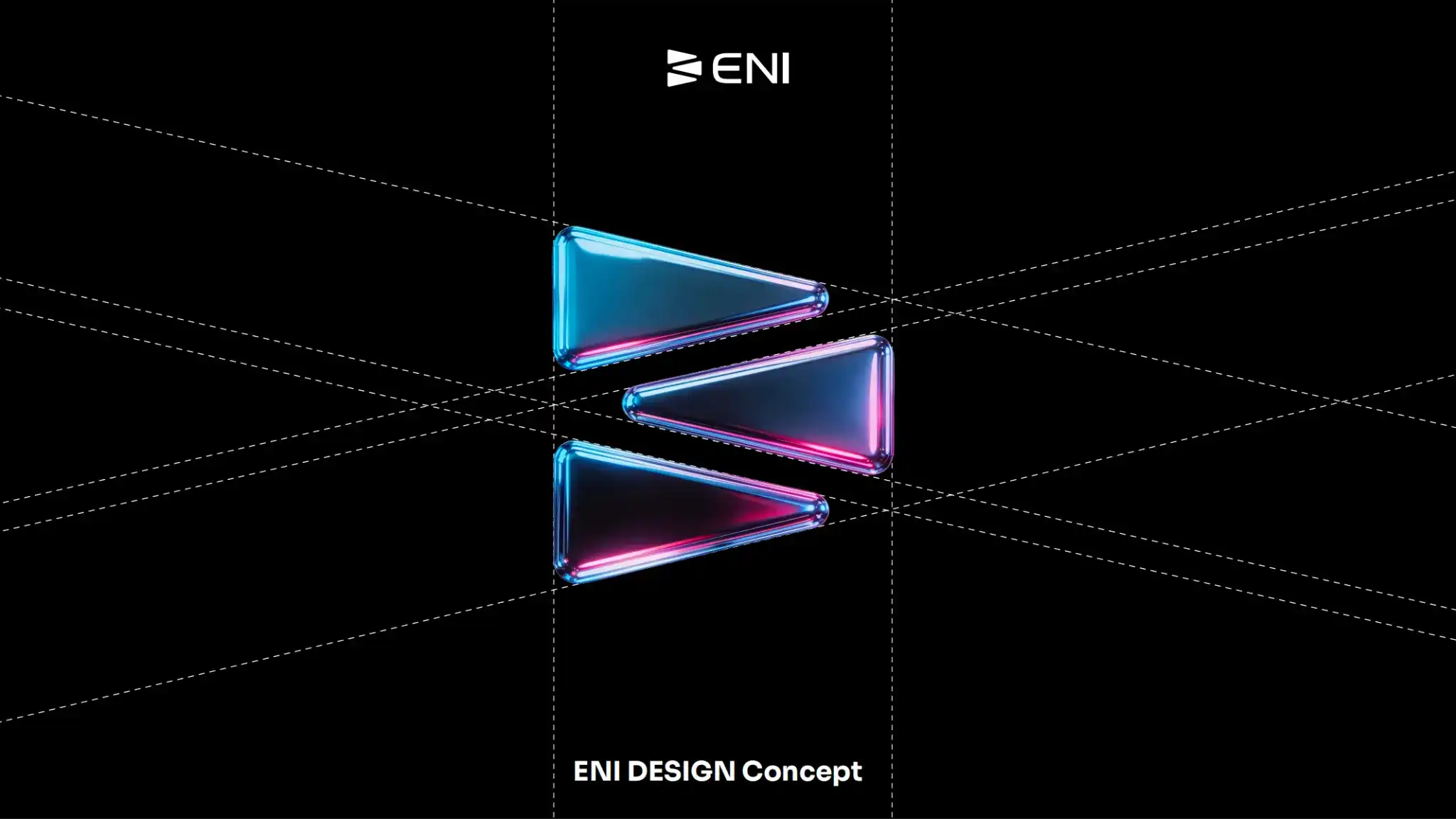
While retaining the basic triangular module, the design team created a more visually proportional symmetrical form by tilting the original straight lines by 25 degrees. The spacing and height between the main elements are strictly fixed at a golden ratio of 1:4. The numerical echo of 25% and the 25-degree angle together form a minimal modular order under advanced aesthetics. This extreme control over proportion and geometric logic is backed by a design team comprising top graduates from Harvard, the University of Pennsylvania, London College of Art, Parsons School of Design, and other prestigious institutions. These multinational talents, who have previously served international brands like Hermès and ByteDance, have infused ENI with an international and trustworthy visual foundation by merging elite global aesthetics with the logic of financial engineering.
From Public Chain to System: Building a Bridge Connecting Technology and Commercial Reality

The core of this transformation lies in ENI moving beyond the realm of a mere "underlying protocol" and evolving toward a comprehensive system standard. Arion emphasized that ENI is not just providing foundational technology but aims to become a bridge—a bridge connecting technological concepts with commercial reality, and a bridge linking traditional finance (TradFi) with Web3.

In practical implementation, ENI adopts differentiated approaches to bridge the gap in business adoption: For large institutions, ENI offers deeply customized architectural solutions, ensuring that Web3 capabilities can be precisely integrated into complex business logic and organizational processes, achieving a leap from point solutions to system-level operational structures; for small and medium-sized enterprises, standardized BaaS matrices and low-loss integration technologies enable "one-click" on-chain deployment and efficient collaboration. This model, which accurately maps to different business scales, is significantly reducing the friction for global enterprises entering Web3, allowing complex commercial realities to seamlessly migrate to efficient on-chain systems.
Global Signal: Leading Web3 Commercialization with a Mature Stance

Announcing the completion of the upgrade in Hong Kong, a financial hub connecting East and West, precisely signals ENI's entry into a globalized and institutionalized phase. As the Web3 industry shifts from technological fervor to commercial implementation, institutional users' requirements for infrastructure have evolved from "usable" to "stable and standardized."

ENI's simultaneous evolution of its brand and visual system is precisely aimed at meeting these institutional-grade standards. Through more logical design language and a comprehensive BaaS matrix, ENI is acting as the chief architect, providing reliable on-chain support for global enterprises. As Arion conveyed in his speech, ENI will serve as the standard bridge for enterprise onboarding, escorting the steady migration of real-world assets and businesses into the next-generation digital economic system.


Crypto di tendenza

Domande pertinenti

QWhat major announcement did ENI's founder and CEO Arion Ho make at the Hong Kong Web3 Carnival?

AArion Ho announced that ENI has completed a comprehensive strategic brand upgrade, transitioning from an underlying protocol to a global institutional-grade financial infrastructure, including updates to its official website and visual identity system.

QHow did ENI incorporate mathematical precision into its brand redesign?

AENI's design team applied a 25-degree tilt to the original straight lines, creating a more symmetrical visual form with intervals and heights strictly fixed at a 1:4 golden ratio. The 25-degree angle and 25% numerical echo together form a minimal modular order under advanced aesthetics.

QWhat is ENI's new strategic positioning after the brand upgrade?

AENI has evolved from being an underlying public chain to an enterprise blockchain-as-a-service (BaaS) platform, aiming to serve as a bridge connecting traditional finance (TradFi) with Web3 and enabling businesses to migrate seamlessly to efficient on-chain systems.

QHow does ENI tailor its services for different types of businesses?

AFor large institutions, ENI offers deeply customized architecture solutions to embed Web3 capabilities into complex business logic. For small and medium enterprises, it provides standardized BaaS matrices and low-loss integration technologies for one-click on-chain deployment.

QWhy did ENI choose Hong Kong as the location to announce its brand upgrade?

AHong Kong is a financial hub connecting East and West, making it an ideal location to signal ENI's entry into a new phase of globalization and institutionalization, aligning with the industry's shift from technological enthusiasm to commercial adoption.

Letture associate

Global Stock Market's Storm Center: South Korea's Stock Market De-leveraging Is Largely Complete

Storm's Eye: South Korean Market De-leveraging Nears Completion The recent sharp correction in South Korean equities, with the KOSPI index dropping 32% from its June high, has been a key trigger for global tech stock volatility. The core driver was not a fundamental shift but a forced de-leveraging process within the market's unique structure, which is now largely complete. Two main leverage channels amplified the sell-off: 1. **Leveraged ETFs:** Their size, proportionally four times larger than in the U.S., peaked near $50 billion. Their mandatory daily rebalancing mechanism created a vicious cycle of "price drop → forced selling → further drop." Approximately 75% of this excess has been unwound, shrinking to $26 billion, with regulatory curbs now blocking new inflows. 2. **Hedge Fund Leverage:** Using swaps to magnify exposure, hedge funds saw their net long positioning fall by over 50% from peak levels. The most intense phase of this institutional de-leveraging is over. In contrast, **retail margin debt** poses minimal systemic risk. At 0.5% of market cap, it is far lower than in the U.S. or China, lacks automatic triggers, and is concentrated in smaller stocks. The conclusion: the high-leverage structures most prone to "chain-reaction selling" have been substantially cleared. The market is transitioning from a liquidity-driven crash to one priced more on fundamentals. The article argues that the AI trend—centered on Korean memory chips—remains intact. This episode represents a painful but necessary clearing of crowded trades, not the end of the AI revolution. For investors, the key question is conviction in the long-term AI direction; if the trend is real, current volatility is a cost of entry, not a terminal risk.

链捕手1 h fa

Global Stock Market's Storm Center: South Korea's Stock Market De-leveraging Is Largely Complete

链捕手1 h fa

The Eternal Fragments of Money: Third-Party Payment Has No First Principle

"The Enduring Fragments of Money: Third-Party Payments Lack a First Principle" Stripe is reportedly attempting to acquire PayPal, marking a significant shift reminiscent of PayPal's merger with the original X.com 30 years ago. The article analyzes Stripe's strategic challenges and the broader payments industry landscape. Despite its initial success with a developer-friendly API model, Stripe missed its optimal IPO window during the pandemic and has since seen its valuation decline. Its attempts to expand through acquisitions and new ventures, particularly in stablecoins (like its OUSD project) and Agent-focused payments (ACP/MPP protocols), have faced headwinds. The author argues that the payment industry remains highly fragmented and is ultimately an adjunct to the traditional banking system. This structure limits the potential for any single player, including Stripe, to achieve complete dominance. While stablecoins and the future rise of autonomous Agent economies present potential growth avenues, they are not yet mainstream and still require integration with the existing financial system. For now, Agent-based transactions are largely used for speculative "volume boosting" rather than substantive business applications. Stripe's current move to acquire PayPal is seen as an attempt to bolster its weak consumer-facing (C-side) business after its stablecoin-focused strategies faltered. Meanwhile, PayPal is described as structurally outdated, unable to revive itself through new products like Venmo or PYUSD. The future of payments may lie not in payments themselves but in value-added services like more efficient settlement networks. The author suggests that companies like Stripe and Circle, which are building their own blockchains (Tempo, Arc) and stablecoins, are positioning themselves to eventually profit from high-efficiency settlement systems. These new networks could potentially bypass some traditional banking layers. In conclusion, the article posits that third-party payment is a perpetually fragmented battlefield where scale alone cannot ensure victory. Players must find new models, focusing on efficiency to compete with the entrenched banking system. Stripe's acquisition of PayPal represents a bet on this uncertain future.

链捕手1 h fa

The Eternal Fragments of Money: Third-Party Payment Has No First Principle

链捕手1 h fa

Trading

Spot

Articoli Popolari

Come comprare AR

Benvenuto in HTX.com! Abbiamo reso l'acquisto di Arweave (AR) semplice e conveniente. Segui la nostra guida passo passo per intraprendere il tuo viaggio nel mondo delle criptovalute.Step 1: Crea il tuo Account HTXUsa la tua email o numero di telefono per registrarti il tuo account gratuito su HTX. Vivi un'esperienza facile e sblocca tutte le funzionalità,Crea il mio accountStep 2: Vai in Acquista crypto e seleziona il tuo metodo di pagamentoCarta di credito/debito: utilizza la tua Visa o Mastercard per acquistare immediatamente ArweaveAR.Bilancio: Usa i fondi dal bilancio del tuo account HTX per fare trading senza problemi.Terze parti: abbiamo aggiunto metodi di pagamento molto utilizzati come Google Pay e Apple Pay per maggiore comodità.P2P: Fai trading direttamente con altri utenti HTX.Over-the-Counter (OTC): Offriamo servizi su misura e tassi di cambio competitivi per i trader.Step 3: Conserva Arweave (AR)Dopo aver acquistato Arweave (AR), conserva nel tuo account HTX. In alternativa, puoi inviare tramite trasferimento blockchain o scambiare per altre criptovalute.Step 4: Scambia Arweave (AR)Scambia facilmente Arweave (AR) nel mercato spot di HTX. Accedi al tuo account, seleziona la tua coppia di trading, esegui le tue operazioni e monitora in tempo reale. Offriamo un'esperienza user-friendly sia per chi ha appena iniziato che per i trader più esperti.

670 Totale visualizzazioniPubblicato il 2024.12.11Aggiornato il 2026.06.02

Come comprare AR

Discussioni

Benvenuto nella Community HTX. Qui puoi rimanere informato sugli ultimi sviluppi della piattaforma e accedere ad approfondimenti esperti sul mercato. Le opinioni degli utenti sul prezzo di AR AR sono presentate come di seguito.

活动图片












