Ending 'Subsidized Growth': The Logic of Ultimate Capital Efficiency Behind Berachain's 'Fiscal' Reform

marsbitPubblicato 2026-03-10Pubblicato ultima volta 2026-03-10

Introduzione

Berachain has implemented a major reform of its Proof-of-Liquidity (PoL) mechanism, reducing the annual inflation rate of its non-transferable governance token $BGT from 8% to 5%—a 46% cut in emissions. This move, described as a "fiscal reform," signals the end of the initial subsidy-driven growth phase and a shift toward a more capital-efficient economic model. The update also involves removing around 200 underperforming reward vaults and introducing stricter, performance-based criteria for vault eligibility. Key tokens in the PoL system include $BERA (gas token), $HONEY (native stablecoin), and $BGT (governance token). The reforms aim to enhance the value and utility of $BGT by directing incentives toward protocols that demonstrate real user activity, sustainable demand, and measurable contributions to the ecosystem—such as boosting transaction volume or deepening liquidity. This restructuring is designed to prioritize quality over quantity, encouraging projects with stronger product-market fit and business models. By making $BGT emissions more scarce and targeted, Berachain aims to build a self-sustaining economy where incentives function as productive capital rather than subsidies, ultimately supporting long-term growth and value creation for token holders.

Author: Black Mario

Recently, Berachain's PoL mechanism underwent a reform, reducing the annual inflation rate of $BGT from 8% to 5% (an active cut of approximately 46% in emissions), while clearing a series of "ghost vaults" and updating the vault access standards. This move has been hailed by the community as a sovereign fiscal reform.

This seems to signal that Berachain is officially ending the subsidy era of its cold start, and through ultimate "capital efficiency" and a "business closed-loop," it is beginning to build a mature economic system with higher ROI certainty.

The Logical Evolution from Cold Start Strategy to Sovereign Value Return

In traditional PoS systems, security is directly tied to the scale of staking, and "staking coins equals participation in governance" is the core logic. Focusing on the PoL (Proof-of-Liquidity) mechanism itself, it is a highly complex financial engineering design that binds network security, governance power, and ecological liquidity together with liquidity as the core element, attempting to redefine the internal power distribution and incentive flow within a public chain.

The operation of the PoL system relies on three types of tokens with clear functions and mutual checks and balances.

  • $BERA (Fuel Base): The operating fuel of the system, carrying basic security functions, is the asset foundation of the entire Berachain.
  • $HONEY (Value Scale): An over-collateralized native stablecoin, serving as the financial settlement medium within the ecosystem, ensuring the stability of on-chain economic activities.
  • $BGT (Governance Hub): As a non-transferable soul-bound token, $BGT is the soul of the PoL system. It deeply binds governance rights with "real ecological contributions." Holding and delegating $BGT means mastering the distribution rights of network incentive routing.

Validators, by receiving delegated $BGT, can dynamically influence which Reward Vaults the incentives flow to. This is not only a symbol of power but also the most critical value lever in Berachain's sovereign economic system.

In the early stages of the mainnet launch, Berachain adopted a high inflation model of approximately 8%–10%. As a typical cold start strategy, it successfully achieved primitive accumulation of liquidity in the short term and verified the实战 resilience of the PoL mechanism.

However, as the ecosystem matures, some potential issues have emerged:

  • The high-yield environment in the early stage attracted a large amount of highly sensitive capital. While this capital completed the task of attracting funds during the cold start phase, its contribution to long-term retention and commercial co-building still has room for optimization.
  • Some vaults in the ecosystem are operating inefficiently, and there are even some self-circulating distribution paths. This, to some extent, disperses the precious $BGT budget and fails to fully transform into long-term stickiness of the ecosystem.
  • Sustained high emission rates have somewhat affected the marginal value of $BGT as a sovereign asset. For long-term builders, optimizing the inflation structure is an inevitable choice to protect their long-term rights and enhance the network's risk resistance.

If the PoL incentive mechanism eventually evolves into a pure operating cost, no matter how good the short-term data looks, the long-term value of the entire ecosystem will face limitations. Incentives should not be just subsidies, nor should they be indiscriminate airdrops. Instead, they should be regarded as productive capital capable of generating ROI. Every unit of $BGT emission should be exchanged for sustainable transactions, user retention, and real cash flow potential. This is perhaps the true meaning behind the slogan "Bera Builds Businesses."

Under this consensus, this reform aimed at "eliminating the false and retaining the true" and重构 sovereign fiscal efficiency officially kicked off at the beginning of the new year 2026.

Berachain's "Fiscal" Reform

$BGT Emission Optimization: Anchoring the Long-Term Value Coordinates of the Ecosystem

In fact, in any mature economy, adjustments in monetary policy often signal a qualitative change in the growth logic. Berachain's reduction of the annual $BGT inflation rate from about 8% to 5% is essentially a key step towards "value sovereignty."
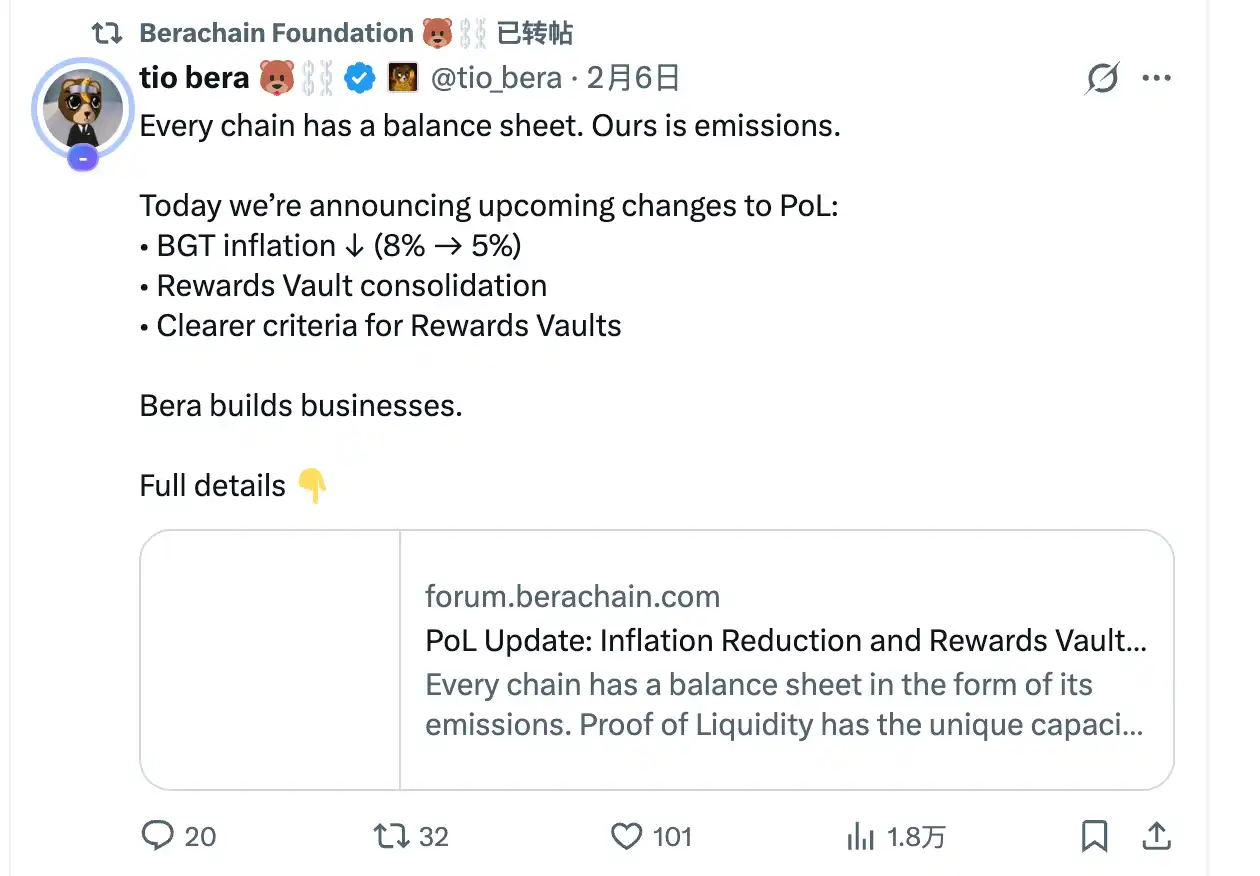
We see that the earlier 8% inflation rate was more like an "expansionary credit" for the ecosystem's startup phase, successfully completing the primitive accumulation of liquidity in the short term. Now, reducing PoL-related emissions by approximately 46% (reward rate reduced from 1.2 to 0.65) not only reflects its precise control over the current ecosystem's carrying capacity and incentive efficiency but also embodies a refinement of liquidity management:

That is, while maintaining the stability of the network security base rate, by moderately tightening new emissions, ensuring that every $BGT injected into the ecosystem gains a higher value anchor.

For $BGT, a governance asset with the attributes of a soul-bound token, scarcity is the core pillar for exercising its引流 power. As the emission rate slows, the marginal dilution pressure faced by holders and delegators is significantly reduced. This "active balance sheet reduction" directly strengthens the hard currency属性 of $BGT as a core governance asset, further promoting the rebalancing of value capture:

Of course, if we observe the development paths of Ethereum or various top L1s, a steady decline in the inflation rate is often the entry ticket to the "golden maturity period." Berachain's turn at this moment actually sends a clear signal that the ecosystem has already achieved stability driven by "endogenous growth" and no longer relies solely on scale expansion.

Then, as the total incentive becomes more precious, protocols within the ecosystem will spontaneously initiate an efficiency competition.

This "tight" incentive budget is actually creating higher溢价 space for high-quality protocols. Under the new economic model, $BGT emission rights will flow more to those "high-productivity protocols" that can generate real interactions and have a deep user base.

Reward Vault Integration—Ecological Value Sedimentation from "Scale Expansion" to "Quality and Depth"

If inflation reduction is a "balance sheet reduction" at the macro level, then the further integration of reward vaults is a precise drip irrigation targeting micro-efficiency within the ecosystem.

The Berachain Foundation stated in its latest tweet that the ecosystem plans to remove about 200 reward vaults with low operational efficiency. Of course, the plan itself is not simply a negation of early projects but more of a resource rebalancing expected after the Berachain ecosystem enters a specific stage.

In fact, during the cold start phase, a wide distribution of vaults helps探测 different market demands. When the ecosystem enters maturity, withdrawing incentive resources from长期闲置 or functionally overlapping pools and re-injecting them into core protocols with real trading activity is an inevitable choice to enhance the network's overall competitiveness.

Similarly, with the integration, Berachain immediately enacted more rigorous and dynamic vault access standards. This means that future incentive distribution will no longer be based on the first-come-first-served inertia of the early days but will更多的是 based on a multi-dimensional KPI evaluation system. Some potential standards may include:

  • Sustained Demand: Examining whether the protocol has generated real transaction volume and user interaction, not just static沉淀 of funds.
  • External Incentive Coordination: Encouraging protocol parties to use their own resources and external financing to form a synergy with $BGT emissions, jointly energizing the ecosystem.
  • Verifiable Contribution: Every unit of incentive emission must be transformed into an observable network effect, such as the depth of $HONEY liquidity or the value回流 of transaction fees.

By clearing some self-circulating or inefficient incentive paths, Berachain is actually making room for growth for teams with real product strength. This process of "discarding the dross and selecting the essential" aims to end models that rely solely on system subsidies for survival,转而扶持 business entities with independent profitability capabilities.

This is also perhaps the embodiment of the "Bera Builds Businesses" vision: the incentive mechanism is no longer an indiscriminate温床 but a precise capital accelerator. Projects筛选ed through this mechanism will have stronger risk resistance and commercial value, thereby providing $BGT holders with more确定性 value support in the fierce L1 competition.

Evolution is the Only Way Out

This major reform of Berachain's PoL marks the ecosystem's official paradigm shift towards a "mature L1 with real output." By optimizing emission efficiency, the ecosystem is彻底重构 $BGT emissions into productive capital with ROI certainty. While pushing the network towards the ultimate capital efficiency interval, it is also anchoring a more solid value signal for $BGT and $BERA holders.

Under the new pilot mechanism, incentives are endowed with precise引流 properties: every unit of injected liquidity will激发超额 real transaction fees, interest income, or ecological溢价 at the protocol layer, thereby constructing a positive value closed-loop of "incentive cost < protocol收益".

This "1 > 1 capital alchemy" is a public chain-level active asset management system,正在 transforming every bit of inflation into KPIs that drive commercial prosperity, fundamentally locking in the return of Berachain's long-term sovereign value, and establishing a leading position towards real economic growth and business闭环 in the highly homogeneous L1 track.

Thus, "Bera Builds Businesses" is also transforming from a grand narrative into a precise financial engine.


Crypto di tendenza

Domande pertinenti

QWhat is the core change in Berachain's PoL mechanism as described in the article?

AThe core change is a reduction in the annual inflation rate of $BGT from 8% to 5%, which is an active cut of approximately 46% in emissions.

QWhat are the three tokens in the PoL system and their primary functions?

AThe three tokens are: $BERA (the gas token and base for security), $HONEY (an over-collateralized native stablecoin for financial settlement), and $BGT (a non-transferable soulbound token that serves as the governance hub, binding governance power to 'real contributions' to the ecosystem).

QWhat was the main purpose of the high inflation model (8-10%) used by Berachain at its mainnet launch?

AIt was a cold-start strategy designed to achieve the primitive accumulation of liquidity in the short term and validate the practical resilience of the PoL mechanism.

QWhat are some of the new potential criteria for a vault to gain access to incentives after the reform?

APotential criteria include: Sustainable Demand (real transaction volume and user interaction), Coordination with External Incentives (using the protocol's own resources and external financing alongside $BGT emissions), and Verifiable Contribution (converting each unit of incentive into observable network effects like $HONEY liquidity depth or fee value回流).

QHow does the article characterize the ultimate goal of Berachain's incentive mechanism after this reform?

AThe goal is to transform the incentive mechanism from a blanket subsidy into a precise capital accelerator, ensuring every unit of $BGT emission is productive capital with a high certainty of ROI, ultimately building a positive value closed-loop where 'incentive cost

Letture associate

Agent Race Ends, Super Workbench Takes Over

The era of fragmented AI agents is ending. Over the past month, China's tech giants—Tencent, Alibaba, and ByteDance—have simultaneously shifted strategy: instead of launching new, standalone AI agents, they are consolidating their various agent projects into unified "super workbenches." Tencent integrated its QClaw teams into WorkBuddy, a strategic product hailed as a potential third flagship after QQ and WeChat. Alibaba is merging its QoderWork, Wukong, and MuleRun agents into a new "Qianwen Office" platform under DingTalk's leadership. ByteDance rebranded its TRAE SOLO coding agent to TRAE Work, signaling a broader focus on workflow collaboration. This convergence marks a pivotal industry consensus. The initial exploration phase, where companies rapidly built numerous overlapping agents for different scenarios, proved costly and inefficient. With open-source tools eroding technical barriers, competition has shifted from agent creation to resource consolidation and cost control. Historically, platform wars are won not by creating more products, but by simplifying them—as seen with browsers unifying web access and super-apps consolidating services. Now, the "super workbench" aims to become the unified AI entry point for work. This reflects a deeper market realization: the primary audience for AI is no longer just programmers (a market in the tens of millions) but all knowledge workers (a market of billions). The real opportunity lies in augmenting everyday tasks—managing emails, documents, data, and meetings—across the entire workday. The core battleground is becoming control over the primary AI entry point that employees use daily. Tencent's WorkBuddy leverages WeChat and Tencent Docs; Alibaba's Qianwen Office taps into DingTalk's organizational data; ByteDance's TRAE Work integrates with Feishu's workflows. Whoever owns this "super workbench" gains strategic control over orchestrating enterprise data and APIs. This shift is redefining enterprise software. Traditional SaaS applications, valued for their user interfaces, will recede into the background. Their core functionalities will be exposed as standardized "Skills" or APIs for the super workbench's agents to invoke. Software value will shift from selling user seats to charging based on API calls and outcomes delivered. The evolution of agents is moving through clear stages: first as novel standalone products, then as consolidated primary work entry points, and finally as pervasive, invisible capabilities embedded into the digital fabric. The recent moves by major tech firms signal the transition from the first stage into the second, accelerating toward the third. In the end, the most successful agent technology may become invisible—like electricity or the HTTP protocol—a fundamental, unnamed infrastructure powering work itself.

marsbit6 min fa

Agent Race Ends, Super Workbench Takes Over

marsbit6 min fa

Michael Saylor: 110 Reasons to Oppose BIP-110

Michael Saylor presents 110 arguments against Bitcoin Improvement Proposal (BIP) 110, a soft fork aimed at restricting certain non-monetary data storage uses (like inscriptions) on the Bitcoin blockchain. He acknowledges the proponents' valid concerns—such as node costs, fee pressure, and preserving Bitcoin's monetary focus—but fundamentally disagrees with the proposed solution. Saylor argues that BIP 110 represents a dangerous precedent of using consensus rules to enforce value judgments on transaction validity, moving away from Bitcoin's core principles of neutrality and permissionless innovation. His key objections are organized into eleven categories: 1) It violates neutrality and hard consensus by banning currently valid transactions. 2) It fails to meet the high burden of proof required for a consensus change, lacking concrete data on the alleged crisis. 3) Its seven bundled technical restrictions are overly broad, targeting generic script functionalities and blocking future upgrade paths. 4) It sacrifices compatibility and future optionality by closing off designed upgrade hooks. 5) Its temporary rules add significant complexity (grandfathering, expiry states) without sufficient justification. 6) The economic and security impacts, particularly on miner revenue and fee markets, are uncertain and unmodeled. 7) Superior, market-based tools (fee markets, relay/mining policies) already exist to manage blockchain load. 8) It stifles innovation by creating a chilling effect for developers. 9) Its modified activation mechanism (55% threshold, forced signaling) is aggressive and risks network splits. 10) The precedent it sets—using consensus to suppress disliked but legal uses—is more dangerous than the problem it aims to solve. 11) A better path exists: improving measurements, refining resource-based policies, and allowing market forces to work. Saylor concludes that Bitcoin's strength lies in its neutral rules, open markets, and hard consensus. Changing these foundational elements to target specific use cases is an unnecessary and risky "iatrogenic" intervention. He advocates for guarding Bitcoin's neutrality rather than acting as its redeemer.

marsbit22 min fa

Michael Saylor: 110 Reasons to Oppose BIP-110

marsbit22 min fa

Trading

Spot

Articoli Popolari

Come comprare POL

Benvenuto in HTX.com! Abbiamo reso l'acquisto di Polygon Ecosystem Token (POL) semplice e conveniente. Segui la nostra guida passo passo per intraprendere il tuo viaggio nel mondo delle criptovalute.Step 1: Crea il tuo Account HTXUsa la tua email o numero di telefono per registrarti il tuo account gratuito su HTX. Vivi un'esperienza facile e sblocca tutte le funzionalità,Crea il mio accountStep 2: Vai in Acquista crypto e seleziona il tuo metodo di pagamentoCarta di credito/debito: utilizza la tua Visa o Mastercard per acquistare immediatamente Polygon Ecosystem TokenPOL.Bilancio: Usa i fondi dal bilancio del tuo account HTX per fare trading senza problemi.Terze parti: abbiamo aggiunto metodi di pagamento molto utilizzati come Google Pay e Apple Pay per maggiore comodità.P2P: Fai trading direttamente con altri utenti HTX.Over-the-Counter (OTC): Offriamo servizi su misura e tassi di cambio competitivi per i trader.Step 3: Conserva Polygon Ecosystem Token (POL)Dopo aver acquistato Polygon Ecosystem Token (POL), conserva nel tuo account HTX. In alternativa, puoi inviare tramite trasferimento blockchain o scambiare per altre criptovalute.Step 4: Scambia Polygon Ecosystem Token (POL)Scambia facilmente Polygon Ecosystem Token (POL) nel mercato spot di HTX. Accedi al tuo account, seleziona la tua coppia di trading, esegui le tue operazioni e monitora in tempo reale. Offriamo un'esperienza user-friendly sia per chi ha appena iniziato che per i trader più esperti.

260 Totale visualizzazioniPubblicato il 2024.12.11Aggiornato il 2026.06.02

Come comprare POL

Discussioni

Benvenuto nella Community HTX. Qui puoi rimanere informato sugli ultimi sviluppi della piattaforma e accedere ad approfondimenti esperti sul mercato. Le opinioni degli utenti sul prezzo di POL POL sono presentate come di seguito.

活动图片