End Of Bitcoin Distribution? Key Data Reveals A Shift In LTH Behavior

bitcoinistPubblicato 2025-12-31Pubblicato ultima volta 2025-12-31

Introduzione

Bitcoin is trading below $90,000 amid deteriorating market sentiment, with analysts warning of a potential bear market. However, on-chain data suggests a shift in long-term holder (LTH) behavior. While social media narratives claim LTHs are distributing Bitcoin at record levels, analysis shows that recent large transfers—including 800,000 BTC moved from Coinbase—skewed the data. After adjusting for this anomaly, LTH supply appears to be stabilizing or even recovering, with a reduction in selling pressure. This shift, combined with short-term holders holding positions, indicates easing sell-side pressure. Bitcoin is currently consolidating around $88K, just above the 200-day moving average—a key support level. A break below could expose the $75K–$80K range, but the current data challenges the dominant bearish narrative and may signal a move toward market balance.

Bitcoin continues to trade below the $90,000 level, struggling to regain bullish momentum as market sentiment deteriorates. A growing number of analysts are now openly calling for a broader bear market, pointing to persistent weakness, failed breakouts, and declining risk appetite across crypto. Despite this gloomy backdrop, not all market participants are convinced that Bitcoin’s next major move will be lower.

Some investors remain focused on 2026, arguing that structural conditions could begin to shift in the coming months. One of the key debates centers on long-term holders (LTHs). While social media narratives increasingly claim that LTHs are distributing Bitcoin at record levels, on-chain data suggests a more nuanced reality.

According to a report by analyst Darkfost, much of the perceived LTH selling has been distorted by large, isolated movements—particularly nearly 800,000 BTC transferred from Coinbase—which skewed traditional LTH metrics.
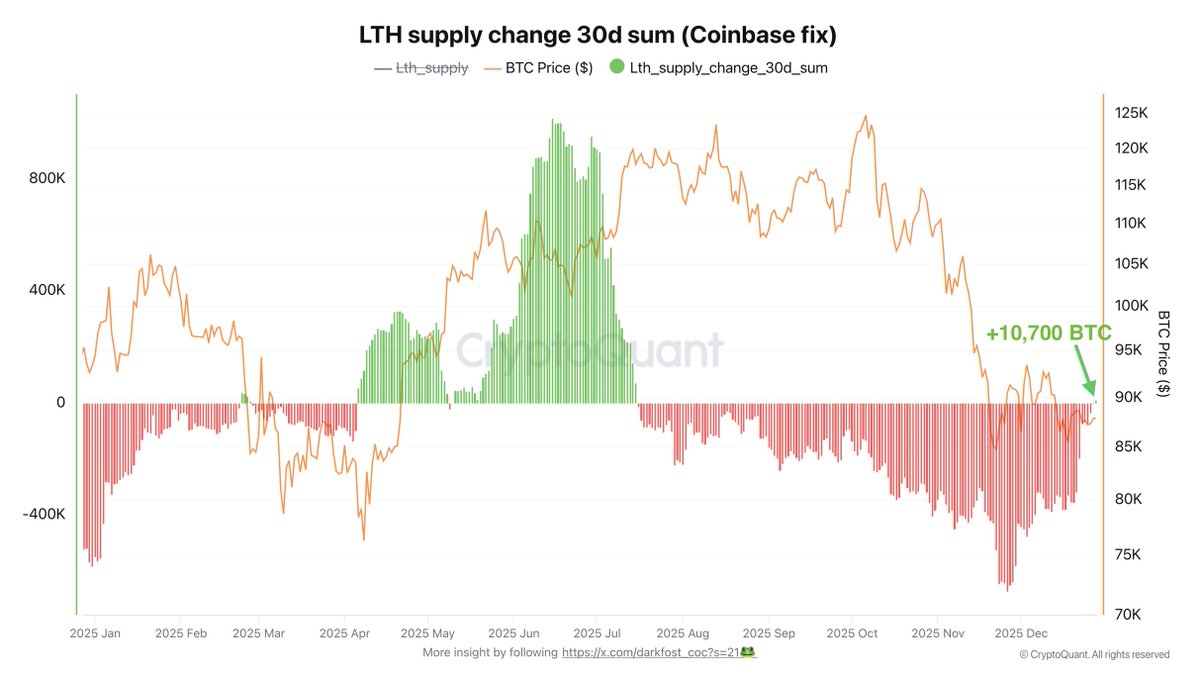
LTH Supply Change 30d sum (Coinbase) | Source: CryptoQuant

After adjusting the data to exclude this anomaly, a clear change in supply dynamics emerges. Rather than accelerating distribution, the adjusted chart shows signs that long-term holder supply is stabilizing, and in some cases beginning to recover. This challenges the dominant bearish narrative and suggests that selling pressure from seasoned holders may be fading.

As Bitcoin consolidates below key resistance, the divergence between price weakness and shifting on-chain behavior sets the stage for a critical inflection point ahead.

Long-Term Holders Reduce Selling Pressure

Darkfost adds important context to the evolving Bitcoin narrative by focusing on long-term holder (LTH) supply dynamics. According to his analysis, the monthly LTH supply change—measured as a 30-day rolling sum—had remained firmly locked in a distribution phase since July 16.

For several months, this metric consistently showed negative readings, confirming that long-term holders were gradually reducing their exposure and releasing supply into the market.

That trend has now shifted. The latest data shows the metric moving back into positive territory, with approximately 10,700 BTC transitioning into long-term held coins. While this figure is still relatively small in absolute terms, it marks a clear inflection from sustained distribution to early re-accumulation.

In practical terms, it suggests that LTHs have slowed their selling activity to the point where their aggregate supply is beginning to grow again.

This shift is particularly notable because it is occurring while short-term holders (STHs) continue to hold their positions rather than aggressively selling. The combination points to a cooling of sell-side pressure from both cohorts, even as price remains under pressure.

Historically, similar transitions in LTH supply behavior have often preceded periods of sideways consolidation or, in more constructive cases, the early stages of bullish recoveries.

While this signal alone does not guarantee an upside move, it does suggest that the market may be moving away from forced distribution and toward a more balanced phase, depending on how broader macro and price trends develop.

Bitcoin Consolidates Above Long-Term Support

Bitcoin’s price action continues to reflect a market caught between structural support and lingering downside pressure. After failing to hold above the $100K–$105K region earlier in the quarter, BTC entered a sharp corrective phase that accelerated into November. That move pushed price decisively below the 50-day and 100-day moving averages, confirming a short-term trend shift from expansion to contraction.
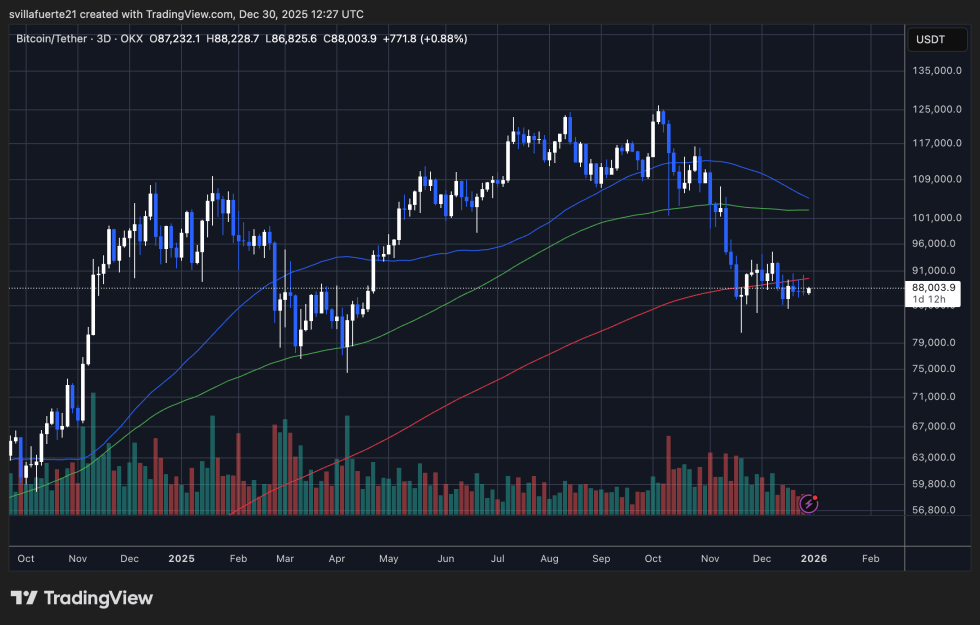
BTC price testing critical level | Source: BTCUSDT chart on TradingView

At present, Bitcoin is consolidating around the $88K zone, hovering just above the rising 200-day moving average, which sits slightly lower and continues to act as a critical long-term support.

This area has become a key battleground: repeated downside wicks suggest buyers are defending the level, but upside follow-through remains limited. The declining slope of the shorter moving averages reinforces the idea that bullish momentum has not yet returned.

Volume dynamics also support a consolidation narrative rather than active accumulation. Selling pressure has eased compared to the November breakdown, but demand has not expanded meaningfully enough to reclaim prior resistance. Structurally, the market appears to be transitioning from a high-volatility selloff into a compression phase.

As long as BTC holds above the 200-day moving average, the broader bullish structure from earlier in the cycle remains technically intact. However, a failure to defend this level would expose the $80K–$75K region as the next major support.

Featured image from ChatGPT, chart from TradingView.com

Domande pertinenti

QWhat key data suggests a shift in long-term holder (LTH) behavior according to the article?

AThe key data is the monthly LTH supply change (30-day rolling sum), which has moved back into positive territory with approximately 10,700 BTC transitioning into long-term held coins, indicating a shift from sustained selling to early re-accumulation.

QWhat event distorted the traditional LTH metrics and created a perception of record selling?

AThe perception was distorted by a large, isolated movement of nearly 800,000 BTC transferred from Coinbase, which skewed the data.

QWhat is the significance of Bitcoin's current price level in relation to the 200-day moving average?

AThe $88K zone, where Bitcoin is consolidating, is just above the rising 200-day moving average, which acts as a critical long-term support. Holding above it keeps the broader structure intact, while a break below could expose the $80K–$75K region.

QHow does the article describe the current market sentiment and the actions of short-term holders (STHs)?

AThe article describes market sentiment as deteriorating, with many analysts calling for a broader bear market. However, short-term holders (STHs) are described as continuing to hold their positions rather than aggressively selling, contributing to a cooling of sell-side pressure.

QWhat does the shift in LTH behavior historically indicate for Bitcoin's price, according to the article?

AHistorically, similar transitions in LTH supply behavior from distribution to re-accumulation have often preceded periods of sideways consolidation or the early stages of bullish recoveries.

Letture associate

Why Do You Always Lose Money on Polymarket? Because You're Betting on News, While the Pros Read the Rules

Why do you always lose money on Polymarket? Because you bet on news, while the pros study the rules. This article explains how top traders ("che tou") profit by meticulously analyzing market rules, not just predicting events. Polymarket, a prediction market platform, often sees disputes over event outcomes due to ambiguous rule wording. For instance, a market asking "Who will be the leader of Venezuela by the end of 2026?" was misinterpreted by many who bet on Delcy Rodríguez, assuming she held power. However, the rules specified "officially holds" as the formally appointed, sworn-in individual. Since Nicolás Maduro was still recognized as president officially, he won the market—even being in prison. To resolve such disputes, Polymarket uses a decentralized arbitration system via UMA protocol. The process involves: 1. Proposal: Anyone can propose a market outcome by staking 750 USDC, earning 5 USDC if unchallenged. 2. Dispute: A 2-hour window allows challenges with a 750 USDC stake; successful challengers earn 250 USDC. 3. Discussion: A 48-hour period on UMA Discord for evidence and debate. 4. Voting: UMA token holders vote in two 24-hour phases (blind then public). Outcomes require >65% consensus and 5M tokens voted; otherwise, four re-votes occur before Polymarket intervention. 5. Settlement: Results are final and automatic. Unlike traditional courts, Polymarket’s system lacks separation between arbitrators and stakeholders—voters often hold market positions, creating conflicts of interest. This leads to herd mentality in discussions and non-transparent outcomes without explanatory rulings, preventing precedent formation. Thus, success on Polymarket hinges on deep rule interpretation, not just event prediction, exploiting gaps between reality and contractual wording.

marsbit1 h fa

Why Do You Always Lose Money on Polymarket? Because You're Betting on News, While the Pros Read the Rules

marsbit1 h fa

DeepSeek Funding: Liang Wenfeng's 'Realist' Pivot

DeepSeek, a leading Chinese AI company, has initiated its first external funding round, aiming to raise at least $300 million at a valuation of no less than $10 billion. This move marks a significant shift from its founder Liang Wenfeng’s previous idealistic stance of rejecting external capital to maintain independence. Despite strong financial backing from its parent company, quantitative trading firm幻方量化 (Huanfang Quant), which provided an estimated $700 million in revenue in 2025 alone, DeepSeek faces mounting challenges. Key issues include a 15-month gap in major model updates, delays in its flagship V4 release, and the loss of several core researchers to competitors offering significantly higher compensation. The company is also undergoing a strategic pivot by migrating its infrastructure from NVIDIA’s CUDA to Huawei’s Ascend platform, a move aligned with China’s push for technological self-reliance amid U.S. export controls. However, DeepSeek lags behind rivals like智谱AI and MiniMax—both now publicly listed—in areas such as product ecosystem, multimodal capabilities, and commercialization. The funding round, though relatively small in scale, is seen as a way to establish a market-validated valuation anchor, making employee stock options more competitive and facilitating talent retention. It also signals DeepSeek’s transition from a pure research-oriented organization to a commercially-driven player in the global AI ecosystem.

marsbit2 h fa

DeepSeek Funding: Liang Wenfeng's 'Realist' Pivot

marsbit2 h fa

Trading

Spot
Futures

Articoli Popolari

Come comprare FRAX

Benvenuto in HTX.com! Abbiamo reso l'acquisto di FRAX (FRAX) semplice e conveniente. Segui la nostra guida passo passo per intraprendere il tuo viaggio nel mondo delle criptovalute.Step 1: Crea il tuo Account HTXUsa la tua email o numero di telefono per registrarti il tuo account gratuito su HTX. Vivi un'esperienza facile e sblocca tutte le funzionalità,Crea il mio accountStep 2: Vai in Acquista crypto e seleziona il tuo metodo di pagamentoCarta di credito/debito: utilizza la tua Visa o Mastercard per acquistare immediatamente FRAXFRAX.Bilancio: Usa i fondi dal bilancio del tuo account HTX per fare trading senza problemi.Terze parti: abbiamo aggiunto metodi di pagamento molto utilizzati come Google Pay e Apple Pay per maggiore comodità.P2P: Fai trading direttamente con altri utenti HTX.Over-the-Counter (OTC): Offriamo servizi su misura e tassi di cambio competitivi per i trader.Step 3: Conserva FRAX (FRAX)Dopo aver acquistato FRAX (FRAX), conserva nel tuo account HTX. In alternativa, puoi inviare tramite trasferimento blockchain o scambiare per altre criptovalute.Step 4: Scambia FRAX (FRAX)Scambia facilmente FRAX (FRAX) nel mercato spot di HTX. Accedi al tuo account, seleziona la tua coppia di trading, esegui le tue operazioni e monitora in tempo reale. Offriamo un'esperienza user-friendly sia per chi ha appena iniziato che per i trader più esperti.

577 Totale visualizzazioniPubblicato il 2026.03.03Aggiornato il 2026.03.03

Come comprare FRAX

Cosa è MANTRA

I. Introduzione al ProgettoMANTRA è una Blockchain Layer 1 con priorità sulla Sicurezza, capace di aderire e far rispettare i requisiti normativi del mondo reale. Costruita per Istituzioni e Sviluppatori, MANTRA offre una Blockchain senza permessi per applicazioni con permessi.Caratteristiche principali: * Costruita utilizzando Cosmos SDK, compatibile con IBC, con supporto per CosmWasm * Sicura tramite un set di validatori PoS sovrano * Scalabile fino a 10k TPS * Moduli, SDK e API integrati per creare, scambiare e gestire RWAs conformi alle normative * Esperienza utente migliorata per integrare utenti e istituzioni non native in Web3.1) Informazioni di baseNome: MANTRA (OM)III. Link correlatiWhitepaper:https://docs.mantrachain.io/Sito ufficiale:https://www.mantrachain.io/Esploratori:https://mintscan.io/mantraSocial Media:https://x.com/MANTRA_ChainNota: L'introduzione al progetto proviene dai materiali pubblicati o forniti dal team ufficiale del progetto, che è solo a scopo di riferimento e non costituisce consulenza per gli investimenti. HTX non si assume responsabilità per eventuali perdite dirette o indirette risultanti.

478 Totale visualizzazioniPubblicato il 2026.03.04Aggiornato il 2026.03.04

Cosa è MANTRA

Come comprare MANTRA

Benvenuto in HTX.com! Abbiamo reso l'acquisto di Mantra (MANTRA) semplice e conveniente. Segui la nostra guida passo passo per intraprendere il tuo viaggio nel mondo delle criptovalute.Step 1: Crea il tuo Account HTXUsa la tua email o numero di telefono per registrarti il tuo account gratuito su HTX. Vivi un'esperienza facile e sblocca tutte le funzionalità,Crea il mio accountStep 2: Vai in Acquista crypto e seleziona il tuo metodo di pagamentoCarta di credito/debito: utilizza la tua Visa o Mastercard per acquistare immediatamente MantraMANTRA.Bilancio: Usa i fondi dal bilancio del tuo account HTX per fare trading senza problemi.Terze parti: abbiamo aggiunto metodi di pagamento molto utilizzati come Google Pay e Apple Pay per maggiore comodità.P2P: Fai trading direttamente con altri utenti HTX.Over-the-Counter (OTC): Offriamo servizi su misura e tassi di cambio competitivi per i trader.Step 3: Conserva Mantra (MANTRA)Dopo aver acquistato Mantra (MANTRA), conserva nel tuo account HTX. In alternativa, puoi inviare tramite trasferimento blockchain o scambiare per altre criptovalute.Step 4: Scambia Mantra (MANTRA)Scambia facilmente Mantra (MANTRA) nel mercato spot di HTX. Accedi al tuo account, seleziona la tua coppia di trading, esegui le tue operazioni e monitora in tempo reale. Offriamo un'esperienza user-friendly sia per chi ha appena iniziato che per i trader più esperti.

194 Totale visualizzazioniPubblicato il 2026.03.04Aggiornato il 2026.03.04

Come comprare MANTRA

Discussioni

Benvenuto nella Community HTX. Qui puoi rimanere informato sugli ultimi sviluppi della piattaforma e accedere ad approfondimenti esperti sul mercato. Le opinioni degli utenti sul prezzo di A A sono presentate come di seguito.

活动图片