Encrypted ETF Weekly Report | Last Week, US Bitcoin Spot ETF Net Outflow $9.95 Billion; US Ethereum Spot ETF Net Outflow $255 Million

链捕手Pubblicato 2026-05-18Pubblicato ultima volta 2026-05-18

Introduzione

Last week, U.S. Bitcoin spot ETFs saw significant net outflows totaling $995 million over three days, with a major contribution of $317 million from BlackRock's IBIT. Their total net asset value (NAV) stands at $104.2 billion. U.S. Ethereum spot ETFs also experienced net outflows of $255 million over five days, largely from BlackRock's ETHA ($186 million out), bringing their total NAV to $12.93 billion. In Hong Kong, Bitcoin spot ETFs recorded a net outflow of 24.91 BTC, reducing their NAV to $323 million. Hong Kong's Ethereum spot ETFs saw no inflows, with an NAV of $68.13 million. U.S. Bitcoin spot ETF options showed increased activity, with a total nominal trading volume of $797 million and a put/call trading ratio of 1.63, indicating a bullish market sentiment. The total open interest reached $23.08 billion. Key developments include VanEck and Grayscale simultaneously filing amended proposals for BNB ETFs, signaling potential SEC review progress. Grayscale also filed for the first U.S. privacy coin ETF (Zcash). Avenir Group remains Asia's largest institutional holder of Bitcoin ETFs. 21Shares launched an actively managed crypto ETF (TKNS), and Bitwise's Hyperliquid ETF (BHYP) is set to list on the NYSE. Institutional activity varied: JPMorgan dramatically increased its Bitcoin ETF holdings (IBIT up 174%), while Jane Street significantly reduced its exposure (IBIT down 71%). Dartmouth College disclosed holdings of $7.7M in Bitcoin ETF and $3.4M in a Solana ETF.

Compiled by: Jerry, ChainCatcher

Last Week's Performance of Cryptocurrency Spot ETFs

US Bitcoin Spot ETF Net Outflow of $9.95 Billion

Last week, US Bitcoin Spot ETFs experienced net outflows for three days, with a total net outflow of 9.95 billion dollars, and total assets under management (AUM) reached $104.29 billion.

Six ETFs were in a net outflow state last week, with the main outflow coming from BlackRock's IBIT, which saw a net outflow of $317 million.
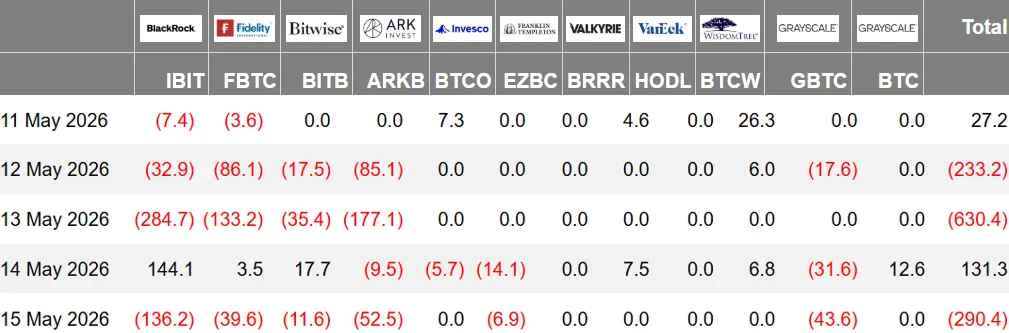
Data Source: Farside Investors

US Ethereum Spot ETF Net Outflow of $255 Million

Last week, US Ethereum Spot ETFs experienced net outflows for five days, with a total net outflow of 2.55 billion dollars, and total AUM reached $12.93 billion.

The main outflow last week came from BlackRock's ETHA, with a net outflow of $186 million. Four Ethereum spot ETFs were in a net outflow state.
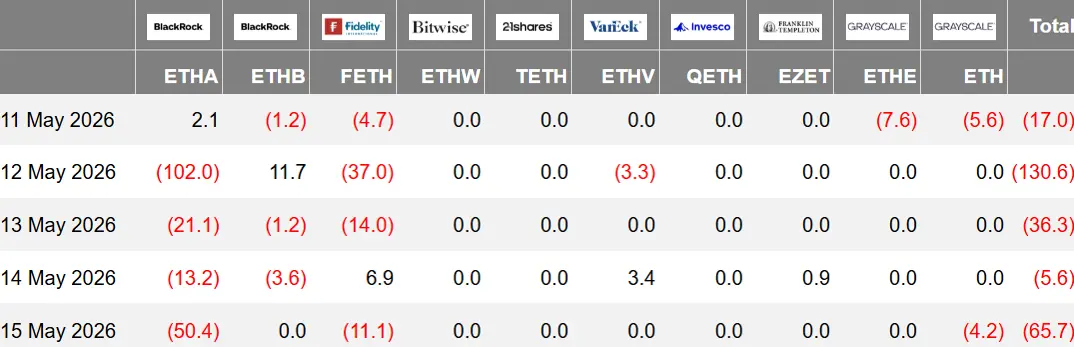
Data Source: Farside Investors

Hong Kong Bitcoin Spot ETF Net Outflow of 24.91 Bitcoins

Last week, Hong Kong Bitcoin Spot ETFs had a net outflow of 24.91 Bitcoins, with an AUM of $323 million. Among them, issuer Harvest Bitcoin's holdings dropped to 210.92 coins, and ChinaAMC's holdings dropped to 2,570 coins.

Hong Kong Ethereum Spot ETFs had no fund inflows, with an AUM of $68.13 million.
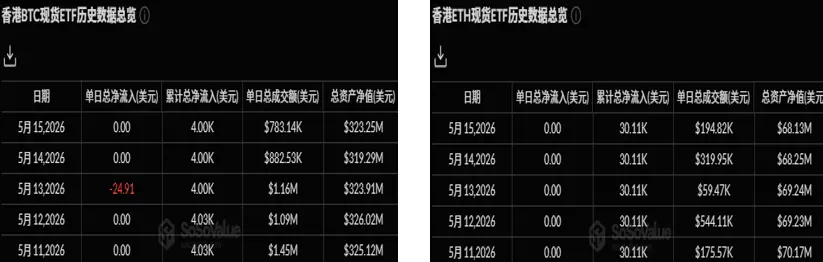
Data Source: SoSoValue

Performance of Cryptocurrency Spot ETF Options

As of May 14, the total notional trading volume for US Bitcoin Spot ETF options was $797 million, with a notional total long/short trading ratio of 1.63.

As of May 14, the total notional open interest for US Bitcoin Spot ETF options reached $23.08 billion, with a notional total long/short ratio of 1.45.

Market trading activity for Bitcoin Spot ETF options has increased in the short term, with overall sentiment leaning bullish.

Additionally, the implied volatility stands at 41.82%.

Data Source: SoSoValue

Overview of Last Week's Cryptocurrency ETF Dynamics

VanEck and Grayscale File BNB ETF Amendments on Same Day

According to The Block, VanEck submitted the fifth amendment to its BNB ETF registration statement to the US Securities and Exchange Commission on Friday (May 15), while Grayscale also submitted the second amendment to its Grayscale BNB ETF prospectus on the same day.

Bloomberg ETF analyst James Seyffart stated that the synchronized actions suggest both issuers are responding to feedback from the US SEC and may be planning a launch in the near future. James Seyffart speculates that BNB might be the next crypto asset to pass SEC scrutiny and have the potential to list in the US.

Meanwhile, Canary Capital separately filed an amendment to its proposal for a staked TRX ETF, which would bundle Tron's staking rewards into a regulated framework.

Grayscale Submits Revised BNB ETF S-1 Again, Possibly Paving Way for US Spot ETF Advancement

Bloomberg ETF analyst James Seyffart stated on platform X that Grayscale has submitted the second revised version of its S-1 filing for its BNB ETF to the US Securities and Exchange Commission (SEC).

He said this revision is likely based on adjustments in response to SEC feedback, suggesting the product may be accelerating its launch process.

Avenir Group Maintains Position as Asia's Largest Institutional Holder of Bitcoin ETF, Ranking First in Region for Eight Consecutive Quarters

The latest disclosed SEC filings show that as of March 31, 2026, Avenir Group holds 18,276,100 shares of BlackRock's iShares Bitcoin Trust (IBIT). Based on the quarter-end closing price, the position value is approximately $702 million, a slight decrease of about 0.061% compared to Q4 2025. Avenir Group has maintained its position as Asia's largest institutional holder of Bitcoin ETFs for eight consecutive quarters since Q2 2024.

Since 2026, Avenir Group has been advancing the integration of TradFi and Crypto, including strategic investments in CoinRoutes, leading a $20 million seed round for Inference Research, and signing an MOU for cooperation with Tiger Brokers, AMINA Bank, and CoinRoutes during Consensus Hong Kong 2026 to promote next-generation institutional-grade trading infrastructure development.

Data: US Dartmouth College Discloses Holding $7.7 Million in Bitcoin ETF and $3.4 Million in SOL ETF

According to MacroScope monitoring, in its submitted 13F filing, US Dartmouth College disclosed that as of March 31, it holds approximately 201,531 shares of BlackRock's Bitcoin ETF "IBIT," valued at $7.7 million, with no change in holdings from the previous quarter.

The college also reported a new position: holdings of Bitwise Solana Staking ETF valued at $3.4 million (304,803 units).

21Shares Announces Launch of Actively Managed Crypto ETF TKNS

According to an official announcement, 21Shares has announced the launch of an actively managed crypto ETF, ticker TKNS. The fund is managed by a professional team, aiming to capture market opportunities and outperform passive index funds. Portfolio managers will adjust holdings based on market conditions to balance long-term goals with short-term opportunities. The fund operates like a standard stock ETF, with simplified tax reporting, and is currently tradable on select brokerage platforms.

Bitwise Hyperliquid ETF to List on New York Stock Exchange This Friday

The Bitwise Hyperliquid ETF will begin trading on the New York Stock Exchange this Friday under the ticker BHYP. Previously, 21Shares' Hyperliquid ETF (THYP) launched this Tuesday, with a first-day trading volume of approximately $1.8 million. BHYP will be the first US fund to offer Hyperliquid staking rewards, with related staking operations to be conducted through Bitwise's subsidiary, Bitwise Onchain Solutions. 21Shares also stated it plans to stake the majority of its HYPE holdings. Hyperliquid is currently a leading on-chain perpetual contract exchange, gradually expanding into tokenized commodities and spot crypto trading. Its native token HYPE is used for platform fee payments and is consistently among the top 15 crypto assets by trading volume.

JPMorgan Chase Significantly Increased Bitcoin ETF Holdings in Q1, IBIT Position Surges 174%

According to a Cointelegraph report, 13F filings show that JPMorgan Chase significantly increased its Bitcoin ETF holdings in the first quarter. Its holdings in BlackRock iShares Bitcoin Trust (IBIT) grew from approximately 3 million shares to 8.3 million shares, an increase of 174%.

Additionally, JPMorgan Chase also significantly increased holdings of other Bitcoin spot ETFs like Fidelity's FBTC and Bitwise's BITB, and slightly increased its holdings of MicroStrategy (MSTR).

Regarding altcoin ETFs, JPMorgan Chase's actions varied: it initiated a position in Bitwise Solana Staking ETF (BSOL), increased holdings of Ethereum-related ETFs, while completely exiting its position in an XRP ETF.

Jane Street Q1 Significantly Reduced Bitcoin ETF Exposure, IBIT Holdings Down 71% QoQ

The latest 13F filing submitted by quantitative giant Jane Street to the US SEC discloses a significant reduction in its Bitcoin ETF exposure for Q1 2026. Its holdings of IBIT decreased approximately 71% quarter-over-quarter to 5,872,212 shares, valued at approximately $225.6 million. Its holdings of FBTC decreased approximately 60% to 1,954,174 shares, valued at approximately $115 million.

Additionally, its holdings of MSTR also decreased approximately 78% quarter-over-quarter to 209,833 shares, valued at approximately $26.18 million.

Grayscale Files First Privacy Coin Spot ETF Application, Multicoin Capital Discloses It Has Accumulated ZEC

Grayscale has filed an application for a Zcash spot ETF, seeking to convert its existing Zcash trust into a spot product, becoming the first privacy coin ETF seeking to list in the US. Concurrently, Multicoin Capital disclosed it has been accumulating ZEC since February, with co-founder Tushar Jain linking the investment thesis to proposed US wealth tax legislation, suggesting that government expansion of surveillance over private financial holdings will drive structural demand for assets shielded from regulatory scrutiny at a mathematical level.

However, this application also raises institutional custody challenges: approximately 30% of Zcash's supply is in shielded address pools, a historical high, but ETF custody would almost certainly need to use transparent address pools to meet audit and balance proof requirements. Previously, the SEC ended its long-term review of Zcash in January 2026 without enforcement action, significantly reducing regulatory uncertainty.


Domande pertinenti

QWhat was the net outflow for U.S. Bitcoin spot ETFs last week, and which fund was the largest contributor?

ALast week, U.S. Bitcoin spot ETFs had a net outflow of $995 million. The primary contributor to this outflow was BlackRock's IBIT, with a net outflow of $317 million.

QHow did the U.S. Ethereum spot ETFs perform in terms of net flow last week?

AU.S. Ethereum spot ETFs experienced a net outflow of $255 million over five days last week, with the total assets under management reaching $12.93 billion.

QWhat significant ETF filing news was reported involving VanEck and Grayscale?

AVanEck and Grayscale both submitted amended filings for their respective BNB ETF proposals on the same day (May 15). Analysts believe this synchronized action indicates both issuers are responding to SEC feedback and potentially preparing for a near-term launch.

QWhich institution maintains the title of Asia's largest Bitcoin ETF institutional holder, and for how long?

AAvenir Group maintains the title of Asia's largest Bitcoin ETF institutional holder. As of March 31, 2026, it held over 18.2 million shares of BlackRock's IBIT, a position it has held for eight consecutive quarters since Q2 2024.

QWhat is the significance of the new ETF application filed by Grayscale mentioned in the article?

AGrayscale filed an application to convert its existing Zcash Trust into a spot ETF, marking the first application for a privacy-focused cryptocurrency ETF in the United States.

Letture associate

The Shutdown of Claude Mythos Revealed the True Cost of Renting AI to Me

The sudden shutdown of Claude Mythos this week starkly highlights a critical, often overlooked risk for founders: when your core capability relies entirely on someone else's platform, your fate is not in your own hands. The key question becomes: who truly owns the intelligence your product depends on? For years, the debate around open-source models focused on cost. Now, the evidence is clear: fine-tuned open-source models can achieve frontier-level quality for specific, mission-critical tasks at a fraction of the cost. However, the deeper issue is control. Relying on a third-party API is like renting; it works until the landlord changes the rules, raises the rent, or asks you to leave—as Mythos experienced. The lesson is not to stop using frontier models—they are incredible infrastructure. The goal is ownership. Ownership means starting with a powerful open-source model and shaping it around what makes your company unique: your data, workflows, domain expertise, and definition of "good." Over time, the model becomes less generic and more reflective of your business, creating durable value. The optimistic conclusion is that AI's future doesn't hinge on one superior model. There is no single frontier. The frontier includes proprietary models, models fine-tuned on company-specific knowledge, specialized models for narrow problems, and intelligent routers orchestrating model ensembles. The most interesting development is not models getting smarter, but intelligence becoming increasingly customizable. The winning companies will be those that transform intelligence into a unique, owned asset. Looking ahead, the vision is not one model dominating all, but many teams owning the part of the frontier that matters most to them.

marsbit27 min fa

The Shutdown of Claude Mythos Revealed the True Cost of Renting AI to Me

marsbit27 min fa

Tiger Research: U.S. Strategic Bitcoin Reserve - Should the Market Be Happy or Disappointed?

Tiger Research analyzes the evolution of U.S. legislative efforts regarding a strategic Bitcoin reserve, concluding the market impact is limited in the short term but potentially positive long-term. The core event was a March 2025 executive order by former President Trump, which designated confiscated Bitcoin as a strategic reserve and promised not to sell existing holdings (approx. 190k BTC). As it contained no mandate to purchase new Bitcoin, the market reacted negatively, with prices dropping 5.7%. Legislative history shows a significant retreat from initial ambitions. The 2024 "BITCOIN Act" proposed mandatory purchases of 1 million BTC over five years. Reintroduced in 2025, it stalled due to high fiscal costs, concerns over dollar hegemony, and opposition from the Treasury Secretary. The current frontrunner, the 2026 "American Retirement and Monetary Advancement (ARMA) Act," is a compromise. It lacks any purchase requirement, instead focusing on consolidating existing government-held Bitcoin and legally prohibiting its sale for at least 20 years. While ARMA has higher passage odds due to bipartisan support and no purchase mandate, its immediate market effect is neutral. It eliminates potential government selling pressure but creates no new demand. The long-term significance is that formally establishing Bitcoin as a national reserve asset in law could later reignite debates on mandatory purchases. Therefore, the path to a government buyer is longer than initially priced by the market, but the directional narrative remains intact.

marsbit30 min fa

Tiger Research: U.S. Strategic Bitcoin Reserve - Should the Market Be Happy or Disappointed?

marsbit30 min fa

US Stock Market Trend (June 16): SpaceX Rises 42% in Two Days, New Fed Chairman Takes Office Today

**U.S. Stocks Trend (June 16): SpaceX Soars 42% in Two Days, New Fed Chair Takes Office Today** Markets surged on Monday following former President Trump's social media announcement of a completed U.S.-Iran deal to reopen the Strait of Hormuz, pending a June 19 signing. The news triggered a broad risk-on rally: oil prices crashed, tech stocks soared, bond yields fell, and defensive sectors lagged. **Market Performance:** The Nasdaq jumped 3.07%, led by semiconductor stocks like Micron (+9.2%). The S&P 500 gained 1.65%, and the Dow rose 0.92% to a record high. However, the Russell 2000 small-cap index underperformed (+0.72%). SpaceX continued its hot streak, rising another 5% pre-market after disclosures of large buys by an Australian billionaire and Cathie Wood's ARK. Boeing also rallied on the transportation optimism. Conversely, energy stocks like Chevron fell over 3% on the oil price plunge, with other defensive sectors also selling off. The day's action showed a clear rotation of funds from energy/defensive plays into AI and tech narratives. **Macro & Outlook:** The VIX fear index fell 8.37%. Treasury yields declined, and WTI crude dropped over 5%. Attention now shifts to a packed schedule: the Bank of Japan is widely expected to hike rates to 1.0% on Tuesday. The Fed's June meeting concludes Wednesday, marking new Chair Wash's debut. While rates are expected to hold, his tone on stubborn inflation and the "dot plot" will be crucial for gauging the 2024 rate path. The formal Iran deal signing is set for Friday. **Trend Perspective:** While the peace deal is a genuine positive, Monday's explosive rally may have gotten ahead of itself, pricing in a swift resolution to inflation concerns. The shortened trading week faces a triple test: BoJ tightening, the Fed's policy stance, and deal implementation details. Tech and semiconductors, which led the surge, remain vulnerable to any disappointment from these key events. The real price discovery begins with the central banks' communications this week.

marsbit51 min fa

US Stock Market Trend (June 16): SpaceX Rises 42% in Two Days, New Fed Chairman Takes Office Today

marsbit51 min fa

Trading

Spot
Futures
活动图片