Embodied Intelligence Breakthrough: Amap Fully Open-Sources Universal Robot Base Model ABot-M0

marsbitPubblicato 2026-04-01Pubblicato ultima volta 2026-04-01

Introduzione

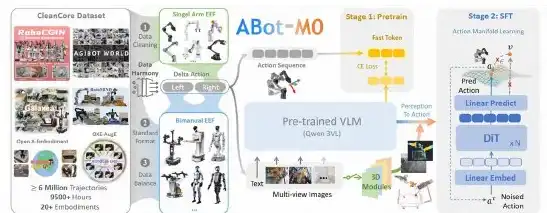
Embodied Intelligence Breakthrough: AutoNavi Open-Sources Universal Robot Base Model ABot-M0 AutoNavi has announced the full open-source release of ABot-M0, the world's first unified architecture-based embodied manipulation base model. This model is designed to enable "one general brain to adapt to multiple forms of robots," aiming to break down barriers between heterogeneous hardware and accelerate the adoption of embodied intelligence in industrial and household settings. ABot-M0 demonstrated exceptional performance in industry tests, achieving a task success rate of 80.5% on the Libero-Plus benchmark—a nearly 30% improvement over the previous benchmark, Pi0. It also set new state-of-the-art records on benchmarks like Libero and RoboCasa. The open-source release addresses long-standing challenges in the field, such as data isolation and deployment difficulties, by providing resources across three key dimensions: - **Data:** The UniACT dataset, the largest of its kind, with over 6 million real operation trajectories and full data pipeline tools. - **Algorithm:** The model architecture and training framework, featuring innovative components like Action Manifold Learning (AML) and a dual-stream perception architecture. - **Model:** End-to-end pre-trained models and a complete toolchain for out-of-the-box deployment, significantly lowering the barrier to adaptation. According to AutoNavi's ABot-M0 technical lead, this open-source initiative aims to build a bridge between ac...

The field of embodied intelligence has reached a milestone. Amap today officially announced the full open-source release of the world's first unified architecture-based robot operation base model ABot-M0. The core positioning of this model is to achieve "one universal brain adaptable to various forms of robots," aiming to break down barriers between heterogeneous hardware and accelerate the transition of embodied intelligence from the laboratory to industrial and home scenarios.

Core Technology and Performance

ABot-M0 has demonstrated outstanding performance in multiple industry authoritative benchmark tests. Data shows that the model achieved a task success rate of up to 80.5% on the Libero-Plus benchmark, a nearly 30% improvement over the previous industry benchmark solution Pi0. Furthermore, it set new SOTA (State-of-the-Art) records in tests such as Libero and RoboCasa.
Full Open-Source Across Three Dimensions

To address the long-standing pain points of "data silos" and "deployment difficulties" in the field of embodied intelligence, Amap's open-source release covers three key dimensions: underlying data, core algorithms, and pre-trained models:

  • Data Level: Open-sourced the currently largest universal robot dataset UniACT. This dataset integrates over 6 million real operation trajectories and provides a complete processing pipeline from heterogeneous data to standardized training data.

  • Algorithm Level: Simultaneously released the model architecture and training framework. Core highlights include Amap's innovative Action Manifold Learning (AML) algorithm and Dual-Stream Perception Architecture, endowing robots with exceptional spatial understanding and action execution capabilities.

  • Model Level: Provided end-to-end pre-trained models and a complete toolchain. Developers can achieve "out-of-the-box" usability without building a framework from scratch, significantly lowering the barrier to adapting to industrial collaborative or home service robots.

Industry Impact

Amap's ABot-M0 technical lead stated that true general embodied intelligence requires the collective refinement of global developers. The open-sourcing of ABot-M0 is not just a sharing of technology but also aims to build a bridge connecting academic research and industrial application, enabling every robot of different forms to possess a smart, reliable, and universal "brain".


Domande pertinenti

QWhat is the name of the general-purpose robotic base model that AutoNavi has fully open-sourced?

AThe model is called ABot-M0.

QWhat is the core positioning or main goal of the ABot-M0 model?

AIts core positioning is to achieve 'one general-purpose brain adapted to various forms of robots', aiming to break down barriers between heterogeneous hardware.

QWhat is the name of the large-scale dataset that was open-sourced alongside the model, and how many real operation trajectories does it contain?

AThe dataset is called UniACT, and it integrates over 6 million real operation trajectories.

QOn which benchmark did ABot-M0 achieve a task success rate of 80.5%, and what was the performance improvement over the previous benchmark solution?

AIt achieved an 80.5% success rate on the Libero-Plus benchmark, which is a nearly 30% improvement over the previous benchmark solution, Pi0.

QName two core technical highlights of the algorithm that were open-sourced.

AThe two core technical highlights are the Action Manifold Learning (AML) algorithm and the Dual-Stream Perception architecture.

Letture associate

VCs on 2025 Crypto Investments: 84% of 118 Tokens Break Issue Price, Only One Type of Company is Quietly Making Money

Crypto investor Ching Tseng categorizes the market into four quadrants based on two axes: crypto-native vs. traditional finance (TradFi)-oriented, and having traction vs. no traction. In 2025, 84.7% of 118 tracked token launches fell below their issuance price, with a median fully diluted valuation drop of 71%. Crypto-native projects without traction are experiencing massive capital destruction, often relying on speculative narratives without sustainable revenue or user retention. Crypto-native teams with traction, often built in prior cycles, generate real revenue but face structural challenges with their tokens lacking direct value capture mechanisms. While some have implemented successful buyback programs, the core issue remains finding growth beyond crypto volatility. TradFi-oriented startups without traction face long, costly enterprise sales cycles but benefit from a robust M&A environment, with crypto acquisitions reaching a record $8.6 billion in 2025. The current winners are TradFi-oriented companies with traction, particularly in the Real World Asset (RWA) tokenization space, which grew from $5.5B to $18.6B in 2025. They are winning through enterprise sales, building alliances, and improving unit economics on established compliance stacks. Their main risk is being bypassed by large incumbent institutions building their own infrastructure. The overarching theme is market maturation, where narrative alone is insufficient for long-term success.

marsbit42 min fa

VCs on 2025 Crypto Investments: 84% of 118 Tokens Break Issue Price, Only One Type of Company is Quietly Making Money

marsbit42 min fa

Trading

Spot
Futures
活动图片