Embodied Intelligence Breakthrough: Amap Fully Open-Sources Universal Robot Base Model ABot-M0

marsbitPubblicato 2026-04-01Pubblicato ultima volta 2026-04-01

Introduzione

Embodied Intelligence Breakthrough: AutoNavi Open-Sources Universal Robot Base Model ABot-M0 AutoNavi has announced the full open-source release of ABot-M0, the world's first unified architecture-based embodied manipulation base model. This model is designed to enable "one general brain to adapt to multiple forms of robots," aiming to break down barriers between heterogeneous hardware and accelerate the adoption of embodied intelligence in industrial and household settings. ABot-M0 demonstrated exceptional performance in industry tests, achieving a task success rate of 80.5% on the Libero-Plus benchmark—a nearly 30% improvement over the previous benchmark, Pi0. It also set new state-of-the-art records on benchmarks like Libero and RoboCasa. The open-source release addresses long-standing challenges in the field, such as data isolation and deployment difficulties, by providing resources across three key dimensions: - **Data:** The UniACT dataset, the largest of its kind, with over 6 million real operation trajectories and full data pipeline tools. - **Algorithm:** The model architecture and training framework, featuring innovative components like Action Manifold Learning (AML) and a dual-stream perception architecture. - **Model:** End-to-end pre-trained models and a complete toolchain for out-of-the-box deployment, significantly lowering the barrier to adaptation. According to AutoNavi's ABot-M0 technical lead, this open-source initiative aims to build a bridge between ac...

The field of embodied intelligence has reached a milestone. Amap today officially announced the full open-source release of the world's first unified architecture-based robot operation base model ABot-M0. The core positioning of this model is to achieve "one universal brain adaptable to various forms of robots," aiming to break down barriers between heterogeneous hardware and accelerate the transition of embodied intelligence from the laboratory to industrial and home scenarios.

Core Technology and Performance

ABot-M0 has demonstrated outstanding performance in multiple industry authoritative benchmark tests. Data shows that the model achieved a task success rate of up to 80.5% on the Libero-Plus benchmark, a nearly 30% improvement over the previous industry benchmark solution Pi0. Furthermore, it set new SOTA (State-of-the-Art) records in tests such as Libero and RoboCasa.
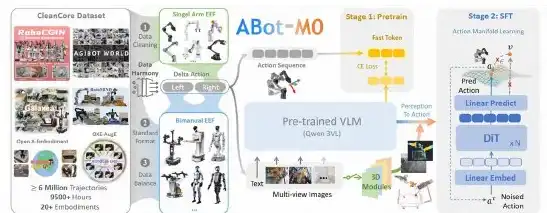
Full Open-Source Across Three Dimensions

To address the long-standing pain points of "data silos" and "deployment difficulties" in the field of embodied intelligence, Amap's open-source release covers three key dimensions: underlying data, core algorithms, and pre-trained models:

  • Data Level: Open-sourced the currently largest universal robot dataset UniACT. This dataset integrates over 6 million real operation trajectories and provides a complete processing pipeline from heterogeneous data to standardized training data.

  • Algorithm Level: Simultaneously released the model architecture and training framework. Core highlights include Amap's innovative Action Manifold Learning (AML) algorithm and Dual-Stream Perception Architecture, endowing robots with exceptional spatial understanding and action execution capabilities.

  • Model Level: Provided end-to-end pre-trained models and a complete toolchain. Developers can achieve "out-of-the-box" usability without building a framework from scratch, significantly lowering the barrier to adapting to industrial collaborative or home service robots.

Industry Impact

Amap's ABot-M0 technical lead stated that true general embodied intelligence requires the collective refinement of global developers. The open-sourcing of ABot-M0 is not just a sharing of technology but also aims to build a bridge connecting academic research and industrial application, enabling every robot of different forms to possess a smart, reliable, and universal "brain".


Domande pertinenti

QWhat is the name of the general-purpose robotic base model that AutoNavi has fully open-sourced?

AThe model is called ABot-M0.

QWhat is the core positioning or main goal of the ABot-M0 model?

AIts core positioning is to achieve 'one general-purpose brain adapted to various forms of robots', aiming to break down barriers between heterogeneous hardware.

QWhat is the name of the large-scale dataset that was open-sourced alongside the model, and how many real operation trajectories does it contain?

AThe dataset is called UniACT, and it integrates over 6 million real operation trajectories.

QOn which benchmark did ABot-M0 achieve a task success rate of 80.5%, and what was the performance improvement over the previous benchmark solution?

AIt achieved an 80.5% success rate on the Libero-Plus benchmark, which is a nearly 30% improvement over the previous benchmark solution, Pi0.

QName two core technical highlights of the algorithm that were open-sourced.

AThe two core technical highlights are the Action Manifold Learning (AML) algorithm and the Dual-Stream Perception architecture.

Letture associate

With Two Consecutive Quarters of Losses, Coinbase Must Rely on Paths Beyond Trading

Coinbase posted its second consecutive quarterly net loss of $359 million on $1.22 billion in revenue for Q2, highlighting its vulnerability to crypto market cycles where weaker prices and lower volatility reduce user trading. However, the report also reveals a strategic shift in its business model. Despite a 25% quarter-over-quarter decline in global spot trading volume, Coinbase increased its market share to a company-record 10.3%. This suggests its position as a compliant U.S. on-ramp is strengthening even in a cooler market. A key development is the diversification of revenue streams. Transaction revenue fell to $599 million, nearly equaling subscription and services revenue of $555 million. Stablecoin services, generating $292 million, are becoming a crucial revenue "floor." This income, derived from interest on the $20 billion average USDC balance held on its platform, is less tied to daily trading activity. Furthermore, while spot trading volume dropped significantly, derivatives volume held steady at $1.03 trillion. Coinbase is pushing to integrate spot, stablecoin, and derivatives liquidity to create a more interconnected and sticky ecosystem for users. The GAAP net loss includes non-cash expenses like stock-based compensation and crypto asset valuation changes. Its adjusted EBITDA remained positive at $208 million for the 14th straight quarter, indicating core operations can cover ongoing costs. The company is also reducing expenses to manage the downturn. The central question moving forward is whether Coinbase's growing market share, stablecoin revenues, and expanding product integration can sufficiently offset the inherent cyclicality of its core trading business during future market contractions.

marsbit6 min fa

With Two Consecutive Quarters of Losses, Coinbase Must Rely on Paths Beyond Trading

marsbit6 min fa

In the Age of Artificial Intelligence, We Need 'Magicians,' Not 'Managers'

In the AI era, leadership must shift from management to magic. As knowledge rapidly expires, value shifts from what leaders know to what they can facilitate. Traditional "inside-out" management, driven by internal experience, is giving way to "outside-in" thinking focused on external opportunities, customer needs, and disruptive change. The core challenge is fostering new ideas that may invalidate existing knowledge. While technologies like steam, electricity, and AI provide the "skeleton" for innovation, it is human vision—connecting technology to customer dreams—that creates magic. Historical figures like Richard Arkwright and Eldridge R. Johnson succeeded not by inventing core technologies, but by reimagining work and business models from the outside in. Leaders must transition from controllers to "architects of flourishing." Their role is to design environments where empowerment, creativity, and adaptive learning thrive. This involves granting autonomy, fostering partnerships, and building resilient systems that scale innovation. Critical leadership qualities now include judgment, creativity, and the ability to learn continuously rather than relying on static expertise. Therefore, cultivating future leaders requires a focus on timeless fundamentals, humanities for broader perspective, and social acuity, rather than over-specialization in quickly outdated technical skills. The future rewards those who respond to the unseen and create conditions for better answers to emerge. Leadership in the AI age is less about having all the answers and more about enabling others to discover them—creating organizations where people explore, imagine, and thrive.

marsbit41 min fa

In the Age of Artificial Intelligence, We Need 'Magicians,' Not 'Managers'

marsbit41 min fa

Trading

Spot
活动图片