EDGE Price Plummets 77%: External Manipulation or Internal Script?

marsbitPubblicato 2026-06-02Pubblicato ultima volta 2026-06-02

Introduzione

On June 2, the native token EDGE of the edgeX protocol experienced a violent flash crash, plummeting over 77% from around $1.14 to a low of $0.32 before partially recovering to approximately $0.64. edgeX officially ruled out a hack or platform security flaw, attributing the event to suspected market manipulation by external actors. The incident reignited community concerns regarding the project's transparency and past controversies. Prominent on-chain investigator ZachXBT highlighted that EDGE supply has long been controlled by a small group, with low circulating liquidity. This structure traces back to a disputed airdrop in April 2026, where the majority of tokens were allocated to partner wallets instead of the community, leading to accusations of a "well-designed rug pull." Despite having notable backers like Circle Ventures and Amber Group, and generating substantial protocol fees, edgeX faces criticism for a recurring pattern of "low float, high control, and opaque market making." While the team investigates the crash and emphasizes its core contracts are operational, user sentiment remains severely damaged, with many expressing a lack of trust in the team's integrity. Meanwhile, prediction markets have already opened betting pools on EDGE's future price.

Original Author: Ma He, Foresight News

Around 4:00 AM on June 2, the native token EDGE of edgeX experienced severe and abnormal volatility. The price plummeted over 77% in a short period from around $1.14, hitting a low of $0.32, and has since rebounded to around $0.64, with a market cap of approximately $250 million.
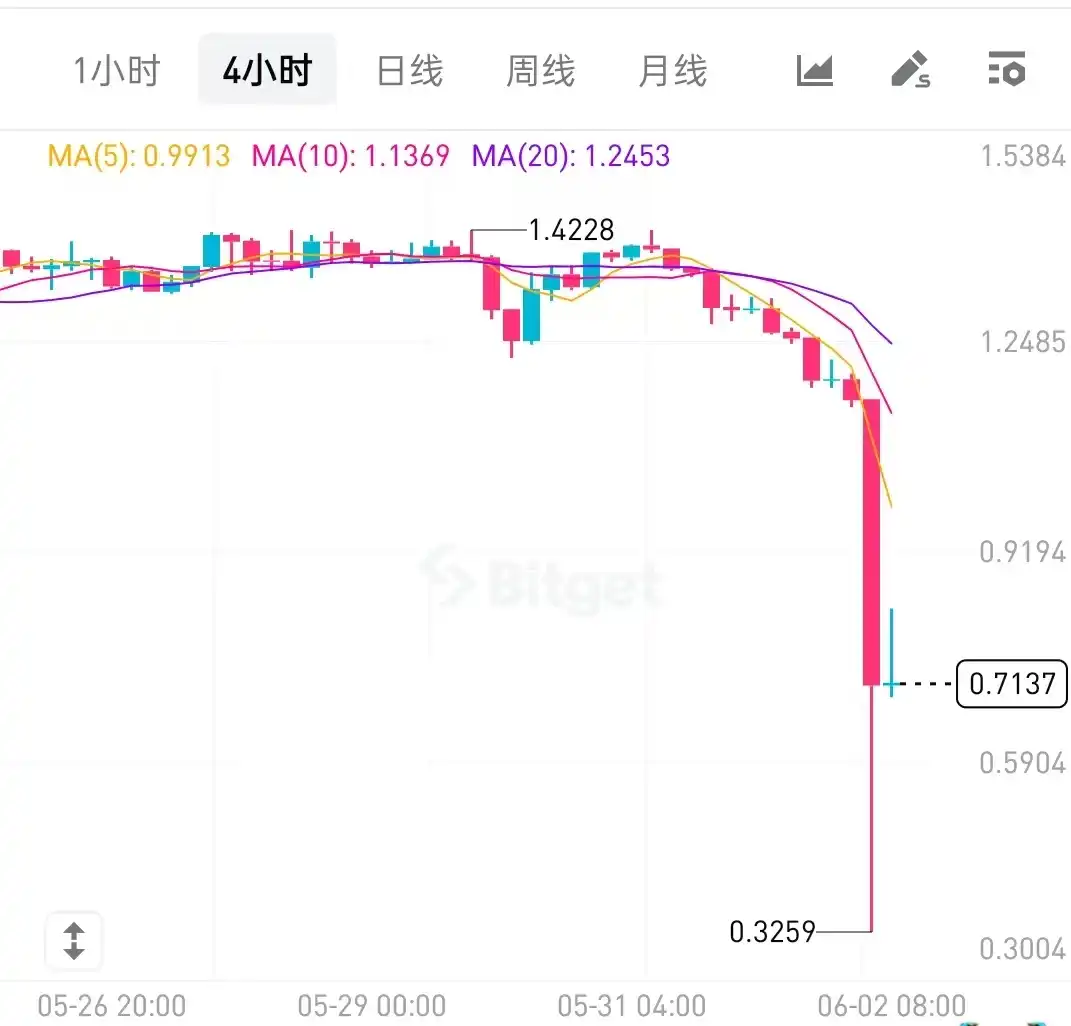
edgeX responded immediately, explicitly ruling out hacking or platform security vulnerabilities, and pointed the finger at "intentional market manipulation by external specific entities."
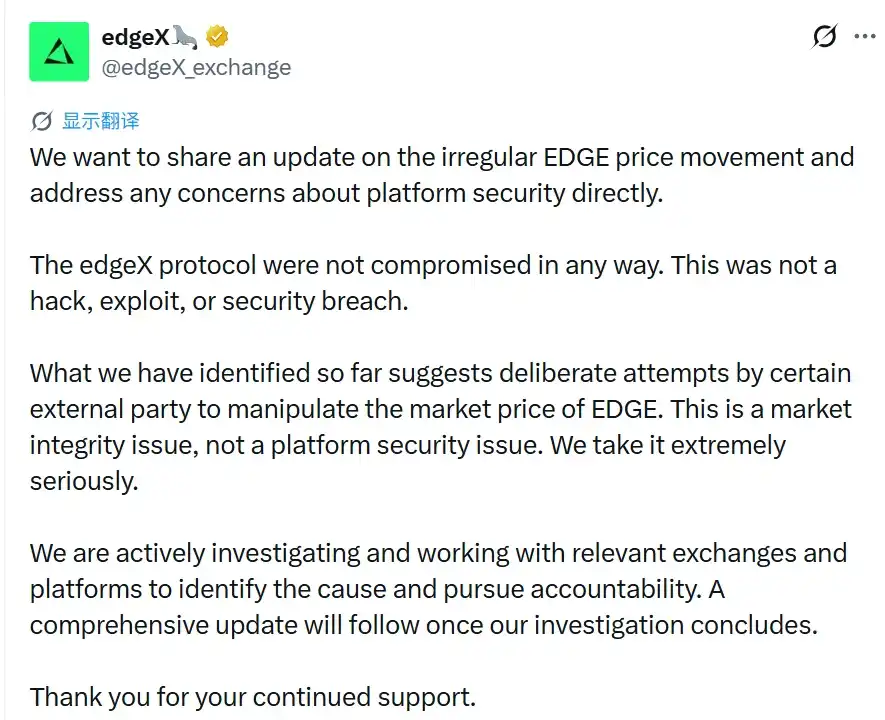
edgeX stated that its protocol was not breached, and there was no hacking or security vulnerability. This price anomaly is suspected to be market manipulation intentionally carried out by external specific entities, making it a market issue rather than a platform security issue. The team is actively investigating and cooperating with relevant exchanges and platforms to trace the responsible parties. Complete investigation results will be announced upon conclusion.

edgeX emphasized that core contracts like SpotVault are operating normally, with no suspicious activity detected, further focusing attention on external market behavior rather than the protocol itself.

On-chain investigator ZachXBT commented after the incident, pointing out that edgeX supply has long been controlled by a few insiders, with low circulation. He called for the project to disclose market maker and counterparty information to improve transparency.
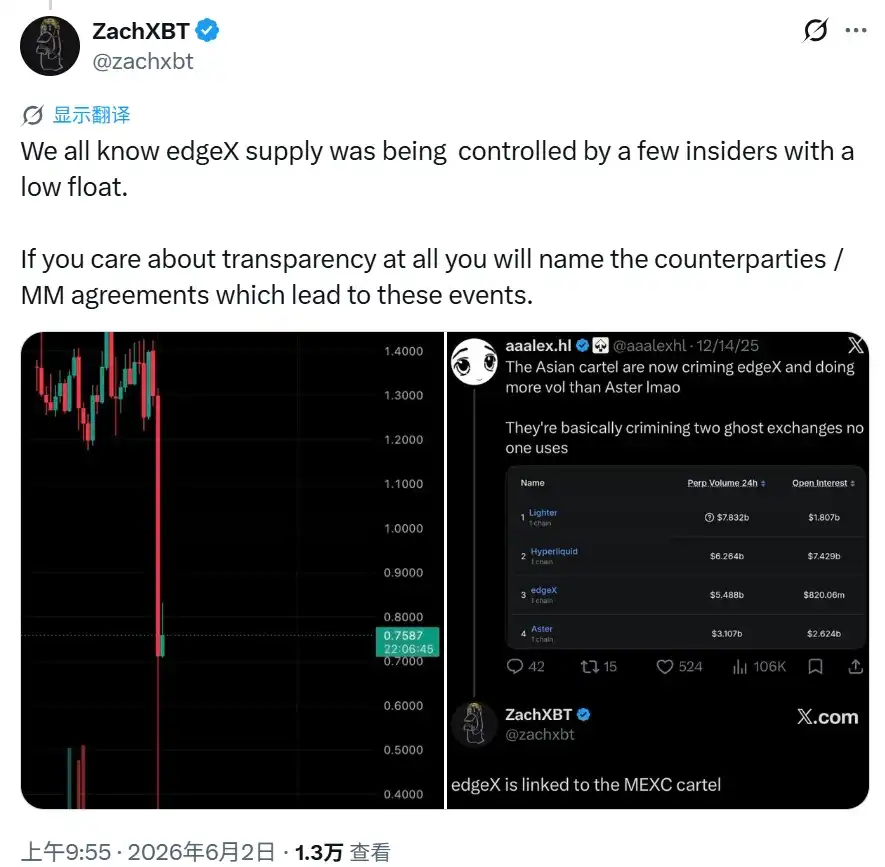
As the incident developed, many users linked this volatility directly to the project's past operations, expressing disappointment in the team's integrity. One community member bluntly stated: "No one is even discussing the EDGE crash anymore. This project team lacks integrity, goes back on their word, there's really little desire to bottom-fish."

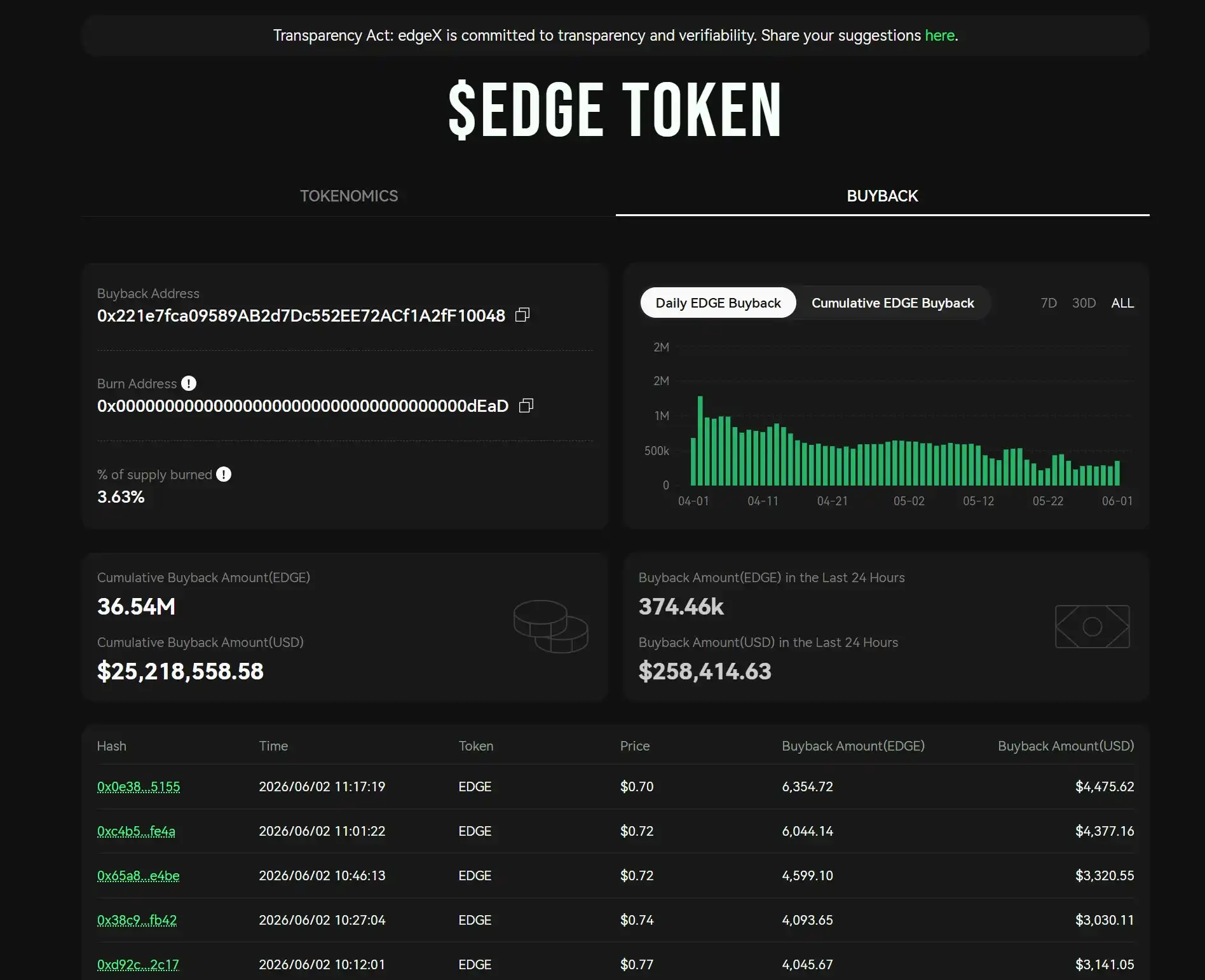
Since its TGE, the EDGE token price rose from $0.7 to $1.5, and subsequently fluctuated around $1.4. The official team also launched a dedicated token website to prove transparency. In late May this year, the protocol launched V2 and adjusted its tokenomics to allocate all profits to repurchasing EDGE. According to its website data, approximately 36.54 million tokens have been repurchased so far, with a total value of around $25 million.
Additionally, related information shows the protocol received investment from Circle Ventures and Amber Group, though specific amounts were not disclosed.

Past Airdrop Controversy Planted Seeds for Subsequent Crash

This incident cannot be separated from the context of edgeX's previous airdrop controversy. In April 2026, the author detailed the entire process of the TGE sparking community dissatisfaction in the article "The Complete Story of the edgeX Airdrop Debacle: An Elaborately Designed Scheme?". The project had promised the community would receive 25% of the token supply, but the actual proportion allocated to ordinary traders was only about 4%, while approximately 14% (valued at around $94.6 million at the time) flowed to partner wallets. Arkham's token flow chart showed at least 80 related addresses were created in 2025, exhibiting consistent behavioral patterns: small test deposits followed by large deposits, and concentrated outflows after TGE, involving about $90 million in token transfers, with some funds flowing to exchanges.

The more core controversy lay in the opaque points exchange mechanism. User feedback indicated huge discrepancies in exchange ratios despite identical trading volumes. Furthermore, the gap between estimated point value (pre-TGE market expectations of $30-40 per point or higher FDV) and actual received amount exceeded 80%. Early contributors and NFT holders also encountered cases of "lowest allocation across the network." Community members flooded the official Twitter account with angry comments, prompting the team to temporarily disable comments.

Afterward, edgeX announced it would lock the controversial 14% share for one year and initiate a buyback, but rejected the community's demand to burn the tokens on Ethereum.
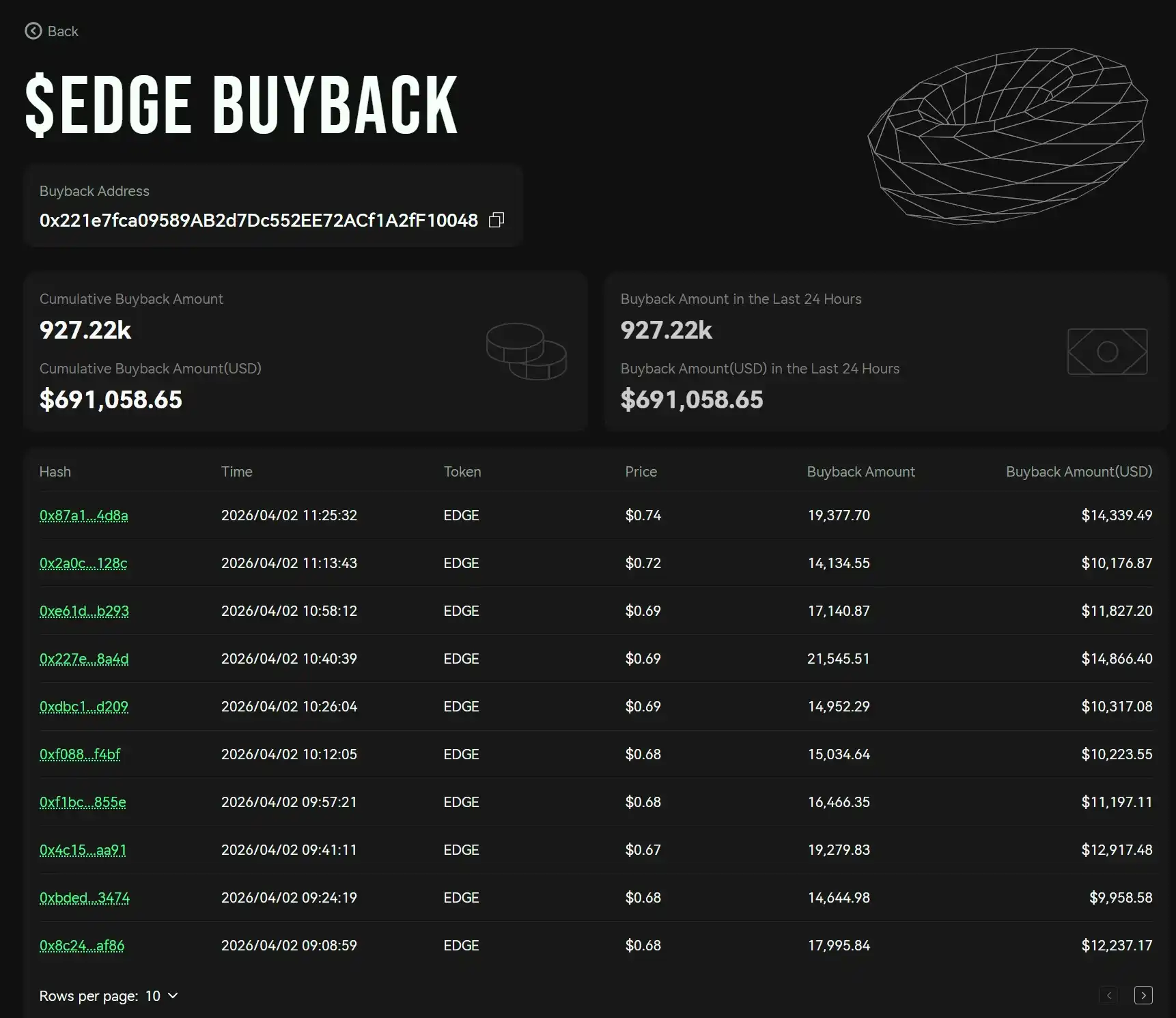
These unresolved issues directly planted the seeds for the current volatility: concentration of chips in a few addresses or related parties makes it easier for external entities to influence prices through large-scale operations. Low circulation is not accidental but an inevitable result of early allocation and lock-up arrangements. When abnormal selling pressure appears in the market, the lack of sufficient depth as a buffer easily triggers a chain reaction.

Structural Risks and Transparency Test

edgeX once carved a niche in the sector with its trading speed, low slippage, and perpetual contract innovation. After TGE, the project experienced a phase of price increase, and its trading volume and fee revenue repeatedly ranked high in DeFi. According to the latest data from DefiLlama, the protocol's total fee revenue over the past 30 days was $10.7 million, and the perpetual DEX's trading volume over the past 30 days reached $42.765 billion.
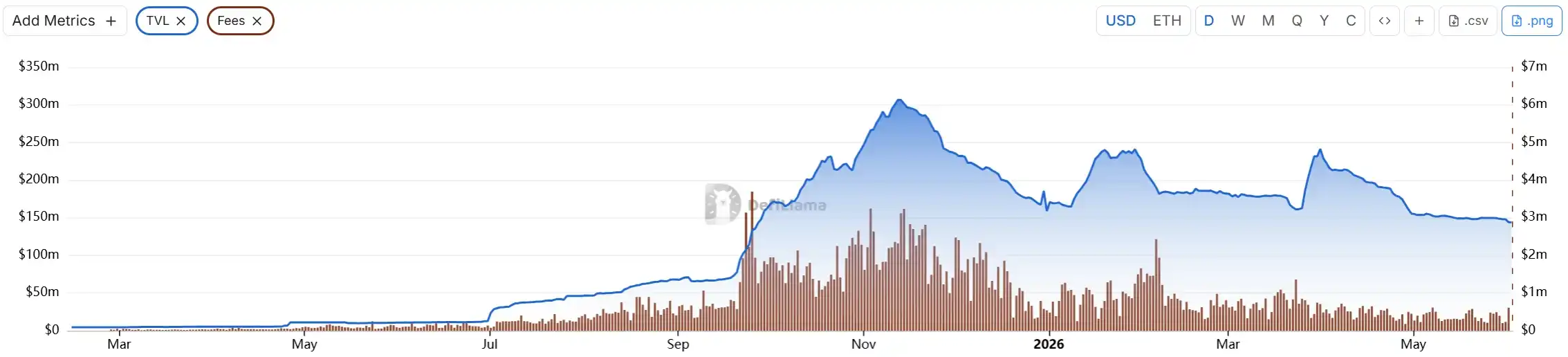
However, from the airdrop allocation controversy to this price anomaly, this model of 'low circulation + high control + opaque market making' has become a tried-and-true 'serial scam scheme' for new projects in recent years. Mouthing 'community first' while wallets honestly dump tokens to related parties is just a single-player game dressed in DeFi clothing.

The accusation of external manipulation is difficult to prove immediately, but the traceable abnormal on-chain transfers are enough to raise community alarm.

Ironically, just as it faces the whirlpool of plummeting token prices, a price prediction market for its EDGE token has quietly launched on Polymarket.
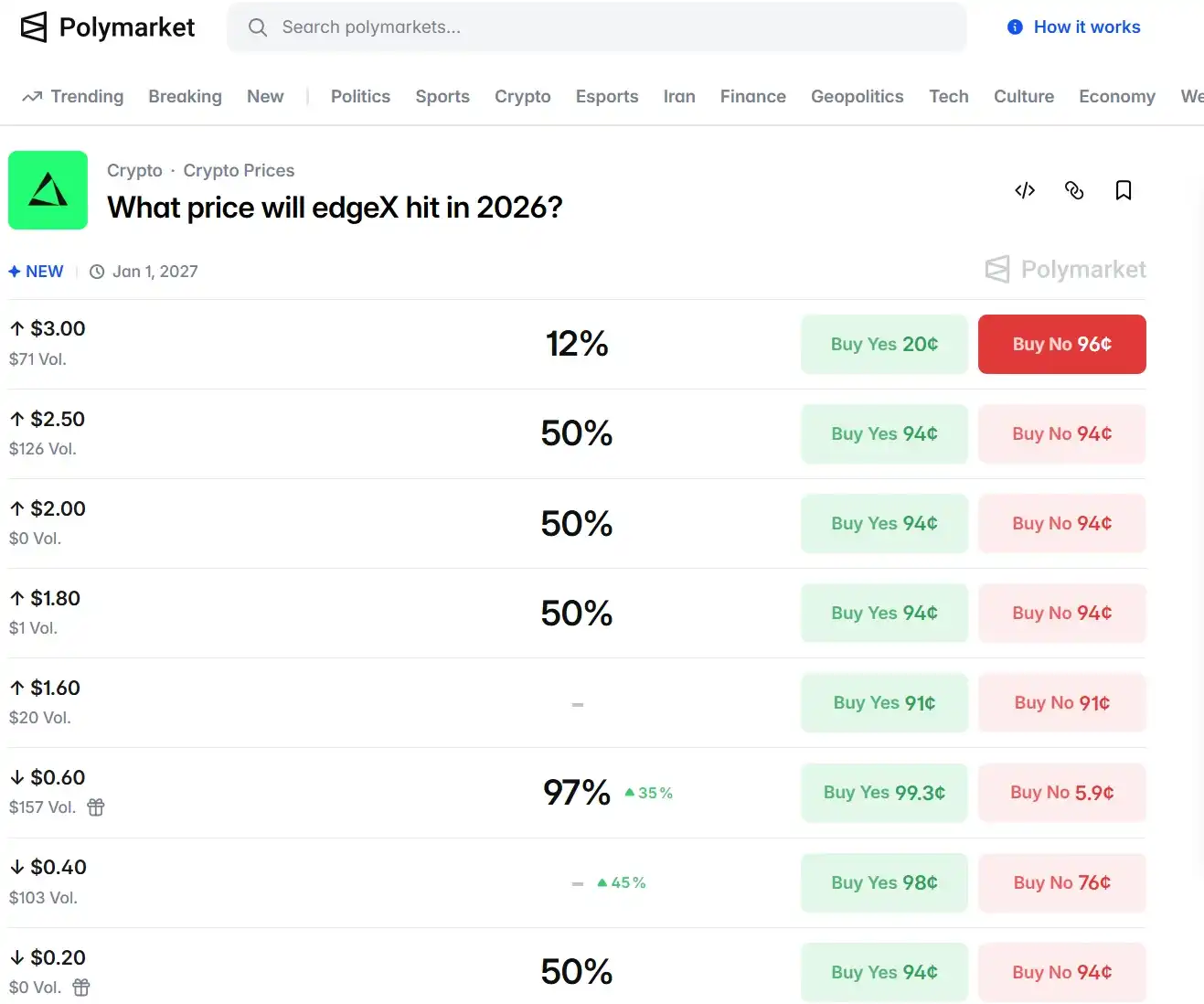
The project team is busy proving its innocence, trapped retail investors are angrily demanding justice. And on Polymarket, some players have already started betting on how much it will rise or fall by this year.


Crypto di tendenza

Domande pertinenti

QWhat caused the sharp 77% price drop in EDGE token according to the edgeX team?

AThe edgeX team explicitly ruled out a hack or platform security vulnerability. They attributed the price drop to 'market manipulation intentionally carried out by a specific external entity', framing it as a market problem rather than a security problem with their platform.

QWhat criticism did ZachXBT level against the edgeX project following the price crash?

AZachXBT criticized the project's lack of transparency. He pointed out that the EDGE supply has long been controlled by a small number of insiders with low circulation, and demanded that the project publicly disclose information about its market makers and counterparties.

QWhat past controversy is mentioned as setting the stage for this price volatility event?

AThe article mentions a significant airdrop controversy from April 2026. The project promised 25% of tokens to the community, but only allocated about 4% to regular traders, while about 14% (worth roughly $94.6 million at the time) went to partner wallets, causing major community discontent and distrust.

QWhat structural risk pattern does the article accuse edgeX and similar new projects of following?

AThe article accuses edgeX of following a pattern common in recent new projects: 'low circulation + high control by insiders + non-transparent market making'. It describes this as a 'serial harvesting scheme' that acts like a single-player game disguised as DeFi.

QHow did the edgeX protocol perform in terms of trading activity prior to this incident according to DefiLlama data?

AAccording to DefiLlama data cited in the article, the edgeX protocol had strong performance metrics. Its total fee revenue over the past 30 days was $10.7 million, and the trading volume for its perpetual DEX over the past 30 days reached $42.765 billion.

Letture associate

Claude's Major New Feature: Screen Recording + Voice, Distilling Your Skills into AI Tasks in One Click

Claude has introduced a major new feature called "Record a Skill," available for Pro, Max, and Team users. This function, found in the Claude desktop app's CoWork menu, allows users to create reusable AI skills simply by recording their screen and providing voice narration while performing a task. Claude then automatically analyzes the recording and generates a functional Skill. A hands-on test confirmed the feature works seamlessly. Users start recording via the Skills manager, perform their workflow while verbally explaining the steps and logic, and avoid including sensitive information. After recording, Claude processes the content and creates the Skill, which can be saved and later invoked with a slash command (/). This eliminates the need for manual adjustments or writing complex instruction files. The innovation goes beyond mere efficiency. Previously, creating a Skill required writing a detailed SKILL.md file in Markdown—a significant barrier for non-technical users. "Record a Skill" bypasses this by directly capturing both actions and the implicit reasoning shared in the narration. This lowers the barrier to knowledge transfer and automation, addressing a core challenge in corporate knowledge management: the difficulty of getting experts to write and maintain documentation. However, the feature also highlights a shift in the nature of work. A case study from March 2026 showed a freelancer whose five-year client relationship was effectively replaced by a hand-coded Claude Skill automating their content workflow. With the even lower barrier of screen recording, the ability to distill personal expertise into automatable skills accelerates this trend. The "moat" for work is moving from simply knowing how to do a task to mastering tasks that are difficult or impossible to automate.

marsbit6 min fa

Claude's Major New Feature: Screen Recording + Voice, Distilling Your Skills into AI Tasks in One Click

marsbit6 min fa

Feeding AI "Noise" Can Also Boost Scores, This Work Enables Positive Transfer with Noise

Feeding "Noise" to AI Can Improve Performance: A Method Enables Positive Transfer from Noise This work, Semi-Supervised Noise Adaptation (SSNA), introduces a Noise Adaptation Framework (NAF) that challenges traditional transfer learning. Instead of requiring a labeled source domain of real data (e.g., images, text), NAF uses randomly generated Gaussian noise as the source. For a target task with C classes, it constructs C noise clusters by sampling from Gaussian distributions. Although this synthetic noise contains no semantic meaning, NAF trains it to form a discriminative class structure in a shared representation space—clustering same-class noise and separating different classes. The key is aligning this learned structure from the noise domain to the real, sparsely labeled target domain. A small number of target labels are still essential to establish the correspondence between noise clusters and actual classes. The training objective combines: 1) supervised loss on the few labeled target samples, 2) classification loss for the noise to build its structure, and 3) a distribution alignment loss (using Negative Domain Similarity) to minimize the gap between the noise and target domains in the shared space. Experiments show significant gains in few-label settings. With just 4 labels per class, NAF with a ResNet-18 backbone improves accuracy over a standard supervised baseline (ERM) by +12.35% on CIFAR-10, +7.61% on CIFAR-100, +4.38% on DTD-47, and +2.74% on Caltech-101. It also benefits fine-grained datasets and scales to ImageNet-1K (with 100 labels/class) and text classification (AG News). NAF can be integrated into existing semi-supervised methods like FixMatch for further gains. Ablation studies confirm the transferred benefit comes from the discriminative structure of the noise, not randomness itself. Collapsing all noise into a single point causes negative transfer, while increasing separation between noise cluster centers improves performance. The amount of noise per class is less critical once a basic structure forms. In conclusion, this work demonstrates that for positive transfer, the semantic content of source data may not be necessary. What can be effectively transferred is the *organizational structure* of categories within a representation space. This offers a promising alternative for scenarios where real source data is unavailable due to privacy, copyright, or procurement constraints.

marsbit7 min fa

Feeding AI "Noise" Can Also Boost Scores, This Work Enables Positive Transfer with Noise

marsbit7 min fa

Trading

Spot

Articoli Popolari

Come comprare EDGE

Benvenuto in HTX.com! Abbiamo reso l'acquisto di edgeX (EDGE) semplice e conveniente. Segui la nostra guida passo passo per intraprendere il tuo viaggio nel mondo delle criptovalute.Step 1: Crea il tuo Account HTXUsa la tua email o numero di telefono per registrarti il tuo account gratuito su HTX. Vivi un'esperienza facile e sblocca tutte le funzionalità,Crea il mio accountStep 2: Vai in Acquista crypto e seleziona il tuo metodo di pagamentoCarta di credito/debito: utilizza la tua Visa o Mastercard per acquistare immediatamente edgeXEDGE.Bilancio: Usa i fondi dal bilancio del tuo account HTX per fare trading senza problemi.Terze parti: abbiamo aggiunto metodi di pagamento molto utilizzati come Google Pay e Apple Pay per maggiore comodità.P2P: Fai trading direttamente con altri utenti HTX.Over-the-Counter (OTC): Offriamo servizi su misura e tassi di cambio competitivi per i trader.Step 3: Conserva edgeX (EDGE)Dopo aver acquistato edgeX (EDGE), conserva nel tuo account HTX. In alternativa, puoi inviare tramite trasferimento blockchain o scambiare per altre criptovalute.Step 4: Scambia edgeX (EDGE)Scambia facilmente edgeX (EDGE) nel mercato spot di HTX. Accedi al tuo account, seleziona la tua coppia di trading, esegui le tue operazioni e monitora in tempo reale. Offriamo un'esperienza user-friendly sia per chi ha appena iniziato che per i trader più esperti.

795 Totale visualizzazioniPubblicato il 2026.03.31Aggiornato il 2026.06.02

Come comprare EDGE

Discussioni

Benvenuto nella Community HTX. Qui puoi rimanere informato sugli ultimi sviluppi della piattaforma e accedere ad approfondimenti esperti sul mercato. Le opinioni degli utenti sul prezzo di EDGE EDGE sono presentate come di seguito.

活动图片