Edel Finance loses $403K as flash-loan oracle exploit hits xStock lending reserves

ambcryptoPubblicato 2026-07-01Pubblicato ultima volta 2026-07-01

Introduzione

Edel Finance, a programmable market layer for tokenized equities, suffered a $403,000 exploit. An attacker manipulated the wrapped xStocks (wGOOGLx) exchange rate via a flash loan, briefly inflating the collateral's value 78-fold to borrow far beyond its true worth. Although the protocol acted promptly to limit losses, the attack revealed critical oracle and collateral pricing vulnerabilities in tokenized lending markets. The exploit severely impacted liquidity, causing total value locked (TVL) to plummet from around $630,000 to roughly $947 as users withdrew funds. A net outflow of approximately $630,000 followed. Recovery hinges on restoring user confidence through deposit growth, stabilized TVL, and stronger oracle protections and risk management practices.

Edel Finance, a programmable market layer for tokenized equities, suffered a roughly $403,000 exploit. This was after an attacker manipulated the wrapped xStocks exchange rate through a flash loan.

The wGOOGLx collateral briefly gained in value about 78-fold over its true value. The inflated valuation allowed the attacker to borrow far more than the collateral’s true value, leaving the lender with significant bad debt.

Fortunately for the users of Edel Finance, they were able to act promptly to contain the issue before additional loss occurring.
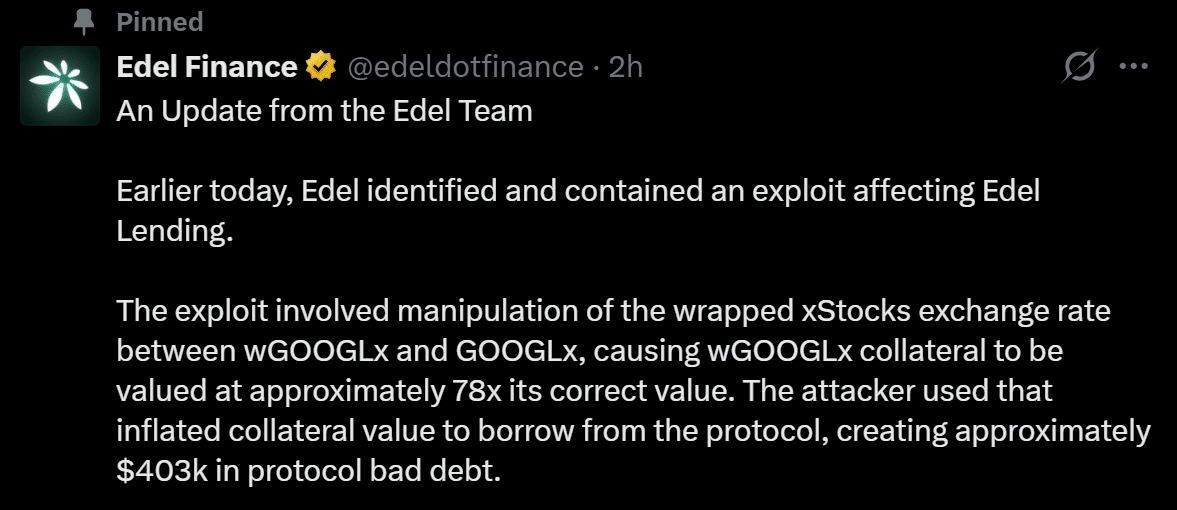
Source: X

In addition, a significant vulnerability was exposed by the attack despite the rapid response by Edel Finance. More importantly, the attack highlighted persistent weaknesses in oracle and collateral pricing across tokenized lending markets.

Conversely, unless the vulnerabilities are fully addressed, confidence remains fragile. Going forward, stronger oracle protections and collateral validation will likely determine how quickly trust returns.

Post-exploit withdrawals leave liquidity under pressure

The aftermath of the exploit quickly spilled into Edel Finance’s liquidity. As confidence deteriorated, total value locked (TVL) plunged from approximately $630,000 to roughly $947, reflecting a rapid wave of user withdrawals.
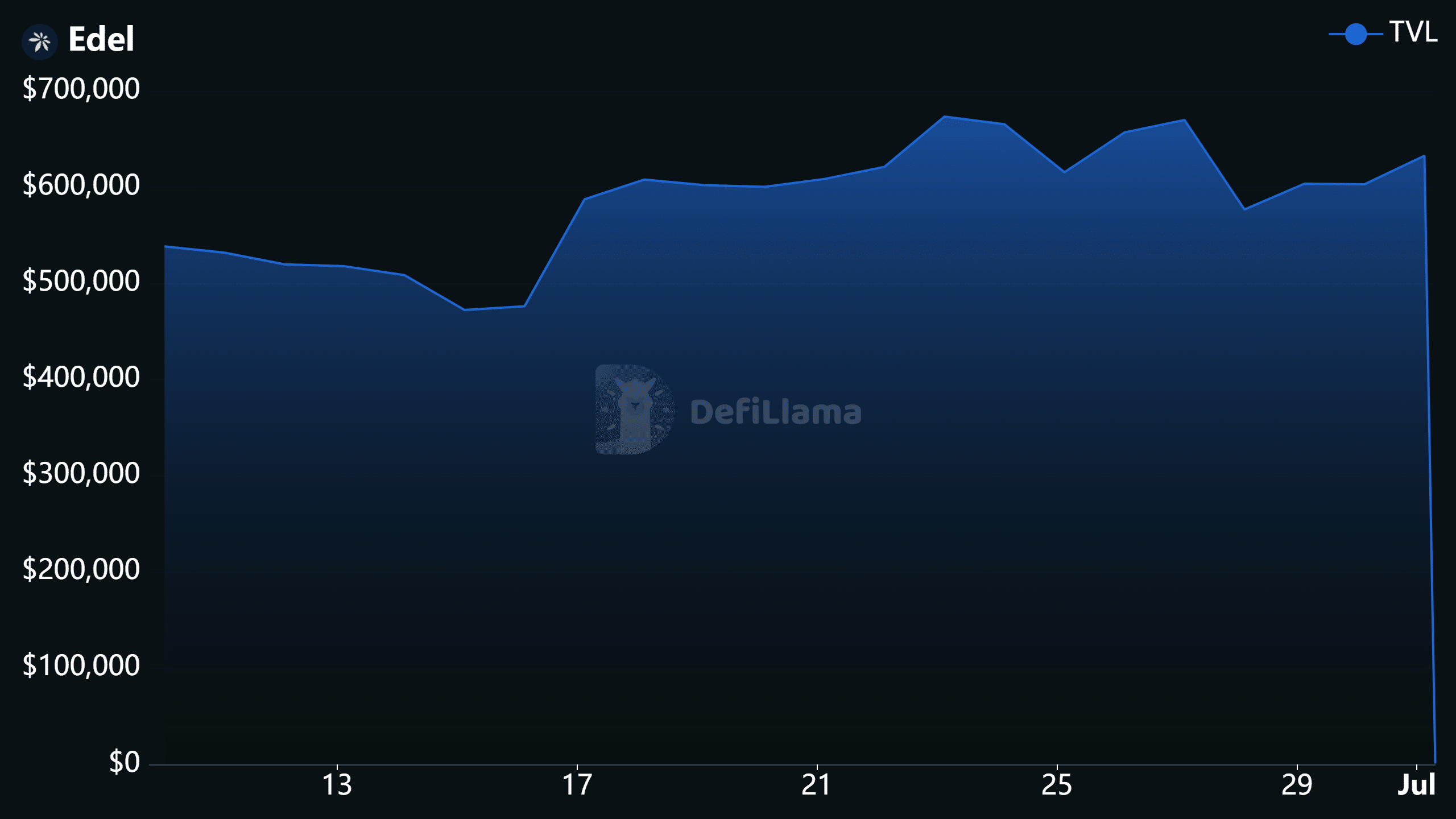
Source: DeFiLlama

Capital flows reinforced the trend further. According to DeFiLlama data, Edel Finance recorded an estimated net outflow of $630,000, the largest on record. Earlier on, a $100,000 inflow had briefly supported liquidity. Even so, it failed to offset the accelerating withdrawals that followed the exploit.
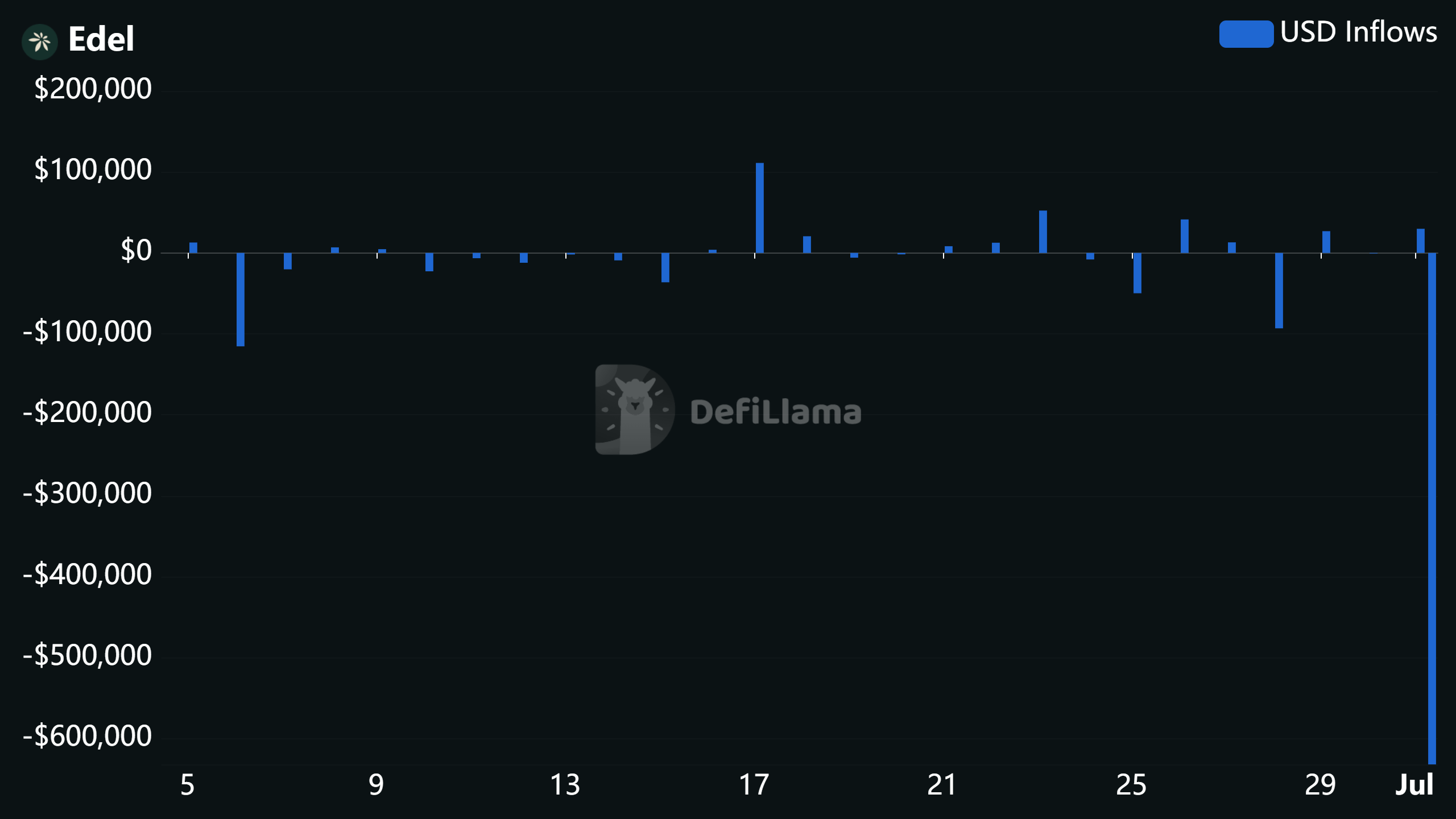
Source: DeFiLlama

These actions suggest that lenders are taking precedence over preserving capital versus supporting the protocol. Going forward, recovery depends on sustained deposit growth, stabilizing TVL, and shrinking daily outflows.

Without continued deposit growth, borrowing will continue to have limited capacity, ultimately limiting the ability of the lending platform to normalize its liquidity and delaying a return to normalcy within the lending markets.

It will take rebuilding confidence among users for meaningful capital to begin returning to Edel Finance through continued use of the lending platform and strengthened risk management practices.


Final Summary

  • Edel Finance’s xStock (wGOOGLx) exploit exposed critical oracle risks, highlighting persistent weaknesses in tokenized lending security.
  • Edel Finance’s recovery now depends on restoring liquidity, rebuilding TVL, and regaining user confidence.


Crypto di tendenza

Domande pertinenti

QWhat was the primary method used by the attacker to exploit Edel Finance?

AThe attacker manipulated the wrapped xStocks exchange rate through a flash loan, artificially inflating the value of wGOOGLx collateral.

QHow much financial loss did Edel Finance suffer due to this exploit?

AEdel Finance suffered a roughly $403,000 exploit.

QWhat specific vulnerability in the protocol did the attack highlight?

AThe attack highlighted persistent weaknesses in oracle and collateral pricing mechanisms across tokenized lending markets.

QWhat happened to Edel Finance's Total Value Locked (TVL) following the exploit?

AFollowing the exploit and user withdrawals, the TVL plunged from approximately $630,000 to roughly $947.

QWhat is identified as essential for Edel Finance's recovery and the return of user capital?

ARecovery depends on rebuilding user confidence, sustained deposit growth, stabilizing TVL, and implementing stronger oracle protections and risk management practices.

Letture associate

Supporters of Bitcoin BIP-110 Update Have Prepared a 'Last Resort' Plan If the Proposal Is Not Adopted: It Could Radically Change BTC's Value

Supporters of the BIP-110 update for Bitcoin have prepared a contingency plan in case the proposal is not adopted, a move that could radically alter BTC's value. Developer Chris Guida has adapted a proof-of-work code originally created by Luke Dashjr in 2017 for the current version of Bitcoin Knots. This adaptation is described as a last-resort measure to be activated if miners do not signal readiness for BIP-110. The proposal itself is a soft fork aimed at temporarily limiting the storage of arbitrary data in Bitcoin transactions. It introduces stricter limits on new transaction outputs, OP_RETURN fields, and witness data, with rules designed to expire after approximately one year. Guida stated this option needs to remain open if miners were to "conspire to betray Bitcoin." Should the contingency code be used, it could change Bitcoin's current mining algorithm. This change would likely prevent existing ASIC miners from generating blocks on the new chain, leading to a large-scale reorganization of the Bitcoin mining network. Luke Dashjr, another Bitcoin Knots developer, contributed to the code and expressed hope it would not be needed, but sees its existence as useful for a potential crisis. A supporter known as Mechanic argued that the mere possibility of a proof-of-work change could act as a deterrent, emphasizing that Bitcoin's rules should be set by participants and node operators, not miners. While miner signals are tracked for BIP-110 activation, data from the proposal's official tracking page indicates support remains limited.

cryptonews.ru19 min fa

Supporters of Bitcoin BIP-110 Update Have Prepared a 'Last Resort' Plan If the Proposal Is Not Adopted: It Could Radically Change BTC's Value

cryptonews.ru19 min fa

Why Did Bitcoin's Price Remain Stable and Not Fall Despite the Recent Major Hack? Here's the Secret

The article discusses why Bitcoin's price remained stable despite a recent $100 million hack targeting individual cold wallets, citing insights from experts on "The Wolf of All Streets" channel. Analysts attribute this resilience to significant institutional shifts in the crypto market. Key points include: 1. **Market Maturation:** The crypto market has transitioned from being dominated by individual retail holders to institutional investors. Most new capital now enters via regulated channels like spot ETFs and custodial services (e.g., Coinbase, Anchorage), making vulnerabilities in individual cold wallets less impactful. 2. **Institutional Dominance:** Control over price dynamics has shifted from miners and crypto exchanges to Wall Street and institutional capital. These large players operate with long-term strategies, viewing price corrections as buying opportunities rather than reasons for panic. 3. **Increased Resilience:** Institutional involvement has reduced market sensitivity to negative news. Sellers are largely exhausted, and remaining holders are steadfast. Major financial institutions (e.g., Morgan Stanley, Wells Fargo) are incorporating crypto assets into portfolios, with research teams recommending allocations of 1–6% to Bitcoin. 4. **Risk Perception:** Bitcoin's integration into traditional financial indices has lowered perceived risk among professionals and institutions, further stabilizing its price against isolated security breaches.

cryptonews.ru59 min fa

Why Did Bitcoin's Price Remain Stable and Not Fall Despite the Recent Major Hack? Here's the Secret

cryptonews.ru59 min fa

Trading

Spot

Articoli Popolari

Come comprare LAYER

Benvenuto in HTX.com! Abbiamo reso l'acquisto di Solayer (LAYER) semplice e conveniente. Segui la nostra guida passo passo per intraprendere il tuo viaggio nel mondo delle criptovalute.Step 1: Crea il tuo Account HTXUsa la tua email o numero di telefono per registrarti il tuo account gratuito su HTX. Vivi un'esperienza facile e sblocca tutte le funzionalità,Crea il mio accountStep 2: Vai in Acquista crypto e seleziona il tuo metodo di pagamentoCarta di credito/debito: utilizza la tua Visa o Mastercard per acquistare immediatamente SolayerLAYER.Bilancio: Usa i fondi dal bilancio del tuo account HTX per fare trading senza problemi.Terze parti: abbiamo aggiunto metodi di pagamento molto utilizzati come Google Pay e Apple Pay per maggiore comodità.P2P: Fai trading direttamente con altri utenti HTX.Over-the-Counter (OTC): Offriamo servizi su misura e tassi di cambio competitivi per i trader.Step 3: Conserva Solayer (LAYER)Dopo aver acquistato Solayer (LAYER), conserva nel tuo account HTX. In alternativa, puoi inviare tramite trasferimento blockchain o scambiare per altre criptovalute.Step 4: Scambia Solayer (LAYER)Scambia facilmente Solayer (LAYER) nel mercato spot di HTX. Accedi al tuo account, seleziona la tua coppia di trading, esegui le tue operazioni e monitora in tempo reale. Offriamo un'esperienza user-friendly sia per chi ha appena iniziato che per i trader più esperti.

347 Totale visualizzazioniPubblicato il 2025.02.11Aggiornato il 2026.06.02

Come comprare LAYER

Discussioni

Benvenuto nella Community HTX. Qui puoi rimanere informato sugli ultimi sviluppi della piattaforma e accedere ad approfondimenti esperti sul mercato. Le opinioni degli utenti sul prezzo di LAYER LAYER sono presentate come di seguito.

活动图片