Earnings Beat Expectations, $222 Million Chain Launch: Can Circle Escape the 'Interest Stock' Valuation Narrative?

marsbitPubblicato 2026-05-12Pubblicato ultima volta 2026-05-12

Introduzione

Circle released its Q1 2026 financial results, with revenue of $6.94 billion missing expectations but adjusted EPS of $0.21 beating forecasts. USDC circulation grew 28% to $770 billion, and on-chain transaction volume surged 263% to $21.5 trillion. The same day, Circle announced it raised $222 million in a token pre-sale for its new Arc blockchain at a $3 billion valuation, led by a16z. It also unveiled Agent Stack, a suite of tools for AI agents to autonomously hold and transact in USDC. CEO Jeremy Allaire stated the company is evolving into a broader internet platform and operating system business. CRCL's stock price rose 16% on the news. Analysts are divided, with some viewing the strategic moves as an effort to shift Circle's valuation narrative away from reliance on USDC interest income and towards being an infrastructure platform and gateway to the AI agent economy. The success of this transition hinges on Arc's adoption and Agent Stack's competitiveness.

Author: Claude, Shenchao TechFlow

Shenchao Introduction: Circle released its Q1 2026 earnings, reporting adjusted EPS of $0.21 which beat expectations, but revenue of $694 million missed estimates. USDC circulation reached $77 billion, and on-chain transaction volume surged 263% to $215 trillion. On the same day, it announced the completion of a $222 million token pre-sale for the Arc blockchain at a $3 billion valuation, with a16z leading a $75 million investment and participation from BlackRock, Apollo, and others. The company also released the Agent Stack toolkit, enabling AI agents to autonomously hold USDC, initiate payments, and call services. CRCL stock soared 16% to $131.76 on the day, bringing year-to-date gains to 66%.

Circle is experiencing its most intense wave of strategic moves since its IPO.

On May 11th, the issuer of the world's second-largest stablecoin, USDC, simultaneously dropped three bombshells: Q1 2026 earnings, the completion of the Arc blockchain token pre-sale, and a new infrastructure toolkit for AI agents called Agent Stack. According to Cointelegraph, CRCL stock closed up nearly 16% at $131.76, hitting its highest level since March 18th and expanding year-to-date gains to 66%, with a market cap of approximately $35 billion.

Circle CEO Jeremy Allaire told CNBC, "We are becoming a broader internet platform company, we're getting into the operating systems business." He positioned Arc as a multi-stakeholder distributed network, analogous to mobile operating systems and cloud platforms.

Viewed together, these three events point to the same conclusion: Circle is attempting to escape the valuation narrative of being a 'one-trick pony' reliant on USDC interest income, and is pivoting towards becoming an infrastructure platform company.

Earnings: Revenue Misses, Profit Beats, USDC Transaction Volume Grows 263%

According to CoinDesk, Circle's Q1 2026 revenue was $694 million, up 20% year-over-year, but below Wall Street's consensus estimate of about $715 million. Adjusted earnings per share were $0.21, beating analyst expectations of $0.17. Adjusted EBITDA was $151 million, a 24% increase year-over-year. Net income was $55 million, down 15% mainly due to post-IPO equity incentive expenses and a 76% increase in operating expenses.

However, key operational metrics showed strong performance.
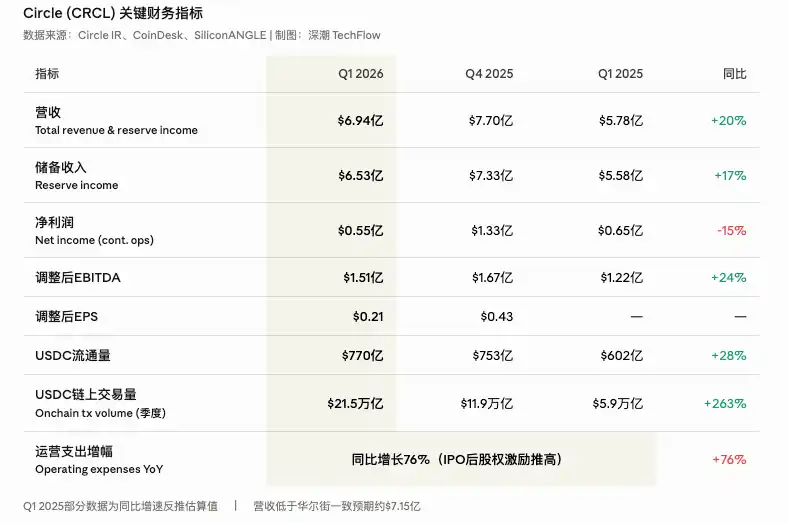
As of the end of Q1, USDC circulation reached $77 billion, up 28% year-over-year. More notably, on-chain USDC transaction volume reached $215 trillion for the quarter, skyrocketing 263% year-over-year. According to a Mizuho analyst report, adjusted USDC transaction volume for 2026 to date is approximately $2.2 trillion, surpassing Tether's USDT (approximately $1.3 trillion), capturing about 64% of adjusted stablecoin transaction volume to take the top spot. This is the first time USDC has led in this metric since 2019.

But the core reason for the revenue miss is clear: interest rates. Over 95% of Circle's revenue comes from interest income on USDC reserve assets. Q1 reserve revenue was $653 million, up 17% year-over-year. In Q4 2025, the reserve yield had already fallen 68 basis points year-over-year to 3.8%. The dampening effect of the interest rate cutting cycle on Circle's revenue is gradually becoming apparent. Even as USDC circulation continues to expand, declining rates remain a sword hanging overhead. This is precisely the underlying motivation for Circle's urgency in crafting its 'second growth curve' story.

Arc Token Pre-Sale: Building Its Own Blockchain, $3 Billion Valuation

Disclosed alongside the earnings was the heavyweight news of the completion of the Arc blockchain token pre-sale. According to an exclusive CNBC report, Circle sold 740 million ARC tokens at a price of $0.30 per token, raising $222 million at a fully diluted valuation of $3 billion. This marks the first token pre-sale conducted by a publicly listed company.

a16z crypto led the round with a $75 million investment. Other participating investors formed a formidable lineup: BlackRock, Apollo Global Management, Intercontinental Exchange (ICE), Standard Chartered Ventures, ARK Invest, General Catalyst, Haun Ventures, and Bullish.
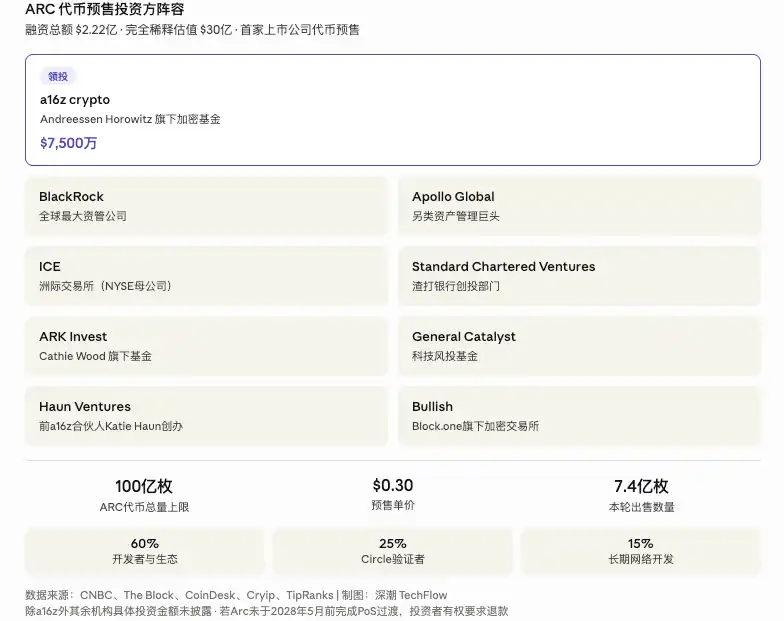
Currently, USDC heavily relies on third-party networks like Ethereum and Solana for settlement and on distributors like Coinbase to reach users. Building its own blockchain signifies Circle's desire to control more of the underlying infrastructure on which USDC operates. From a defensive perspective, with the GENIUS Act signed into law and the CLARITY Act scheduled for a preliminary vote in the Senate Banking Committee this week, the legalization of stablecoin regulation is lowering industry barriers to entry, potentially allowing banks and fintech companies to launch their own dollar tokens. By building its own network, Circle is attempting to lock in a first-mover advantage at the infrastructure layer before this competitive landscape fully materializes.

Circle explicitly stated in its earnings report that current performance guidance does not yet include "future Arc-related revenue streams," hinting that Arc could become an independent revenue source alongside USDC.

Agent Stack: When AI Agents Become the 'Customer'

The third card played on the same day was the Circle Agent Stack, a suite of financial infrastructure tools designed for AI agents.

According to Decrypt, Agent Stack consists of four core components: Agent Wallets allow AI agents to autonomously hold assets; Circle CLI allows developers and AI agents to build applications on the Circle platform; Agent Marketplace enables AI agents to browse, evaluate, and pay for services offered by other agents; Nanopayments, based on Circle Gateway, support gas-free USDC transfers as low as $0.000001.

Allaire stated in the press release, "Financial infrastructure has historically been built for humans, with manual onboarding flows, approvals, and payment flows. It was never designed for software that runs autonomously. Agent Stack is our first full-service suite built for AI agents themselves as customers, not just developers and enterprises."

Circle is betting on a future of machine-to-machine payments: AI agents autonomously transacting with each other, hiring each other's services, settling instantly on-demand, all conducted in USDC.

But Circle is not the only player; recently, Amazon partnered with Coinbase and Stripe, Google Cloud with the Solana Foundation, and MoonPay have all launched similar AI agent stablecoin payment solutions.

$35 Billion Valuation: Can It Hold?

CRCL's current market capitalization is approximately $35 billion, with a forward P/E ratio of about 135x, far above the industry median of around 33x. Citi analyst Peter Christiansen has a $243 price target, Bernstein's Gautam Chhugani has a $190 target, and all 12 analysts tracked by TipRanks give a 'Buy' rating, with a consensus target price of $138.50.

But some are applying the brakes. Compass Point downgraded CRCL to 'Sell' in April, warning that gross margins are narrowing in the first half of 2026 due to USDC supply shifting to lower-margin areas. Even per management guidance, non-reserve revenue (full-year $150-170 million) remains negligible compared to the reserve revenue engine. Whether Arc can transition from a whitepaper to a business line that genuinely contributes revenue is a core validation point for the second half of 2026.

William Blair analyst Andrew Jeffrey told clients that Circle stock "could remain volatile" in the near term, but the company has multiple positive catalysts stemming from its "significant stablecoin commercial advantages."

CRCL had already surged nearly 20% on May 4th when the bipartisan compromise version of the CLARITY Act was finalized. This week's preliminary vote in the Senate Banking Committee will be the next catalytic event. Analysts believe the Act essentially provides Circle with a "regulatory shield": compliance restrictions mean Circle is not required to distribute USDC reserve earnings to users, effectively preserving its profit margins under regulatory cover.

Having played its three cards, Circle's valuation narrative has shifted from a 'stablecoin interest income stock' to an 'infrastructure platform + AI agent economy gateway.' Whether this narrative materializes depends on the actual adoption of the Arc mainnet after its launch and Agent Stack's competitive performance in the machine-to-machine payments arena.


Domande pertinenti

QWhat were the key highlights of Circle's Q1 2026 financial results, and what is the main concern regarding its revenue?

ACircle's Q1 2026 revenue was $6.94 billion, missing analyst estimates, but adjusted EPS of $0.21 exceeded expectations. USDC circulation reached $770 billion, and on-chain transaction volume surged 263% to $21.5 trillion. The main concern is that over 95% of revenue comes from interest on USDC reserves. With interest rates declining, this poses a significant risk to future revenue, driving Circle's need to develop new growth areas.

QWhat is the significance of Circle's Arc blockchain token presale, and which major investors participated?

AThe Arc blockchain token presale raised $222 million at a $3 billion fully diluted valuation. This marks the first token presale by a publicly traded company. Major investors include a16z crypto (leading $75 million), BlackRock, Apollo Global Management, ICE, Standard Chartered Ventures, ARK Invest, General Catalyst, Haun Ventures, and Bullish. Arc aims to give Circle more control over the underlying infrastructure for USDC and create a new, independent revenue stream beyond stablecoin interest.

QWhat is Circle Agent Stack, and what future trend does it represent for the company?

ACircle Agent Stack is a financial infrastructure toolkit designed for AI agents. Its core components include Agent Wallets for autonomous asset holding, a CLI for development, an Agent Marketplace for AI-to-AI service transactions, and Nanopayments for tiny, gasless USDC transfers. It represents Circle's bet on a future of machine-to-machine (M2M) payments, where AI agents autonomously trade, hire services, and settle transactions instantly using USDC, positioning Circle as an entry point to the AI agent economy.

QWhat is the current market valuation and analyst sentiment for Circle (CRCL), and what are the opposing views?

ACircle's market capitalization is approximately $35 billion, with a forward P/E ratio of about 135, significantly higher than the industry median. Analysts are generally bullish, with Citi setting a $243 price target and Bernstein at $190. TipRanks shows all 12 tracked analysts give a 'Buy' rating. However, Compass Point downgraded CRCL to 'Sell', citing narrowing gross margins and the still-insignificant contribution of non-reserve revenue compared to the core interest income business.

QHow is Circle attempting to change its valuation narrative, and what does its success depend on?

ACircle is attempting to shift its valuation narrative from being a 'stablecoin interest income stock' to an 'infrastructure platform + AI agent economy gateway.' This strategic pivot is driven by the launch of the Arc blockchain and the Agent Stack toolkit. The success of this new narrative depends on the actual adoption of the Arc mainnet after its launch and Circle's competitive performance in the emerging machine-to-machine payment sector against rivals like Amazon/Coinbase and Google Cloud/Solana.

Letture associate

Blocked Its Own Treasure, WeChat AI Steps Up

Tencent's stock surged over 10% on June 2nd amid reports that WeChat, with 1.43 billion monthly users, is finalizing tests for a native AI Agent. The reported feature, accessible by swiping right from the main interface, allows users to issue commands in natural language. The AI then decomposes tasks and automatically calls upon relevant Mini Programs within WeChat to complete actions like ordering food, booking tickets, or making payments, creating a closed-loop service execution system. This strategic shift follows the internal conflict and subsequent "blocking" of Tencent's standalone AI app, Yuanbao, by WeChat for violating sharing rules during a 2026 Spring Festival promotion. The incident highlighted a lack of internal consensus and exposed the weakness of competing in the standalone AI assistant arena against rivals like ByteDance's Doubao (345M MAU) and Alibaba's Qianwen. The new WeChat AI Agent aims to leverage WeChat's unique assets—its massive user base, standardized Mini Program APIs, WeChat Pay, and identity system—to move from simple content generation to actual task execution. Analysts note this changes the competitive landscape from model benchmarks to which AI can connect to more real-world services. However, success depends on key variables: the capability of Tencent's underlying Hunyuan model, managing massive inference costs, and redesigning incentives for Mini Program developers whose traffic might be bypassed. The move is seen as an attempt to keep user service intent within WeChat's ecosystem as AI begins to redefine how users access services.

marsbit17 min fa

Blocked Its Own Treasure, WeChat AI Steps Up

marsbit17 min fa

ByteDance Adopts Arm CPUs, Jensen Huang: So Sad I Didn't Buy Arm

**Summary:** At Computex 2026, Arm CEO Rene Haas announced that ByteDance and Oracle have adopted Arm's self-designed Arm AGI data center CPU. The company expects significant revenue growth from this product, projecting $20 billion in demand for the 2027/2028 fiscal years. Haas noted that restricting AI-capable CPUs from the US to China is nearly impossible due to their widespread applications. Arm's stock has surged dramatically this year, notably rising 16% after NVIDIA's Arm-based Vera CPU and RTX Spark announcements. A highlight was the informal, humorous on-stage conversation between Haas and NVIDIA CEO Jensen Huang. Huang joked about NVIDIA's failed attempt to acquire Arm and playfully lamented selling his Arm shares. Both executives showed a clear sense of camaraderie and shared regret over the missed merger. Key technical topics were discussed: 1. **AI PC Design:** Huang explained NVIDIA's RTX Spark superchip (with a 20-core Arm CPU) is designed for future AI agents that will autonomously run and use tools on PCs, blending local and cloud processing. 2. **Agent vs. OS:** Huang emphasized the operating system remains crucial, as AI agents rely on its APIs and tools to function. 3. **Growth Constraints:** He identified the shift to "useful AI" that generates profitable tokens as a primary driver for immense, almost limitless, computational demand. Haas outlined Arm's strategy across PC and data centers. For PCs, Arm collaborates with partners like NVIDIA and MediaTek, offering its compute subsystem (CSS) for custom SoCs. In data centers, its Arm AGI CPU (built on TSMC's 3nm process) has gained major partners including OpenAI, Meta, and now ByteDance and Oracle. Arm presented a multi-year roadmap for its in-house CPU line. The article concludes that while GPUs dominated the AI training race, the explosion of AI agents is shifting significant focus to CPUs for inference, state management, and tool orchestration. The industry is trending towards vertical integration, with companies like cloud providers designing chips and chip/IP firms offering full solutions, all competing to deliver more efficient computing per watt.

marsbit37 min fa

ByteDance Adopts Arm CPUs, Jensen Huang: So Sad I Didn't Buy Arm

marsbit37 min fa

New Wall Street Play: Yen Shorts Still Adding, But Japan Stocks Don't Rely on Carry Trade Unwinding

On June 3rd, USD/JPY hit 160.44, its highest level since July 2024, while the Nikkei 225 surged past 68,000 points. Contrary to popular narratives of an imminent "carry trade unwind" akin to August 2024, data reveals a more complex picture. Speculative net short positions in yen futures have actually increased, reaching -114,667 contracts by late May, suggesting traders are doubling down rather than retreating. Meanwhile, Japan's Finance Ministry conducted its largest-ever single-round FX intervention (11.73 trillion yen) in April-May but failed to hold the 160 yen line. The Nikkei's rally is not driven by carry trade dynamics. Foreign investors are aggressively buying Japanese stocks, with net purchases in 2026 running nearly 16 times higher than 2025 levels. This inflow is concentrated in AI and semiconductor-related stocks like SoftBank and Socionext, fueled by positive sector outlooks, rather than being a flight from unwinding yen shorts. Furthermore, the Nikkei has continued climbing despite the Bank of Japan's (BOJ) rate hikes to 0.75%. This disconnect exists because the current equity boom is fueled by AI-driven foreign investment, not reliant on cheap yen funding. However, this relationship remains fragile. Should the BOJ hike rates further (e.g., to 1.0%) while dollar weakness increases carry trade costs, the trajectories of the yen and Japanese stocks could reconverge, potentially triggering volatility.

marsbit41 min fa

New Wall Street Play: Yen Shorts Still Adding, But Japan Stocks Don't Rely on Carry Trade Unwinding

marsbit41 min fa

Broadcom's Q3 Guidance Misses Expectations by $12 Billion, After-Hours Trading Plummets Over 13%, AI Narrative "Cooling"?

On June 3, Broadcom released record Q2 FY26 results with revenue of $22.19B, up 48% YoY, and AI chip sales of $10.8B, up 143%. Adjusted EPS of $2.44 beat estimates. However, its Q3 AI semiconductor revenue guidance of $16B, while up over 200% YoY, fell roughly $1.2B (7%) short of analyst consensus expectations of $17.2B. This miss, coupled with slightly weaker-than-expected software revenue, triggered a severe market reaction. CEO Hock Tan maintained the FY26 AI revenue outlook of over $100B but did not raise it, disappointing investors who had priced in more robust growth. The stock plummeted over 13% in after-hours trading, erasing roughly $270B in market cap. The sell-off extended to peers like Marvell. A key concern for markets, particularly for Chinese optical module suppliers, was Tan's comment that the contribution of AI networking (e.g., Ethernet switches, optical interconnect chips) to AI revenue, currently near 40%, is expected to normalize to around 30% over time, signaling a potential peak in growth for that segment. Despite the guidance shortfall, Tan reiterated that AI demand remains "insatiable" and reaffirmed the long-term target of exceeding $100B in AI revenue by FY27. The reaction highlights the heightened sensitivity and premium valuation placed on AI-exposed stocks, where anything less than stellar guidance can prompt significant profit-taking. The broader question is whether this represents a cooling AI narrative or a correction in overstretched valuations.

marsbit42 min fa

Broadcom's Q3 Guidance Misses Expectations by $12 Billion, After-Hours Trading Plummets Over 13%, AI Narrative "Cooling"?

marsbit42 min fa

Trading

Spot
Futures

Articoli Popolari

Come comprare BEAT

Benvenuto in HTX.com! Abbiamo reso l'acquisto di Audiera (BEAT) semplice e conveniente. Segui la nostra guida passo passo per intraprendere il tuo viaggio nel mondo delle criptovalute.Step 1: Crea il tuo Account HTXUsa la tua email o numero di telefono per registrarti il tuo account gratuito su HTX. Vivi un'esperienza facile e sblocca tutte le funzionalità,Crea il mio accountStep 2: Vai in Acquista crypto e seleziona il tuo metodo di pagamentoCarta di credito/debito: utilizza la tua Visa o Mastercard per acquistare immediatamente AudieraBEAT.Bilancio: Usa i fondi dal bilancio del tuo account HTX per fare trading senza problemi.Terze parti: abbiamo aggiunto metodi di pagamento molto utilizzati come Google Pay e Apple Pay per maggiore comodità.P2P: Fai trading direttamente con altri utenti HTX.Over-the-Counter (OTC): Offriamo servizi su misura e tassi di cambio competitivi per i trader.Step 3: Conserva Audiera (BEAT)Dopo aver acquistato Audiera (BEAT), conserva nel tuo account HTX. In alternativa, puoi inviare tramite trasferimento blockchain o scambiare per altre criptovalute.Step 4: Scambia Audiera (BEAT)Scambia facilmente Audiera (BEAT) nel mercato spot di HTX. Accedi al tuo account, seleziona la tua coppia di trading, esegui le tue operazioni e monitora in tempo reale. Offriamo un'esperienza user-friendly sia per chi ha appena iniziato che per i trader più esperti.

175 Totale visualizzazioniPubblicato il 2026.01.22Aggiornato il 2026.06.02

Come comprare BEAT

Discussioni

Benvenuto nella Community HTX. Qui puoi rimanere informato sugli ultimi sviluppi della piattaforma e accedere ad approfondimenti esperti sul mercato. Le opinioni degli utenti sul prezzo di BEAT BEAT sono presentate come di seguito.

活动图片












