Earning $100,000 in 10 Days: An Interview with OpenClaw's Practical Experience in Prediction Markets

Odaily星球日报Pubblicato 2026-03-16Pubblicato ultima volta 2026-03-16

Introduzione

In an interview with Odaily Planet Daily, Kevin, a former ERP architect and Web3 investor, shares how he used OpenClaw to generate a profit of approximately $100,000 in just 10 days, turning a $30,000 investment into over $130,000 at its peak (currently around $112,000). Kevin began his crypto journey during the "inscription summer" of 2023, earning his first significant returns from ORDI. He later transitioned to prediction markets, specifically Polymarket, in mid-2025, attracted by its improved liquidity and user experience. Initially, he used self-developed algorithmic strategies for arbitrage, primarily in sports betting markets, doubling a $100,000 investment over several months. Since integrating OpenClaw in late February, Kevin adopted a hybrid approach: 60% of his strategy remains automated arbitrage, while 40% uses OpenClaw for predictive betting. OpenClaw helps gather and analyze factors like smart money movements, public sentiment, team lineups, and player conditions—even identifying new influencing variables. It also automates backtesting, strategy discovery, and execution, making it effective in Polymarket due to its AI-friendly API. While currently focused on sports markets with limited automated capital ($1,000 per test account), Kevin plans to expand into other domains and may later offer paid OpenClaw "Skills" based on his methodology.

Original | Odaily Planet Daily (@OdailyChina)

Author | Golem (@web 3_golem)

Currently, "raising lobsters" is no longer difficult, but how to master OpenClaw and actually use it to make money still puzzles many lobster farmers.

Last week, I spoke with some deep users of OpenClaw in the crypto space. Some mentioned that OpenClaw's heartbeat mechanism and scheduled tasks can improve the efficiency of news trading, but more interviewees believed that using OpenClaw to trade cryptocurrencies for profit is still challenging.(Related reading:Odaily Editorial Tea Party)

However, where there's a will, there's a way. A trader named Kevin , with the assistance of OpenClaw, turned a $30,000 principal into 4 times its value in 10 days, achieving a net profit of $100,000 (currently slightly retraced to $82,000). Kevin himself stated that this was initially just an experiment, but he didn't expect to actually make money.
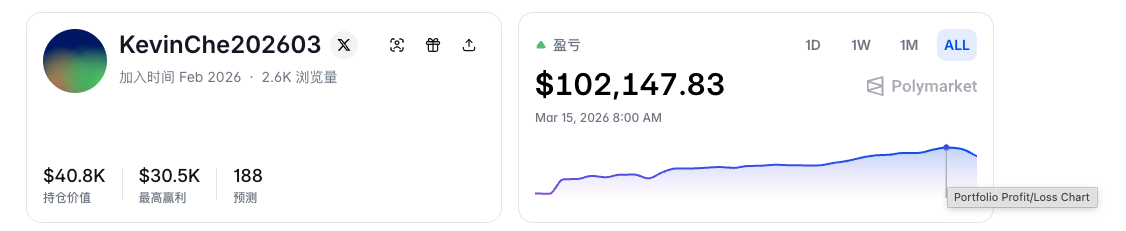
So how did Kevin transform OpenClaw from a toy that only burns tokens into a money-making machine? Odaily Planet Daily spoke with Kevin, who shared his personal crypto journey and how he leveraged OpenClaw in prediction markets, hoping readers can gain some inspiration.

Transition from "Scientist" to "Prophet"

Kevin's early career primarily involved designing ERP architectures for enterprises. He later joined a Top 3 domestic internet giant to build a sports event betting software system from scratch. This professional background laid the foundation for Kevin's current achievements in prediction markets. After 2018, Kevin entered the Web3 investment sector, mainly incubating and accelerating startups.

However, Kevin's first real windfall came five years after entering the crypto space. In 2023, ordi emerged, ushering in the "Inscription Summer" for the crypto market. With a background in computers and code, Kevin became one of the highly sought-after "scientists" at that time(Odaily Note: Scientists refer to those who could write programs and code to quickly participate in new asset deployments during the inscription craze).

"The period when ordi was listed on Binance was when my account assets reached their peak. I ultimately pocketed about over 2 million RMB," Kevin said, noting that he was also among the first batch of people to participate in the ordi launch, with a cost of less than 1 RMB per token, subsequently enjoying a thousand-fold increase.

After inscriptions completely cooled down, Kevin began searching for other opportunities and finally started seriously researching and participating in the prediction market Polymarket in the summer of 2025. "I had played Polymarket before, but the liquidity was poor, so I ignored it," Kevin said. For someone who had worked in traditional sports betting, the early Polymarket's trading depth was completely insufficient.

However, after Polymarket successfully predicted Trump becoming the 47th President of the United States in 2025, Kevin's attention returned to Polymarket. "After 2025, Polymarket's reputation grew, its liquidity could handle large orders, and more importantly, deposits and withdrawals became very convenient," so Kevin began experimenting with algorithms on Polymarket, becoming a "prophet".

Kevin's journey in prediction markets is divided into two stages: before using OpenClaw assistance and after using OpenClaw assistance. For clarity, Odaily Planet Daily has condensed Kevin's sharing as follows, enjoy~

How to Play Prediction Markets Before Using OpenClaw

Odaily Planet Daily: When you started playing Polymarket in the summer of 2025, how much money did you invest, and what was the final profit?

Kevin: I invested a total of about $100,000 at that time, and the total profit by this year is approximately double the principal.

Odaily Planet Daily: What strategy did you mainly use?

Kevin: I don't bet directly; instead, I wrote programs for automated arbitrage to make money. My previous experience building sports event betting systems in a Web3 internet company, which also involved order book design, was very helpful in understanding Polymarket's order book. Therefore, I used programs to capture spreads between order books, especially in sports events, where a lot of emotional arbitrage can be done.

Odaily Planet Daily: Do you have a dedicated team, and is anyone providing you with funds?

Kevin: I'm doing this alone; AI assistance is enough. Initially, I was afraid Polymarket might hinder withdrawals, so I ran dozens of accounts. But later, I found the deposit and withdrawal process very smooth, so I reduced the number of accounts. I mainly use my own money to run strategies, but indeed, some people provide funds for me to run strategies for them, but this is just one way to make money.

How to Play Prediction Markets After Using OpenClaw

Odaily Planet Daily: So when did you start using OpenClaw to play prediction markets?

Kevin: At the end of February. This was itself an experiment to see how much money OpenClaw could make at the trading level, but I didn't expect it to actually make money. For example, the account KevinChe202603, I used $30,000 in capital and made up to $100,000 at its peak, all within just 10 days.

Odaily Planet Daily: So what is your specific strategy?

Kevin: Frankly, this account's strategy is mixed. Currently, 60% is still running the previous automated arbitrage algorithm, and 40% is using the "Lobster" (OpenClaw) for subjective betting. Compared to market making arbitrage, betting is a complex decision, requiring consideration of the prediction market's smart money, sentiment, lineups, player form, etc. OpenClaw's role here is to actively collect various factors that determine the outcome of a match and turn them into an indicator. After several training sessions, it can also find other influencing factors that I might overlook, saving me a lot of time and mental effort.

Odaily Planet Daily: But isn't this just AI predicting matches? Conversational AI can do that too, and some developers have even specifically created AI prediction tools for matches. What's special about OpenClaw?

Kevin: Having an information advantage is just one of OpenClaw's strengths. It can also mine new strategies by itself, conduct its own backtesting, and perform automated betting in matches. If the strategy is good, we just need to give the money to OpenClaw; everything else is automated, which AI prediction tools cannot do. For example, it can actively discover some smart money addresses and fool addresses, either following the smart money's bets or using the fool addresses as a counter-indicator.

Additionally, this is why Polymarket, among all prediction markets, integrates particularly well with OpenClaw—because Polymarket's API is the most AI-friendly, making data access very convenient for AI.

Odaily Planet Daily: In which areas is OpenClaw primarily betting now? Is it fully automated already?

Kevin: Based on my areas of expertise, OpenClaw is currently also experimenting mainly in the sports competition领域. But once mature, I will consider expanding OpenClaw to other areas. Right now, I give OpenClaw small amounts of capital for automated betting, around $1000. I still don't dare to put too much money in a fully automated account.

Odaily Planet Daily: Is your strategy replicable? Or will you write a Skill for the market in the future?

Kevin: Also trying. Because there is indeed user demand for this, to see if my methodology can be combined to allow everyone to build a money-making Lobster. Later, I also plan to package some Skills for the market to use, which will certainly be paid.


Domande pertinenti

QWhat was Kevin's initial investment and profit using OpenClaw in the prediction market?

AKevin started with a $30,000 investment and achieved a peak profit of $100,000 within 10 days, though it later retraced to $82,000.

QWhat was Kevin's professional background before using OpenClaw in prediction markets?

AKevin initially designed ERP systems for enterprises, then worked at a top-three internet company in China to build sports betting systems from scratch, and later moved to Web3 investment to incubate startups.

QHow did Kevin use OpenClaw to assist in his prediction market strategy?

AKevin used OpenClaw to collect various factors influencing game outcomes, transform them into indicators, and automate betting. It also helped identify smart money addresses and automate strategies, with 40% of his account using OpenClaw for subjective betting.

QWhat was Kevin's strategy in prediction markets before using OpenClaw?

ABefore OpenClaw, Kevin used automated arbitrage programs to profit from spreads between different market makers, particularly in sports events, leveraging emotional arbitrage without personally gambling.

QWhy does Kevin believe Polymarket is well-suited for integration with OpenClaw?

AKevin believes Polymarket is ideal for OpenClaw integration because it has user-friendly APIs that make data access easy for AI, good liquidity for large orders, and smooth deposit and withdrawal processes.

Letture associate

Annual Salary of Millions Competing for Electricians, Meta Rushes to Open Its Own Technical School

The AI boom is facing an unexpected bottleneck: a severe shortage of skilled construction workers and electricians. As tech giants like Meta, OpenAI, and Alphabet race to build massive data centers—such as OpenAI's $16 billion "Stargate" project—they are hitting a critical labor wall. The U.S. needs an estimated 130,000 more electricians, 240,000 construction workers, and 150,000 supervisors by 2030 for AI infrastructure alone, but tens of thousands of electrician jobs go unfilled each year. While AI companies offer high premiums, with electricians earning up to $280,000 annually, worker scarcity still causes massive losses—delays on a single project can cost $14.2 million per month. The complexity of building AI data centers, which require immense power (equivalent to powering hundreds of thousands of homes), sophisticated electrical systems, and advanced liquid cooling solutions, demands highly skilled technicians who are in short supply. To combat this, companies are investing heavily in training. Meta has committed $115 million to a free training school offering tuition, housing, and stipends, targeting 5,000 new workers. OpenAI is partnering with unions to secure skilled labor. These efforts are paying off, with a significant rise in Gen Z interest in trade schools over college. However, the power demands are staggering. AI data centers are driving a rapid surge in electricity consumption, projected to account for up to 12% of U.S. power use by 2028 and raising costs for consumers. Furthermore, the construction boom is project-based, leading to a potential future glut of trained workers once building peaks, which could depress wages industry-wide. The race for AI supremacy now depends as much on skilled hands as on advanced chips.

marsbit26 min fa

Annual Salary of Millions Competing for Electricians, Meta Rushes to Open Its Own Technical School

marsbit26 min fa

OpenAI No Longer Sells Its Most Expensive Model for Profit

OpenAI is shifting its business strategy away from promoting its most expensive, flagship models for every task. Recent price cuts—80% for GPT-5.6 Luna and 20% for Terra—signal a deeper change: the company now actively advises users that many tasks don't require the most powerful model. Instead, OpenAI recommends a tiered approach: use the high-end GPT-5.6 Sol for complex planning and analysis, then delegate execution to cheaper models like Luna. This mirrors moves by Anthropic, which recently launched Claude Opus 5 at half the price of its top model, Fable 5. Both companies are de-emphasizing flagship models as primary revenue drivers, using them instead for brand prestige and technological showcases. The industry is entering a "mass-market" phase, similar to automotive, where high-volume, cost-effective models handle daily operations and drive scale. OpenAI's price reductions are partly enabled by AI models themselves optimizing underlying code and infrastructure, creating a self-reinforcing cycle of efficiency gains and cost reduction. Competition is shifting from "who is smartest" to "who offers the best value." The goal is no longer selling individual models but fostering widespread API adoption and ecosystem lock-in. By making AI calls cheap and ubiquitous, companies like OpenAI aim to become the indispensable, utility-like infrastructure powering automated workflows—the "water and electricity" of software, quietly embedded everywhere.

marsbit26 min fa

OpenAI No Longer Sells Its Most Expensive Model for Profit

marsbit26 min fa

Will the Fed Definitely Raise Interest Rates in September? How Will Crypto and U.S. Stocks Withstand the Pressure?

The market's expectation for a September Fed rate hike surged dramatically in early August, jumping from under 50% to over 80% within a week. This shift followed a contentious July FOMC meeting, where a 9-3 vote to hold rates revealed growing dissent from hawkish members advocating for an immediate hike to combat persistent inflation. The primary catalyst for this repricing is rising oil prices, driven by renewed geopolitical tensions around the Strait of Hormuz, which threaten global supply. Energy costs directly influence inflation metrics, making the upcoming July CPI report (due August 12th) a critical data point. If it shows inflation reaccelerating, the probability of a September hike will solidify. For Bitcoin and crypto assets, this is typically bearish news. Bitcoin continues to behave as a high-beta, liquidity-sensitive risk asset. A rate hike raises the opportunity cost of holding non-yielding assets and could drive capital toward money markets, pressuring crypto prices in the short term. However, historical patterns suggest that if a hike is perceived as the end of a tightening cycle rather than the start, any negative price impact may be brief. U.S. stocks, particularly crypto-linked equities like Coinbase and growth-oriented tech stocks, are also vulnerable. Higher rates increase discount rates in valuation models, putting pressure on high-multiple companies. This coincides with a pivotal tech earnings season where investor focus has shifted from massive AI capital expenditure to tangible revenue and cash flow generation. Companies with negative cash flow and weak growth narratives could face heightened volatility if borrowing costs rise in September. In summary, a September Fed hike has evolved into a mainstream market scenario. Key factors to watch are oil prices, the July CPI report, and Fed communications, which will determine the final decision and its impact on volatile crypto and equity markets.

marsbit37 min fa

Will the Fed Definitely Raise Interest Rates in September? How Will Crypto and U.S. Stocks Withstand the Pressure?

marsbit37 min fa

Trading

Spot
活动图片




