Early Trading Made a Fortune? A Comprehensive Guide to Genius's New Rules

Odaily星球日报Pubblicato 2026-01-20Pubblicato ultima volta 2026-01-20

Introduzione

**Title: Early Traders Made Huge Gains? Understanding Genius' New Rules** Genius, a highly discussed DEX, announced new GP points rules for its Season 1, ending April 12, with a 50% increase in airdrop allocation. The team confirmed that GP points earned from early trading volume remain valid, benefiting users who followed initial interaction guides. Key updates: - Total S1 GP points are fixed at 200 million, with 75 million already distributed from pre-whitepaper trading. The remaining 125 million will be distributed weekly starting January 20, at 10 million GP per week. - Distribution is weighted to prevent whales from dominating, allowing smaller traders to earn points. - Stablecoin swaps (e.g., USDT/USDC) now have a 0.5x weight; other spot trades retain 1.0x. - Previous task-based and referral GP rewards were removed. Now, points are earned solely via spot trading volume. - New trading tiers introduce fee discounts based on cumulative trading volume, though zero-fee trading remains active indefinitely. - Referrals now offer 35% commission on invitees’ trading fees post-zero-fee campaign. - The GENIUS token will be created before April 12, 2026, with a TGE expected randomly before then. Despite platform bugs from high traffic, Genius’ strong backing (including investment from YZi Labs and CZ as advisor) and confirmed TGE make it noteworthy. With a potential $300M FDV and 10% airdrop, each GP point could be worth ~$0.15. Early participants may have profitable opportuniti...

Original | Odaily Planet Daily (@OdailyChina)

Author | Asher (@Asher_ 0210)
Yesterday, Genius, a DEX that has been highly discussed recently, announced new point rules on platform X: Season 1 will end on April 12, with an additional 50% airdrop quota.

Notably, the Genius team stated that the GP points earned from trading volume have been retained. Congratulations to those who participated early through the point-earning guide shared by Odaily Planet Daily (click here to jump to the article: YZi Labs Invests Tens of Millions, CZ as Advisor—How to Earn Genius Points?). These users may have already "made a fortune" in GP points (platform website: https://www.tradegenius.com/).
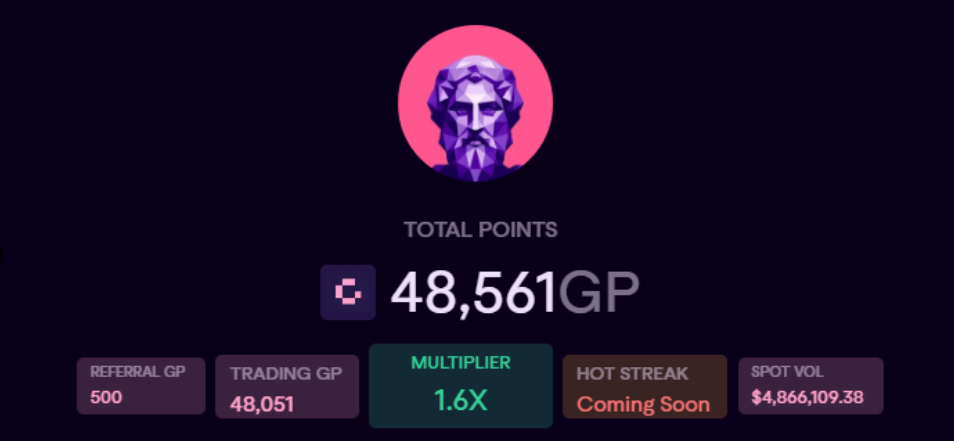
Early users "aggressively" traded to earn massive GP points from volume

Below, Odaily Planet Daily explains Genius's new GP point rules to help users better participate in platform interactions and earn GP points.

Season 1 Total of 200 Million GP Points, 125 Million GP Points Still to Be Distributed

The community had many questions about GP point distribution. This time, the official emphasized that Season 1 has a total of 200 million GP points, with no additional issuance. The specific distribution is as follows:

  • 75 million GP points have been distributed, which are the trading points earned by users before the platform updated the whitepaper. GP points from referral rewards have been reclaimed;
  • 125 million GP points are still to be distributed, including 5 million GP points from the wheel-of-fortune reward. Referral reward points and trading task points have been canceled.

The remaining 125 million GP points will be distributed starting at 5:00 AM UTC+8 today (January 20), with 10 million GP points distributed every weekend. Additionally, points are allocated using a weighted distribution to ensure that whale traders do not monopolize all GP releases, allowing smaller traders to also receive GP allocations.

Notably, the trading volume weight for stablecoin USDT to USDC conversions has been adjusted to 0.5x, while the weight for other spot trading volumes remains 1.0x.

Other Changes in the New Rules

As explained by the team members in the official Telegram, on one hand, all previous GP task points (trading tasks + referral tasks) have been cleared; on the other hand, under the new rules, GP points can only be earned through spot trading volume.
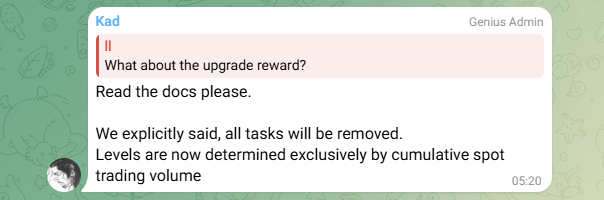
Official explanation of the new rules

New Trading Tiers

The new trading tier divisions and fee discounts are as follows:

  • Level 1—Smart: Cumulative trading volume of $100,000, trading fee 0.3%;
  • Level 2—Ultra Genius: Cumulative trading volume of $1 million, trading fee 0.2%;
  • Level 3—Mastermind: Cumulative trading volume of $10 million, trading fee 0.1%;
  • Level 4—Mogger Genius: Cumulative trading volume of $100 million, trading fee 0.05%.

The current zero-fee trading promotion's end date has not been announced.

Referral Rewards

Referring friends for trading no longer earns GP points, but after the zero-fee promotion ends, users can earn a 35% commission from the trading fees of invited friends.

For example, if an invited user's trading fee tier is 0.2%, the rebate earned would be 0.07% (35% * 0.2%).

GENIUS Token to Be Created Before April 12, 2026

According to the documentation, the GENIUS token will be created before the end of Season 1. Therefore, TGE will occur randomly between now and April 12.

Platform Has Many Bugs, But Strong Funding Background and Confirmed TGE Make It Worth Attention

Since its launch a few days ago, Genius has been overloaded due to a large influx of studios, resulting in frequent bugs. Although the team has been working to resolve issues, some functions still have problems and cannot fully satisfy users. As of now, referral points and trading tasks have not been fully removed, and the wheel-of-fortune reward is still under maintenance.

With the new rules update, TGE will occur before April 12, significantly increasing the certainty of earning from Genius. With only 200 million GP points distributed before TGE, GP points will be particularly "valuable," and the cost of earning them will only increase. KOL Nathan stated, "With tens of millions in investment, the FDV should be around $300–500 million. Congratulations to those who got on board early, earning 37.5% of the total airdrop in just 3 days." Based on the data below, with a $300 million FDV and a 10% airdrop allocation, each point would be worth $0.15.
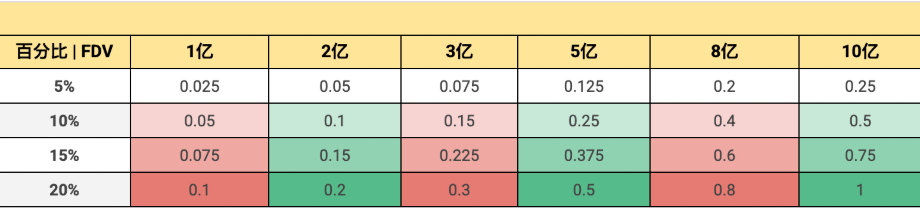
Genius Point Value Estimation

Perhaps it is still worth interacting now, while trading fees are still zero and the new rules have just been launched.


Domande pertinenti

QWhat is the total amount of GP points allocated for Season 1 on Genius, and how much remains to be distributed?

AThe total amount of GP points for Season 1 is 200 million. 75 million GP points have already been distributed, and 125 million GP points remain to be distributed.

QHow has the new rule changed the way users can earn GP points?

AThe new rule has removed all previous GP task points (trading tasks and invitation tasks). Users can now only earn GP points by generating trading volume through spot trades.

QWhat is the new weight assigned to the trading volume of stablecoin USDT to USDC conversions?

AThe trading volume weight for stablecoin USDT to USDC conversions has been adjusted to 0.5x.

QWhen is the GENIUS token expected to be created (TGE)?

AThe GENIUS token is expected to be created before the end of Season 1, which is April 12, 2026. The TGE will occur randomly between now and that date.

QWhat is the referral reward structure under the new rules?

AReferring friends no longer generates GP point rewards. However, after the platform's zero-fee trading activity ends, users can earn a 35% commission from the trading fees of the users they invite.

Letture associate

Misjudged A-Shares: Resilience, Expectations, and Confidence

China's A-share market recently faced selling pressure, especially in tech sectors, initially triggered by a global tech sell-off that began in South Korea. However, the article argues this is a case of "mistaken injury" and highlights the market's underlying resilience. This resilience stems from three main pillars: **1) Tech Sector Fundamentals:** Unlike Korea's market dominated by a few memory chip stocks, China's tech sector is diversified across computing, communications, electronics, and semiconductors, supported by dual narratives of global AI supply chains and domestic substitution. Core areas like optical modules and fiber optics continue to show strong earnings growth. **2) "National Team" Support:** State-backed institutions and large corporations have made significant market purchases and announced buybacks, providing liquidity and signaling confidence. This is seen as a stabilizing policy signal, often associated with market bottoms. **3) Broader Market Pillars:** Other major sectors are showing endogenous recovery momentum. Consumer stocks benefit from stabilizing CPI and signs of sector recovery (e.g., liquor price hikes). Cyclical sectors like aluminum have high earnings, potential price increases due to tight supply, and low valuations. The financial sector offers stable dividends and low valuations. The conclusion is that the sell-off was driven by external contagion, not a collapse in fundamentals. With strong policy support and recovering momentum across key sectors, the A-share market possesses the toughness to regain stability.

marsbit24 min fa

Misjudged A-Shares: Resilience, Expectations, and Confidence

marsbit24 min fa

The Clarity Act's Journey Through Congress: The Thorny Path of Bipartisan Compromise in the U.S.

The U.S. Congress is struggling to advance the crypto market structure bill known as the Clarity Act, with bipartisan compromise proving difficult. Key hurdles include unresolved disputes over "yield" products and, more critically, the inclusion of strong ethics provisions for elected officials—a non-negotiable demand for many Democrats. While a compromise on yield was reached in May, securing only limited Democratic support in committee, the separate Senate Agriculture Committee version later passed with no Democratic votes due to the ethics impasse. As Republicans push for a full Senate vote in July, demands for ethics rules have expanded, and other contentious issues like developer protections and concerns from law enforcement and large banks further complicate negotiations. Despite consensus on the need for legislation, the path forward is unclear. Recent discussions between senators and White House officials aim to find acceptable ethics language. Some lawmakers question whether a compromise text can garner enough bipartisan support, with one Democrat stating the current proposal lacks the strong ethics provisions required for their vote. Potential short-term goals for the crypto community include symbolic Senate action before the August recess, a longer-term aim for passage by 2026, or establishing a detailed framework that addresses ethics and other compromises. The process remains arduous, relying on the traditional, vote-by-vote effort to build bipartisan support.

marsbit44 min fa

The Clarity Act's Journey Through Congress: The Thorny Path of Bipartisan Compromise in the U.S.

marsbit44 min fa

Are Kalshi and Polymarket Founders at Odds? This Business Rivalry Is More Brutal Than You Think

"The Rivalry Between Kalshi and Polymarket Founders Turns Bitter and Litigious" The intense feud between Tarek Mansour, CEO of Kalshi, and Shayne Coplan, founder of Polymarket, has escalated far beyond typical business competition into personal animosity and regulatory battles. Both lead billion-dollar prediction market platforms, but their approaches differ sharply. Kalshi positions itself as the compliant operator, securing U.S. regulatory approval before launching. In contrast, Polymarket initially operated offshore, allowing U.S. users to access its platform via VPN, which drew regulatory scrutiny. The conflict reached a peak in November 2024 when FBI agents raided Coplan's New York apartment. While Coplan publicly blamed political motives, his team privately suspected Kalshi was involved. According to sources, Kalshi's lawyers had previously reported Polymarket's operations to federal prosecutors, highlighting its accessibility to U.S. users despite a ban. This incident fueled mutual accusations and underhanded tactics, including social media smear campaigns and attempts to sabotage each other's major business deals. Their rivalry also played out in Washington, influencing regulatory debates. Kalshi actively lobbied against Polymarket's practices, framing them as illegal and unethical. Polymarket, after facing a CFTC fine and investigation, later acquired a licensed U.S. firm to launch a domestic app, regaining a foothold. Despite the hostility, both companies have seen massive growth, with combined trading volumes soaring. However, increased regulatory scrutiny, particularly around insider trading on Polymarket's platform, continues to pose challenges. The founders' deep-seated mutual disdain ensures their battle for market dominance remains as much a personal vendetta as a commercial one.

marsbit53 min fa

Are Kalshi and Polymarket Founders at Odds? This Business Rivalry Is More Brutal Than You Think

marsbit53 min fa

Trading

Spot
活动图片




