During the World Cup, USDT becomes the preferred chip for illegal gambling? Beware of three typical scams

marsbitPubblicato 2026-06-22Pubblicato ultima volta 2026-06-22

Introduzione

During the 2026 FIFA World Cup, USDT has become the preferred payment method for illegal online gambling due to its price stability, anonymity, and fast cross-border transfers. This article analyzes how USDT facilitates this activity and outlines three major scams targeting users. **Why USDT is the "Chip of Choice"**: It solves bettors' anxiety over crypto volatility, enables instant cross-border transfers without traditional banking, and shows significant abnormal transaction spikes during major events. **The Fund Flow**: Gambling platforms use a complex laundering chain involving multi-layer address hopping, cross-chain transfers (e.g., Polygon to Tron), mixers like Tornado Cash, and final cash-out via exchanges. **Three Typical Scams**: 1. **"USDT Betting Evades Regulation"**: Fake platforms promising anonymous, high-odds betting but manipulating outcomes. 2. **Fake Sportsbooks**: High-quality replica sites that allow small initial withdrawals to build trust before freezing accounts with larger funds. 3. **"Insider Tips / Guaranteed Wins"**: Schemes selling fabricated "AI predictions" or "fixed match" models to exploit information anxiety. **Identifying Suspicious Addresses**: Key chain-based indicators include a "fast-in, fast-out" transaction pattern, clustered addresses with consistent behavior, uniform Gas fee patterns, and frequent cross-chain jumps. **User Protection Advice**: * Avoid any project promoting "USDT betting," "Web3 predictions," or "anonymous h...

Preface

At 12:00 AM Beijing time on June 12, 2026, the 23rd FIFA World Cup officially kicked off. With 48 teams, 104 matches, and spanning three host nations—Canada, Mexico, and the United States—it is not only a global celebration for football fans but also a "high-risk area" for illegal gambling and cryptocurrency scams.

Hong Kong police have explicitly stated that, with the start of the World Cup, illegal gambling activities are expected to increase significantly. More alarmingly, in recent years, the promotion, communication, and betting methods for illegal gambling have shown a clear trend of digitization, even using virtual currencies to settle bets to evade law enforcement investigations. Meanwhile, on-chain security monitoring has discovered multiple active cryptocurrency scams targeting World Cup fans, with related scam funds converging into specific public chain and exchange addresses.

USDT—this stablecoin with a market cap of approximately $190 billion—is leveraging its features of price stability, strong anonymity, and fast cross-border transfers to become the "preferred chip" for illegal gambling payments during the World Cup. Deconstructing this on-chain capital flow is a key step in understanding the risk chain behind online gambling.

Part 01 - Why has USDT become the "Preferred Chip" for World Cup Online Gambling?

During the World Cup, gambling platforms experience a surge in demand for fund flows, with USDT playing a central role.

1. Stablecoins Solve "Betting Volatility Anxiety"

Traditional cryptocurrencies (BTC/ETH) are highly volatile, while USDT is pegged to the US dollar, allowing users to:

• Deposit 1000 USDT ≈ 1000 USD

• Be unaffected by market fluctuations

• Use it directly as a "betting unit"

This enables gambling platforms to establish a unified pricing system.

2. No Reliance on Banking Systems, Cross-Border Transfers in Seconds

USDT (especially TRC-20) offers:

• Transfers without KYC

• Global wallet interoperability

• Irreversible transactions

For gambling platforms, this means: once funds enter the chain, they enter an "irrecoverable state."

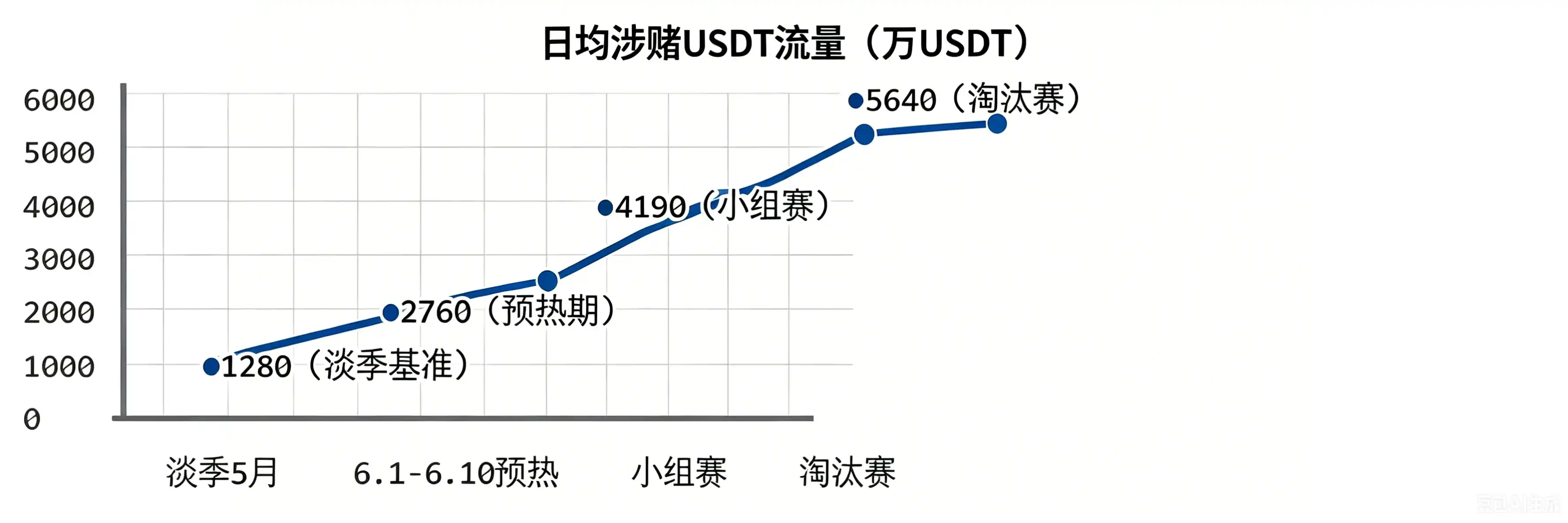
3. Significant Anomalies in USDT Traffic During the World Cup

According to observations from multiple on-chain security institutions:

• The frequency of USDT transfers during the World Cup period has increased significantly.

• Activity of gambling-related addresses has increased.

• The number of intermediary addresses has expanded rapidly.
Part 02 - At a Glance: The Complete On-Chain Fund Flow of USDT Online Gambling

The capital flow in USDT online gambling is not a simple "gambler → platform → withdrawal" process but involves complex money laundering chains with multi-layered hops and cross-chain dispersion.

1. Gambler Deposit

The gambler sends USDT from their personal wallet to the deposit address provided by the platform. This address is often a one-time address generated by the platform to track the user's deposit. The transaction is usually recorded on the Tron or Ethereum network.
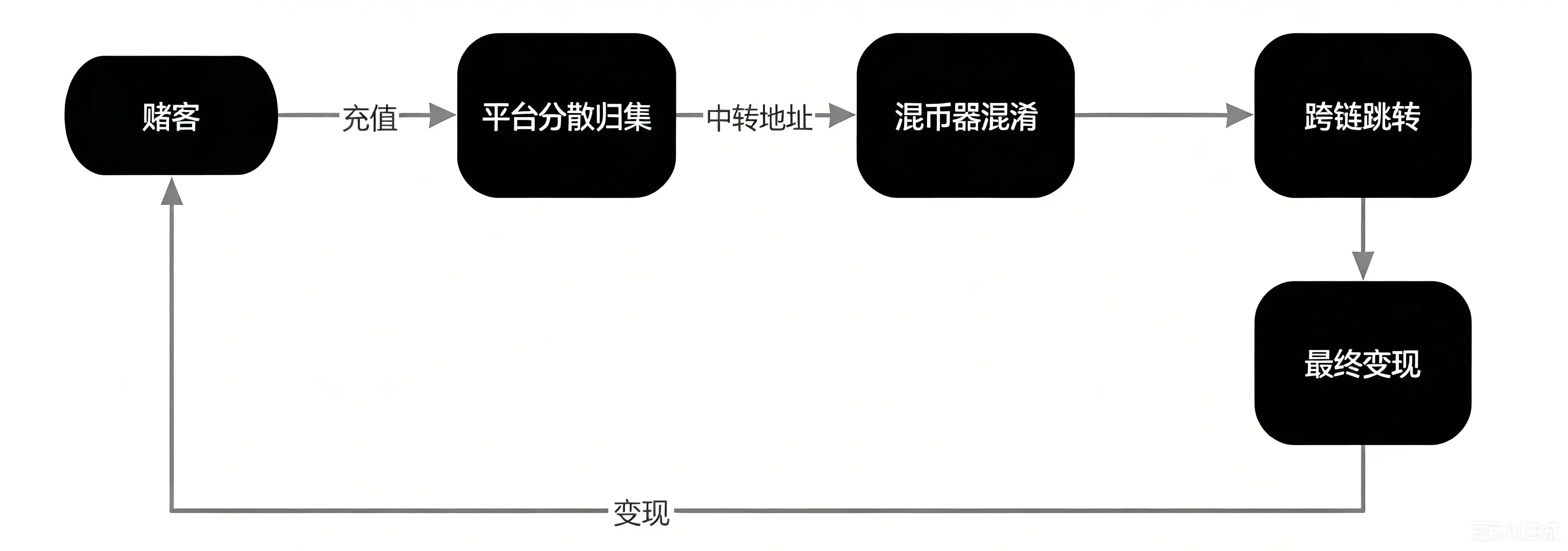
2. Platform Dispersed Aggregation

The platform does not concentrate all gambling funds in a single address but aggregates them through numerous scattered addresses. Each address receives small amounts of funds, which are then transferred out in a dispersed manner to evade detection by on-chain monitoring and risk control systems.

3. Intermediary Address Group

Funds are gathered from dispersed addresses into an intermediary address group. This stage is characterized by rapid inflows and outflows, with large sums briefly held—funds are quickly transferred out after entering, and the Gas fee payment patterns across addresses controlled by the same group are highly consistent, serving as a key clue for on-chain identification.

4. Mixer Obfuscation

Some funds enter mixers (like Tornado Cash), where multiple funds from different sources are mixed and then redistributed, disrupting the correlation of fund origins and increasing tracing difficulty.

5. Cross-Chain Hopping

Funds hop across multiple public chains via cross-chain bridges—for example, flowing from Polygon to Tron, then to Ethereum. This leverages the information silos between different blockchains to create a "broken chain illusion."

6. Final Cashing Out

Funds are funneled into exchange deposit addresses, exchanged for fiat currency to complete the money laundering. Notably, security monitoring platforms have found that World Cup-related crypto scam funds are moving from Polygon to Tron and directly into exchange deposit addresses—indicating that the entire money laundering chain is accelerating its closure.

Part 03 - Three Typical USDT Online Gambling Scams During the World Cup

Scams during the World Cup are not a "single model" but operate with a high degree of industrial sophistication.

1. "USDT Betting to Evade Regulation" Scam

Updated tactics:

• "Bet on-chain, no real-name verification needed"

• "Unregulated, high odds"

Nature:

👉Fake betting platform + backend manipulation of outcomes

2. Counterfeit Sports Betting Platforms (High-Replica Sites)

Characteristics:

• UI highly模仿s legitimate platforms

• Allows small withdrawals initially

• Directly freezes accounts later

Typical pattern:

👉"Let you win 100 USDT first, then make you lose 1000 USDT"

3. Inside Information Predictions / Guaranteed Win Plans

Tactics:

• "Internal data predictions"

• "AI analysis guarantees wins"

• "Match result manipulation models"

Nature:

👉Harvesting "information-anxious users"

Case: The "Gambling Network" Behind Promotion and Referral

Beyond scams directly targeting gamblers, online gambling groups are also deploying large-scale promotion and referral operations. During the World Cup, the "guaranteed profit recommendations," "inside score predictions," and "high-odds entry points" you scroll past on social media are often paid advertisements for gambling websites.

In June 2026, during the "Clean Internet—2026" campaign, the Yulin Public Security Cyberspace Department in Guangxi cracked a case involving World Cup online gambling promotion and referral. The suspects established a studio, posting a large number of gambling-related advertisements in graphic and video formats across multiple social media platforms, providing referral and operational services for gambling websites to profit illegally. They have since been criminally detained.

The police action illustrates: Online gambling promotion and referral are clearly illegal and subject to crackdowns. As ordinary users, encountering such ads—do not click, do not trust, do not share.

Part 04 - How to Identify USDT Gambling Addresses On-Chain?

From a security analysis perspective, abnormal fund flows can be identified through on-chain behavior:

1. Rapid In-and-Out Pattern

The most typical transaction feature of gambling addresses is rapid in-and-out—funds remain in an address for an extremely short time, rarely staying overnight; dispersed inflow, concentrated outflow—small amounts from different addresses converge, then are transferred out in a large sum; daily balance is essentially zero—funds do not settle in any address.

2. Abnormal Address Clustering

Clustering algorithms can reveal that many addresses interacting with the same gambling platform, while seemingly independent, show high consistency in transaction timing, amount distribution, and counterparty interactions, allowing them to be grouped as the same entity.

3. Gas Fee Consistency

Different addresses controlled by the same group show highly consistent Gas fee payment patterns—whether in Gas price selection, transaction time distribution, or Gas limit settings, they exhibit clear signs of "the same operator." This is known as a "behavioral fingerprint" in on-chain analysis.

4. High-Frequency Cross-Chain Hopping

Gambling funds frequently hop across different public chains—entering Polygon, exiting Tron, then moving to Ethereum. This cross-chain behavior itself is a significant risk indicator, especially when funds eventually converge into exchange deposit addresses, essentially locking in the cashing-out stage.

Part 05 - How Can Ordinary Users Identify and Prevent USDT Online Gambling Traps?

As an ordinary user, you don't need to become an on-chain detective, but the following points can help you avoid most traps:

✅Avoid Any Projects Involving "USDT Betting"

As soon as you see the following keywords:

• Stablecoin betting

• On-chain gambling

• Web3 prediction games

• High returns without real-name verification

👉Directly assess as high risk.

✅Be Wary of "Guaranteed Profit Models"

Any promises of:

• Guaranteed wins

• Inside information

• AI predictions ensuring victory

• High win-rate tips

👉Are standard tactics of gambling scams.

✅Don't Believe "Ability to Withdraw Small Profits"

The core logic of gambling scams:

Let you win first, then encourage you to increase your stake.

Platforms often allow small withdrawals initially to build trust. As users gradually increase their investments, the platform restricts withdrawals using excuses like account anomalies, deposit requirements, or withdrawal reviews, eventually absconding with the funds.

👉The ability to withdraw small amounts does not indicate platform safety.

✅Preserve On-Chain Evidence (Crucial)

If you have already transferred funds to a suspicious platform, be sure to immediately save:

• Transaction hash

• Wallet address

• Chat records

• Transfer screenshots

• Platform URL

While blockchain transactions are difficult to reverse, on-chain data is public and transparent. Complete evidence aids in subsequent fund tracking, risk analysis, and reporting to relevant authorities.

👉Upon discovering anomalies, stop transferring funds immediately and preserve evidence first.

Conclusion

USDT makes cross-border fund transfers extremely efficient but also endows illicit industries with unprecedented "liquidity capabilities." The World Cup is not just a sporting event; it is also becoming one of the most active periods for illicit fund flows on-chain.

From an on-chain perspective, the nature of such USDT online gambling is not complicated:

⚠️Using stablecoins as packaging, gambling as the entry point, and cross-chain transfers for laundering.

For ordinary users, the most effective protective measure is simply one statement:

⚠️Not participating in any form of on-chain gambling is the best risk isolation.

Crypto di tendenza

Domande pertinenti

QWhy is USDT becoming the preferred 'chip' for illegal online gambling during the World Cup?

AUSDT has become the preferred choice for illegal online gambling during the World Cup due to three main reasons: 1. Its stability (pegged to the US dollar) solves the 'betting volatility anxiety' for users and platforms. 2. It allows for cross-border, near-instantaneous transfers without reliance on the traditional banking system and without the need for KYC, making transactions difficult to trace and irreversible. 3. There is a significant, observable increase in USDT transaction frequency and activity on gambling-related blockchain addresses during the World Cup period.

QWhat are the three typical scams related to USDT online gambling during the World Cup mentioned in the article?

AThe three typical USDT online gambling scams are: 1. The 'USDT betting to avoid regulation' scam, which uses promises of anonymity and high odds to lure users to fake platforms that manipulate results. 2. Fake sports betting platforms (high imitation sites) that mimic legitimate platforms, allow small withdrawals initially to build trust, and then freeze accounts after users deposit larger amounts. 3. 'Inside information / guaranteed win' schemes that claim to use internal data, AI analysis, or match-fixing models to predict outcomes, essentially preying on users' information anxiety.

QHow can ordinary users identify and prevent falling into USDT online gambling traps?

AOrdinary users can protect themselves by: 1. Avoiding any project involving 'USDT betting,' 'on-chain gambling,' 'Web3 guessing,' or promises of 'high returns without real-name verification.' 2. Being wary of any scheme promising guaranteed wins, inside information, AI-predicted victories, or high-win-rate tips. 3. Not being fooled by the ability to withdraw small profits initially, as this is a common tactic to build trust before scamming larger deposits. 4. Preserving on-chain evidence (transaction hash, wallet addresses, chat records, screenshots, website URLs) if they have already transferred funds to a suspicious platform.

QFrom a blockchain analysis perspective, what are the key characteristics for identifying addresses involved in USDT online gambling?

AKey on-chain characteristics for identifying USDT gambling addresses include: 1. A 'fast-in, fast-out' transaction pattern, where funds are received and sent out almost immediately without staying overnight. 2. Address clustering anomalies, where many seemingly independent addresses show highly consistent behavior patterns (transaction timing, amount distribution, counterparties). 3. Consistency in Gas fee payment patterns across different addresses controlled by the same entity, acting as a behavioral fingerprint. 4. High-frequency cross-chain jumps (e.g., Polygon to Tron to Ethereum), which is a significant risk signal, especially when funds ultimately flow into exchange deposit addresses.

QWhat is the complete fund flow path for USDT online gambling as described in the article?

AThe complete on-chain fund flow path for USDT online gambling is a multi-layered process: 1. Player Deposit: Users transfer USDT from their personal wallets to addresses provided by the gambling platform. 2. Platform Dispersed Collection: The platform collects funds into numerous分散 addresses to avoid detection. 3. Transit Address Groups: Funds are aggregated from分散 addresses into transit address groups, characterized by quick transfers and large amounts. 4. Mixer Obfuscation: Some funds enter mixers (e.g., Tornado Cash) to break the link between source and destination. 5. Cross-Chain Jumps: Funds are moved across different blockchains (e.g., Polygon to Tron to Ethereum) using cross-chain bridges to create disconnection. 6. Final Cash-Out: Funds are sent to exchange deposit addresses to be converted into fiat currency, completing the money laundering cycle.

Letture associate

Conversation with Co-founder of Hyperdash: Why is Hyperliquid Still Severely Undervalued?

Interview Summary with Hanson Birringer, Co-founder of Hyperdash: Why Hyperliquid Remains Undervalued In an interview on *The Rollup*, Hanson Birringer, Co-founder and Chief Revenue Officer of Hyperdash—a trading data analytics platform for Hyperliquid—shared his investment thesis on the Hyperliquid ecosystem. He described Hyperliquid as a pure play on three key crypto super-trends: perpetual contracts, real-world assets (RWAs), and stablecoins. The platform is an open-source, decentralized, and high-performance financial system uniquely positioned to bridge traditional institutional capital with decentralized finance. Birringer highlighted Hyperliquid's leadership in perpetual DEX trading and its recent innovation of RWA perpetual contracts. He emphasized the significance of USDC becoming a core quoting asset, which, by allocating 90% of its backend yield from assets like US treasuries to a protocol buyback fund, creates substantial, programmatic buy pressure for the Hype token. He addressed regulatory challenges, noting that Hyperliquid's policy team is actively engaging with US regulators like the CFTC to establish clear rules for decentralized venues. Once achieved, regulated brokers could route orders directly to Hyperliquid's backend, tapping into its low-cost liquidity layer. Regarding revenue, Birringer was optimistic, citing the immense size of traditional financial markets. Even capturing a small fraction of global trading volume in products like RWA perpetuals could lead to exponential growth for the protocol. The recently launched Grayscale Hyperliquid ETF, seeded by their SPV (Hyper Holdings Global), provides a compliant on-ramp for institutional investors drawn to the clear "cash flow + token buyback" model. Finally, he discussed Hyperdash's acquisition of Imperator, enhancing its data and node infrastructure to serve both retail traders and traditional asset managers. His bullish case rests on Hyperliquid's potential to provide unprecedented global access to dollar-based capital markets. He struggled to articulate a bear case, seeing the long-term trends of internet adoption and financial inclusion as powerful tailwinds.

marsbit48 min fa

Conversation with Co-founder of Hyperdash: Why is Hyperliquid Still Severely Undervalued?

marsbit48 min fa

DeepSeek V4 'Full-Blooded Edition' Leaked, Could Be Released As Early As Tomorrow

The highly anticipated full release of DeepSeek V4 is imminent, expected to launch as early as tomorrow after nearly three months of waiting. A select group has already received access to the GA (General Availability) beta, which includes two versions: DeepSeek V4 Flash and DeepSeek V4 Pro. Early testers report that V4's overall performance is close to the level of Opus 4.8, with coding capabilities rivaling GPT-5.6 Sol. Its agent abilities are significantly enhanced, and 3D/SVG generation has improved notably. While it may not surpass the recently released Kimi K3 in performance, its expected price point is significantly lower. The official release will introduce a new "peak/off-peak" pricing model for its API. For example, deepseek-v4-pro will cost $0.87 per million output tokens during standard times and $1.74 during peak hours. The flash version is even more aggressive at $0.28/$0.56 per million tokens, with cached input tokens priced extremely low at $0.0028. This makes V4 a strong contender in terms of cost-effectiveness, potentially offering Opus-level capabilities at a fraction of the cost, continuing DeepSeek's reputation as a "price disruptor" in the AI market. Initial demos showcasing V4's capabilities have begun circulating, including generated 3D simulation games, HTML games blending elements of Minecraft and No Man's Sky, and classic games like a "Cut the Rope" clone. The final GA version is set to replace the older deepseek-chat and deepseek-reasoner models, which will be retired on July 24th.

marsbit57 min fa

DeepSeek V4 'Full-Blooded Edition' Leaked, Could Be Released As Early As Tomorrow

marsbit57 min fa

WEEX Labs Weekly Observation: The 'Power Restructuring' of AI Infrastructure and the 'Deep Dive Movement' into the Real Economy

WEEX Labs Weekly Review: AI Infrastructure's "Power Restructuring" and the "Deep Dive" into the Real Economy Mid-July 2026 marks a pivotal shift in the global AI industry. The allocation of computing power is transferring from cloud giants to compute resource owners, while the core value of AI is solidifying around its penetration into physical industry, moving beyond the race for model parameters. The era of fragmented model development is over, replaced by a capital-intensive, integrated chain driven by hard tech. Key developments this week include Meta's planned entry into the cloud computing market with "MetaCompute." This move by social media giants with massive GPU clusters challenges traditional cloud providers like AWS, integrating compute, models, and data into one-stop services, which will squeeze smaller rental providers and shift enterprise focus towards underlying model ecosystems. Chinese foundational models like DeepSeek-V4 and Tencent's Hy-3 are pushing towards "utility" status through open-source releases and extreme cost reductions via MoE architectures. This lowers entry barriers for enterprises, allowing them to focus resources on private deployment and deep business integration. Embodied intelligence, particularly humanoid robots, is transitioning from lab demos to real-world factory applications, driven by policies promoting large-scale, practical deployment in logistics and manufacturing. The value focus is shifting from spectacle to stable industrial data and real operational efficiency. Global governance, through forums like WAIC, is evolving from theoretical ethics to practical operational frameworks for "Sovereign AI," raising geopolitical compliance barriers and making auditability and data sovereignty core design requirements from the outset. WEEX Labs Insights: The current transformation shows AI's prosperity is deeply embedding into the fabric of global manufacturing. Strategic recommendations include: 1) leveraging open-source models for private, proprietary knowledge bases; 2) maintaining cloud provider diversity to avoid vendor lock-in from integrated model ecosystems; and 3) seeking opportunities in the "embodied infrastructure" supporting robots, such as data collection, industrial simulation, and factory AI adaptation services.

marsbit1 h fa

WEEX Labs Weekly Observation: The 'Power Restructuring' of AI Infrastructure and the 'Deep Dive Movement' into the Real Economy

marsbit1 h fa

Is WEEX TradFi Reliable? What You Should Know Before Your First Trade of U.S. Stock Tokens

In recent years, cryptocurrency users have expanded their focus beyond Bitcoin and Ethereum to include popular traditional financial (TradFi) assets like Nvidia, Apple, and Tesla stocks. This shift raises key questions: What do these TradFi assets represent on crypto trading platforms? How do they differ from traditional stock ownership? And how can users assess the reliability of platforms offering such products? TradFi products, such as those offered by WEEX TradFi (including NVDA, MSFT, AAPL, TSLA, and QQQ tokens), are blurring the lines between crypto and traditional markets. They allow users to trade based on the price movements of traditional assets within a familiar digital asset trading environment. However, it's crucial to understand that trading a "stock token" is not equivalent to owning the actual stock. Users are participating in price speculation, not gaining shareholder rights like dividends or voting. A key feature of these products is 7x24 trading, offering flexibility beyond traditional market hours. While convenient, this also introduces unique risks, such as potential liquidity gaps and volatility when underlying markets are closed. For users evaluating TradFi products, reliability hinges on transparency and risk management. Critical factors include understanding the product mechanism, how prices track the underlying assets, and the associated risks—especially when using leverage. Popular stocks and indices are still subject to company performance, macroeconomic shifts, and sector trends. Ultimately, TradFi represents a new gateway connecting crypto users to global markets. The future points toward integrated trading environments where the distinction between "crypto investor" and "traditional investor" fades. For newcomers, a platform's reliability stems not from promises, but from a clear understanding of the product, a comprehensive view of risks, and informed judgment of the platform's capabilities.

marsbit1 h fa

Is WEEX TradFi Reliable? What You Should Know Before Your First Trade of U.S. Stock Tokens

marsbit1 h fa

Trading

Spot

Articoli Popolari

Come comprare CHIP

Benvenuto in HTX.com! Abbiamo reso l'acquisto di USD.AI (CHIP) semplice e conveniente. Segui la nostra guida passo passo per intraprendere il tuo viaggio nel mondo delle criptovalute.Step 1: Crea il tuo Account HTXUsa la tua email o numero di telefono per registrarti il tuo account gratuito su HTX. Vivi un'esperienza facile e sblocca tutte le funzionalità,Crea il mio accountStep 2: Vai in Acquista crypto e seleziona il tuo metodo di pagamentoCarta di credito/debito: utilizza la tua Visa o Mastercard per acquistare immediatamente USD.AICHIP.Bilancio: Usa i fondi dal bilancio del tuo account HTX per fare trading senza problemi.Terze parti: abbiamo aggiunto metodi di pagamento molto utilizzati come Google Pay e Apple Pay per maggiore comodità.P2P: Fai trading direttamente con altri utenti HTX.Over-the-Counter (OTC): Offriamo servizi su misura e tassi di cambio competitivi per i trader.Step 3: Conserva USD.AI (CHIP)Dopo aver acquistato USD.AI (CHIP), conserva nel tuo account HTX. In alternativa, puoi inviare tramite trasferimento blockchain o scambiare per altre criptovalute.Step 4: Scambia USD.AI (CHIP)Scambia facilmente USD.AI (CHIP) nel mercato spot di HTX. Accedi al tuo account, seleziona la tua coppia di trading, esegui le tue operazioni e monitora in tempo reale. Offriamo un'esperienza user-friendly sia per chi ha appena iniziato che per i trader più esperti.

326 Totale visualizzazioniPubblicato il 2026.04.21Aggiornato il 2026.06.02

Come comprare CHIP

Discussioni

Benvenuto nella Community HTX. Qui puoi rimanere informato sugli ultimi sviluppi della piattaforma e accedere ad approfondimenti esperti sul mercato. Le opinioni degli utenti sul prezzo di CHIP CHIP sono presentate come di seguito.

活动图片