Dubai, Hong Kong, and now Japan as regulatory heat intensifies for KuCoin!

ambcryptoPubblicato 2026-03-27Pubblicato ultima volta 2026-03-27

Introduzione

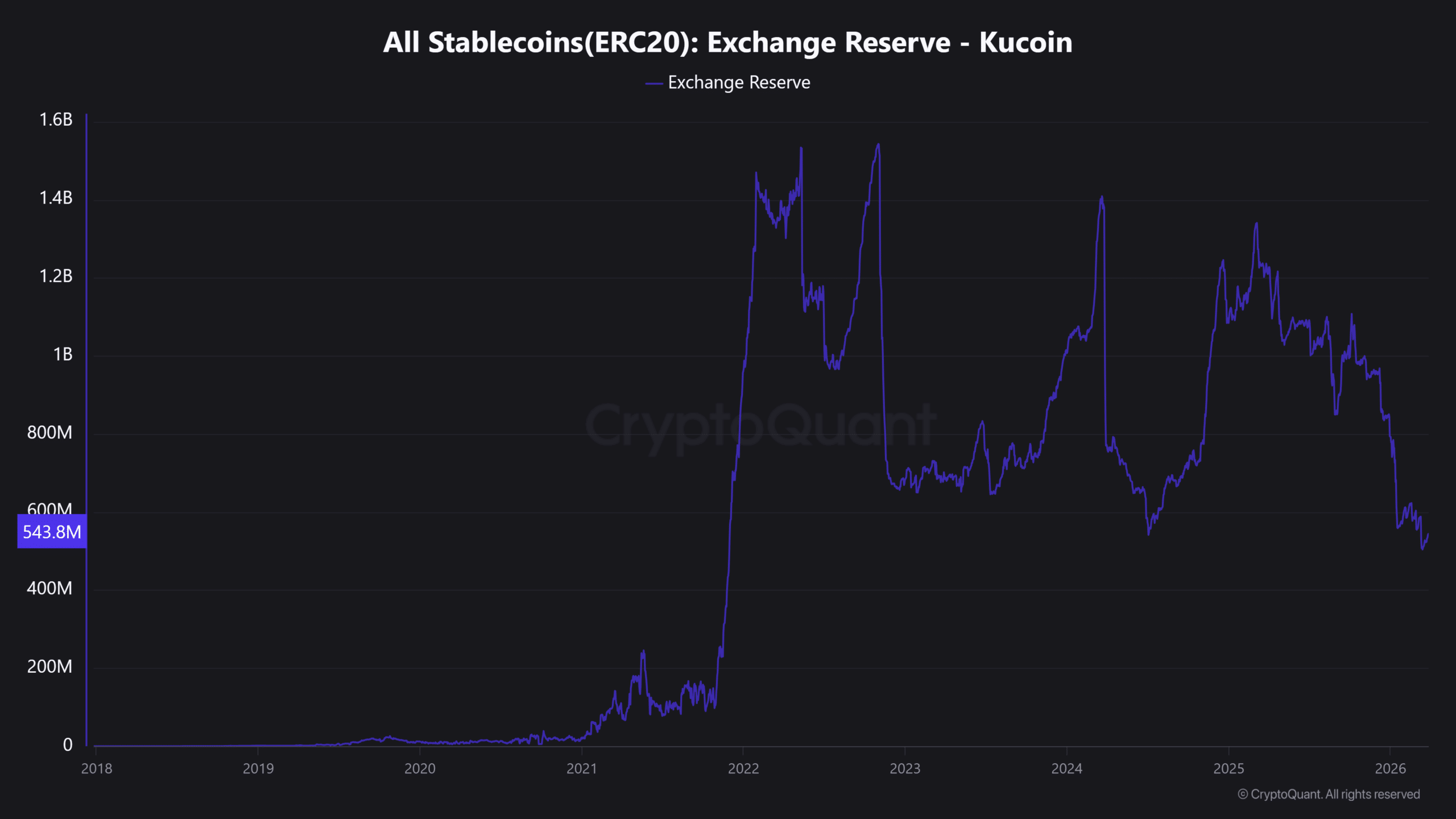
Japan's Financial Services Agency (FSA) has issued a warning to KuCoin and several other firms for operating unregistered over-the-counter (OTC) derivative services. This action is part of broader regulatory challenges for the exchange, which has recently faced operational bans or restrictions in Hong Kong, Austria, and Dubai for failing to meet local licensing and anti-money laundering requirements. These persistent regulatory issues have significantly eroded user trust, leading to a substantial decline in user funds. The exchange's stablecoin reserves plummeted from over $1.3 billion to $543 million in one year, indicating ongoing user caution and persistent outflows despite market rallies.

Japan’s financial market watchdog, the Financial Services Agency (FSA), has flagged KuCoin and other crypto exchanges and firms for operating certain services without proper registration.

In a statement on Thursday, the watchdog included KuCoin in the list of “unregistered businesses to which warning letters have been issued.”

The agency added that KuCoin, NeonFX, TheOption, and GTCFX were slapped with notices in March for “soliciting over-the-counter (OTC) derivative transactions via the internet.”

Interestingly, the escalation comes after the agency requested Apple and Google to block access to five unregistered crypto exchanges in February 2025. Amongst those targeted during the crackdown were KuCoin, Bybit, MEXC Global, LBank, and Bitget.

KuCoin’s regulatory headwinds

However, KuCoin’s regulatory woes go well beyond Japan. In May 2024, the exchange was forced to wind down its operations in Hong Kong. This followed restrictions and a crackdown on platforms with ties to mainland China.

Failure to meet the new licensing requirements prompted KuCoin to withdraw from Hong Kong and block users from the region from accessing the platform.

Fast forward to February 2026, and the exchange was partially banned by the Austrian Financial Market Authority (FMA). It failed to implement proper procedures to enforce anti-money laundering laws, as required by the EU’s MiCA guidelines. This was just three months after getting the MiCA license.

Earlier in March, the firm faced another regulatory hiccup with Dubai’s Virtual Assets Regulatory Authority (VARA). The agency issued a “cease and desist” order against KuCoin, alongside three other exchanges, for operating without a license. As such, the firms were banned from advertising or operating in Dubai without a valid license.

Impact of regulatory pressure on KuCoin

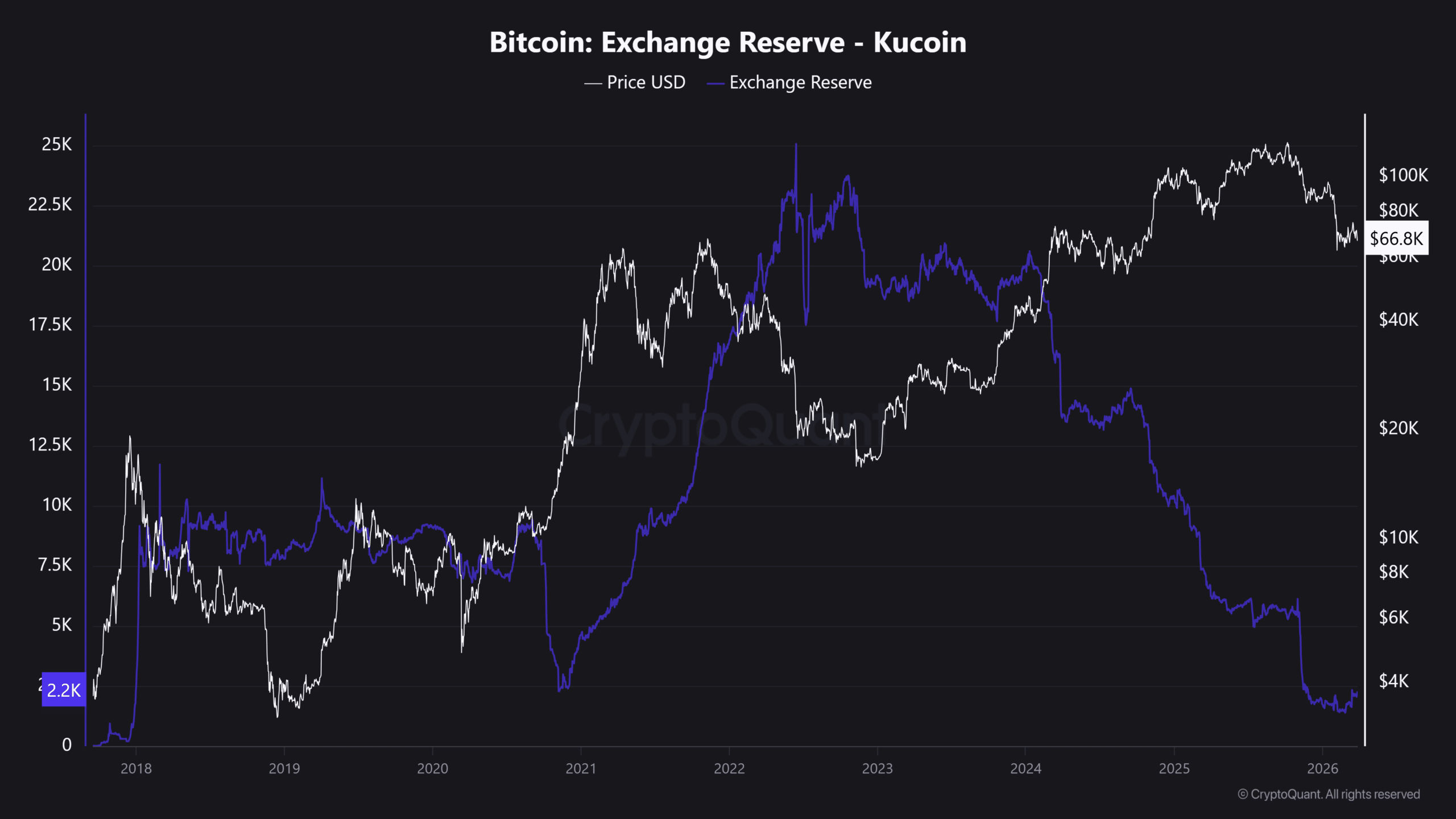
Unsurprisingly, the recurring patterns of regulatory hiccups have begun to affect user trust. This was illustrated by the Bitcoin and stablecoin reserves on the exchange. For Bitcoin, the exchange reserves dropped from 14K BTC in 2024 to 2100 BTC in early 2026.
Source: CryptoQuant

Here, it’s worth noting that the BTC exchange reserve decline was a broader trend across other platforms, likely due to transfers to self-custody wallets.

However, a deeper look at the liquidity or user funds held by the exchange, as painted by the stablecoin reserves, underscored a somewhat worried user base. The stablecoin exchange reserves fell from over $1.3 billion to $543M in just one year.

Even the mid-2025 rally and early 2026 recovery didn’t attract much flow into the exchange – Hinting at caution from users.
Source: CryptoQuant

Final Summary

  • Japan has sent a warning letter to KuCoin and other firms for operating unlicensed OTC derivatives trading.
  • Ongoing regulatory headwinds have eroded user trust, with user funds dropping from over $1.3B to $543M amid persistent outflows.


Domande pertinenti

QWhat regulatory action did Japan's FSA take against KuCoin in March 2026?

AJapan's Financial Services Agency (FSA) issued a warning letter to KuCoin for soliciting over-the-counter (OTC) derivative transactions without proper registration.

QWhich other regions has KuCoin faced regulatory challenges in besides Japan?

AKuCoin has faced regulatory challenges in Hong Kong (May 2024), Austria (February 2026), and Dubai (March 2026).

QHow did KuCoin's stablecoin reserves change between 2025 and early 2026?

AKuCoin's stablecoin reserves dropped from over $1.3 billion to $543 million in just one year, indicating significant user fund outflows.

QWhy did KuCoin wind down its operations in Hong Kong in 2024?

AKuCoin withdrew from Hong Kong after failing to meet new licensing requirements following a crackdown on platforms with ties to mainland China.

QWhat was the consequence of KuCoin's failure to comply with EU's MiCA guidelines in Austria?

AThe Austrian Financial Market Authority (FMA) partially banned KuCoin for failing to implement proper anti-money laundering procedures as required by MiCA, just three months after obtaining the license.

Letture associate

Qualcomm: AI Hype Subsides, When Will Smartphones Emerge from the Gloom?

Qualcomm reported its Q3 FY2026 results (ending June 2026), with revenue of $9.95B, down 4% YoY but above expectations. Gross margin declined to 53.1%, pressured by rising costs across manufacturing and memory. Key business segments showed mixed performance: Handset revenue fell 19.6% YoY to $5.09B, dragged by an 11% decline in non-Apple Android shipments and weaker high-end mix. Conversely, Automotive revenue surged 61% to $1.59B, and IoT grew 9% to $1.83B. Core operating profit dropped 41% YoY due to margin compression and higher expenses. Management's Q4 FY2026 guidance projects revenue of $9.7B-$10.5B, in line with consensus, but Non-GAAP EPS guidance of $2.05-$2.25 fell short of expectations. Amidst persistent weakness in its core handset market, Qualcomm is pursuing growth in AI, focusing on Edge AI (smartphones, PCs, automotive) and Data Center AI. Its data center strategy includes four pillars: AI accelerators (e.g., AI200), commercial CPUs (Dragonfly C1000), custom silicon, and connectivity solutions. While these initiatives initially boosted its stock, concerns over AI capital expenditure sustainability have since erased those gains. The company targets $5B in data center revenue for FY2027 and $15B for FY2029. The report concludes that with the traditional handset business still under pressure, the data center opportunity is currently viewed as a longer-term option, and a more conservative valuation based on core operations may be warranted until AI contributions materialize.

marsbit4 min fa

Qualcomm: AI Hype Subsides, When Will Smartphones Emerge from the Gloom?

marsbit4 min fa

From TPU to Self-Evolving Agents: How Jeff Dean Predicts the Next Step in AI

At the 2026 YC Startup School, Jeff Dean outlined his vision for AI's next phase, shifting focus from simply scaling models to building intelligent, autonomous systems. He believes AI's progress is no longer just about creating smarter models, but about integrating them into systems capable of long-term, iterative work, automated experimentation, and continuous learning. This evolution moves the competition from "who has the bigger model" to "who can best organize intelligence." Dean suggests AI capabilities are now comparable to a junior engineer, enabling the automation of complex workflows. However, the true challenge and opportunity lie in managing these AI "workers" at scale. He emphasizes the importance of **context engineering**—structuring tools, memory, and feedback loops—over raw model power. For startups, this means building deep expertise in niche domains where general models currently fail (near 0-1% success rates), leveraging proprietary data, specialized tools, and domain-specific evaluators. A recurring theme is re-examining fundamental constraints. Dean's past work, like moving Google's search index to memory or creating the TPU, stemmed from questioning outdated assumptions about hardware and cost. He sees similar inflection points today, particularly in **specialized inference hardware** to drastically reduce latency and energy consumption for real-time Agent operation. Notably, he points out that in modern AI systems, the dominant cost is often not computation but **data movement**. Reliable, long-running Agents require robust system design, borrowing concepts from distributed computing like checkpointing, state management, and parallel exploration to handle failures and maintain progress over days or weeks. As AI automates execution, the scarcest human skills will shift to **defining clear specifications**, **judging what problems are worth solving** (taste), and designing effective feedback loops. Ultimately, Dean's framework prioritizes understanding the problem deeply, identifying the true bottlenecks, and systematically building closed-loop systems where AI can not only perform tasks but also improve AI itself.

marsbit4 min fa

From TPU to Self-Evolving Agents: How Jeff Dean Predicts the Next Step in AI

marsbit4 min fa

Trading

Spot
活动图片




