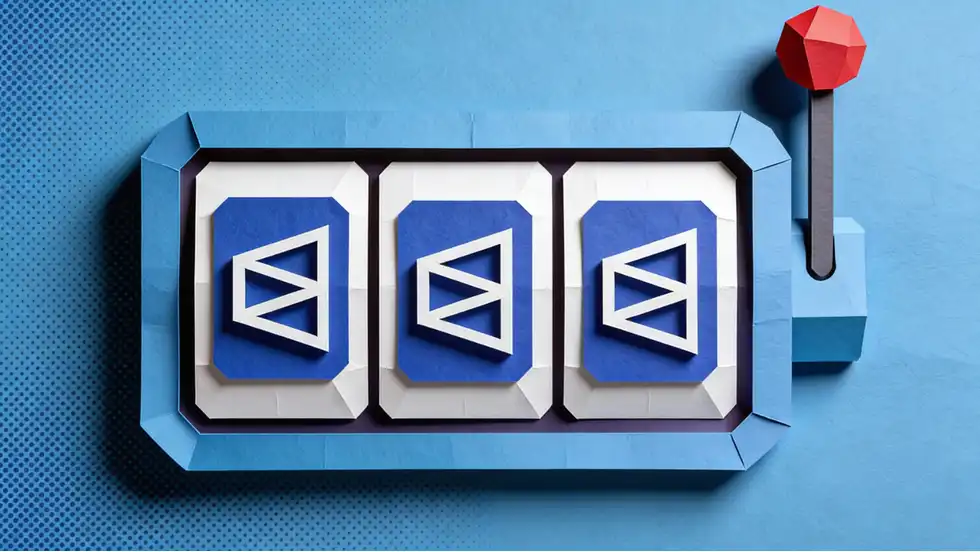
Drift Protocol incident uncovered: Did ‘negligence’ lead to the $285M loss?

ambcryptoPubblicato 2026-04-06Pubblicato ultima volta 2026-04-06

Introduzione

Drift Protocol's $285 million hack underscores a critical industry lesson: security cannot be sacrificed for scalability. This incident, potentially linked to the same group behind the 2024 Radiant Capital hack, reveals a meticulously planned attack where perpetrators posed as a legitimate firm to gain trust. In response, Drift froze protocol functions and collaborated with law enforcement, though market confidence remained shaken. The timing is significant, as Solana recently tested quantum-resistant upgrades that slowed the network by 90%, highlighting the inherent trade-offs between security and performance. Public scrutiny has intensified, with some labeling the breach "civil negligence," signaling a shift in the 2026 cycle toward prioritizing security, accountability, and quantum-threat preparedness over mere scalability.

This cycle clearly favors security over scalability, which marks a big shift from previous years.

Back in 2025, protocols like Ethereum [ETH] and Solana [SOL] focused on scaling the network, boosting transaction throughput, reducing congestion, and staying competitive in the fast-growing DeFi space. Their goal was simple: make the blockchain more scalable, even if that meant taking on extra risk under the hood.

However, the recent Drift protocol incident drives home a clear lesson: you cannot trade security for speed. In this context, could the attack actually act as a blessing in disguise, pushing the community and protocol teams to rethink operational security and put integrity above scalability?
Source: X

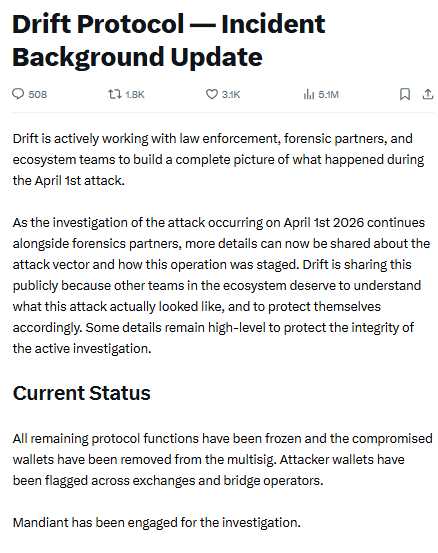
According to the official statement, the team is working closely with law enforcement and forensic experts to investigate the Drift incident. Because of this, they froze all protocol functions, removed compromised wallets, and flagged attacker wallets across exchanges.

Interestingly, early evidence ties the attack to the same group behind the October 2024 Radiant Capital hack, though final attribution is still pending. The big takeaway? This was a months-long, carefully planned operation. The attackers posed as a legitimate trading firm, building trust through in-person meetings, and even deposited over $1 million to appear credible.

On paper, Drift’s response shows accountability in action, but the market reaction didn’t really reflect confidence. So, the question is, does this Drift incident expose security weaknesses and force the industry to rethink operational practices to prevent similar attacks in the future?

Drift incident sparks public pressure and industry wake-up call

Even with the massive $285 million hack, the Drift incident highlights some important lessons.

According to AMBCrypto, the “timing” makes this attack especially relevant. Solana recently tested a quantum-resistant model to prepare for future quantum threats, but the experiment slowed the network by 90%, showing that security upgrades can come at a cost.

In this light, the Drift incident clearly shows that security can’t be an afterthought, even as protocols chase speed, scalability, and new features. Put simply, even with Solana’s 90% slowdown, the focus must stay on robust, practical security, something the Drift incident helped bring into sharp focus.
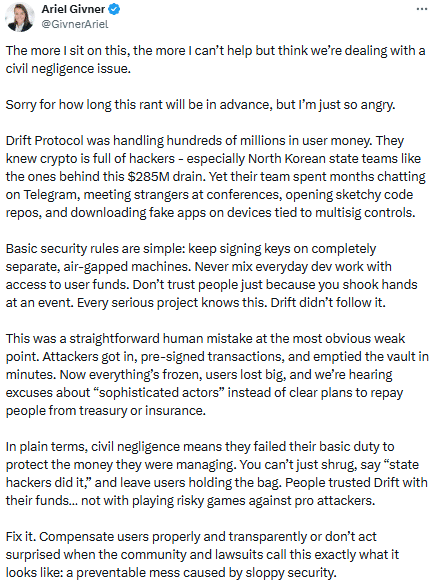
Source: X

Beyond the technical lessons, the public scrutiny that followed, though, adds another layer of pressure.

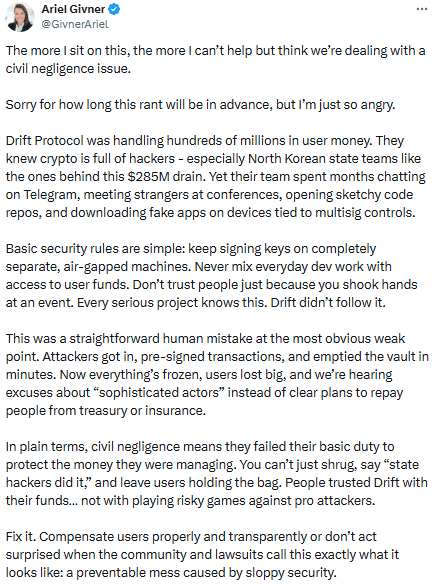
As the post above highlights, some reactions even called the hack “civil negligence,” implying that the protocol itself carried responsibility for the breach, alongside the attackers. This perspective isn’t too far-fetched, given the industry’s approach to security over the past few cycles.

Looking at it this way, the Drift protocol incident could be the wake-up call the market needed to move away from last year’s “scalability-first” mindset. The 2026 cycle is therefore shaping up to be security-driven, fueled by accountability, public pressure, and growing concerns around quantum threats.


Final Summary

  • The Drift incident highlights that security must come before speed, forcing protocols to rethink operational practices.
  • Public scrutiny and industry pressure are pushing the 2026 cycle to be security-driven, with quantum-threat preparedness taking center stage.


Domande pertinenti

QWhat was the main focus of blockchain protocols like Ethereum and Solana in 2025, according to the article?

AIn 2025, protocols like Ethereum and Solana focused on scaling the network, boosting transaction throughput, reducing congestion, and staying competitive in the fast-growing DeFi space, even if it meant taking on extra risk.

QWhat is the primary lesson the Drift protocol incident is said to drive home?

AThe primary lesson is that you cannot trade security for speed, and it should push the community to rethink operational security and put integrity above scalability.

QHow did the attackers gain the trust of the Drift protocol before the exploit?

AThe attackers posed as a legitimate trading firm, building trust through in-person meetings, and deposited over $1 million to appear credible.

QWhat broader industry shift is the Drift incident sparking for the 2026 cycle?

AThe incident is sparking a shift towards a security-driven cycle, fueled by accountability, public pressure, and growing concerns around quantum threats, moving away from the previous 'scalability-first' mindset.

QWhat was the estimated financial loss from the Drift Protocol incident?

AThe estimated financial loss from the Drift Protocol incident was $285 million.

Letture associate

Why Do You Always Lose Money on Polymarket? Because You're Betting on News, While the Pros Read the Rules

Why do you always lose money on Polymarket? Because you bet on news, while the pros study the rules. This article explains how top traders ("che tou") profit by meticulously analyzing market rules, not just predicting events. Polymarket, a prediction market platform, often sees disputes over event outcomes due to ambiguous rule wording. For instance, a market asking "Who will be the leader of Venezuela by the end of 2026?" was misinterpreted by many who bet on Delcy Rodríguez, assuming she held power. However, the rules specified "officially holds" as the formally appointed, sworn-in individual. Since Nicolás Maduro was still recognized as president officially, he won the market—even being in prison. To resolve such disputes, Polymarket uses a decentralized arbitration system via UMA protocol. The process involves: 1. Proposal: Anyone can propose a market outcome by staking 750 USDC, earning 5 USDC if unchallenged. 2. Dispute: A 2-hour window allows challenges with a 750 USDC stake; successful challengers earn 250 USDC. 3. Discussion: A 48-hour period on UMA Discord for evidence and debate. 4. Voting: UMA token holders vote in two 24-hour phases (blind then public). Outcomes require >65% consensus and 5M tokens voted; otherwise, four re-votes occur before Polymarket intervention. 5. Settlement: Results are final and automatic. Unlike traditional courts, Polymarket’s system lacks separation between arbitrators and stakeholders—voters often hold market positions, creating conflicts of interest. This leads to herd mentality in discussions and non-transparent outcomes without explanatory rulings, preventing precedent formation. Thus, success on Polymarket hinges on deep rule interpretation, not just event prediction, exploiting gaps between reality and contractual wording.

marsbit35 min fa

Why Do You Always Lose Money on Polymarket? Because You're Betting on News, While the Pros Read the Rules

marsbit35 min fa

DeepSeek Funding: Liang Wenfeng's 'Realist' Pivot

DeepSeek, a leading Chinese AI company, has initiated its first external funding round, aiming to raise at least $300 million at a valuation of no less than $10 billion. This move marks a significant shift from its founder Liang Wenfeng’s previous idealistic stance of rejecting external capital to maintain independence. Despite strong financial backing from its parent company, quantitative trading firm幻方量化 (Huanfang Quant), which provided an estimated $700 million in revenue in 2025 alone, DeepSeek faces mounting challenges. Key issues include a 15-month gap in major model updates, delays in its flagship V4 release, and the loss of several core researchers to competitors offering significantly higher compensation. The company is also undergoing a strategic pivot by migrating its infrastructure from NVIDIA’s CUDA to Huawei’s Ascend platform, a move aligned with China’s push for technological self-reliance amid U.S. export controls. However, DeepSeek lags behind rivals like智谱AI and MiniMax—both now publicly listed—in areas such as product ecosystem, multimodal capabilities, and commercialization. The funding round, though relatively small in scale, is seen as a way to establish a market-validated valuation anchor, making employee stock options more competitive and facilitating talent retention. It also signals DeepSeek’s transition from a pure research-oriented organization to a commercially-driven player in the global AI ecosystem.

marsbit1 h fa

DeepSeek Funding: Liang Wenfeng's 'Realist' Pivot

marsbit1 h fa

Trading

Spot
Futures

Articoli Popolari

Come comprare DRIFT

Benvenuto in HTX.com! Abbiamo reso l'acquisto di Drift Protocol (DRIFT) semplice e conveniente. Segui la nostra guida passo passo per intraprendere il tuo viaggio nel mondo delle criptovalute.Step 1: Crea il tuo Account HTXUsa la tua email o numero di telefono per registrarti il tuo account gratuito su HTX. Vivi un'esperienza facile e sblocca tutte le funzionalità,Crea il mio accountStep 2: Vai in Acquista crypto e seleziona il tuo metodo di pagamentoCarta di credito/debito: utilizza la tua Visa o Mastercard per acquistare immediatamente Drift ProtocolDRIFT.Bilancio: Usa i fondi dal bilancio del tuo account HTX per fare trading senza problemi.Terze parti: abbiamo aggiunto metodi di pagamento molto utilizzati come Google Pay e Apple Pay per maggiore comodità.P2P: Fai trading direttamente con altri utenti HTX.Over-the-Counter (OTC): Offriamo servizi su misura e tassi di cambio competitivi per i trader.Step 3: Conserva Drift Protocol (DRIFT)Dopo aver acquistato Drift Protocol (DRIFT), conserva nel tuo account HTX. In alternativa, puoi inviare tramite trasferimento blockchain o scambiare per altre criptovalute.Step 4: Scambia Drift Protocol (DRIFT)Scambia facilmente Drift Protocol (DRIFT) nel mercato spot di HTX. Accedi al tuo account, seleziona la tua coppia di trading, esegui le tue operazioni e monitora in tempo reale. Offriamo un'esperienza user-friendly sia per chi ha appena iniziato che per i trader più esperti.

323 Totale visualizzazioniPubblicato il 2024.12.11Aggiornato il 2025.03.21

Come comprare DRIFT

Discussioni

Benvenuto nella Community HTX. Qui puoi rimanere informato sugli ultimi sviluppi della piattaforma e accedere ad approfondimenti esperti sul mercato. Le opinioni degli utenti sul prezzo di DRIFT DRIFT sono presentate come di seguito.

活动图片