Drift Protocol halts operations after suspected $285m exploit as funds move across wallets

ambcryptoPubblicato 2026-04-01Pubblicato ultima volta 2026-04-01

Introduzione

Drift Protocol has halted deposits and withdrawals after confirming an active attack, with initial estimated losses around $285 million. Blockchain security firm PeckShield reported the losses span multiple assets, including $71.4M in USDC and $159.3M in JLP, among others. The attacker has begun moving funds across wallets, likely to obscure transaction trails. Unverified reports suggest the exploit may have involved a compromised administrative key, allowing manipulation of protocol parameters, though this remains unconfirmed. The incident reflects a trend of sophisticated DeFi attacks targeting governance and internal controls. An investigation is ongoing with no timeline for restoring operations.

Drift Protocol has halted deposits and withdrawals after confirming it is experiencing an active attack, with early estimates suggesting losses could reach hundreds of millions of dollars.

The protocol disclosed the incident in a public update on 1 April, stating that it is coordinating with security firms, bridges, and exchanges to contain the situation.

“This is not an April Fools joke,” the team said, adding that further updates will follow as the investigation develops.
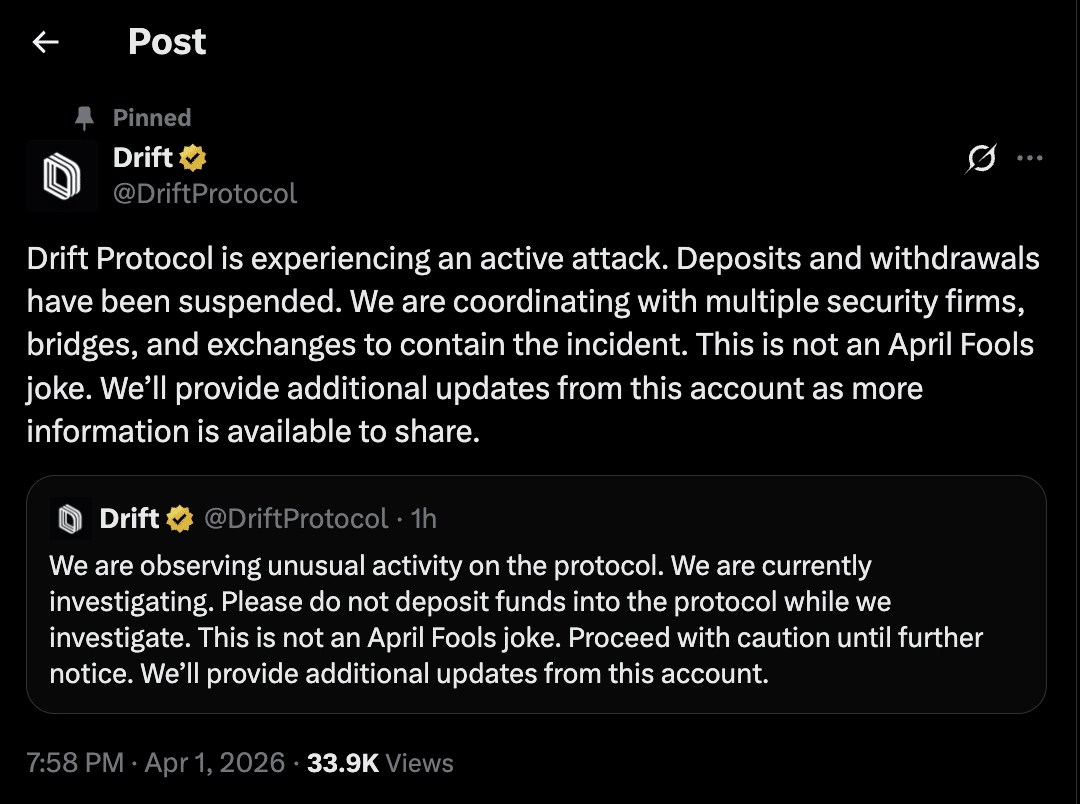
Source: X

Estimated losses near $285m as breakdown emerges

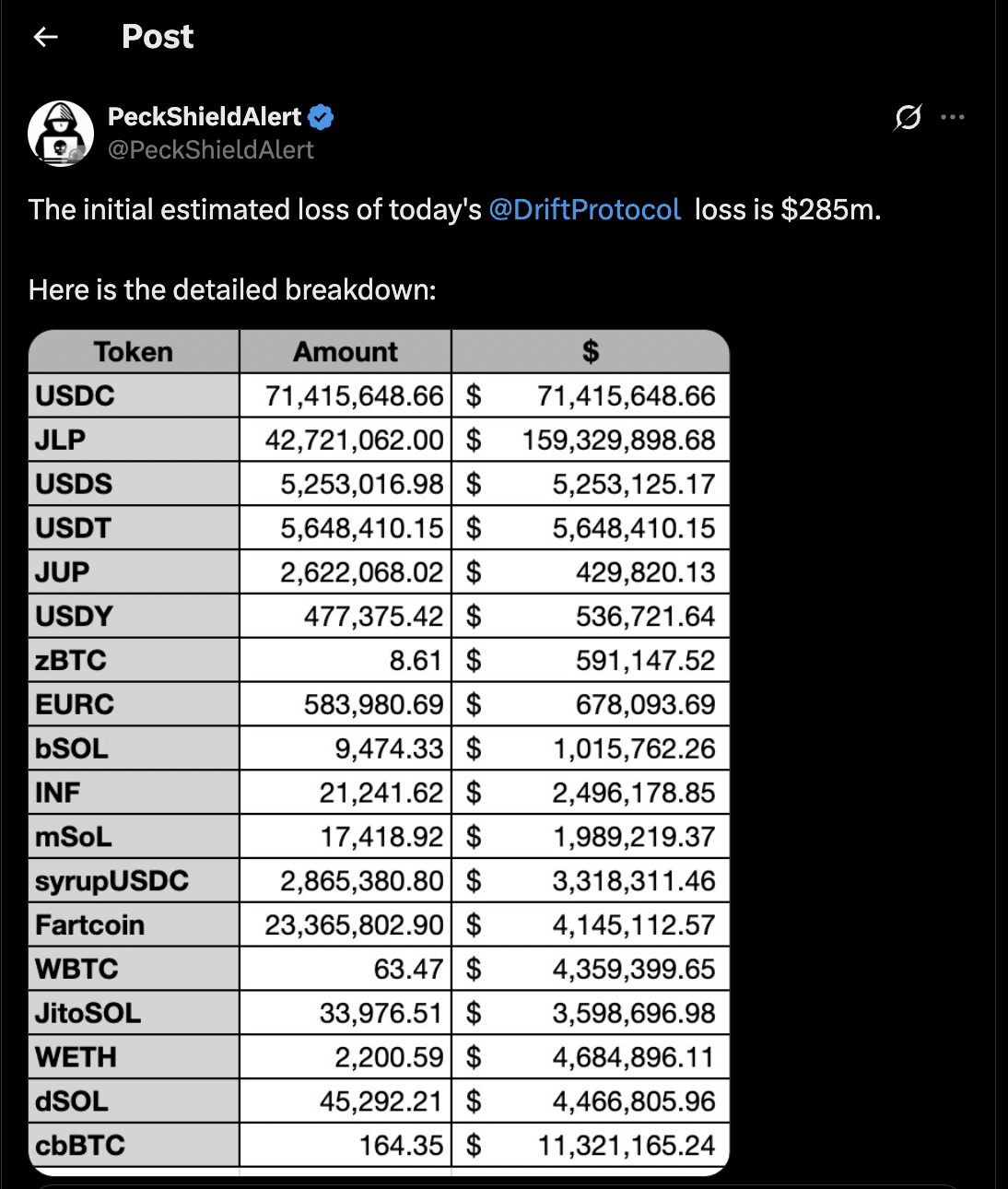
Blockchain security firm PeckShield estimated the initial losses at around $285m, based on early on-chain analysis.

A breakdown shared by the firm suggests the exploit spans multiple assets, including:

  • $71.4m in USDC
  • $159.3m in JLP
  • Smaller amounts across USDT, WETH, wrapped BTC, and Solana-based assets
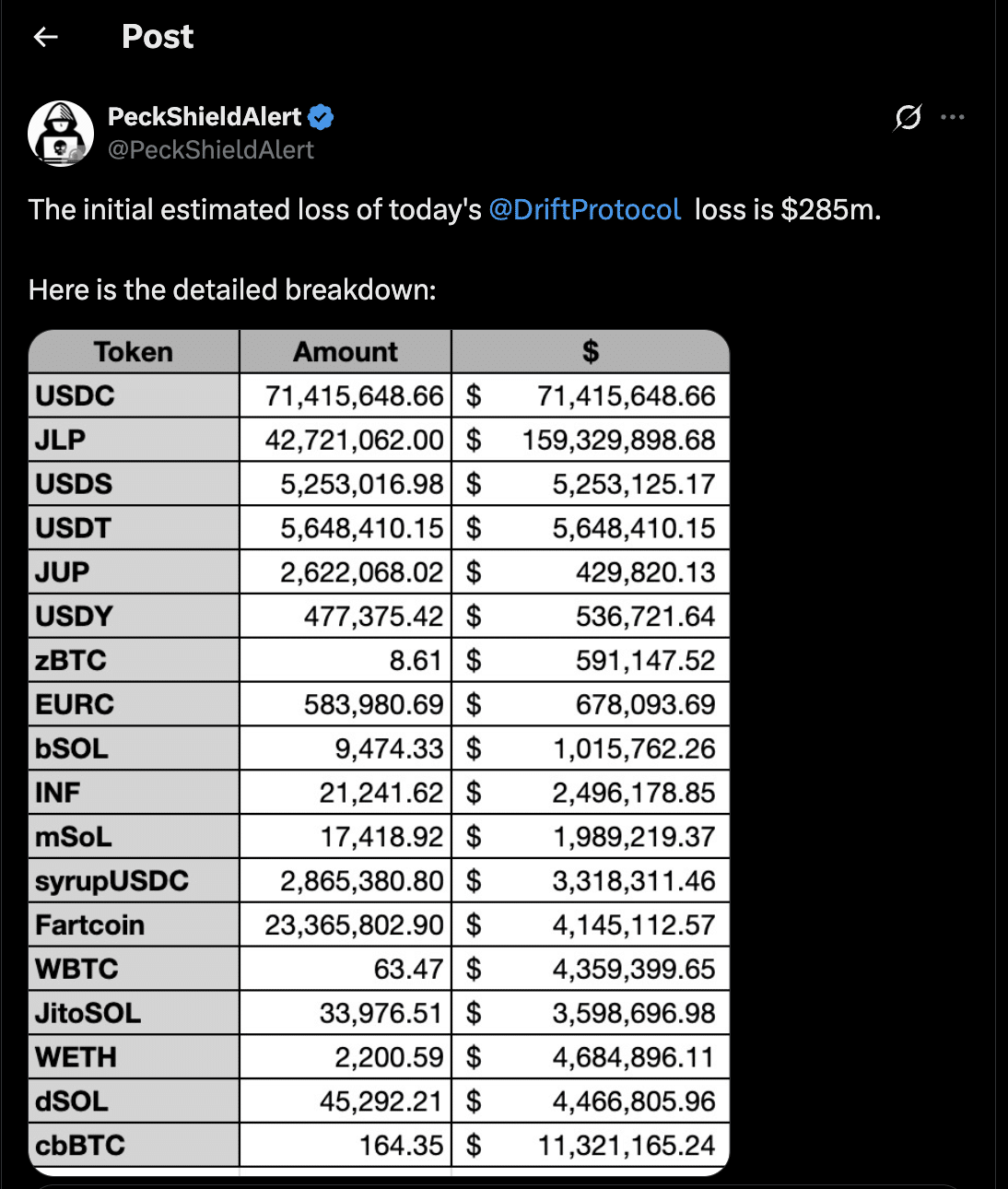
Source: X

While the figures remain preliminary, the scale places the incident among the larger DeFi exploits in recent months.

Funds begin moving across wallets

Separate on-chain tracking indicates that the attacker has already begun moving funds across multiple wallets. This is a pattern typically associated with attempts to obscure transaction trails.

Initial flows suggest assets are being split and transferred through different addresses, with some movements potentially involving cross-chain bridges. This behavior is consistent with past exploits where attackers rapidly redistribute funds to reduce traceability and recovery risk.

At the time of writing, there has been no confirmed recovery of funds.

Unverified reports point to potential exploit mechanism

Unconfirmed reports circulating on social media suggest the attacker may have gained access to a privileged administrative key, allowing them to modify protocol parameters.

According to these accounts, the attacker allegedly manipulated collateral settings, inflated the value of a low-liquidity asset, and used it to borrow higher-value tokens before draining liquidity from the system.

However, these claims remain unverified, and Drift Protocol has not confirmed the attack vector.

A growing pattern of complex DeFi exploits

The incident adds to a broader trend of increasingly sophisticated exploits targeting decentralized finance protocols, where vulnerabilities often extend beyond simple smart contract bugs.

In several recent cases, attackers have exploited governance controls, oracle mechanisms, or internal parameter systems rather than purely external vulnerabilities.

If confirmed, the suspected method in this case would reflect a similar pattern, highlighting how complex protocol design and privileged access controls can introduce new risk surfaces.

Investigation ongoing

Drift Protocol said it is working with multiple partners to investigate the breach and contain further damage. No timeline has been provided for restoring normal operations.

The full scope of the exploit, including the exact attack vector and potential recovery efforts, remains unclear.


Final Summary

  • Drift Protocol has paused operations following an active attack, with early estimates placing losses at around $285m.
  • While funds are already being moved on-chain, the exact exploit method remains unconfirmed as investigations continue.


Domande pertinenti

QWhat is the estimated financial loss from the Drift Protocol exploit according to initial on-chain analysis by PeckShield?

AThe estimated financial loss from the Drift Protocol exploit is approximately $285 million.

QWhat specific action did Drift Protocol take in response to the active attack?

ADrift Protocol halted all deposits and withdrawals in response to the active attack.

QWhat is one of the unverified potential mechanisms for the exploit that was circulating on social media?

AUnverified reports on social media suggested the attacker may have gained access to a privileged administrative key, allowing them to modify protocol parameters, manipulate collateral settings, and drain liquidity.

QWhich two assets made up the largest portions of the stolen funds according to the breakdown?

AAccording to the breakdown, the two largest portions of the stolen funds were $159.3 million in JLP and $71.4 million in USDC.

QWhat broader trend in decentralized finance (DeFi) does this incident contribute to?

AThis incident contributes to the broader trend of increasingly sophisticated exploits targeting DeFi protocols, where vulnerabilities often extend beyond simple smart contract bugs to include governance controls, oracle mechanisms, or internal parameter systems.

Letture associate

Can DeepSeek Save China One Trillion Dollars?

"DeepSeek and the $1 Trillion Infrastructure Question" The article examines whether DeepSeek's AI optimization breakthroughs could potentially save China $1 trillion in future AI infrastructure costs. The analysis begins with Nvidia's upcoming Vera Rubin AI platform, costing ~$7.8 million, where memory (HBM4/LPDDR5X) constitutes $2 million—a 435% cost increase in one year, highlighting how AI hardware spending is shifting toward expensive memory components. DeepSeek's approach works in the opposite direction. Through three key technical innovations showcased in DeepSeek V4, the company dramatically improves hardware efficiency: 1. **Memory Compression (MLA)**: Re-engineers the attention mechanism to compress long-context memory (KV Cache) by over 90%, drastically reducing expensive HBM usage. 2. **Selective Activation (MoE)**: Employs Mixture-of-Experts architecture where only a small fraction of parameters (e.g., 49B out of 1.6T in V4-Pro) are activated per token, allowing most parameters to reside in cheaper memory/SSD. 3. **Computation Caching**: Reuses previously computed results via cache hits, replacing expensive GPU computations with cheap memory reads. Combined, these optimizations allow the same hardware to produce approximately 4x more tokens, effectively reducing required hardware investment by 75%. DeepSeek's pricing reflects this: a 10-billion token workload costs ~$522 monthly versus ~$9,000-$10,000 for competitors. The $1 trillion savings projection stems from McKinsey's estimate that global AI infrastructure will require ~$5.2 trillion investment by 2030. As China's daily token consumption grows toward quadrillions, even marginal efficiency gains scale massively. With a conservative 4x throughput improvement, China could avoid building tens of thousands of AI data centers equivalent to ~7 trillion RMB ($1 trillion) in saved investment. Critically, this strategy shifts dependency from scarce, expensive GPU/HBM—where China lags—toward more accessible storage, caching, and systems engineering where domestic suppliers like CXMT are gaining strength. Rather than "replacing Nvidia," DeepSeek rebalances AI's value chain away from monolithic hardware dependency. Ultimately, DeepSeek's technical breakthroughs could lower the barrier to AI adoption across Chinese industries by making advanced capabilities affordable at scale—transforming who can access next-generation AI.

marsbit45 min fa

Can DeepSeek Save China One Trillion Dollars?

marsbit45 min fa

Overturning the Mainstream Approach to Hallucinations: Metacognition is the New Solution for Large Models to Break the Hallucination Barrier

This paper, "Hallucinations Undermine Trust; Metacognition is a Way Forward," proposes a paradigm shift in combating AI hallucination. It argues that the current mainstream approaches—striving for omniscience by scaling data/models or having AI abstain from uncertain answers—are fundamentally flawed. The former has inevitable knowledge gaps, while the latter imposes a crippling "utility tax," requiring the rejection of many correct answers to achieve high accuracy, due to models' poor "discrimination" (the ability to distinguish correct from incorrect answers internally). The core contribution is redefining hallucination not as "being wrong," but as "expressing false information with unwarranted certainty." The proposed solution is **Faithful Uncertainty** or **Metacognition**: enabling AI to accurately perceive its internal uncertainty and honestly express it in its language (e.g., using hedging phrases when unsure). This creates a more reliable assistant that provides useful information while signaling its confidence, minimizing harm from errors. The paper emphasizes that metacognition is critical for the era of AI Agents. Without it, Agents cannot intelligently decide when to use tools like search engines, leading to inefficiency and misuse. Key implementation challenges are highlighted: the "bootstrapping paradox" of training with static uncertainty data, the "alignment distortion signal" where human preference training suppresses internal uncertainty cues, and the difficulty of causally evaluating true metacognition vs. its superficial imitation. The paper concludes that the goal should not be an infallible AI, but one that is honest about the limits of its knowledge, thereby building user trust through transparent communication of its certainty.

marsbit49 min fa

Overturning the Mainstream Approach to Hallucinations: Metacognition is the New Solution for Large Models to Break the Hallucination Barrier

marsbit49 min fa

Hedge by Buying Gold and Oil, Chase Soaring Returns with AI. ‘Dated’ Bitcoin Enters a Bear Market

Bitcoin has recently declined, hitting a two-month low near $66,123, while Ethereum fell to a three-month low around $1,837. Analysts suggest the drop is not merely due to factors like ETF outflows or MicroStrategy's selling but reflects a deeper issue: Bitcoin is losing a broader asset competition. In a near-zero interest rate environment, Bitcoin previously thrived as an outlet for investor dissatisfaction with inflation and limited options. However, the market landscape has shifted. Bitcoin now occupies an "awkward middle ground," facing competition on three fronts. For inflation hedging, investors prefer gold, energy stocks, and commodity producers—assets with tangible backing and clearer pricing power. For growth exposure, AI-related companies with actual revenues and profits are more attractive. Even within crypto, investors can choose stablecoins, exchanges, or infrastructure firms tied directly to adoption, offering clearer business models and leverage. Thus, Bitcoin is no longer the top choice for hedging, growth, or crypto exposure. This shift is evident in market reactions: despite recent warnings about persistent inflation from a Fed official, Bitcoin did not rally as it might have in the past. Instead, capital flowed to assets with direct commodity or energy exposure. The recent ETF outflows and MicroStrategy sales are symptoms, not causes, of this new reality. Investors are becoming more selective, demanding clearer value propositions beyond mere scarcity. The emerging bear case for Bitcoin is not about it being a bubble or failed technology, but that scarcity alone is no longer sufficient.

华尔街日报52 min fa

Hedge by Buying Gold and Oil, Chase Soaring Returns with AI. ‘Dated’ Bitcoin Enters a Bear Market

华尔街日报52 min fa

Trading

Spot
Futures

Articoli Popolari

Come comprare DRIFT

Benvenuto in HTX.com! Abbiamo reso l'acquisto di Drift Protocol (DRIFT) semplice e conveniente. Segui la nostra guida passo passo per intraprendere il tuo viaggio nel mondo delle criptovalute.Step 1: Crea il tuo Account HTXUsa la tua email o numero di telefono per registrarti il tuo account gratuito su HTX. Vivi un'esperienza facile e sblocca tutte le funzionalità,Crea il mio accountStep 2: Vai in Acquista crypto e seleziona il tuo metodo di pagamentoCarta di credito/debito: utilizza la tua Visa o Mastercard per acquistare immediatamente Drift ProtocolDRIFT.Bilancio: Usa i fondi dal bilancio del tuo account HTX per fare trading senza problemi.Terze parti: abbiamo aggiunto metodi di pagamento molto utilizzati come Google Pay e Apple Pay per maggiore comodità.P2P: Fai trading direttamente con altri utenti HTX.Over-the-Counter (OTC): Offriamo servizi su misura e tassi di cambio competitivi per i trader.Step 3: Conserva Drift Protocol (DRIFT)Dopo aver acquistato Drift Protocol (DRIFT), conserva nel tuo account HTX. In alternativa, puoi inviare tramite trasferimento blockchain o scambiare per altre criptovalute.Step 4: Scambia Drift Protocol (DRIFT)Scambia facilmente Drift Protocol (DRIFT) nel mercato spot di HTX. Accedi al tuo account, seleziona la tua coppia di trading, esegui le tue operazioni e monitora in tempo reale. Offriamo un'esperienza user-friendly sia per chi ha appena iniziato che per i trader più esperti.

344 Totale visualizzazioniPubblicato il 2024.12.11Aggiornato il 2026.06.02

Come comprare DRIFT

Discussioni

Benvenuto nella Community HTX. Qui puoi rimanere informato sugli ultimi sviluppi della piattaforma e accedere ad approfondimenti esperti sul mercato. Le opinioni degli utenti sul prezzo di DRIFT DRIFT sono presentate come di seguito.

活动图片