Dragonfly Survey on Current State of Crypto Recruitment: Compliance Roles +340%, Data Science +74%, Crypto Enters the Era of On-Demand Hiring

marsbitPubblicato 2026-04-16Pubblicato ultima volta 2026-04-16

Introduzione

Dragonfly's 2026 crypto talent report reveals a fundamental shift in hiring: companies now recruit based on actual need rather than market hype. In 2025, the industry saw a net reduction of 472 roles, but compliance positions surged by 340% and data science roles grew by 74%. The second half of 2025 brought discipline and recovery, with hiring stabilizing. Candidates are now more cautious, prioritizing company durability, clear role definition, and tangible impact over broad narratives. Engineering, AI/ML, and security roles remain highly competitive. Founders are advised to hire based on milestones—not cycles—and provide clear value propositions to attract talent. Remote work remains common, but key hubs like New York and the Bay Area dominate. AI's influence is significant, but its unclear impact in crypto may slow hiring. The outlook for 2026 is flat to moderate growth, driven by execution-focused teams with credible stories.

Author: Zackary Skelly (Head of Talent at Dragonfly)

Compiled by: Deep Tide TechFlow

Deep Tide Introduction: Dragonfly releases the 2026 crypto industry insights report, revealing a fundamental shift in hiring logic. In 2025, the industry saw a net reduction of 472 people, but compliance roles surged by 340%, and data science roles grew by 74%. The most critical change: candidates are no longer impulsive about the bull market; they want clear value explanations and certainty. If you can't explain "why this role is important," the conversion rate will plummet.

1/

We are now in the first quarter of 2026, and the hiring situation in the cryptocurrency space is completely different from any previous cycle.

We have just released the latest "Talent Insights Report," detailing how we got here and what it means for founders and talent teams.

2/

TL;DR

2025 did not kill crypto hiring; it matured it.

Companies are no longer hiring based on price but on actual needs.

This shift has become the new benchmark heading into 2026.
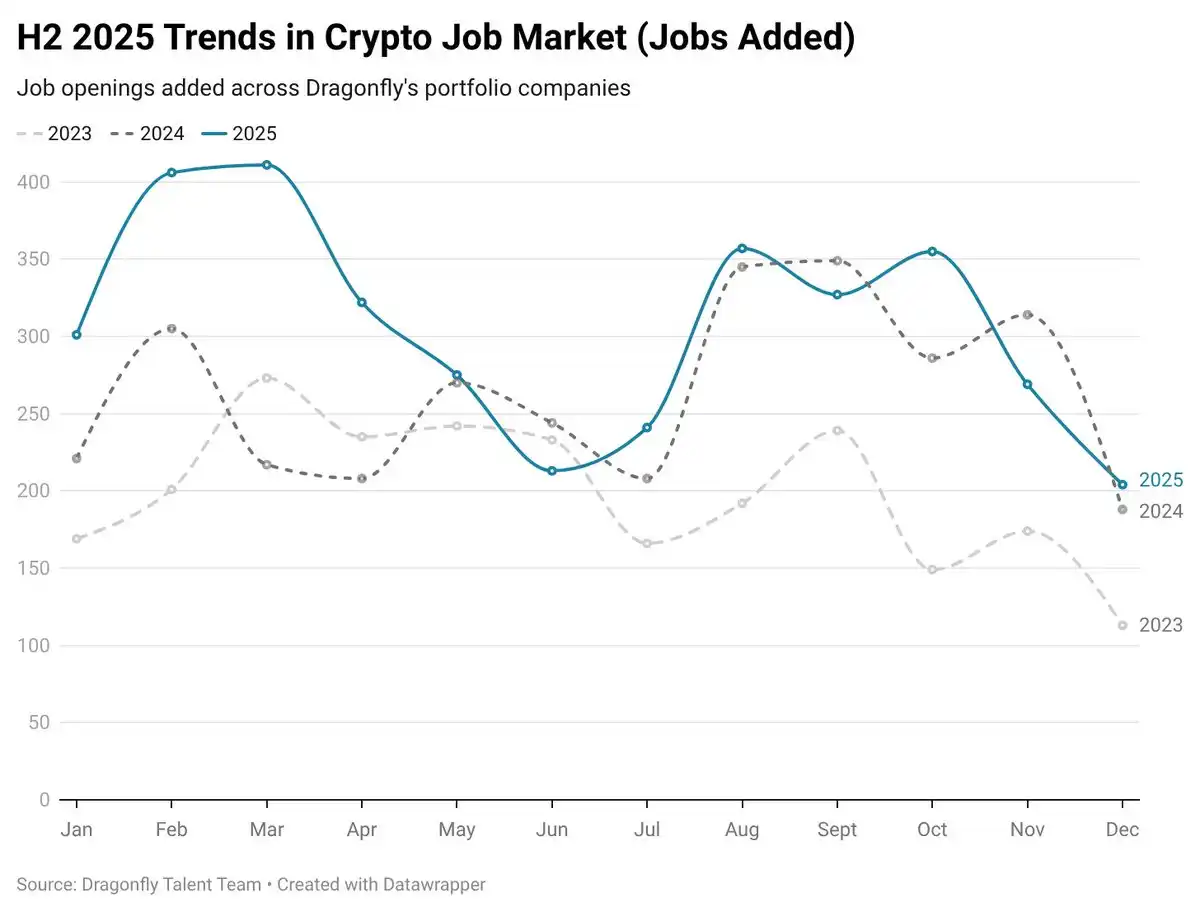
3/

The year was clearly divided into two halves.

The first half of 2025 (25H1) was turbulent, with pro-crypto optimism quickly reversing amid macro shocks.

Job removals surged in March (750), with most losses concentrated in the first half.

Approximately 3,700 new jobs were added for the year, while about 4,100 were removed, resulting in a net reduction of -472.
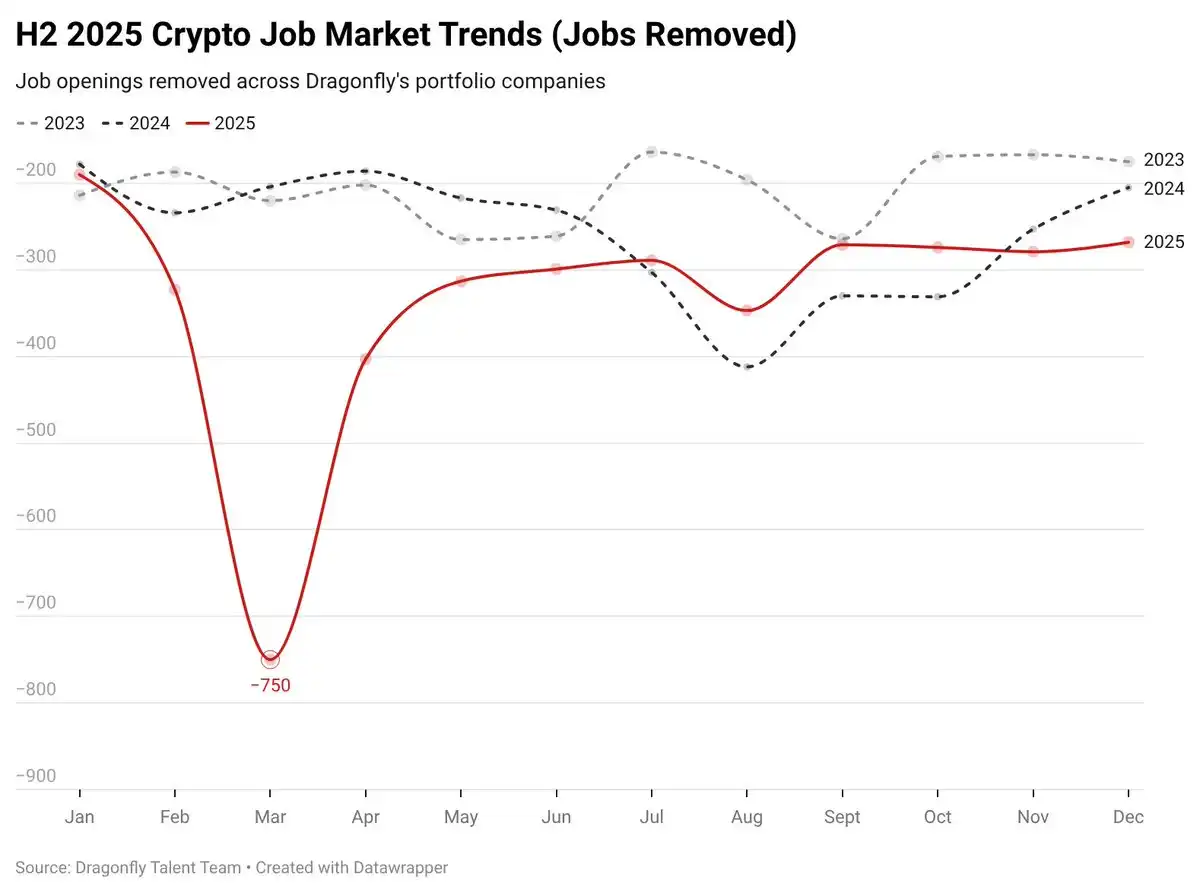
4/

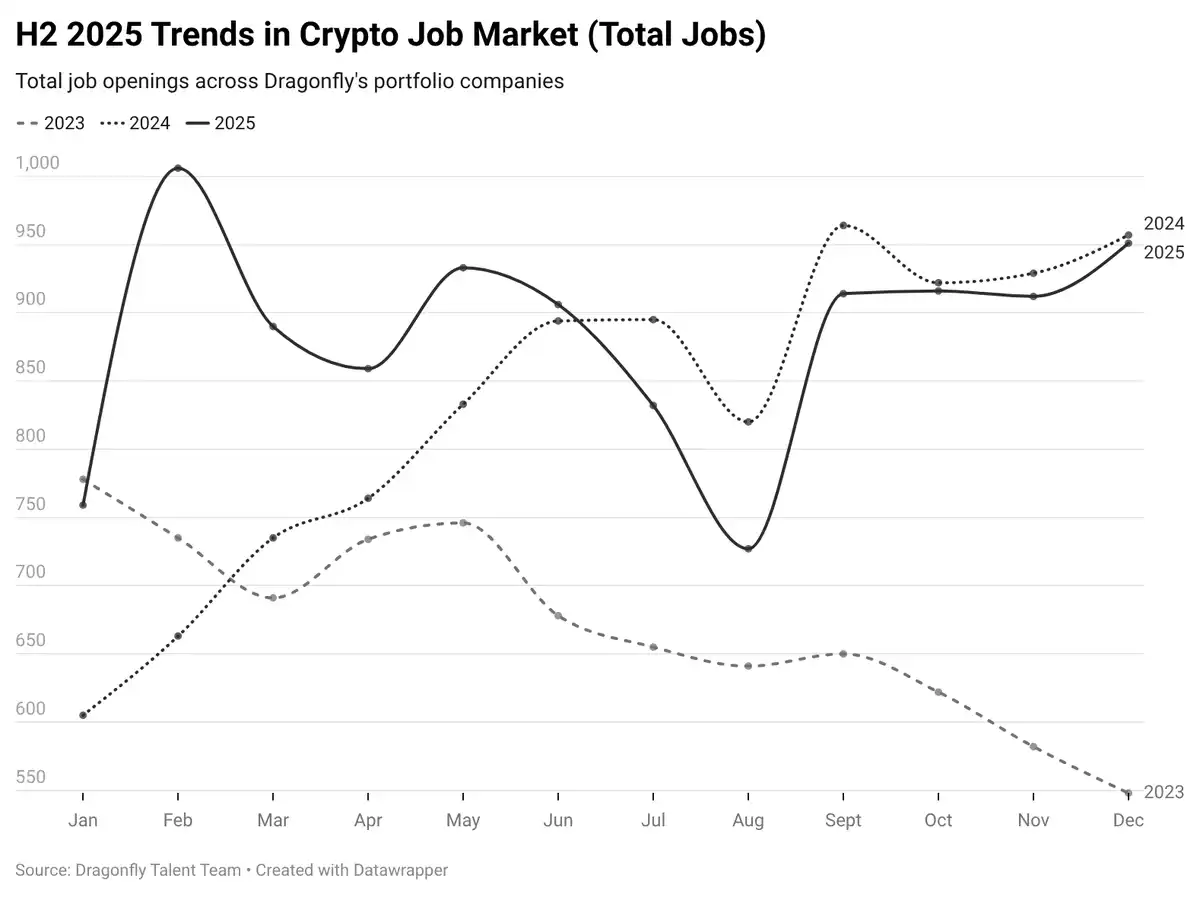
The second half (H2) brought discipline and recovery.

The overall job trend in H2 was largely consistent with 2024, just at a lower overall level.

July reset, August bottomed out, September reopened, and Q4 stabilized.

The more severe reset in spring was the main reason 2025 overall was lower than 2024.
5/

In our 25H1 report, we made some predictions. Let's score them now:

✓ Late Q3 rebound (September job openings +26%), Q4 slowdown, compliance hiring started early

✗ Underestimated the degree of divergence in traffic and applications; overestimated the resilience of legal roles relative to compliance roles

6/

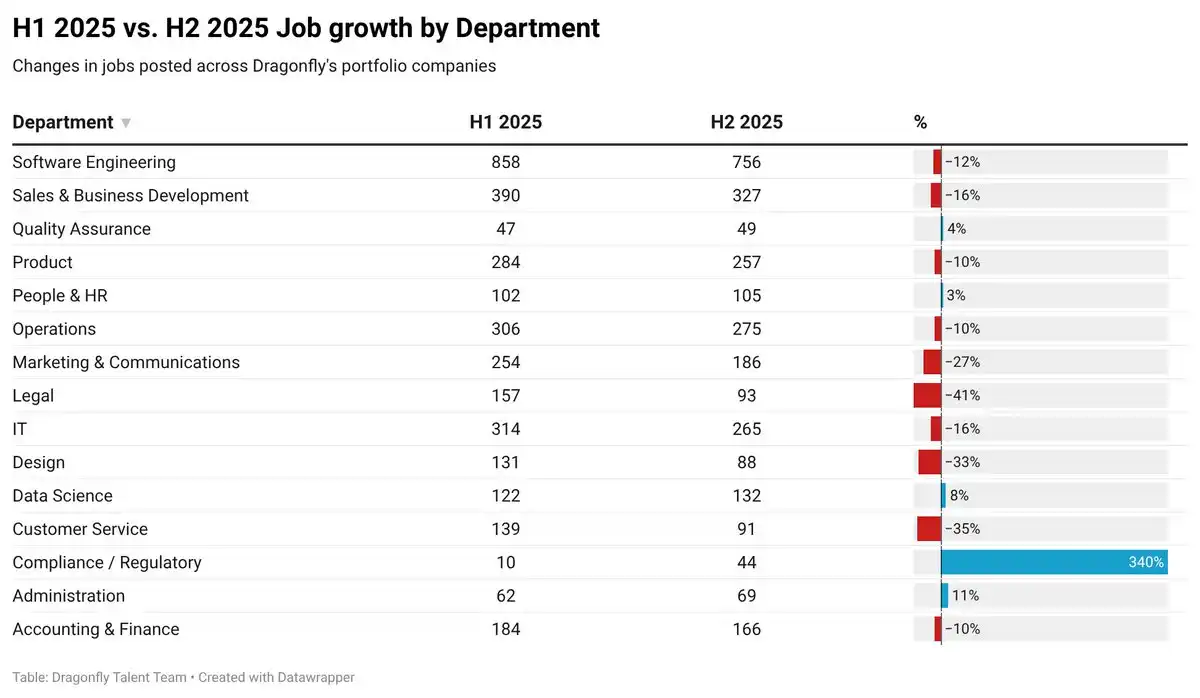
The real shift from 25H1 to H2 was not how many people companies hired, but what roles they hired for. Core first, earn the right to scale.

→ Engineering: -12%, still the anchor → Marketing: -27% → Design: -33% → Customer Service: -35% → Sales & BD: -16% → Legal: -41% → Compliance: +340%
7/

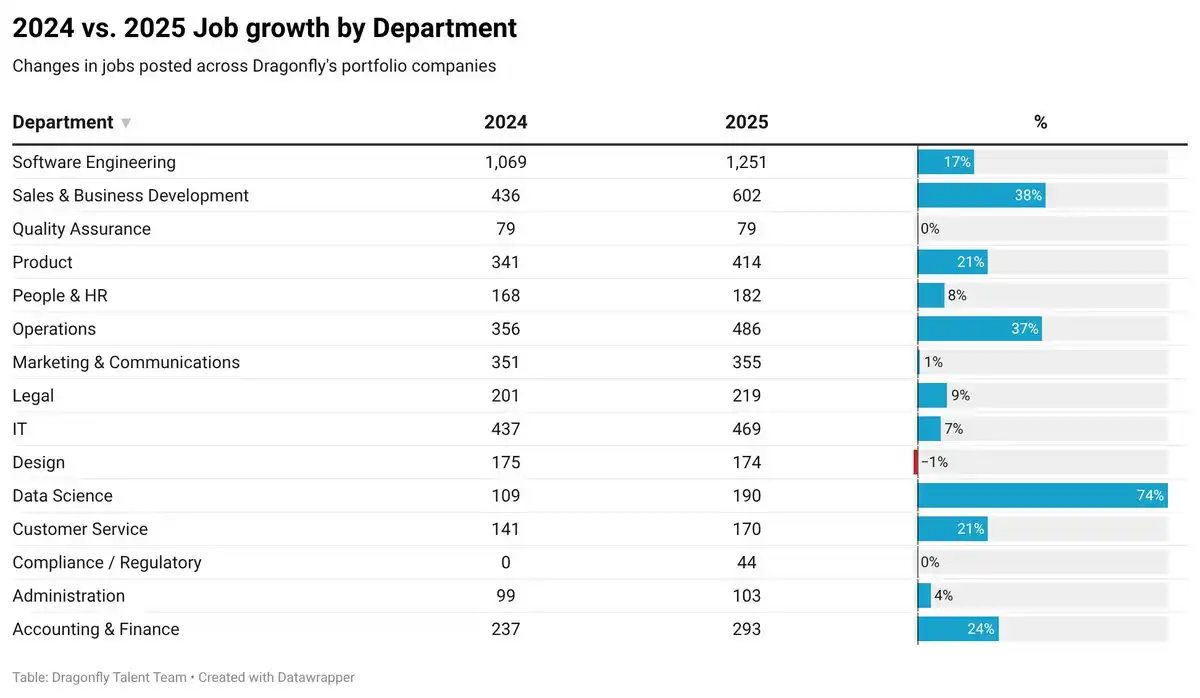
Data science was the clearest winner of the year, up +74% year-over-year. (Thanks to AI?)
8/

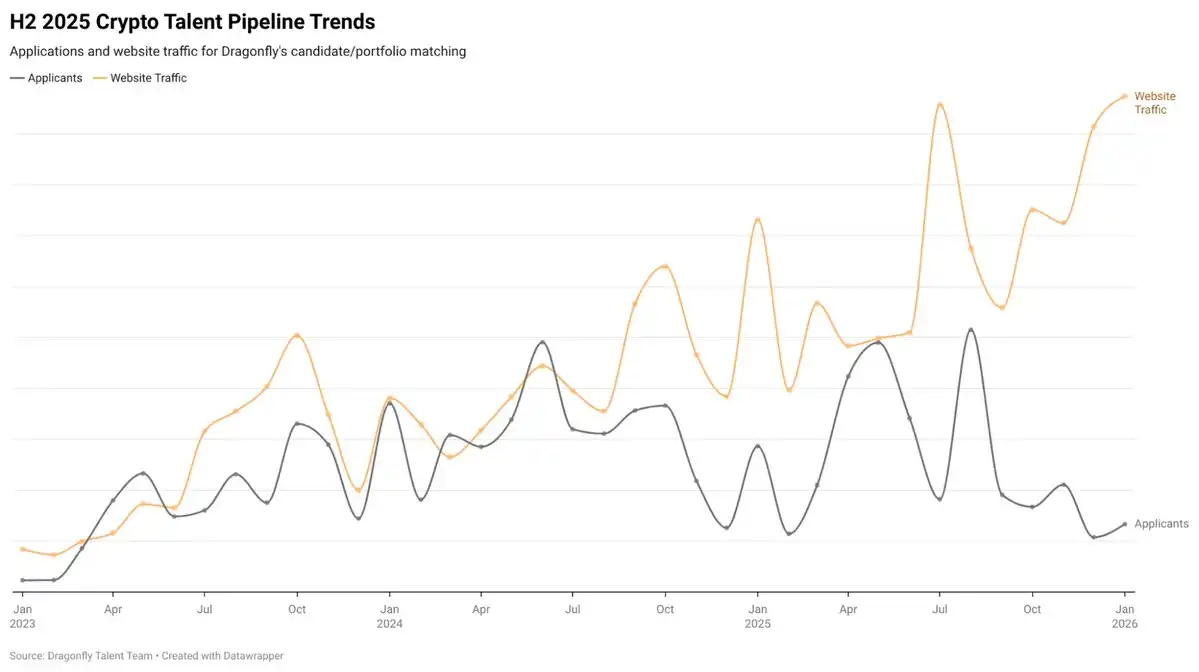
Interesting changes also happened on the candidate side.

Traffic remained stable in the second half, while applications dropped by about 26%.

People are still browsing, just not submitting applications as easily.
9/

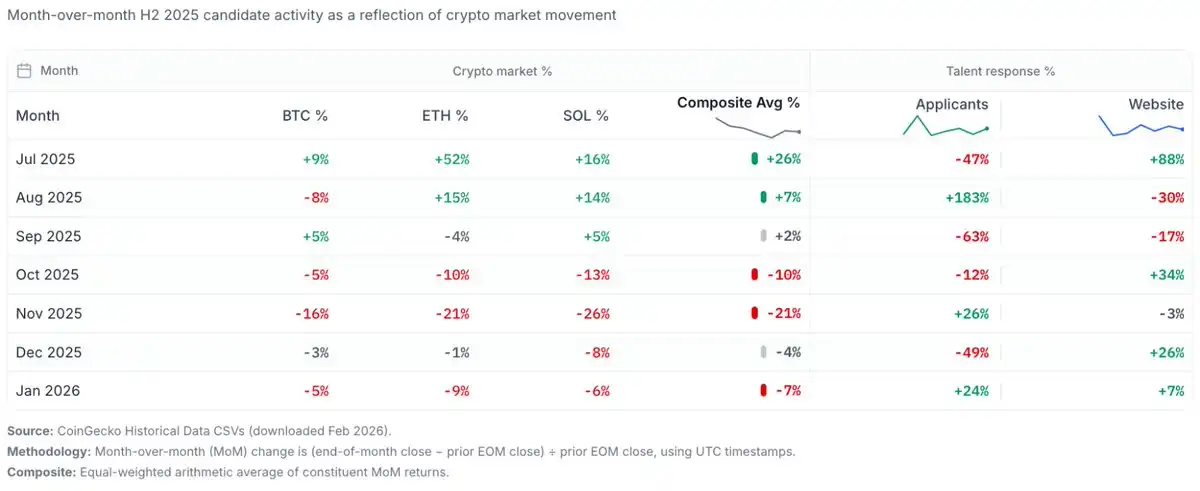
In early cycles, market excitement did most of the hiring work: rising salaries, influx of applications.

This mechanism is failing.

Stronger months still drive page views, but attention conversion rates are not what they used to be.
10/

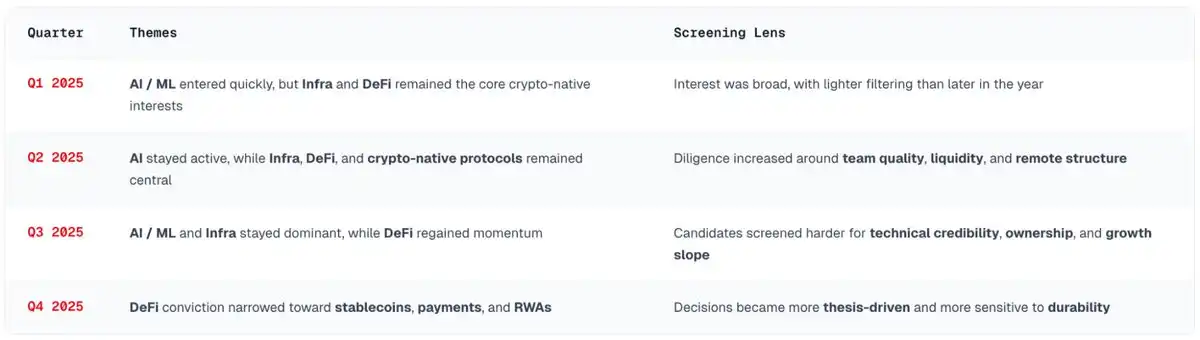
Why? Partly because candidates have become more cautious.

They are more rigorously screening companies for durability, ownership clarity, team quality, and technical credibility: open-source proof, product depth, hardcore problems, GTM roadmap.

Generic category narratives no longer work.
11/

Areas of concentrated belief: Infrastructure, DeFi, L1, and L2 remain core, but DeFi interest has narrowed to stablecoins, payments, and RWA.

Fintech-related and institutional use cases have gained significant attention. AI remains a key interest point.

12/

Stage preferences also tell an interesting story.

Seed and Series A stages are still the most attractive to candidates, with high demand for founder roles and first-employee roles. However, larger, more mature companies can still attract interest.

13/

The most common factor causing candidates to drop out is not compensation, stage, or size, but ambiguity.

If you cannot clearly explain why the company is important, what specific scope they will own, and why the opportunity has lasting power, the conversion rate will drop significantly.

14/

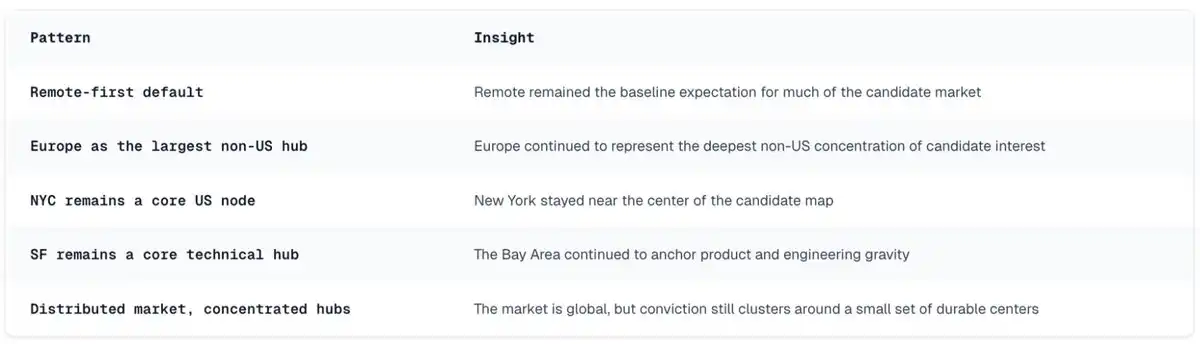
Geographically, remote work is still the norm, but the most active hiring teams are more concentrated in New York and lean towards in-person work.

Talent remains global, but New York + the Bay Area still dominate. Europe is the largest non-US hub.

(Note: Specific geographic hiring = smaller TAM, longer hiring cycles.)
15/

Another factor shaping the current landscape: Hiring is concentrating towards later-stage teams and significantly in the verticals candidates are most interested in.

We expect hiring for the remainder of 2026 to be driven more by acquisitions, pivots, and consolidation, rather than pure new growth.

16/

So what should founders do?

Hire based on milestones—product launches, revenue, partnerships, regulatory progress—not market cycles or calendar plans.

Companies that did well with hiring in H2 2025 could clearly articulate and stick to the reason for each role's existence.

17/

Know that teams are different, so sequence hires thoughtfully:

→ Core builders first (engineering, security, data/protocol) → BD explores fit → Product is flexible based on type (consumer earlier, infrastructure leaner) → Compliance, finance, risk → Marketing/support scales after leverage appears

18/

Keep pipelines always open for scarce talent.

Engineering, AI/ML, and security roles are severely supply-constrained and cannot be restarted from zero every cycle. Even if specific needs are closed, relationships should be kept warm.

19/

Recognize that the way roles are sold has changed.

Candidates want runway clarity, clear ownership for the first 30–60 days, and transparent upside mechanisms.

You must sell differentiation. You are not selling your category; you are selling why you will win and what specific role they can play.

20/

You also need a real AI story. Not "we are an AI company."

Candidates want to know:

→ How AI is used internally → How it changes the product → Whether it creates a real advantage

Vague answers lose talent.

21/

Specific advice for talent teams:

Put your strongest people at the front of the process (first impressions matter), keep interview loops tight, and provide clear feedback.

22/

An open question: AI makes 2026 harder to predict.

People can do more with fewer people. Better tools enable some to start their own. Some might go work directly on AI.

Meanwhile, higher output per employee means faster scaling, and crypto is positioned more broadly than ever.

23/

Our current view on AI's impact: Before clear AI × Crypto use cases solidify, deceleration signals are stronger than acceleration signals.

📎 Further reading: The Agentic Economy Will Be Massive, Agentic Commerce Won't

24/

Our baseline expectation for 2026: Flat to moderate growth, led by engineering, AI/data, and security. Consolidation will continue.

Whether bull, baseline, or bear market, this is a year focused on quality building.

25/

The teams that will win talent will be those with the most credible stories, not the loudest ones.

Execution discipline, durable business models, and good explanations of both are essential.

Domande pertinenti

QWhat were the key changes in the crypto hiring landscape in 2025 according to Dragonfly's report?

AThe key changes were a shift from hiring based on market hype to hiring based on actual need, with a net reduction of 472 jobs. Compliance roles surged by 340% and data science roles grew by 74%, while roles in marketing, design, customer service, sales, BD, and legal declined significantly.

QWhich job function saw the highest percentage increase in hiring in 2025, and what was the speculated reason?

AData science saw the highest percentage increase at 74%, with the report speculating that this growth might be due to the influence of AI.

QHow did candidate behavior change in the second half of 2025 (H2)?

ACandidate traffic remained stable, but the number of applications submitted dropped by approximately 26%. Candidates became more cautious, browsing jobs but not applying as readily, and demanded greater clarity on a company's importance, role specifics, and long-term viability.

QWhat are the new priorities for founders when hiring in the current crypto environment?

AFounders should hire based on specific milestones (like launches, revenue, partnerships, regulatory progress) rather than market cycles. They must clearly articulate why each role is important, provide clear runways, define ownership for the first 30-60 days, and offer transparent upside mechanisms.

QWhat is the geographic concentration of the most active crypto hiring teams and the talent pool?

AThe most active hiring teams are concentrated in New York and favor in-person work. The talent pool remains global, but New York and the Bay Area dominate, with Europe being the largest non-US hub.

Letture associate

It Took Me a Year to See the Hard Truth About Agent Payments

**Title: It Took Me a Year to See the Hard Truth About Agent Payments** Over the past year, I've worked on infrastructure for the Agent economy, engaging with major players like Stripe, Visa, Coinbase, and numerous startups. The findings reveal a stark reality: genuine, widespread demand for Agent-based payments does not yet exist. **Key Observations:** * **Agent-to-Merchant (Shopping):** The user experience for AI shopping often falls short, especially for visual product discovery. While AI excels at understanding needs, conversational interfaces can't yet replace browsing and comparing multiple products visually. Current merchant interest is largely defensive ("Agent Engine Optimization") for a future that hasn't arrived. High-frequency, low-friction purchases (like food delivery) are potential fits, but lack open APIs and face high AI inference costs. Simpler, more affordable, or cross-language interactions for complex UIs are a niche opportunity but require massive consumer distribution to scale. * **Agent-to-API (Developer Tools):** Developer payment needs for APIs (computing, data, models) are already met through subscriptions and prepaid credits. The core challenge is not payment friction but supplier economics: most large SaaS providers prefer enterprise contracts over micropayments for API calls. Protocols like MPP and x402 suit the long-tail of smaller services but cater to a developer market historically reluctant to pay for these tools. Major infrastructure needs at the top of the stack are already being addressed. * **Agent-to-Agent (Machine Commerce):** This is a long-term vision with almost no current transaction volume. While a future with high-speed, high-frequency, multi-party machine-to-machine transactions would require novel infrastructure, it remains theoretical. The market is not here yet. * **Agent-to-Finance:** This is the only category with clear, present demand. Financial professionals and DeFi users already pay for tools, and AI augmentation is a natural evolution. Autonomous AI agents can enable entirely new financial strategies. However, competition is fierce from established, regulated incumbents who can more easily layer AI onto their existing products. **The Core Insight:** Companies, especially giants with long time horizons, are building defensively for a potential future of mass machine commerce. For them, early investment is a low-cost hedge. For startups, the current market reality is different. The primary challenge isn't just moving money between agents (payments). The larger, unsolved problem is **orchestration** – coordinating work between agents and humans, verifying outcomes, and then settling. Payment is just a part of settlement, which is just a part of orchestration. Companies that solve the orchestration problem will subsume payments, not the other way around. After a year of building, we see the real, growing, and underserved market opportunity lies in this broader domain of orchestration.

链捕手17 min fa

It Took Me a Year to See the Hard Truth About Agent Payments

链捕手17 min fa

Claude Opus 4.8 Finds a $4.5 Billion Bug: The AI Era is Mass-Producing Hackers

A researcher discovered a critical "infinite mint" vulnerability in the Zcash cryptocurrency's Orchard protocol using Claude Opus 4.8, leading to a swift fix but also a 50% market drop, erasing billions in value. This incident highlights a new era where powerful, accessible AI models are dramatically lowering the barrier to finding software vulnerabilities. Previously, the security community feared specialized models like Claude Mythos Preview, capable of finding decades-old zero-day exploits. The Zcash case, however, involved a publicly available, general-purpose model. This shift makes advanced security auditing—and attack capabilities—accessible to far more people, not just experts. The mass democratization of vulnerability discovery brings a dual challenge: a flood of low-quality, AI-generated false reports that overwhelm maintainers, and the real, rapid uncovering of deep, dangerous bugs. Open-source projects, often understaffed and unfunded, are particularly vulnerable to this "attention DDoS." The article cites examples like curl shutting down its bug bounty program due to the unsustainable workload. Our perceived digital safety has often been luck, relying on the high cost and effort required to find deeply hidden flaws in complex systems, as seen with historical vulnerabilities like Heartbleed or Baron Samedit. AI changes this cost structure, effectively "mass-producing flashlights" to illuminate every corner of our codebase. While large companies operate extensive security chains involving external white-hat hackers and massive defensive operations, the global cybersecurity workforce faces a severe shortage, especially of experienced personnel capable of analyzing complex threats and coordinating fixes. The core dilemma emerges: AI makes *finding* bugs cheap and scalable, but *fixing* them remains a slow, expensive, and human-intensive process. The article concludes that AI won't destroy the internet but acts as a bright light, revealing that our digital existence is not inherently secure but is precariously maintained by ongoing human effort. The true cost in the AI era may not be discovery, but whether there will be enough people left willing and able to do the hard work of repair.

marsbit50 min fa

Claude Opus 4.8 Finds a $4.5 Billion Bug: The AI Era is Mass-Producing Hackers

marsbit50 min fa

Codex Goal Mode Usage Guide: How to Make AI Continuously Pursue a Specific Objective

"Codex Goal Mode: How to Make AI Work Continuously Toward a Specific Goal" OpenAI's Codex "goal mode" (/goal) transforms the AI from a reactive code assistant into a proactive execution agent capable of working autonomously for hours or even days to achieve a defined objective. To maximize its effectiveness, follow these key principles: 1. **Define Clear, Verifiable Exit Criteria:** The goal prompt should be a concise, measurable success condition, not a lengthy specification. Use quantifiable metrics like "reduce build time by 30%" or "achieve 100% test parity." 2. **Provide Initial Guidance and Tools:** Direct Codex toward likely problem areas and specify available tools (e.g., browsers, testing environments) to prevent it from exploring unproductive paths. 3. **Enable Progress Measurement:** Equip Codex with ways to track advancement, such as creating comparison tools for visual tasks or evaluation sets, ensuring it can gauge its own progress. 4. **Use a Realistic Execution Environment:** For tasks like performance optimization, provide access to environments that closely mimic production (e.g., similar configs, databases) to yield valid results. 5. **Be Cautious with Visual Goals:** Avoid vague "pixel-perfect" instructions. Instead, supplement visual references with functional checklists or design system specifications to prevent Codex from obsessing over minor details. 6. **Implement Progress Tracking:** For long-running tasks, have Codex commit code to draft PRs, update progress documents, or send Slack updates to maintain visibility into its work. 7. **Review and Consolidate Results:** Once the goal is met, instruct Codex to review its work, clean up ineffective experimental code, and reflect on what strategies succeeded or failed. Ultimately, using goal mode shifts the developer's role from writing prompts to managing a persistent engineering agent—defining objectives, establishing metrics, configuring environments, and conducting final reviews.

marsbit2 h fa

Codex Goal Mode Usage Guide: How to Make AI Continuously Pursue a Specific Objective

marsbit2 h fa

From Ethereum to AI's 'CROPS': What Exactly Is This 'Slow Variable' That Vitalik Has Repeatedly Emphasized?

Recently, Vitalik Buterin has frequently emphasized the concept of "CROPS," first outlined in the Ethereum Foundation's March mandate as core principles guiding its focus: Censorship Resistance, Capture Resistance, Open Source, Privacy, and Security. CROPS represents Ethereum's commitment to providing foundational capabilities for user sovereignty—enabling asset ownership, identity expression, and coordination without reliance on centralized platforms or surrendering ultimate control. This framework is gaining new urgency with the rise of AI, particularly AI agents managing digital assets and automating transactions. While AI offers convenience, it risks centralizing user data, intent, and control if dependent on opaque, centralized services. Vitalik argues for "CROPS AI"—AI that is open, privacy-preserving, secure, and capable of local execution to maintain user agency. He highlights convergence between "CROPS Ethereum access layers" and "CROPS AI," such as using zero-knowledge proofs for private remote LLM calls and Ethereum RPC reads, ensuring users can access services without exposing sensitive information. Ultimately, CROPS is not just an abstract ideal but a practical guide for Ethereum's development and AI integration. It addresses the critical long-term question: as digital systems grow more powerful, how can users retain control over their privacy, assets, and autonomy? In an AI-driven era, these principles may define Ethereum's enduring value—prioritizing verifiable, secure, and user-centric design over short-term optimizations like speed and cost alone.

marsbit2 h fa

From Ethereum to AI's 'CROPS': What Exactly Is This 'Slow Variable' That Vitalik Has Repeatedly Emphasized?

marsbit2 h fa

Trading

Spot
Futures

Articoli Popolari

Come comprare ERA

Benvenuto in HTX.com! Abbiamo reso l'acquisto di Caldera (ERA) semplice e conveniente. Segui la nostra guida passo passo per intraprendere il tuo viaggio nel mondo delle criptovalute.Step 1: Crea il tuo Account HTXUsa la tua email o numero di telefono per registrarti il tuo account gratuito su HTX. Vivi un'esperienza facile e sblocca tutte le funzionalità,Crea il mio accountStep 2: Vai in Acquista crypto e seleziona il tuo metodo di pagamentoCarta di credito/debito: utilizza la tua Visa o Mastercard per acquistare immediatamente CalderaERA.Bilancio: Usa i fondi dal bilancio del tuo account HTX per fare trading senza problemi.Terze parti: abbiamo aggiunto metodi di pagamento molto utilizzati come Google Pay e Apple Pay per maggiore comodità.P2P: Fai trading direttamente con altri utenti HTX.Over-the-Counter (OTC): Offriamo servizi su misura e tassi di cambio competitivi per i trader.Step 3: Conserva Caldera (ERA)Dopo aver acquistato Caldera (ERA), conserva nel tuo account HTX. In alternativa, puoi inviare tramite trasferimento blockchain o scambiare per altre criptovalute.Step 4: Scambia Caldera (ERA)Scambia facilmente Caldera (ERA) nel mercato spot di HTX. Accedi al tuo account, seleziona la tua coppia di trading, esegui le tue operazioni e monitora in tempo reale. Offriamo un'esperienza user-friendly sia per chi ha appena iniziato che per i trader più esperti.

347 Totale visualizzazioniPubblicato il 2025.07.17Aggiornato il 2026.06.02

Come comprare ERA

Discussioni

Benvenuto nella Community HTX. Qui puoi rimanere informato sugli ultimi sviluppi della piattaforma e accedere ad approfondimenti esperti sul mercato. Le opinioni degli utenti sul prezzo di ERA ERA sono presentate come di seguito.

活动图片














