Dragonfly Survey on Current State of Crypto Recruitment: Compliance Roles +340%, Data Science +74%, Crypto Enters the Era of On-Demand Hiring

marsbitPubblicato 2026-04-16Pubblicato ultima volta 2026-04-16

Introduzione

Dragonfly's 2026 crypto talent report reveals a fundamental shift in hiring: companies now recruit based on actual need rather than market hype. In 2025, the industry saw a net reduction of 472 roles, but compliance positions surged by 340% and data science roles grew by 74%. The second half of 2025 brought discipline and recovery, with hiring stabilizing. Candidates are now more cautious, prioritizing company durability, clear role definition, and tangible impact over broad narratives. Engineering, AI/ML, and security roles remain highly competitive. Founders are advised to hire based on milestones—not cycles—and provide clear value propositions to attract talent. Remote work remains common, but key hubs like New York and the Bay Area dominate. AI's influence is significant, but its unclear impact in crypto may slow hiring. The outlook for 2026 is flat to moderate growth, driven by execution-focused teams with credible stories.

Author: Zackary Skelly (Head of Talent at Dragonfly)

Compiled by: Deep Tide TechFlow

Deep Tide Introduction: Dragonfly releases the 2026 crypto industry insights report, revealing a fundamental shift in hiring logic. In 2025, the industry saw a net reduction of 472 people, but compliance roles surged by 340%, and data science roles grew by 74%. The most critical change: candidates are no longer impulsive about the bull market; they want clear value explanations and certainty. If you can't explain "why this role is important," the conversion rate will plummet.

1/

We are now in the first quarter of 2026, and the hiring situation in the cryptocurrency space is completely different from any previous cycle.

We have just released the latest "Talent Insights Report," detailing how we got here and what it means for founders and talent teams.

2/

TL;DR

2025 did not kill crypto hiring; it matured it.

Companies are no longer hiring based on price but on actual needs.

This shift has become the new benchmark heading into 2026.
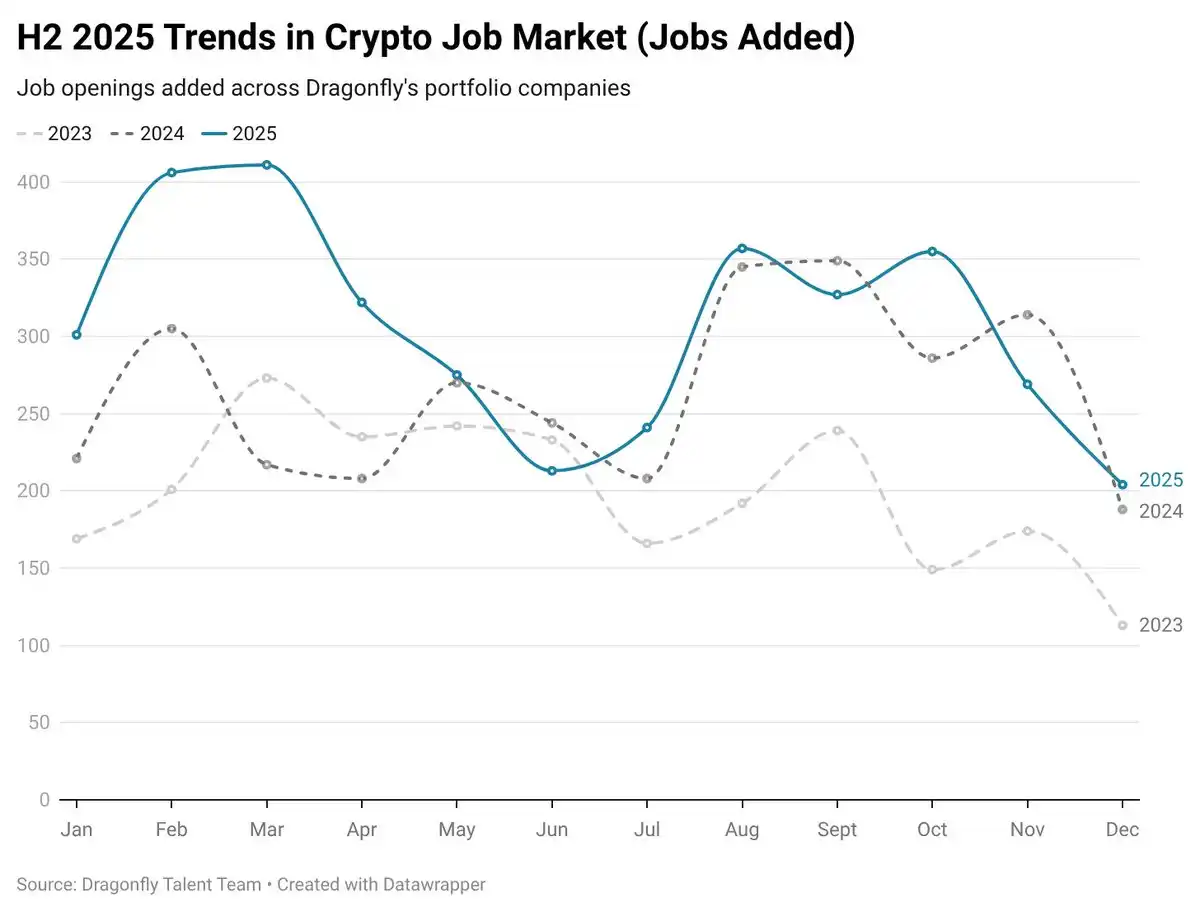
3/

The year was clearly divided into two halves.

The first half of 2025 (25H1) was turbulent, with pro-crypto optimism quickly reversing amid macro shocks.

Job removals surged in March (750), with most losses concentrated in the first half.

Approximately 3,700 new jobs were added for the year, while about 4,100 were removed, resulting in a net reduction of -472.
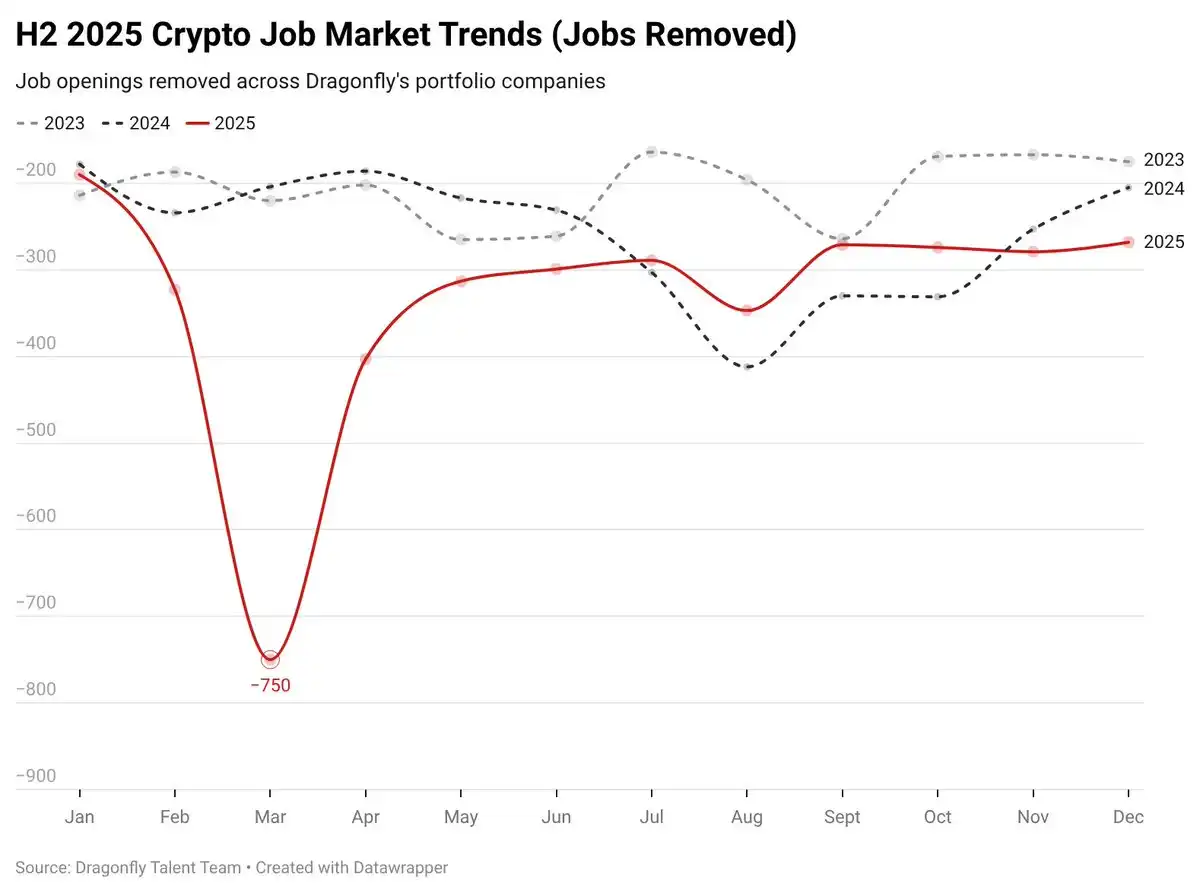
4/

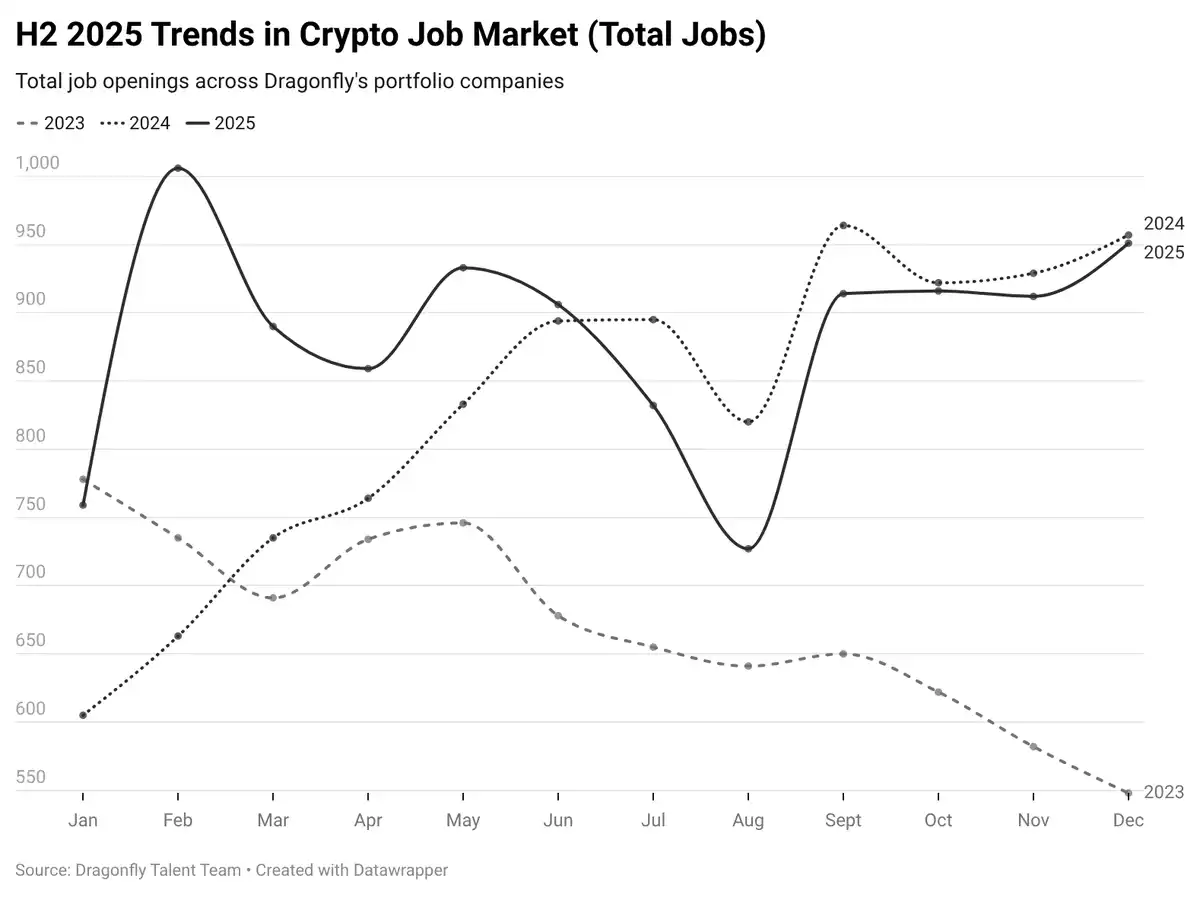
The second half (H2) brought discipline and recovery.

The overall job trend in H2 was largely consistent with 2024, just at a lower overall level.

July reset, August bottomed out, September reopened, and Q4 stabilized.

The more severe reset in spring was the main reason 2025 overall was lower than 2024.
5/

In our 25H1 report, we made some predictions. Let's score them now:

✓ Late Q3 rebound (September job openings +26%), Q4 slowdown, compliance hiring started early

✗ Underestimated the degree of divergence in traffic and applications; overestimated the resilience of legal roles relative to compliance roles

6/

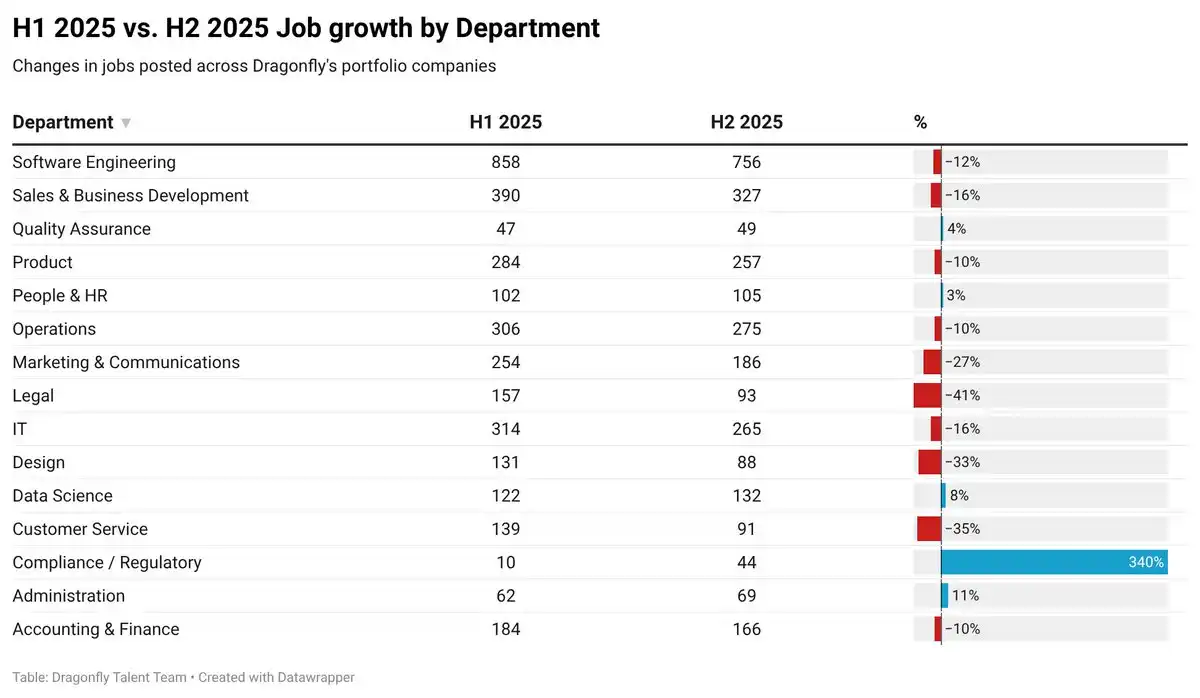
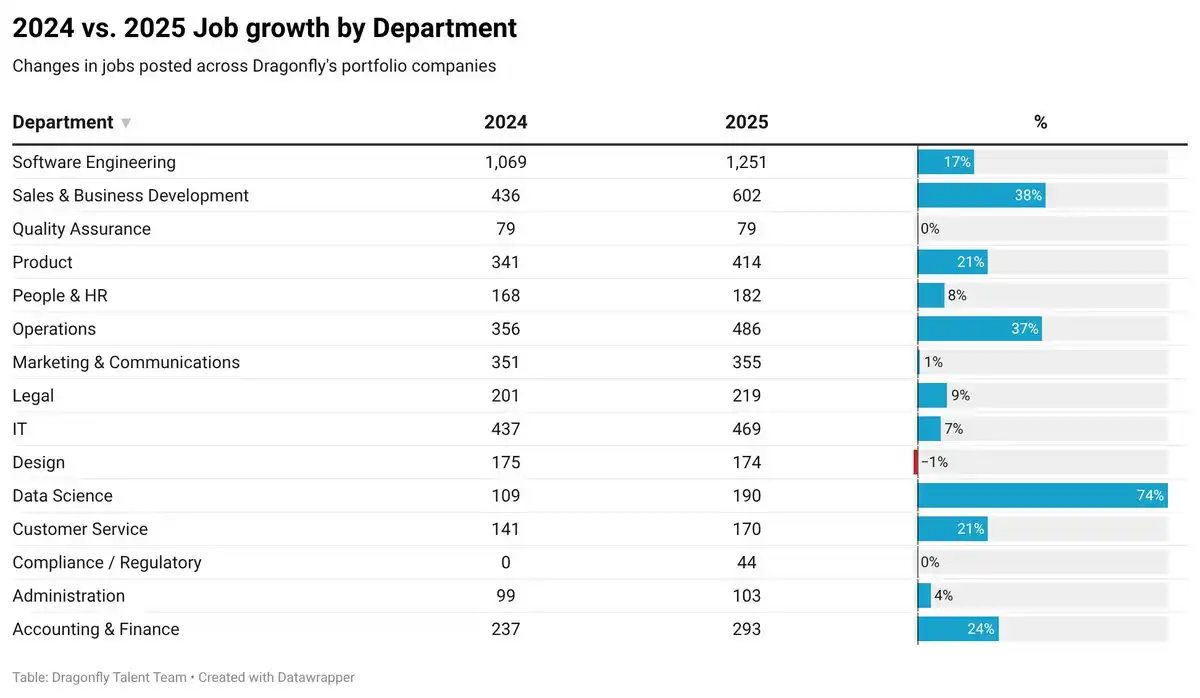
The real shift from 25H1 to H2 was not how many people companies hired, but what roles they hired for. Core first, earn the right to scale.

→ Engineering: -12%, still the anchor → Marketing: -27% → Design: -33% → Customer Service: -35% → Sales & BD: -16% → Legal: -41% → Compliance: +340%
7/

Data science was the clearest winner of the year, up +74% year-over-year. (Thanks to AI?)
8/

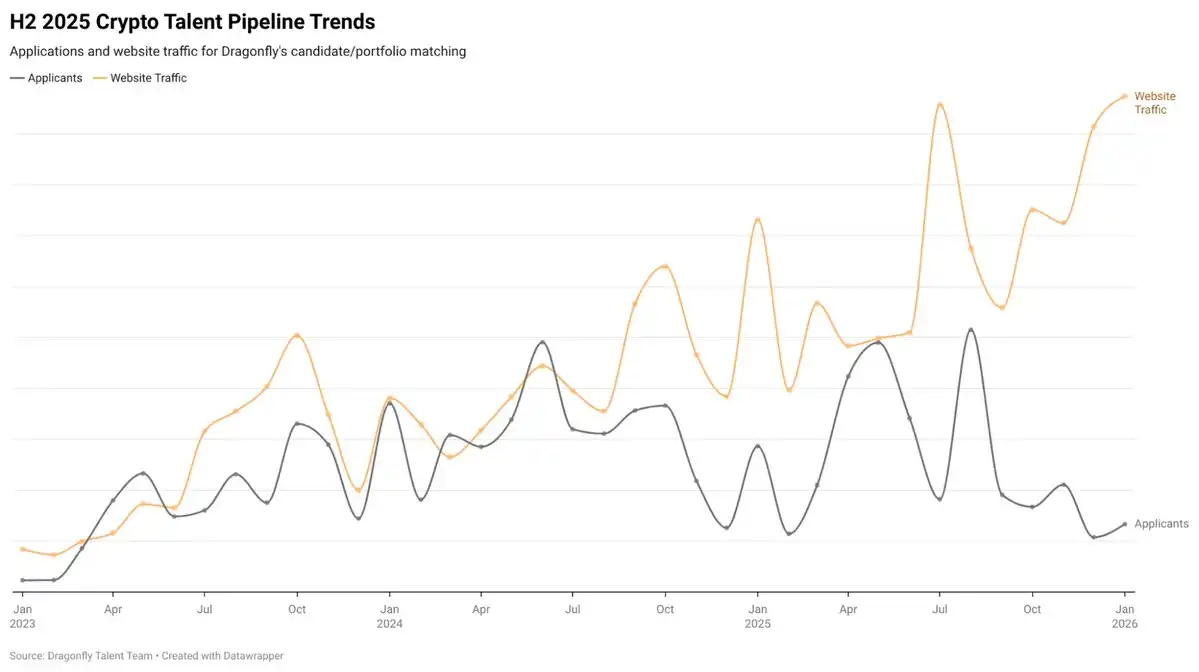
Interesting changes also happened on the candidate side.

Traffic remained stable in the second half, while applications dropped by about 26%.

People are still browsing, just not submitting applications as easily.
9/

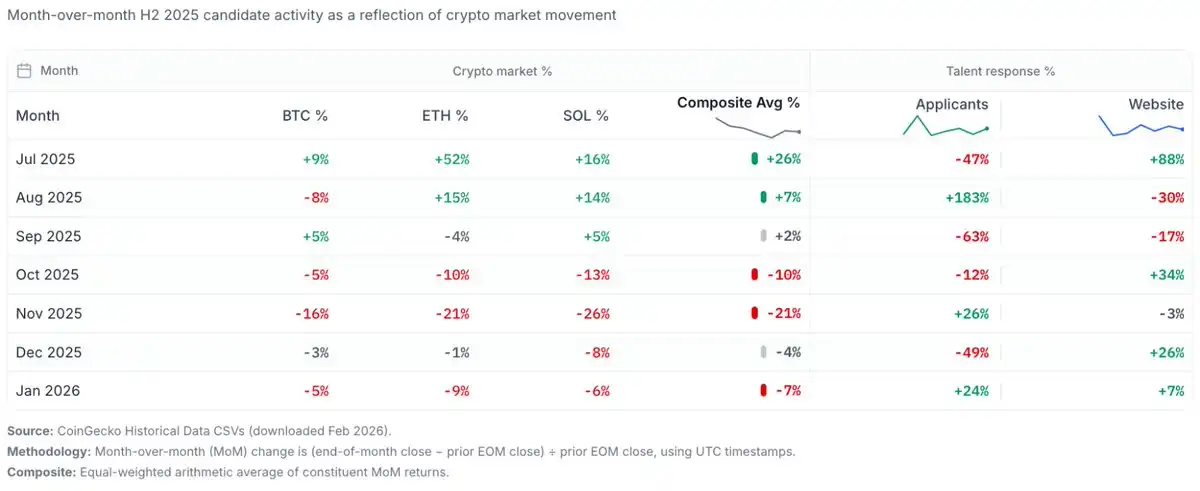
In early cycles, market excitement did most of the hiring work: rising salaries, influx of applications.

This mechanism is failing.

Stronger months still drive page views, but attention conversion rates are not what they used to be.
10/

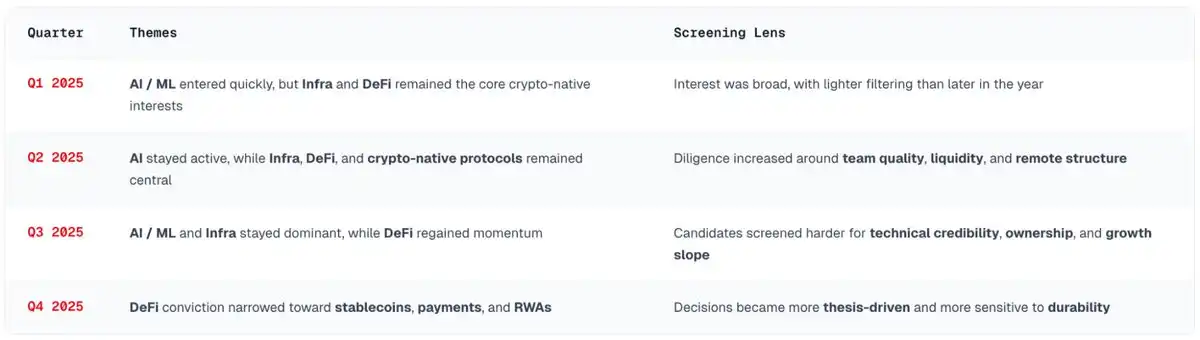
Why? Partly because candidates have become more cautious.

They are more rigorously screening companies for durability, ownership clarity, team quality, and technical credibility: open-source proof, product depth, hardcore problems, GTM roadmap.

Generic category narratives no longer work.
11/

Areas of concentrated belief: Infrastructure, DeFi, L1, and L2 remain core, but DeFi interest has narrowed to stablecoins, payments, and RWA.

Fintech-related and institutional use cases have gained significant attention. AI remains a key interest point.

12/

Stage preferences also tell an interesting story.

Seed and Series A stages are still the most attractive to candidates, with high demand for founder roles and first-employee roles. However, larger, more mature companies can still attract interest.

13/

The most common factor causing candidates to drop out is not compensation, stage, or size, but ambiguity.

If you cannot clearly explain why the company is important, what specific scope they will own, and why the opportunity has lasting power, the conversion rate will drop significantly.

14/

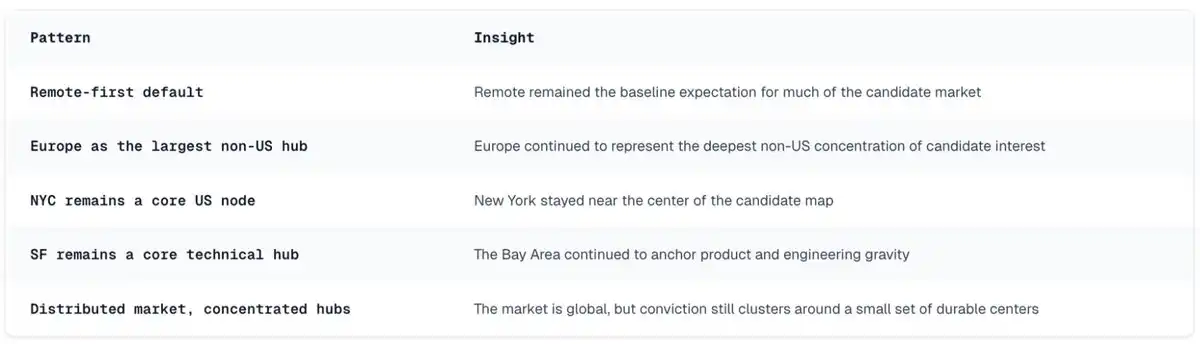
Geographically, remote work is still the norm, but the most active hiring teams are more concentrated in New York and lean towards in-person work.

Talent remains global, but New York + the Bay Area still dominate. Europe is the largest non-US hub.

(Note: Specific geographic hiring = smaller TAM, longer hiring cycles.)
15/

Another factor shaping the current landscape: Hiring is concentrating towards later-stage teams and significantly in the verticals candidates are most interested in.

We expect hiring for the remainder of 2026 to be driven more by acquisitions, pivots, and consolidation, rather than pure new growth.

16/

So what should founders do?

Hire based on milestones—product launches, revenue, partnerships, regulatory progress—not market cycles or calendar plans.

Companies that did well with hiring in H2 2025 could clearly articulate and stick to the reason for each role's existence.

17/

Know that teams are different, so sequence hires thoughtfully:

→ Core builders first (engineering, security, data/protocol) → BD explores fit → Product is flexible based on type (consumer earlier, infrastructure leaner) → Compliance, finance, risk → Marketing/support scales after leverage appears

18/

Keep pipelines always open for scarce talent.

Engineering, AI/ML, and security roles are severely supply-constrained and cannot be restarted from zero every cycle. Even if specific needs are closed, relationships should be kept warm.

19/

Recognize that the way roles are sold has changed.

Candidates want runway clarity, clear ownership for the first 30–60 days, and transparent upside mechanisms.

You must sell differentiation. You are not selling your category; you are selling why you will win and what specific role they can play.

20/

You also need a real AI story. Not "we are an AI company."

Candidates want to know:

→ How AI is used internally → How it changes the product → Whether it creates a real advantage

Vague answers lose talent.

21/

Specific advice for talent teams:

Put your strongest people at the front of the process (first impressions matter), keep interview loops tight, and provide clear feedback.

22/

An open question: AI makes 2026 harder to predict.

People can do more with fewer people. Better tools enable some to start their own. Some might go work directly on AI.

Meanwhile, higher output per employee means faster scaling, and crypto is positioned more broadly than ever.

23/

Our current view on AI's impact: Before clear AI × Crypto use cases solidify, deceleration signals are stronger than acceleration signals.

📎 Further reading: The Agentic Economy Will Be Massive, Agentic Commerce Won't

24/

Our baseline expectation for 2026: Flat to moderate growth, led by engineering, AI/data, and security. Consolidation will continue.

Whether bull, baseline, or bear market, this is a year focused on quality building.

25/

The teams that will win talent will be those with the most credible stories, not the loudest ones.

Execution discipline, durable business models, and good explanations of both are essential.

Domande pertinenti

QWhat were the key changes in the crypto hiring landscape in 2025 according to Dragonfly's report?

AThe key changes were a shift from hiring based on market hype to hiring based on actual need, with a net reduction of 472 jobs. Compliance roles surged by 340% and data science roles grew by 74%, while roles in marketing, design, customer service, sales, BD, and legal declined significantly.

QWhich job function saw the highest percentage increase in hiring in 2025, and what was the speculated reason?

AData science saw the highest percentage increase at 74%, with the report speculating that this growth might be due to the influence of AI.

QHow did candidate behavior change in the second half of 2025 (H2)?

ACandidate traffic remained stable, but the number of applications submitted dropped by approximately 26%. Candidates became more cautious, browsing jobs but not applying as readily, and demanded greater clarity on a company's importance, role specifics, and long-term viability.

QWhat are the new priorities for founders when hiring in the current crypto environment?

AFounders should hire based on specific milestones (like launches, revenue, partnerships, regulatory progress) rather than market cycles. They must clearly articulate why each role is important, provide clear runways, define ownership for the first 30-60 days, and offer transparent upside mechanisms.

QWhat is the geographic concentration of the most active crypto hiring teams and the talent pool?

AThe most active hiring teams are concentrated in New York and favor in-person work. The talent pool remains global, but New York and the Bay Area dominate, with Europe being the largest non-US hub.

Letture associate

After 50x Storage Surge, Justin Sun Always Looks to the Next Decade

Sun Yuchen, known for his controversial stunts like a $30 million lunch with Warren Buffett (canceled due to a kidney stone) and eating a $6.2 million duct-taped banana, is often overshadowed by a significant fact: his decade-long track record of spotting major investment trends. In 2016, he famously advised young people to invest in Bitcoin, Nvidia, Tesla, and Tencent instead of buying property. A hypothetical $20,000 investment in Nvidia and Tesla from that list would now be worth over 50 million RMB. His latest major call was on November 6, 2025, predicting a "50x storage opportunity" tied to the AI boom, which materialized with Sandisk's stock surging nearly 50-fold by 2026. Looking ahead, Sun now focuses on the next frontier: Physical AI. He identifies four key areas: 1. **Embodied AI/Robotics**: He sees this reaching its "iPhone moment," with companies like UBTech and Galaxy General leading in commercialization. 2. **Drones**: Viewed as the first commercially viable form of Physical AI, revolutionizing sectors from warfare (e.g., AeroVironment's Switchblade) to logistics. 3. **Spatial Computing**: Beyond VR, it's about AI understanding physical space, a foundational technology for robotics and autonomous systems, exemplified by Apple's Vision Pro. 4. **Space Exploration**: After a 2025 suborbital flight with Blue Origin, Sun advocates for space as the ultimate frontier, discussing blockchain's potential role in space asset management and data transactions. His investment philosophy involves betting on entire, inevitable trends rather than single companies. For robotics, he sees Tesla (the body/manufacturer) and Nvidia (the brain/AI platform) as complementary plays. In defense drones, he highlights companies making tanks obsolete (AeroVironment) and those augmenting fighter jets (Kratos). For space, he participated in Blue Origin's flight and anticipates SpaceX's potential IPO to redefine the sector's valuation. Sun Yuchen's vision frames the next two decades not as a revolution in information flow (like the internet), but in the fundamental operation of the physical world through AI-powered robots, autonomous systems, and spatial intelligence, ultimately extending human and AI activity into space. While many still focus on conventional assets, he continues to look toward the next technological horizon.

marsbit37 min fa

After 50x Storage Surge, Justin Sun Always Looks to the Next Decade

marsbit37 min fa

The Billionaires Behind the Most Expensive Midterm Election in History

"The Most Expensive Midterm Elections and Their Billionaire Backers" This analysis details the unprecedented scale of spending in the 2026 midterm elections, highlighting the key billionaire donors shaping the political landscape. Jeff Yass, founder of Susquehanna International Group, has contributed over $81 million, ranking third among individual donors behind George Soros ($102.6M) and Elon Musk ($84.8M). Yass is a major donor to Trump's MAGA Inc. and supports school choice and various candidates. Overall, federal committees have raised over $4.7 billion this cycle, with political ad spending projected to reach $10.8 billion. Republican-aligned groups are significantly out-raising their Democratic counterparts. "Dark money" from undisclosed sources continues to grow. The core stakes involve control of Congress and policy direction for Trump's final term. Donors are also motivated by specific issues: Sergey Brin and Chris Larsen are funding opposition to a proposed California wealth tax and supporting crypto-friendly policies. Other top donors include OpenAI's Greg Brockman and his wife Anna ($50M total to MAGA Inc. and an AI-focused PAC), Richard Uihlein ($45.3M to conservative causes), venture capitalists Marc Andreessen and Ben Horowitz (each over $44M to crypto/AI PACs and MAGA Inc.), Miriam Adelson ($42.6M to GOP leadership PACs), Paul Singer ($33.9M), and Diane Hendricks ($25.8M to MAGA Inc.). The article notes that the peak fundraising period is still ahead, with major primaries approaching.

marsbit39 min fa

The Billionaires Behind the Most Expensive Midterm Election in History

marsbit39 min fa

The Largest IPO in History Is Approaching, Surpassing SpaceX, 28 Years of AI Self-Iteration, Countdown to Intelligence Explosion

"Anthropic Nears Trillion-Dollar IPO, Fueled by Explosive Growth and 2028 'Intelligence Explosion' Warning Anthropic is considering a deal valuing the AI company near $1 trillion, potentially leading to one of the largest IPOs ever and surpassing SpaceX. Its revenue has skyrocketed, with Annual Recurring Revenue (ARR) reaching $45 billion in May 2026—a 500% increase in just five months. This vertical growth curve is attributed to its key products, Claude Code and Cowork, dominating AI coding and enterprise collaboration. Beyond commercial success, co-founder Jack Clark issued a pivotal warning in an interview: there is a greater than 50% chance that by the end of 2028, AI systems will achieve recursive self-improvement—the ability to autonomously build a 'better version' of themselves, initiating an 'intelligence explosion.' This prophecy underpins the company's astronomical valuation, as the market prices in the potential for transformative and disruptive AI. Further signaling its ambition, Anthropic formed a $1.5 billion joint venture with Goldman Sachs and Blackstone, aiming to disrupt traditional consulting firms like McKinsey by deploying Claude AI for complex strategic work. This move tests AI's capacity to replace high-level cognitive labor, a precursor to its predicted autonomous evolution. The narrative presents a dual future: unprecedented economic opportunity alongside significant risks like economic restructuring and security threats. Anthropic's meteoric rise and Clark's 2028 prediction frame the coming years as a countdown to a potential technological singularity."

marsbit51 min fa

The Largest IPO in History Is Approaching, Surpassing SpaceX, 28 Years of AI Self-Iteration, Countdown to Intelligence Explosion

marsbit51 min fa

Trading

Spot
Futures

Articoli Popolari

Come comprare ERA

Benvenuto in HTX.com! Abbiamo reso l'acquisto di Caldera (ERA) semplice e conveniente. Segui la nostra guida passo passo per intraprendere il tuo viaggio nel mondo delle criptovalute.Step 1: Crea il tuo Account HTXUsa la tua email o numero di telefono per registrarti il tuo account gratuito su HTX. Vivi un'esperienza facile e sblocca tutte le funzionalità,Crea il mio accountStep 2: Vai in Acquista crypto e seleziona il tuo metodo di pagamentoCarta di credito/debito: utilizza la tua Visa o Mastercard per acquistare immediatamente CalderaERA.Bilancio: Usa i fondi dal bilancio del tuo account HTX per fare trading senza problemi.Terze parti: abbiamo aggiunto metodi di pagamento molto utilizzati come Google Pay e Apple Pay per maggiore comodità.P2P: Fai trading direttamente con altri utenti HTX.Over-the-Counter (OTC): Offriamo servizi su misura e tassi di cambio competitivi per i trader.Step 3: Conserva Caldera (ERA)Dopo aver acquistato Caldera (ERA), conserva nel tuo account HTX. In alternativa, puoi inviare tramite trasferimento blockchain o scambiare per altre criptovalute.Step 4: Scambia Caldera (ERA)Scambia facilmente Caldera (ERA) nel mercato spot di HTX. Accedi al tuo account, seleziona la tua coppia di trading, esegui le tue operazioni e monitora in tempo reale. Offriamo un'esperienza user-friendly sia per chi ha appena iniziato che per i trader più esperti.

330 Totale visualizzazioniPubblicato il 2025.07.17Aggiornato il 2025.07.17

Come comprare ERA

Discussioni

Benvenuto nella Community HTX. Qui puoi rimanere informato sugli ultimi sviluppi della piattaforma e accedere ad approfondimenti esperti sul mercato. Le opinioni degli utenti sul prezzo di ERA ERA sono presentate come di seguito.

活动图片













