Double Whammy: Circle's Growth Logic Is Being 'Dismantled' Simultaneously by Legislation and Competitors

marsbitPubblicato 2026-03-25Pubblicato ultima volta 2026-03-25

Introduzione

U.S. stablecoin issuer Circle (CRCL) experienced its largest single-day drop, falling over 20% on March 24, following the leak of a draft version of the Clarity Act. The bill aims to prohibit digital asset service providers from paying yields—directly or indirectly—on stablecoin holdings, including any structure “economically or functionally equivalent to interest.” This directly impacts Circle’s key partner Coinbase, which currently shares most of the reserve interest earnings from USDC holdings with users through its “USDC Rewards” program. The proposed rule could significantly slow USDC’s growth, which has been partly driven by its use as a high-yield savings alternative. Without yield incentives, demand for USDC may decline, undermining Circle’s revenue model built on scale expansion. On the same day, rival Tether announced it had hired a Big Four accounting firm to conduct a full financial audit—including its USDT reserves. This move enhances Tether’s credibility and could diminish Circle’s competitive edge in transparency and compliance, which had previously driven its growth. The draft legislation reinforces a regulatory stance that stablecoins should function primarily as payment instruments rather than interest-bearing assets, challenging Circle’s core growth strategy.

Original Author: Sanqing, Foresight News

On March 24 (Eastern Time), the share price of stablecoin issuer Circle (CRCL) closed at $101.17 on the New York Stock Exchange, marking a single-day drop of over 20%, its largest single-day decline since going public. Its largest distribution partner, Coinbase (COIN), also fell nearly 10% in sync, closing at $181.04 on the Nasdaq.

The trigger for the sell-off was the leaked details of the latest draft text of the Clarity Act. The draft intends to prohibit digital asset service providers from "directly or indirectly" paying yields on stablecoin balances, and also bans any structural arrangements that are "economically or functionally equivalent to interest."

Image Source: Tweet by Eleanor Terrett, host of Crypto in America and former Fox Business reporter

On the same day, its competitor Tether announced that it had hired one of the Big Four accounting firms to conduct its first full financial audit (including the USDT reserves).

"Directly or Indirectly": Who Do These Five Words Block?

The draft text was submitted to crypto industry representatives for review in a closed-door meeting on March 24, with banking representatives to follow for review the next day. Reporter Eleanor Terrett disclosed the draft details on X, citing a related email.

USDC itself has never paid interest, and Circle, as the issuer, has never paid any yield to holders. So, what does the draft's prohibition on issuers paying interest have to do with Circle?

The draft's "scope" extends beyond the issuer. The entity actually paying yields to users is Coinbase.

According to the revenue-sharing structure disclosed in Circle's prospectus, 100% of the reserve interest for USDC held by users on the Coinbase platform belongs to Coinbase; for USDC circulating outside the platform, 50% of the reserve interest belongs to Coinbase.

Coinbase passes on the vast majority of the reserve proceeds obtained on-platform to users in the form of "USDC Rewards." According to an analysis by Columbia Law School, Coinbase's profit margin on USDC Rewards is extremely thin, retaining only about 20 to 25 basis points.

The "directly or indirectly" and "economically or functionally equivalent to interest" clauses in the Clarity Act draft are precisely designed to block this loophole.

This ban may have a limited financial impact on Coinbase, or could even be positive. Coinbase is both a shareholder of Circle and holds a pure profit share of 50% of the reserve income from off-platform USDC. Its commercial incentive to promote USDC will not disappear because of this.

However, USDC's competitors are not only USDT but also the US dollar itself.

USDC Rewards allowed USDC to play the de facto role of a "digital high-yield savings account." This has also been one of the drivers behind USDC's growth rate outpacing USDT's for two consecutive years. Once this channel is closed, users holding USDC would see yields drop to zero, reducing their willingness to hold it.

The path of demand contraction points to Circle. Weakened holding motivation on the retail end leads to a slowdown in the growth of the total circulating supply of USDC. The speed at which the reserve pool thickens subsequently decreases, and Circle's revenue growth story, built on the expectation of scale expansion, begins to loosen.

The draft also preserves an exemption for "activity-based rewards." Rewards linked to payments, transfers, or platform usage are still permitted. But this is a completely different product from the current "hold-to-earn" model.

Furthermore, the standard phrasing "economically or functionally equivalent to interest" is overly vague, leaving significant room for interpretation by future regulators. The boundaries of activity-based rewards also face the risk of being tightened.

Another Pressure on the Same Day

If the Clarity Act draft is dismantling Circle's growth flywheel, then the audit announcement made by Tether on the same day targets another competitive advantage of Circle.

USDC's long-term differentiation narrative has largely been built on compliance.

Circle regularly undergoes reserve attestations from top-tier accounting firms. During the years when regulatory uncertainty weighed on Tether, "We are the transparent and compliant one" was an extremely effective card for institutional clients and compliance-sensitive exchanges.

Tether, on the other hand, relied on quarterly attestations rather than full audits to respond to the outside world. S&P Global had previously assigned USDT a "weak" credit rating in 2025, warning of under-collateralization risks if Bitcoin prices fell further.

Additionally, the GENIUS Act requires large stablecoin issuers to undergo annual independent audits. Tether's hiring of a Big Four firm seems more like a response to this legal obligation. Regardless of the motive, the timing of this signal was enough to add to the market's negative sentiment.

USDC's growth rate has outpaced USDT's for two consecutive years. The narrative of compliance and transparency has been one of the most important drivers of this growth. Tether's hiring of a Big Four auditor has not yet begun, and the results are far from known. But if the audit is completed successfully, it is obvious that the compliance premium that Circle relies on to maintain its growth advantage will be compressed.
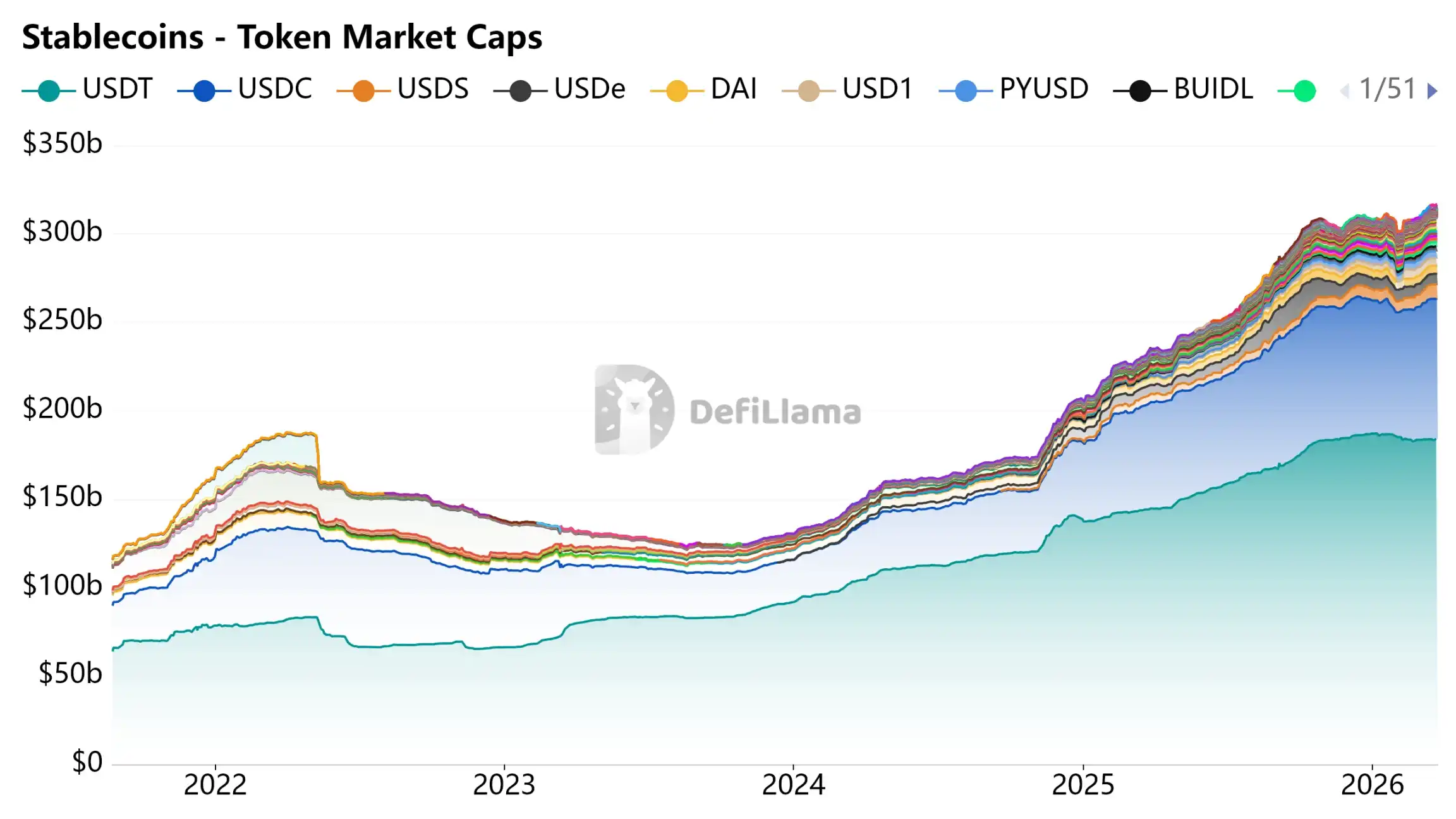
Image Source: DeFiLlama - Stablecoins

Payment Tool, Not Savings Account

Circle's value benefits from its growth model: yield incentives drive users to hold USDC, scale expansion leads to a thickening reserve pool, and reserve interest supports revenue growth. For this model to work, the premise is that stablecoins are allowed to play the role of an interest-bearing asset or savings deposit.

The Clarity Act draft is negating this premise at the legislative level.

Without yield incentives, the growth of USDC's scale must instead rely on natural penetration through real payment scenarios. This path is not impassable, but it is much slower and far more uncertain than yield-driven growth.

Compliance preserves Circle's license, but it does not preserve its growth model. The bankers' answer is clear: stablecoins can exist, but they cannot bear interest.


Domande pertinenti

QWhat caused Circle's stock price to drop by over 20% on March 24th?

AThe sharp decline in Circle's stock price was triggered by the leaked details of the Clarity Act draft, which proposes to prohibit digital asset service providers from paying yields, directly or indirectly, on stablecoin balances, including any structure economically or functionally equivalent to interest.

QHow does the Clarity Act draft impact Coinbase's USDC Rewards program?

AThe Clarity Act draft, with its 'direct or indirect' and 'economically or functionally equivalent to interest' clauses, is designed to close the loophole that allowed Coinbase to pay 'USDC Rewards' to users. This program, funded by the interest earned on USDC reserves, would likely be prohibited, removing a key incentive for users to hold USDC on the platform.

QWhat is the significance of Tether announcing a full financial audit on the same day?

ATether's announcement of hiring a Big Four accounting firm for its first full financial audit (including USDT reserves) challenges Circle's key competitive advantage of transparency and compliance. If completed successfully, this audit could compress the 'compliance premium' that has been a major driver of USDC's growth advantage over USDT in recent years.

QWhat was the core growth model for Circle and USDC that is being challenged?

ACircle's growth model was driven by yield incentives encouraging users to hold USDC, leading to an expansion of its circulating supply. This growth thickened the reserve pool, and the interest earned on those reserves supported revenue growth. The Clarity Act draft legislatively challenges this model by aiming to prevent stablecoins from functioning as interest-bearing savings accounts.

QWhat alternative path for USDC's growth does the article suggest if the yield incentive is removed?

AIf the yield incentive is removed, USDC's growth would have to rely solely on organic penetration into real payment use cases. The article states that this path is viable but will be much slower and more uncertain compared to the previous model driven by收益激励 (yield incentives).

Letture associate

Must-Watch Events Next Week|CLARITY Act Could Face Senate Vote; SpaceX, Circle to Report Earnings (8.3-8.9)

**Summary: Key Events and Developments to Watch (August 3-9)** The upcoming week is marked by significant financial disclosures, key legislative deadlines, and notable product updates. **Major Financial Events:** Several companies are scheduled to release their Q2 2026 earnings. American Bitcoin (ABTC) will report on August 3, followed by SpaceX and Hut 8 Mining Corp. on August 4, and Circle on August 5. Notably, a significant portion of SpaceX shares (up to 12% of total shares) will be unlocked on August 6 following their earnings release. **Key Legislative Deadline:** The U.S. Senate faces an August 7 deadline to secure 60 votes for the CLARITY Act, a bipartisan bill aiming to establish a federal regulatory framework for cryptocurrencies. The Senate may hold a full vote on the bill during the week. **Economic Data:** The U.S. July Non-Farm Payrolls report will be released on August 7, providing crucial labor market data. **Technology & Product Updates:** * **Shutdowns:** DeFi portfolio tracker Zapper and wallet app Ctrl Wallet will cease operations on August 3. * **Upgrades:** LayerZero will deprecate its v1 relayers on August 3. XRP Ledger's new version 3.3.0, featuring five new functions, is expected next week. * **AI:** Elon Musk announced that the advanced Grok 4.6 AI model is set for release around August 7. * **Bitcoin:** The BIP-110 forced signaling for a potential Bitcoin network change is scheduled to begin around August 8. **Other Notable Events:** Chinese robotics firm Unitree Tech has set its preliminary price inquiry for its IPO for August 5. South Korean exchange Upbit will delist AQT and AERGO tokens on August 3.

marsbit1 h fa

Must-Watch Events Next Week|CLARITY Act Could Face Senate Vote; SpaceX, Circle to Report Earnings (8.3-8.9)

marsbit1 h fa

Stocks Are Plummeting More Sharply Than Cryptocurrencies. Where Has the Money Gone?

Stock Markets Plunge Deeper Than Cryptocurrencies: Where Did the Money Go? In late July, Seoul's Kospi index triggered circuit breakers for two consecutive days, plummeting over 40% from its June high. The collapse was led by heavyweight stocks like SK Hynix, whose record profits still disappointed investors, and devastating leveraged ETFs, with one major product losing over 83% of its value. This signaled a global, forced deleveraging targeting the most crowded trades. Interestingly, while stocks exhibited extreme volatility akin to crypto markets, Bitcoin rose nearly 15% in July after a prior steep drop. Analysis shows the money fleeing equities did not flow into Bitcoin. Instead, Bitcoin had already absorbed its sell-off in May-June, when U.S. spot Bitcoin ETFs saw historic outflows. The true safe-haven beneficiary was gold, whose price rose over 20% year-on-year, highlighting a decoupling between Bitcoin and gold as "digital gold." The sell-off was a targeted unwinding of leveraged positions in tech and semiconductors, accelerated by broker-dealer risk management and shifts in the AI narrative, including new competition from Chinese memory chipmakers. The retreat path was clear: from high-valuation tech stocks to cash and U.S. Treasuries, then to gold. For Bitcoin to attract sustained institutional inflows, conditions like eased global liquidity pressure, a "soft-landing" Fed rate cut, and U.S. regulatory clarity via legislation like the stalled CLARITY Act are needed. Currently, Bitcoin is not a safe haven but an already-cleared asset. Its low correlation with tech stocks, however, makes it a potential diversification play for institutional portfolios once the storm passes. The money isn't here yet, but the positioning is underway.

marsbit1 h fa

Stocks Are Plummeting More Sharply Than Cryptocurrencies. Where Has the Money Gone?

marsbit1 h fa

In Conversation with Ray Dalio: We Are Currently in an AI Bubble, with 1% of My Portfolio in Bitcoin

Ray Dalio, founder of Bridgewater Associates, warns in an interview that the current AI boom shows classic bubble characteristics, which could lead to significant economic downturns as seen in past cycles like 1929 or 2000. He explains that speculative enthusiasm, fueled by debt and overvaluation, often precedes a crash when rising rates or taxation force asset sales, causing widespread losses and recession. Dalio also outlines his "Big Cycle" theory, describing an approximate 80-year pattern where widening wealth gaps, massive government deficits, and shifting geopolitical power (like China's rise) create internal conflict and global instability. He emphasizes that we are in a late-cycle, transitional phase where traditional powers like the US and UK face decline. For personal wealth protection, Dalio advises diversification beyond cash into assets like stocks, bonds, real estate, and particularly gold, which he prefers over Bitcoin. While he holds about 1% of his portfolio in Bitcoin as a non-printable hard asset, he views gold as more secure from technological or governmental threats. Regarding AI's impact, Dalio believes it will disproportionately benefit capital owners, worsening inequality by replacing both physical and cognitive labor. He suggests that human intuition and emotional intelligence, combined with AI, will be key for future workers. On taxation, Dalio argues that wealth taxes are impractical and risk triggering asset sell-offs, reducing productive investment. He points to the UK as a cautionary example of debt, low productivity, and political strife. Geopolitically, Dalio foresees a more regionalized world, with the US showing weakness in prolonged conflicts like with Iran, akin to past imperial declines. The ideal outcome, he suggests, is coexisting powerful blocs (e.g., Americas, China-Asia Pacific) without major war.

marsbit4 h fa

In Conversation with Ray Dalio: We Are Currently in an AI Bubble, with 1% of My Portfolio in Bitcoin

marsbit4 h fa

Trading

Spot
活动图片




