Don't Rush to Declare Crypto Dead, AI Is Reviving It

比推Pubblicato 2026-03-12Pubblicato ultima volta 2026-03-12

Introduzione

Summary: The article argues that AI is revitalizing the crypto space by enabling an emerging "agent economy" where AI agents autonomously conduct transactions on-chain. It notes crypto's stagnation since 2021 but highlights how AI agents could drive demand. Key projects like Bankr and Venice, alongside infrastructure from Stripe and Coinbase, are building the foundation for this shift. The piece explains why blockchains are ideal for agent economies due to standards like ERC-8004 (digital identity), x402 (micro-payments), and stablecoins (global currency). Current on-chain agent activities include deploying apps, creating content, trading DeFi, and even hiring humans. With major tech companies racing to develop agent infrastructure and AI capabilities growing exponentially, the author concludes that the agent economy—though still early—is too significant to ignore.

Author: Nick, Investment Partner at Breed.vc

Compiled and Edited by: BitpushNews


"Imagine somewhere around 2027, a real 'nation of geniuses' emerges. Picture, say, 50 million people, each more capable than any Nobel laureate, politician, or technologist. Now imagine that, because AI systems operate hundreds of times faster than humans, this 'nation' has a time advantage over all others: for every cognitive action we take, this nation can take ten." — Dario Amodei

"In our view, agents will likely soon be responsible for most internet transactions, and we will need blockchains." — Stripe

We can imagine the creativity, economic progress, and level of wealth that the agent economy will generate.

Last month, the crypto community predicted that this economy would run on-chain, and as the largest companies, capital allocators, and developers put forward this proposition, the prediction seems reasonable.

We had similar fantasies at the end of '24, but in typical crypto fashion, it was too early then, and the hype was short-lived.

Since then, the quality of AI models and blockchain infrastructure has developed to a point where we are conducting this experiment again.

In this report, we will examine the current state of the crypto economy, review the history of crypto agents, discuss why the agent economy might exist on-chain, explore what agents are doing today, and look at what comes next.

The Current State of the Crypto Economy
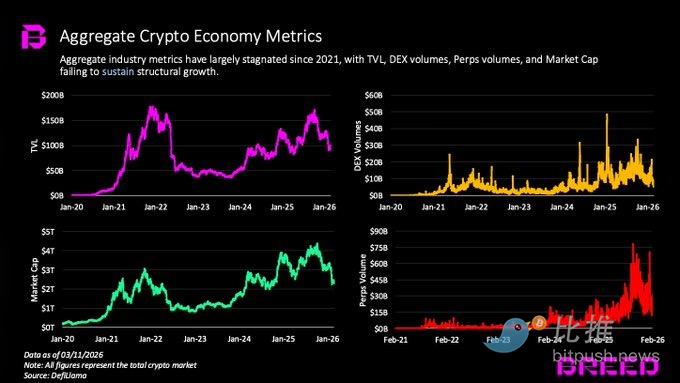
The lack of growth in the crypto asset class since the 2021 bull market has been disappointing. Most industry-wide metrics are at or below 2021 levels. Crypto world supremacy did not arrive.

AI agents provide a credible path to expanding demand.

The Seeds of the Crypto Agent Revival
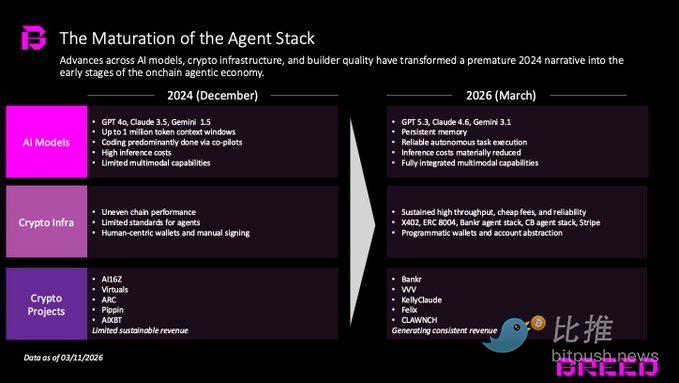
The "AI agents on blockchain" meta-narrative in 2024 was premature. The models, crypto infrastructure, and teams were not ready.

However, it wasn't all for nothing, as these lessons became the seeds of today's revival.

Projects like Bankr and Venice continued building so they could support today's models. Companies like Coinbase and Stripe recognized the potential and began developing their own supportive infrastructure.

Combine higher-quality teams with the continued building of a new generation of models, and you have the early stages of an on-chain agent economy.

Some projects are now generating recurring revenue and attracting high-quality developers—like Austen Allred, Nat Eliason, and Nik Pash—which is exactly what the crypto space desperately needs.

However, an on-chain agent economy is far from a certainty, as every payments company on Earth is racing to build this infrastructure.

Why the Agent Economy Will Run On-Chain
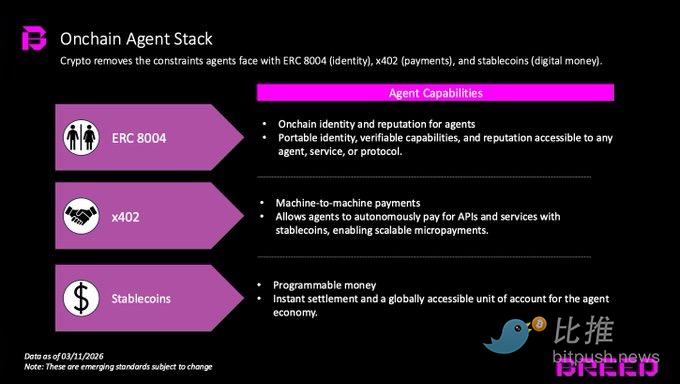
There is no stronger signal than Stripe explicitly stating that agents will run on blockchain rails. Their reasoning: every API call an agent makes today requires an account, an API key, and a linked credit card. This model breaks down when you have thousands of agents executing millions of microtransactions daily.

Blockchain solves these limitations by combining ERC-8004, x402, and stablecoins.

  • ERC-8004 gives each agent an on-chain identity, portable reputation, and verifiable capabilities that any other agent or service can query—the digital equivalent of identity and credit scores.

  • x402 allows agents to autonomously pay for APIs and services using stablecoins and scale micro-payments—the machine-to-machine payment layer for the internet.

  • Stablecoins give agents a globally accessible, programmable unit of account that can settle transactions instantly—the currency of the agent economy.

What Agents Are Doing Today

Today, agents are increasing their activity on-chain: launching applications, generating videos to promote these applications, contracting with other agents, handling governance matters for their users, selling NFTs, trading in DeFi, and even hiring humans.

The most exciting of these developments is the interaction with DeFi. Uniswap and Fluid are riding the agent narrative and beginning to build supportive infrastructure.

Furthermore, in the past month, OpenAI has made two agent-related announcements: Frontier, a platform designed to help businesses build, deploy, and manage AI colleagues; and EVM Bench, an evaluation framework for testing AI agents' ability to detect, patch, and exploit smart contract vulnerabilities.

Agents Are Coming

You might dismiss it as AI doom fiction, but the predictions of "AI 2027" are alarmingly accurate. If anything, AI progress is moving faster than the proposed timeline.

If this trajectory continues, we will see exponential growth in agent capabilities and intelligence over the next year.

Key parts of the stack still need to be built, but every major tech company in the world is racing against the clock to do so.

The social discussion around agents today might be frenzied, but the reality on the ground and the scale of the opportunity are too large to ignore.

Marc Andreessen (a16z partner) put it well: "Is it real? Or is it fake? It doesn't really matter. It's out there, and models are being trained on it."


Twitter:https://twitter.com/BitpushNewsCN

Bitpush TG Discussion Group:https://t.me/BitPushCommunity

Bitpush TG Subscription: https://t.me/bitpush

Original link:https://www.bitpush.news/articles/7619270

Domande pertinenti

QWhat is the main argument presented in the article regarding the future of Crypto and AI?

AThe article argues that AI is revitalizing the crypto space by creating an on-chain agent economy, where AI agents will drive demand, economic activity, and innovation through blockchain infrastructure.

QAccording to the article, why might the agent economy need to operate on-chain?

AThe agent economy needs to operate on-chain because traditional payment models (requiring accounts, API keys, and credit cards) fail at scale for micro-transactions. Blockchain solutions like ERC-8004, x402, and stablecoins provide identity, micro-payments, and a global programmable currency for agents.

QWhat are some specific activities that AI agents are already performing on-chain today, as mentioned in the article?

AAI agents are currently deploying applications, generating promotional videos, contracting other agents, handling governance tasks, selling NFTs, trading in DeFi, and even hiring humans on-chain.

QWhich companies or projects are cited as recognizing the potential of on-chain AI agents and building supportive infrastructure?

ACompanies like Stripe, Coinbase, Bankr, Venice, Uniswap, and Fluid are recognized for seeing the potential and developing infrastructure to support on-chain AI agents.

QWhat key blockchain technologies are highlighted as enabling the agent economy, and what role does each play?

AERC-8004 provides on-chain identity and reputation, x402 enables autonomous micro-payments for APIs and services, and stablecoins offer a global, programmable unit of account for instant settlement in the agent economy.

Letture associate

a16z: AI's 'Amnesia', Can Continuous Learning Cure It?

The article "a16z: AI's 'Amnesia' – Can Continual Learning Cure It?" explores the limitations of current large language models (LLMs), which, like the protagonist in the film *Memento*, are trapped in a perpetual present—unable to form new memories after training. While methods like in-context learning (ICL), retrieval-augmented generation (RAG), and external scaffolding (e.g., chat history, prompts) provide temporary solutions, they fail to enable true internalization of new knowledge. The authors argue that compression—the core of learning during training—is halted at deployment, preventing models from generalizing, discovering novel solutions (e.g., mathematical proofs), or handling adversarial scenarios. The piece introduces *continual learning* as a critical research direction to address this, categorizing approaches into three paths: 1. **Context**: Scaling external memory via longer context windows, multi-agent systems, and smarter retrieval. 2. **Modules**: Using pluggable adapters or external memory layers for specialization without full retraining. 3. **Weights**: Enabling parameter updates through sparse training, test-time training, meta-learning, distillation, and reinforcement learning from feedback. Challenges include catastrophic forgetting, safety risks, and auditability, but overcoming these could unlock models that learn iteratively from experience. The conclusion emphasizes that while context-based methods are effective, true breakthroughs require models to compress new information into weights post-deployment, moving from mere retrieval to genuine learning.

marsbit2 h fa

a16z: AI's 'Amnesia', Can Continuous Learning Cure It?

marsbit2 h fa

Can a Hair Dryer Earn $34,000? Deciphering the Reflexivity Paradox in Prediction Markets

An individual manipulated a weather sensor at Paris Charles de Gaulle Airport with a portable heat source, causing a Polymarket weather market to settle at 22°C and earning $34,000. This incident highlights a fundamental issue in prediction markets: when a market aims to reflect reality, it also incentivizes participants to influence that reality. Prediction markets operate on two layers: platform rules (what outcome counts as a win) and data sources (what actually happened). While most focus on rules, the real vulnerability lies in the data source. If reality is recorded through a specific source, influencing that source directly affects market settlement. The article categorizes markets by their vulnerability: 1. **Single-point physical data sources** (e.g., weather stations): Easily manipulated through physical interference. 2. **Insider information markets** (e.g., MrBeast video details): Insiders like team members use non-public information to trade. Kalshi fined a剪辑师 $20,000 for insider trading. 3. **Actor-manipulated markets** (e.g., Andrew Tate’s tweet counts): The subject of the market can control the outcome. Evidence suggests Tate’sociated accounts coordinated to profit. 4. **Individual-action markets** (e.g., WNBA disruptions): A single person can execute an event to profit from their pre-placed bets. Kalshi and Polymarket handle these issues differently. Kalshi enforces strict KYC, publicly penalizes insider trading, and reports to regulators. Polymarket, with its anonymous wallet-based system, has historically been more permissive, arguing that insider information improves market accuracy. However, it cooperated with authorities in the "Van Dyke case," where a user traded on classified government information. The core paradox is reflexivity: prediction markets are designed to discover truth, but their financial incentives can distort reality. The more valuable a prediction becomes, the more likely participants are to influence the event itself. The market ceases to be a mirror of reality and instead shapes it.

marsbit3 h fa

Can a Hair Dryer Earn $34,000? Deciphering the Reflexivity Paradox in Prediction Markets

marsbit3 h fa

Trading

Spot
Futures
活动图片





