Don't Rush to Declare Crypto Dead, AI Is Reviving It

比推Pubblicato 2026-03-12Pubblicato ultima volta 2026-03-12

Introduzione

Summary: The article argues that AI is revitalizing the crypto space by enabling an emerging "agent economy" where AI agents autonomously conduct transactions on-chain. It notes crypto's stagnation since 2021 but highlights how AI agents could drive demand. Key projects like Bankr and Venice, alongside infrastructure from Stripe and Coinbase, are building the foundation for this shift. The piece explains why blockchains are ideal for agent economies due to standards like ERC-8004 (digital identity), x402 (micro-payments), and stablecoins (global currency). Current on-chain agent activities include deploying apps, creating content, trading DeFi, and even hiring humans. With major tech companies racing to develop agent infrastructure and AI capabilities growing exponentially, the author concludes that the agent economy—though still early—is too significant to ignore.

Author: Nick, Investment Partner at Breed.vc

Compiled and Edited by: BitpushNews


"Imagine somewhere around 2027, a real 'nation of geniuses' emerges. Picture, say, 50 million people, each more capable than any Nobel laureate, politician, or technologist. Now imagine that, because AI systems operate hundreds of times faster than humans, this 'nation' has a time advantage over all others: for every cognitive action we take, this nation can take ten." — Dario Amodei

"In our view, agents will likely soon be responsible for most internet transactions, and we will need blockchains." — Stripe

We can imagine the creativity, economic progress, and level of wealth that the agent economy will generate.

Last month, the crypto community predicted that this economy would run on-chain, and as the largest companies, capital allocators, and developers put forward this proposition, the prediction seems reasonable.

We had similar fantasies at the end of '24, but in typical crypto fashion, it was too early then, and the hype was short-lived.

Since then, the quality of AI models and blockchain infrastructure has developed to a point where we are conducting this experiment again.

In this report, we will examine the current state of the crypto economy, review the history of crypto agents, discuss why the agent economy might exist on-chain, explore what agents are doing today, and look at what comes next.

The Current State of the Crypto Economy
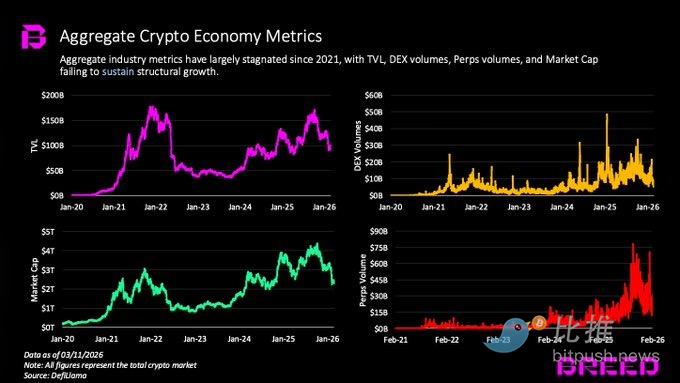
The lack of growth in the crypto asset class since the 2021 bull market has been disappointing. Most industry-wide metrics are at or below 2021 levels. Crypto world supremacy did not arrive.

AI agents provide a credible path to expanding demand.

The Seeds of the Crypto Agent Revival
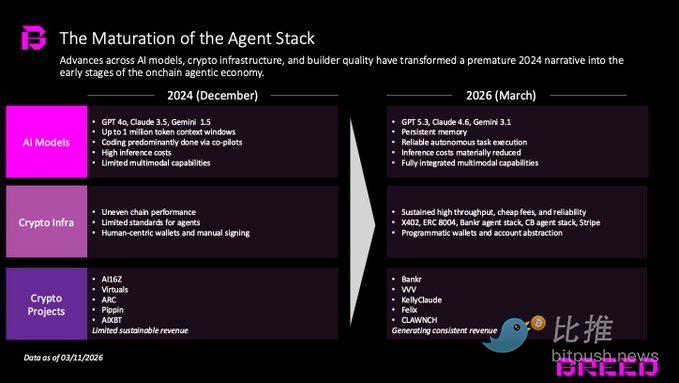
The "AI agents on blockchain" meta-narrative in 2024 was premature. The models, crypto infrastructure, and teams were not ready.

However, it wasn't all for nothing, as these lessons became the seeds of today's revival.

Projects like Bankr and Venice continued building so they could support today's models. Companies like Coinbase and Stripe recognized the potential and began developing their own supportive infrastructure.

Combine higher-quality teams with the continued building of a new generation of models, and you have the early stages of an on-chain agent economy.

Some projects are now generating recurring revenue and attracting high-quality developers—like Austen Allred, Nat Eliason, and Nik Pash—which is exactly what the crypto space desperately needs.

However, an on-chain agent economy is far from a certainty, as every payments company on Earth is racing to build this infrastructure.

Why the Agent Economy Will Run On-Chain
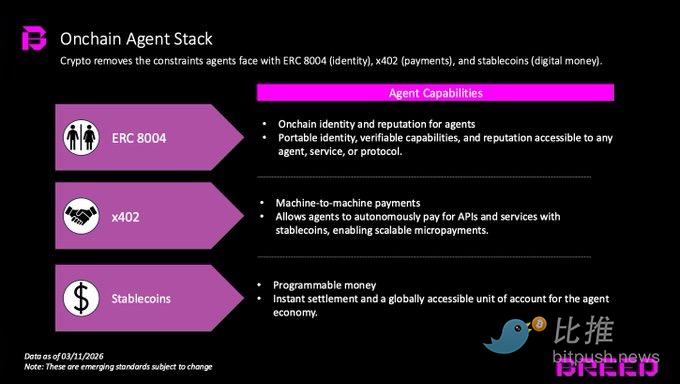
There is no stronger signal than Stripe explicitly stating that agents will run on blockchain rails. Their reasoning: every API call an agent makes today requires an account, an API key, and a linked credit card. This model breaks down when you have thousands of agents executing millions of microtransactions daily.

Blockchain solves these limitations by combining ERC-8004, x402, and stablecoins.

  • ERC-8004 gives each agent an on-chain identity, portable reputation, and verifiable capabilities that any other agent or service can query—the digital equivalent of identity and credit scores.

  • x402 allows agents to autonomously pay for APIs and services using stablecoins and scale micro-payments—the machine-to-machine payment layer for the internet.

  • Stablecoins give agents a globally accessible, programmable unit of account that can settle transactions instantly—the currency of the agent economy.

What Agents Are Doing Today

Today, agents are increasing their activity on-chain: launching applications, generating videos to promote these applications, contracting with other agents, handling governance matters for their users, selling NFTs, trading in DeFi, and even hiring humans.

The most exciting of these developments is the interaction with DeFi. Uniswap and Fluid are riding the agent narrative and beginning to build supportive infrastructure.

Furthermore, in the past month, OpenAI has made two agent-related announcements: Frontier, a platform designed to help businesses build, deploy, and manage AI colleagues; and EVM Bench, an evaluation framework for testing AI agents' ability to detect, patch, and exploit smart contract vulnerabilities.

Agents Are Coming

You might dismiss it as AI doom fiction, but the predictions of "AI 2027" are alarmingly accurate. If anything, AI progress is moving faster than the proposed timeline.

If this trajectory continues, we will see exponential growth in agent capabilities and intelligence over the next year.

Key parts of the stack still need to be built, but every major tech company in the world is racing against the clock to do so.

The social discussion around agents today might be frenzied, but the reality on the ground and the scale of the opportunity are too large to ignore.

Marc Andreessen (a16z partner) put it well: "Is it real? Or is it fake? It doesn't really matter. It's out there, and models are being trained on it."


Twitter:https://twitter.com/BitpushNewsCN

Bitpush TG Discussion Group:https://t.me/BitPushCommunity

Bitpush TG Subscription: https://t.me/bitpush

Original link:https://www.bitpush.news/articles/7619270

Domande pertinenti

QWhat is the main argument presented in the article regarding the future of Crypto and AI?

AThe article argues that AI is revitalizing the crypto space by creating an on-chain agent economy, where AI agents will drive demand, economic activity, and innovation through blockchain infrastructure.

QAccording to the article, why might the agent economy need to operate on-chain?

AThe agent economy needs to operate on-chain because traditional payment models (requiring accounts, API keys, and credit cards) fail at scale for micro-transactions. Blockchain solutions like ERC-8004, x402, and stablecoins provide identity, micro-payments, and a global programmable currency for agents.

QWhat are some specific activities that AI agents are already performing on-chain today, as mentioned in the article?

AAI agents are currently deploying applications, generating promotional videos, contracting other agents, handling governance tasks, selling NFTs, trading in DeFi, and even hiring humans on-chain.

QWhich companies or projects are cited as recognizing the potential of on-chain AI agents and building supportive infrastructure?

ACompanies like Stripe, Coinbase, Bankr, Venice, Uniswap, and Fluid are recognized for seeing the potential and developing infrastructure to support on-chain AI agents.

QWhat key blockchain technologies are highlighted as enabling the agent economy, and what role does each play?

AERC-8004 provides on-chain identity and reputation, x402 enables autonomous micro-payments for APIs and services, and stablecoins offer a global, programmable unit of account for instant settlement in the agent economy.

Letture associate

From Robinhood to Polymarket: Is the Era of Integrating All Assets on a Single Platform Coming?

From Robinhood to Polymarket: The Era of All-in-One Asset Platforms Is Coming Asset classes are rapidly converging. Platforms that once specialized in single categories—such as stocks, cryptocurrencies, or prediction markets—are now moving toward offering all three. Robinhood pioneered this model, starting with equities, adding crypto in 2018, and prediction markets in 2025. This strategy has proven resilient: when crypto revenues fell, other segments like options and stocks filled the gap. Now, prediction market leaders Polymarket and Kalshi are moving in the same direction, both announcing perpetual futures trading on April 21, 2026, pending regulatory approval. These futures will cover assets like Bitcoin, gold, and stocks such as Nvidia. This trend mirrors the consolidation seen in consumer tech, like smartphones replacing dedicated cameras and MP3 players. Younger users, accustomed to interacting with multiple asset types from an early age, will increasingly demand unified platforms. A key competitive advantage in prediction markets is collateral utilization—idle assets locked during betting periods. Polymarket’s move into perpetuals may be a strategy to generate yield from that capital, similar to earlier DeFi integrations like PolyAave. As the regulatory landscape evolves, traditional finance is also likely to incorporate crypto and prediction markets, further accelerating this convergence.

marsbit6 min fa

From Robinhood to Polymarket: Is the Era of Integrating All Assets on a Single Platform Coming?

marsbit6 min fa

OpenAI Goes Left, DeepSeek Goes Right

On April 24, 2026, DeepSeek released V4, a Chinese large language model offering a free "million-token context window," enabling it to process vast amounts of data like entire books or years of corporate documents in one go. In contrast, OpenAI’s GPT-5.5, released around the same time, is more powerful but significantly more expensive, charging up to $180 per million output tokens. DeepSeek’s strategy represents a shift from a pure AI research firm to a heavy-infrastructure player, building data centers in Inner Mongolia’s Ulanqab to bypass U.S. chip export restrictions. This move, supported by Huawei’s Ascend chips and China’s cheap green electricity, highlights a fundamental divergence in AI development models: U.S. firms focus on high-cost, high-margin services, while Chinese players like DeepSeek prioritize accessibility and affordability. Facing intense talent poaching from tech giants, DeepSeek is seeking a $44 billion valuation funding round to retain researchers and scale infrastructure. Meanwhile, Chinese manufacturers are compressing AI models to run on smartphones, making AI accessible offline and across the Global South. Through open-source models and localized solutions, Chinese AI is empowering non-English speakers and low-income users, driving a form of "digital equality." While Silicon Valley builds walled gardens, DeepSeek and others are turning AI into a public utility—like tap water—flowing freely to those previously left behind.

marsbit32 min fa

OpenAI Goes Left, DeepSeek Goes Right

marsbit32 min fa

$292 Million KelpDAO Cross-Chain Bridge Hack: Who Should Foot the Bill?

On April 18, 2026, an attacker stole 116,500 rsETH (worth ~$292M) from KelpDAO’s cross-chain bridge in 46 minutes—the largest DeFi exploit of 2026. The stolen assets were deposited into Aave V3 as collateral, causing $177–200M in bad debt and triggering a cascade of losses across nine DeFi protocols. Aave’s TVL dropped by ~$6B overnight. This legal analysis argues that KelpDAO and LayerZero Labs share concurrent liability, with fault apportioned 60%/40%. KelpDAO negligently configured its bridge with a 1-of-1 decentralized verifier network (DVN)—a single point of failure—despite LayerZero’s explicit recommendation of a 2-of-3 setup. LayerZero, which operated the compromised DVN, failed to secure its RPC infrastructure against a known poisoning attack vector. Both protocols’ terms of service cap liability at $200 (KelpDAO) or $50 (LayerZero), but these limits are likely unenforceable due to unconscionability, gross negligence exceptions, and potential securities law invalidation (if rsETH is deemed a security under the Howey test). Aave’s governance also faces fiduciary duty claims for raising rsETH’s loan-to-value ratio to 93%—far above competitors’ 72–75%—without adequately assessing bridge risks, amplifying the systemic fallout. Practical recovery targets include LayerZero Labs (a registered Canadian entity), KelpDAO’s founders, auditors, and identifiable Aave governance delegates. The incident underscores escalating legal risks for DeFi protocols, infrastructure providers, and governance participants.

marsbit1 h fa

$292 Million KelpDAO Cross-Chain Bridge Hack: Who Should Foot the Bill?

marsbit1 h fa

Trading

Spot
Futures
活动图片