Don't Rush to Declare Crypto Dead, AI Is Reviving It

比推Pubblicato 2026-03-12Pubblicato ultima volta 2026-03-12

Introduzione

Summary: The article argues that AI is revitalizing the crypto space by enabling an emerging "agent economy" where AI agents autonomously conduct transactions on-chain. It notes crypto's stagnation since 2021 but highlights how AI agents could drive demand. Key projects like Bankr and Venice, alongside infrastructure from Stripe and Coinbase, are building the foundation for this shift. The piece explains why blockchains are ideal for agent economies due to standards like ERC-8004 (digital identity), x402 (micro-payments), and stablecoins (global currency). Current on-chain agent activities include deploying apps, creating content, trading DeFi, and even hiring humans. With major tech companies racing to develop agent infrastructure and AI capabilities growing exponentially, the author concludes that the agent economy—though still early—is too significant to ignore.

Author: Nick, Investment Partner at Breed.vc

Compiled and Edited by: BitpushNews


"Imagine somewhere around 2027, a real 'nation of geniuses' emerges. Picture, say, 50 million people, each more capable than any Nobel laureate, politician, or technologist. Now imagine that, because AI systems operate hundreds of times faster than humans, this 'nation' has a time advantage over all others: for every cognitive action we take, this nation can take ten." — Dario Amodei

"In our view, agents will likely soon be responsible for most internet transactions, and we will need blockchains." — Stripe

We can imagine the creativity, economic progress, and level of wealth that the agent economy will generate.

Last month, the crypto community predicted that this economy would run on-chain, and as the largest companies, capital allocators, and developers put forward this proposition, the prediction seems reasonable.

We had similar fantasies at the end of '24, but in typical crypto fashion, it was too early then, and the hype was short-lived.

Since then, the quality of AI models and blockchain infrastructure has developed to a point where we are conducting this experiment again.

In this report, we will examine the current state of the crypto economy, review the history of crypto agents, discuss why the agent economy might exist on-chain, explore what agents are doing today, and look at what comes next.

The Current State of the Crypto Economy
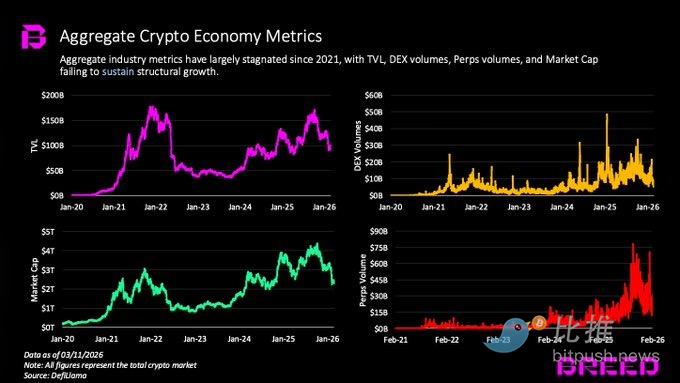
The lack of growth in the crypto asset class since the 2021 bull market has been disappointing. Most industry-wide metrics are at or below 2021 levels. Crypto world supremacy did not arrive.

AI agents provide a credible path to expanding demand.

The Seeds of the Crypto Agent Revival
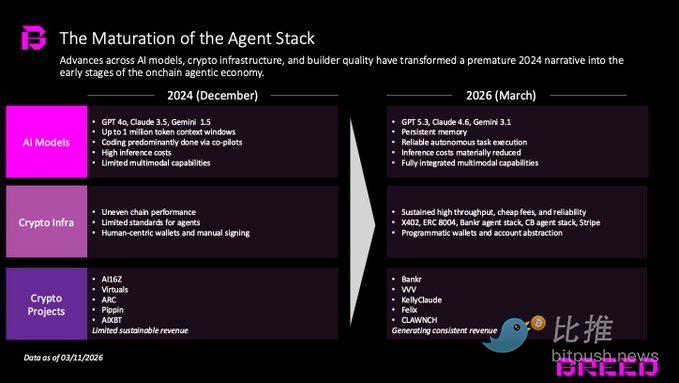
The "AI agents on blockchain" meta-narrative in 2024 was premature. The models, crypto infrastructure, and teams were not ready.

However, it wasn't all for nothing, as these lessons became the seeds of today's revival.

Projects like Bankr and Venice continued building so they could support today's models. Companies like Coinbase and Stripe recognized the potential and began developing their own supportive infrastructure.

Combine higher-quality teams with the continued building of a new generation of models, and you have the early stages of an on-chain agent economy.

Some projects are now generating recurring revenue and attracting high-quality developers—like Austen Allred, Nat Eliason, and Nik Pash—which is exactly what the crypto space desperately needs.

However, an on-chain agent economy is far from a certainty, as every payments company on Earth is racing to build this infrastructure.

Why the Agent Economy Will Run On-Chain
There is no stronger signal than Stripe explicitly stating that agents will run on blockchain rails. Their reasoning: every API call an agent makes today requires an account, an API key, and a linked credit card. This model breaks down when you have thousands of agents executing millions of microtransactions daily.

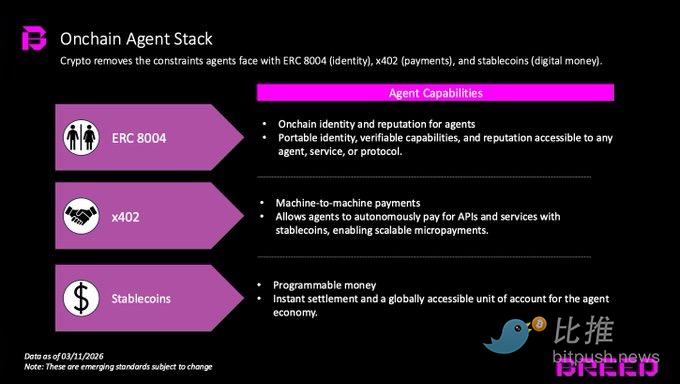
Blockchain solves these limitations by combining ERC-8004, x402, and stablecoins.

  • ERC-8004 gives each agent an on-chain identity, portable reputation, and verifiable capabilities that any other agent or service can query—the digital equivalent of identity and credit scores.

  • x402 allows agents to autonomously pay for APIs and services using stablecoins and scale micro-payments—the machine-to-machine payment layer for the internet.

  • Stablecoins give agents a globally accessible, programmable unit of account that can settle transactions instantly—the currency of the agent economy.

What Agents Are Doing Today

Today, agents are increasing their activity on-chain: launching applications, generating videos to promote these applications, contracting with other agents, handling governance matters for their users, selling NFTs, trading in DeFi, and even hiring humans.

The most exciting of these developments is the interaction with DeFi. Uniswap and Fluid are riding the agent narrative and beginning to build supportive infrastructure.

Furthermore, in the past month, OpenAI has made two agent-related announcements: Frontier, a platform designed to help businesses build, deploy, and manage AI colleagues; and EVM Bench, an evaluation framework for testing AI agents' ability to detect, patch, and exploit smart contract vulnerabilities.

Agents Are Coming

You might dismiss it as AI doom fiction, but the predictions of "AI 2027" are alarmingly accurate. If anything, AI progress is moving faster than the proposed timeline.

If this trajectory continues, we will see exponential growth in agent capabilities and intelligence over the next year.

Key parts of the stack still need to be built, but every major tech company in the world is racing against the clock to do so.

The social discussion around agents today might be frenzied, but the reality on the ground and the scale of the opportunity are too large to ignore.

Marc Andreessen (a16z partner) put it well: "Is it real? Or is it fake? It doesn't really matter. It's out there, and models are being trained on it."


Twitter:https://twitter.com/BitpushNewsCN

Bitpush TG Discussion Group:https://t.me/BitPushCommunity

Bitpush TG Subscription: https://t.me/bitpush

Original link:https://www.bitpush.news/articles/7619270

Domande pertinenti

QWhat is the main argument presented in the article regarding the future of Crypto and AI?

AThe article argues that AI is revitalizing the crypto space by creating an on-chain agent economy, where AI agents will drive demand, economic activity, and innovation through blockchain infrastructure.

QAccording to the article, why might the agent economy need to operate on-chain?

AThe agent economy needs to operate on-chain because traditional payment models (requiring accounts, API keys, and credit cards) fail at scale for micro-transactions. Blockchain solutions like ERC-8004, x402, and stablecoins provide identity, micro-payments, and a global programmable currency for agents.

QWhat are some specific activities that AI agents are already performing on-chain today, as mentioned in the article?

AAI agents are currently deploying applications, generating promotional videos, contracting other agents, handling governance tasks, selling NFTs, trading in DeFi, and even hiring humans on-chain.

QWhich companies or projects are cited as recognizing the potential of on-chain AI agents and building supportive infrastructure?

ACompanies like Stripe, Coinbase, Bankr, Venice, Uniswap, and Fluid are recognized for seeing the potential and developing infrastructure to support on-chain AI agents.

QWhat key blockchain technologies are highlighted as enabling the agent economy, and what role does each play?

AERC-8004 provides on-chain identity and reputation, x402 enables autonomous micro-payments for APIs and services, and stablecoins offer a global, programmable unit of account for instant settlement in the agent economy.

Letture associate

Bitwise: Crypto Becomes a Contrarian Investment, Three Logics to Understand the Current Market

**Summary** Matt Hougan, Bitwise's CIO, analyzes the current crypto market through three key lenses, arguing it has shifted from a momentum-driven to a contrarian investment. **1) Crypto Becomes a Contrarian Play:** The market is weak, with major assets like Bitcoin and Ethereum down significantly. Capital has moved to hot sectors like AI, leaving crypto as an "unloved" asset class. This transforms crypto investing from trend-following to a test of patience and fundamental analysis. Investors now favor projects with solid fundamentals (e.g., Hyperliquid) over speculative ones. **2) Regulatory Overhang:** The uncertain fate of the U.S. CLARITY Act, a major crypto regulatory framework, is a key headwind. With its passage in 2024 seen as far from guaranteed (estimates range from 30-55%), institutional capital remains on the sidelines, choosing less risky alternatives like AI stocks. The market needs clarity—whether the bill passes or fails—more than any specific outcome to move decisively. **3) Capital Rotates to New Fundamentals:** This cycle differs from past bear markets where money fled to Bitcoin. Now, capital seeks smaller assets with strong use cases. While major cryptos fell in May 2024, tokens like Hyperliquid (+72%), Zcash (+50%), and XLM (+44%) rallied on their specific fundamentals. This rotation confirms the new contrarian, fundamentals-driven logic and signals the bear market may be in its later stages. **Conclusion:** Short-term pressure persists due to regulatory uncertainty and competition from AI narratives. Investing in crypto now requires a contrarian mindset—acting against the crowd and focusing on fundamental value. Patience and targeting high-quality projects based on their merits are essential for capturing long-term gains.

marsbit45 min fa

Bitwise: Crypto Becomes a Contrarian Investment, Three Logics to Understand the Current Market

marsbit45 min fa

ChatGPT Might Be Disappearing Soon

OpenAI announced at its "Intelligence at Work" event that its coding assistant, Codex, will be fully integrated into the ChatGPT app within weeks. This move marks a strategic shift from a conversational AI (Chat) towards a unified "agentic" platform capable of execution. Codex, originally launched to compete with Anthropic's Claude Code, has grown rapidly to 5 million weekly active users, with 20% being non-developers like analysts and designers. Its enterprise revenue now constitutes 40% of OpenAI's total. The integration is the first step in creating a super-app combining ChatGPT (interface), Codex (execution engine), and the Atlas browser (web access). OpenAI also unveiled new Codex features: specialized Agent plugins for six professional roles, an "Annotations" tool for direct document editing, and a "Sites" function to turn work into shareable web apps. Internally, this reflects a power shift; the Codex team now leads core product strategy. While the ChatGPT brand remains for its vast user base, the platform's future is focused on autonomous agents that perform tasks, not just chat. The article notes that competition with Claude Code pushed OpenAI's development, with Codex competing on cost-effectiveness and accessibility rather than raw coding quality. It concludes that the essence of "ChatGPT" is evolving from a chatbot into an AI agent platform, with the name potentially becoming a legacy symbol of its original function.

marsbit55 min fa

ChatGPT Might Be Disappearing Soon

marsbit55 min fa

WWDC26 Ultimate Preview: The All-New Siri is the Main Course, iOS 27 is Another Year of Refinements

Apple has confirmed WWDC26 will begin on June 8, with the keynote at 10 AM PT (1 AM Beijing Time, June 9). This year's focus is expected to shift significantly from routine OS updates to Apple's progress in AI, particularly a major overhaul of Siri. Reports indicate the highlight will be a new Siri, reportedly powered by Google's Gemini technology. This upgraded assistant is expected to appear as a lightweight bubble from the Dynamic Island and be accessible via a unified "Search or Ask" system-wide entry point. It aims to deeply integrate with iOS 27, iPadOS 27, and macOS 27, accessing personal data like messages, photos, and documents, with a potential standalone Siri app also in development. For iOS 27, leaks suggest incremental improvements rather than major redesigns. Key updates may include a redesigned, more customizable Camera app, enhanced photo editing tools within the Photos app, and potential early system optimizations for a future foldable iPhone. The update is also rumored to prioritize bug fixes, stability, and performance optimization. iPadOS 27 is anticipated to focus on improving productivity features like window management, file systems, and external display support to better utilize the iPad's hardware. macOS 27 is seen as a core platform for Apple Intelligence, likely receiving an optimized Siri, new AI features, and continued refinement of the "Liquid Glass" design language. Notably, macOS 27 may finally drop support for Intel-based Macs. The overarching theme for WWDC26 is whether Apple can effectively integrate AI across its ecosystem. The success of the new Siri and Apple Intelligence will be judged on their ability to move beyond standalone features and become a cohesive, context-aware system layer that understands user workflows across iPhone, iPad, Mac, and other devices, while maintaining Apple's emphasis on privacy and stability. The conference represents Apple's critical attempt to catch up and redefine the AI assistant experience after a perceived slow start in the generative AI era.

marsbit1 h fa

WWDC26 Ultimate Preview: The All-New Siri is the Main Course, iOS 27 is Another Year of Refinements

marsbit1 h fa

Trading

Spot
Futures
活动图片