Don't Just Focus on Iran, the US Private Credit Crisis is Step by Step Repeating the 'Subprime Crisis'

比推Pubblicato 2026-03-09Pubblicato ultima volta 2026-03-09

Introduzione

Amidst geopolitical tensions, a private credit crisis is rapidly unfolding within the US financial system, drawing parallels to the 2008 subprime mortgage crisis. Major asset managers are facing significant stress: BlackRock restricted redemptions from its $26 billion HPS Corporate Lending Fund (HLEND), capping repurchases at 5% despite 9.3% redemption requests to avoid forced asset sales. Similarly, Blackstone’s $82 billion private credit fund (BCRED) saw a record 7.9% in redemption demands, prompting internal capital injections to avoid gating. Blue Owl Capital, whose stock fell below its $10 SPAC IPO price, sold $1.4 billion in loans to manage redemptions, exacerbating liquidity fears. PIMCO issued a stark warning, predicting a "full default cycle" for direct lending due to relaxed underwriting standards, overexposure to the software sector (vulnerable to AI disruption), and insufficient liquidity compensation for investors. The crisis highlights structural vulnerabilities: semi-liquid funds offering quarterly redemptions are backed by long-duration private loans, creating a mismatch. Redemptions force asset sales, driving down valuations and triggering further withdrawals—a vicious cycle reminiscent of 2008. With the private credit market valued at $1.8 trillion, systemic risks from opacity, concentration, and liquidity mismatches are now under severe strain.

Source: Wall Street Insights

Original Title: Don't Just Focus on Iran, the US Private Credit Crisis is Step by Step Repeating the 'Subprime Crisis'


While market attention is focused on geopolitical risks, a quietly spreading private credit crisis is accelerating within the US financial system. Redemption waves, asset sell-offs, fund gating—this script, investors have seen it in 2008.

This week, the world's largest asset management company, BlackRock, announced restrictions on investor redemptions from its $26 billion HPS Corporate Lending Fund (HLEND), becoming the most impactful signal to date.

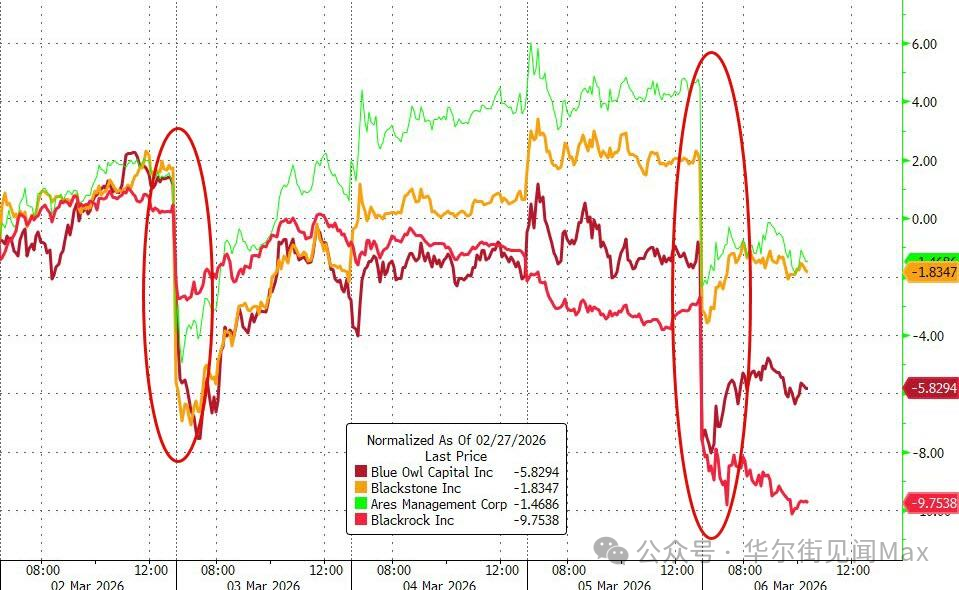
Previously, Blackstone's private credit fund faced a record 7.9% redemption request, and Blue Owl's stock price fell below its SPAC IPO price.

Three private credit giants sounding alarms in succession—the gears of a vicious cycle have already engaged.

Simultaneously, Pacific Investment Management Company (PIMCO) warned in its latest client report: the direct lending industry is about to face a "full default cycle," and stress testing is inevitable. This judgment comes from a long-time critic of private credit, and its weight cannot be ignored.

The spread of the private credit crisis is directly reflected in the stock price trends of related listed companies. Blue Owl's stock price fell below its SPAC issuance price, while private credit-related businesses of institutions like Blackstone and BlackRock face valuation pressure. The entire industry is undergoing a systemic reassessment of investor confidence.
01 Gating: BlackRock "Restricts Redemptions" for Its Private Credit Fund

According to a Wall Street Insights article, BlackRock stated in a declaration on Friday that shareholders of its HPS Corporate Lending Fund (HLEND) applied to redeem 9.3% of the shares this time, but the fund's management decided to set the repurchase上限 at 5%, approximately $12 billion.

BlackRock characterized this move in the statement as a "fundamental" arrangement for fund liquidity management, stating that without restrictions, a "structural mismatch" between investor capital and the duration of private credit loans would occur.

This wording sounds calm, but the market understood its implication: if redemptions were fully paid, BlackRock would be forced to initiate large-scale asset sales.

Previously, another private credit division under BlackRock had shown alarming signals—BlackRock TCP Capital Corp. reported in its Q4 report that it wrote down a $25 million loan to Infinite Commerce Holdings directly to zero from 100 cents, whereas just three months prior, the loan was marked at par value. From 100 to 0, three months, without warning.

02 Spreading Fire: The Vicious Cycle Triggered by Sell-offs

BlackRock's gating is not an isolated event, but the end point—or rather, a new starting point—of a fuse that has already been lit.

Three weeks ago, Blue Owl Capital took action first.

Faced with substantial redemption requests (primarily due to its highly concentrated exposure to software loans, which are rapidly depreciating under the impact of AI), Blue Owl announced the sale of $1.4 billion in private credit loans, effectively freezing investor funds by substituting asset sales for restoring the quarterly redemption mechanism.

The company emphasized that the assets slated for sale were all of the highest internal risk rating (Tier 1 or 2 on a five-tier system).

However, this strategy of "selling the best assets first" is precisely an accelerator for the crisis spread. If secondary market buying interest exists only for high-quality assets, the sale of investment portfolios from other Business Development Companies (BDCs) will face even thinner liquidity. It is reported that NMFC has indicated it is advancing the sale of approximately $500 million of its investment portfolio (17% of its total investments as of Q3 2025).

Blackstone's situation is equally severe. Its private credit fund BCRED manages $82 billion, and redemption requests this quarter reached a record 7.9%, exceeding the statutory上限 of 7%. To avoid triggering the gating mechanism, Blackstone employees were required to personally subscribe to $150 million to fill the gap.

Three institutions, three responses, but the same logic: gating or de facto gating to avoid forced sales triggering a greater valuation collapse. Analysis points out that the problem is, BlackRock's gating decision itself has sent the strongest panic signal to the market, potentially triggering more investors to rush for redemptions.

03 Blue Owl: Stock Price Falls Below IPO Price, Risk Exposure Continues to be Revealed

As the "epicenter" of this crisis, Blue Owl Capital's situation continues to deteriorate. Its stock price fell below the $10 SPAC IPO price this week, hitting a three-year low.

According to Bloomberg citing informed sources, Blue Owl holds a £36 million (approximately $48 million) exposure to London property lender Century Capital Partners Ltd.—a risk exposure it indirectly acquired through the acquisition of Atalaya Capital Management in 2024.

Century applied for administration last month, with total liabilities of about £95 million; NatWest Group and Hampshire Trust Bank are its priority creditors.

Blue Owl holds the riskiest junior tranche in Century's loan portfolio. Century's administrator, RSM UK, expects to fully recover the senior loans, but the fate of the junior tranche is another matter.

This event reveals another side of the private credit expansion period: asset-backed financing was once seen by industry leaders as a new frontier for growth, with executives from Pimco, Carlyle Group, Marathon, and Blackstone publicly optimistic about this track. Now, the risks of this track are emerging in unexpected ways.

04 PIMCO Warning: A Full Default Cycle is on the Way

Just as the private credit market was filled with alarm, PIMCO analysts Lotfi Karoui and Gabriel Cazaubieilh issued the most direct warning to date in their latest client report. The two analysts wrote in the report:

"Like every mature segment of the leveraged finance market, direct lending will eventually face a full default cycle—a cycle that will test its resilience to both industry-specific shocks and macroeconomic shocks."

PIMCO is one of the early critics of private credit. While direct lending strategies saw soaring fundraising规模, this institution managing approximately $2.3 trillion in assets chose to position contrarily, actively seeking potential problems among private credit-backed companies.

PIMCO's analysis pointed out several core risks:

First, record fundraising规模 post the 2008 financial crisis led to持续松弛 underwriting standards;

Second, the high concentration of direct loan portfolios in the software industry will drag down relative performance under AI impact;

Third, direct loan funds have long failed to provide sufficient risk premium compensation for investors' liquidity lock-up.

Regarding the liquidity困境 faced by BDC investors, PIMCO's wording was equally blunt: "Semi-liquidity does not equal full liquidity. Investors must assess their own liquidity needs and tolerance for capital being restricted."

However, PIMCO also differentiated between different tracks within private credit, believing that细分领域 like asset-backed financing still have investment value, offering "investment-grade-like" risk levels. Last year, PIMCO raised over $7 billion for its asset-backed financing strategy.

05 Repeating the Subprime Crisis?

The structural logic of this round of crisis is not complicated: semi-liquid products promise quarterly redemptions, but the underlying assets are longer-duration private loans; when redemption requests exceed a threshold, managers either gate or sell assets; selling depresses asset prices, triggers more valuation markdowns,进而引发更多赎回—thus the cycle.

This logic played out once in the subprime mortgage market in 2008. Back then, the initial cracks also appeared in a market corner considered "sufficiently diversified, sufficiently professional."

Today, the private credit market has reached a规模 of $1.8 trillion, and the risk concentration, valuation opacity, and liquidity mismatch within it are being tested in a similar way.


Twitter:https://twitter.com/BitpushNewsCN

Bitpush TG Discussion Group:https://t.me/BitPushCommunity

Bitpush TG Subscription: https://t.me/bitpush

Original link:https://www.bitpush.news/articles/7617966

Domande pertinenti

QWhat major signal did BlackRock send regarding the private credit crisis, and what was the specific action taken?

ABlackRock announced it would limit investor redemptions from its $26 billion HPS Corporate Lending Fund (HLEND), capping repurchases at 5% of shares instead of the requested 9.3%, to prevent a structural mismatch between investor capital and the duration of private credit loans.

QAccording to the article, what is the 'vicious cycle' mechanism currently unfolding in the private credit market?

AThe vicious cycle involves redemption requests forcing fund managers to either gate redemptions or sell assets. Asset sales depress valuations, which triggers further markdowns and, in turn, prompts more redemption requests, creating a self-reinforcing downward spiral.

QWhich company is described as the 'epicenter' of this crisis, and what specific financial trouble is it facing?

ABlue Owl Capital is described as the 'epicenter.' Its stock price fell below its $10 SPAC IPO price, and it was revealed to have a high-risk, junior exposure of £36 million to the now-bankrupt London property lender Century Capital Partners Ltd.

QWhat stark warning did PIMCO issue in its client report about the direct lending industry?

APIMCO warned that the direct lending industry is headed for a 'full default cycle' that will test its resilience to both industry-specific shocks, like the impact of AI on the software sector, and broader macroeconomic shocks.

QHow does the article draw a parallel between the current private credit crisis and the 2008 subprime mortgage crisis?

AThe article draws a parallel by highlighting the similar structural logic: a liquidity mismatch where semi-liquid products (like private credit funds offering quarterly redemptions) are backed by illiquid, long-duration assets. This creates a cycle of redemptions, forced asset sales, and collapsing valuations, mirroring the initial cracks seen in the 'sufficiently diversified and professional' subprime mortgage market in 2008.

Letture associate

North Korean Hackers Loot $500 Million in a Single Month, Becoming the Top Threat to Crypto Security

North Korean hackers, particularly the notorious Lazarus Group and its subgroup TraderTraitor, have stolen over $500 million from cryptocurrency DeFi platforms in less than three weeks, bringing their total theft for the year to over $700 million. Recent major attacks on Drift Protocol and KelpDAO, resulting in losses of approximately $286 million and $290 million respectively, highlight a strategic shift: instead of targeting core smart contracts, attackers are now exploiting vulnerabilities in peripheral infrastructure. For instance, the KelpDAO attack involved compromising downstream RPC infrastructure used by LayerZero's decentralized validation network (DVN), allowing manipulation without breaching core cryptography. This sophisticated approach mirrors advanced corporate cyber-espionage. Additionally, North Korea has systematically infiltrated the global crypto workforce, with an estimated 100 operatives using fake identities to gain employment at blockchain companies, enabling long-term access to sensitive systems and facilitating large-scale thefts. According to Chainalysis, North Korean-linked hackers stole a record $2 billion in 2025, accounting for 60% of all global crypto theft that year. Their total historical crypto theft has reached $6.75 billion. Post-theft, they employ specialized money laundering methods, heavily relying on Chinese OTC brokers and cross-chain mixing services rather than standard decentralized exchanges. Security experts, while acknowledging the increased sophistication, emphasize that many attacks still exploit fundamental weaknesses like poor access controls and centralized operational risks. Strengthening private key management, limiting privileged access, and enhancing coordination among exchanges, analysts, and law enforcement immediately after an attack are critical to improving defense and fund recovery chances. The industry's challenge now extends beyond secure smart contracts to safeguarding operational security at the infrastructure level.

marsbit10 min fa

North Korean Hackers Loot $500 Million in a Single Month, Becoming the Top Threat to Crypto Security

marsbit10 min fa

Circle CEO's Seoul Visit: No Korean Won Stablecoin Issuance, But Met All Major Korean Banks

Circle CEO Jeremy Allaire's recent activities in Seoul indicate a strategic shift for the company, moving away from issuing a Korean won-backed stablecoin and instead focusing on embedding itself as a key infrastructure provider within Korea’s financial and crypto ecosystem. Despite Korea accounting for nearly 30% of global crypto trading volume—with a market characterized by high retail participation and altcoin dominance—Circle has chosen not to compete for the role of stablecoin issuer. Instead, Allaire met with major Korean banks (including Shinhan, KB, and Woori), financial groups, leading exchanges (Upbit, Bithumb, Coinone), and tech firms like Kakao. This approach reflects a broader industry transition: the core of stablecoin competition is shifting from issuance rights to systemic positioning. With Korean regulators still debating whether banks or tech companies should issue stablecoins, Circle is avoiding regulatory uncertainty by strengthening its role as a service and technology partner. The company is deepening integration with trading platforms, building connections, and promoting stablecoin infrastructure. This positions Circle to benefit regardless of which entity eventually issues a won stablecoin. Allaire also noted the potential for a Chinese yuan stablecoin in the next 3–5 years, underscoring a regional trend of stablecoins becoming more regulated and integrated with traditional finance. Ultimately, Circle’s strategy highlights that future influence in the stablecoin market will belong not necessarily to the issuers, but to the foundational infrastructure layers that enable cross-system transactions.

marsbit38 min fa

Circle CEO's Seoul Visit: No Korean Won Stablecoin Issuance, But Met All Major Korean Banks

marsbit38 min fa

SpaceX Ties Up with Cursor: A High-Stakes AI Gambit of 'Lock First, Acquire Later'

SpaceX has secured an option to acquire AI programming company Cursor for $60 billion, with an alternative clause requiring a $10 billion collaboration fee if the acquisition does not proceed. This structure is not merely a potential acquisition but a strategic move to control core access points in the AI era. The deal is designed as a flexible, dual-path arrangement, allowing SpaceX to either fully acquire Cursor or maintain a binding partnership through high-cost collaboration. This "option-style" approach minimizes immediate regulatory and integration risks while ensuring long-term alignment between the two companies. At its core, the transaction exchanges critical AI-era resources: SpaceX provides its Colossus supercomputing cluster—one of the world’s most powerful AI training infrastructures—while Cursor contributes its AI-native developer environment and strong product adoption. This synergy connects compute power, models, and application layers, forming a closed-loop AI capability stack. Cursor, founded in 2022, has achieved rapid growth with over $1 billion in annual revenue and widespread enterprise adoption. Its value lies in transforming software development through AI agents capable of coding, debugging, and system design—positioning it as a gateway to future software production. For SpaceX, this move is part of a broader strategy to evolve from a aerospace company into an AI infrastructure empire, integrating xAI, supercomputing, and chip manufacturing. Controlling Cursor fills a gap in its developer tooling layer, strengthening its AI narrative ahead of a potential IPO. The deal reflects a shift in AI competition from model superiority to ecosystem and entry-point control. With programming tools as a key battleground, securing developer loyalty becomes crucial for dominating the software production landscape. Risks include questions around Cursor’s valuation, technical integration challenges, and potential regulatory scrutiny. Nevertheless, the deal underscores a strategic bet: controlling both compute and software development access may redefine power dynamics in the AI-driven future.

marsbit1 h fa

SpaceX Ties Up with Cursor: A High-Stakes AI Gambit of 'Lock First, Acquire Later'

marsbit1 h fa

Trading

Spot
Futures
活动图片





