DOJ Crypto Unit Closure Sparks Scrutiny Of Deputy AG’s Personal Crypto Stakes

bitcoinistPubblicato 2026-01-29Pubblicato ultima volta 2026-01-29

Introduzione

The Justice Department's decision to disband its National Cryptocurrency Enforcement Team (NCET) in April 2025 is under scrutiny from six US senators. They are questioning Deputy Attorney General Todd Blanche about potential conflicts of interest due to his personal cryptocurrency holdings. The senators, including Mazie Hirono and Elizabeth Warren, demand documents and a full explanation for the unit's closure and whether Blanche's finances influenced the decision. Critics argue the timing of his divestment raises ethical concerns, while supporters claim it was approved by ethics officials. The lawmakers are seeking a detailed timeline and records to ensure federal conflict-of-interest laws were followed.

The Justice Department’s move last year to shut a specialized crypto enforcement team is drawing fresh fire after six US senators pressed the deputy attorney general for answers about his personal stakes in digital assets.

The lawmakers say the timing and Deputy Attorney General Todd Blanche’s holdings raise real questions about conflicts that need clear records and a full explanation.

Senators Demand Answers

Reports say the letter, dated January 28, 2026, was sent by Senator Mazie Hirono and joined by Senators Elizabeth Warren, Richard Durbin, Sheldon Whitehouse, Chris Coons, and Richard Blumenthal.

They asked Blanche to provide documents and explain why the National Cryptocurrency Enforcement Team (NCET) was disbanded in April 2025 and whether his own finances played any role in that decision. The lawmakers pointed to federal conflict rules and asked for the timeline and approvals behind the memo.
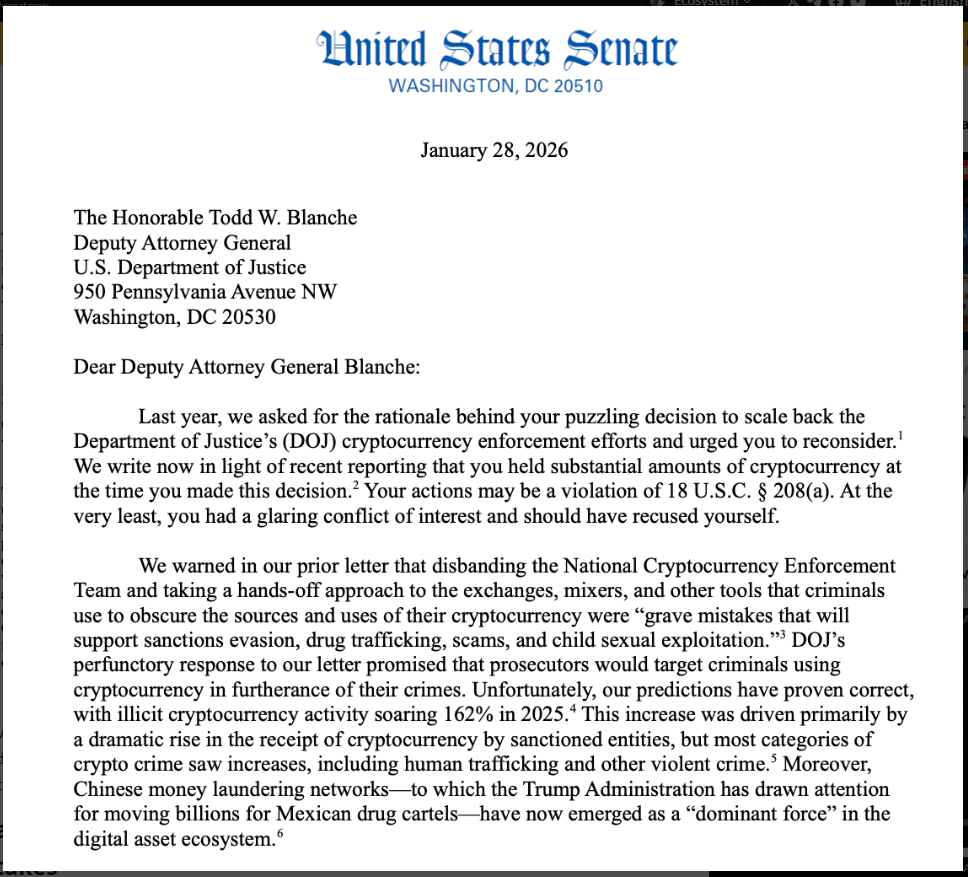
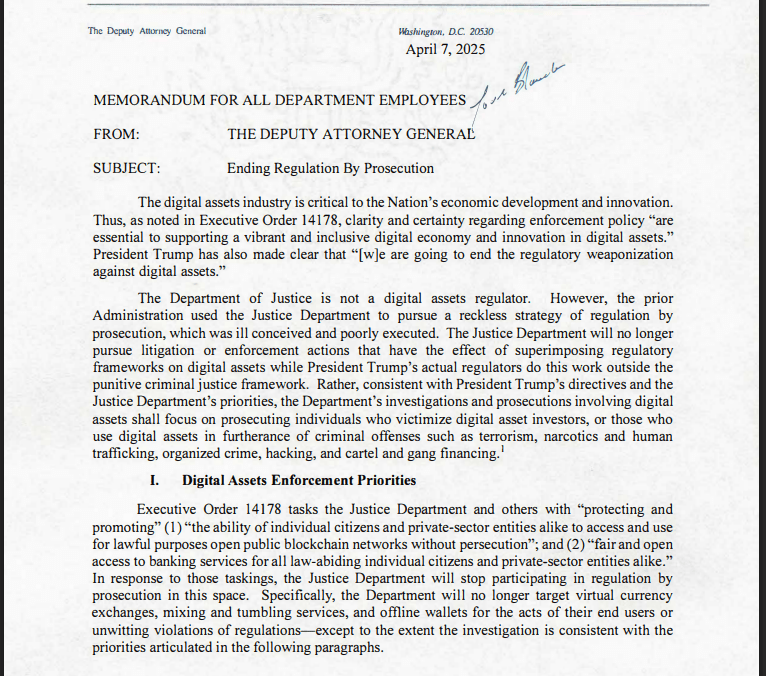
The memo signed by Deputy Attorney General Todd Blanche. Source: DOJ

He agreed to divest, and some sales or transfers happened weeks to months after the memo. Critics say that sequence looks bad and could run afoul of conflict rules; supporters say the matters were cleared by ethics officials.

People On Both Sides Are Talking

Proponents of the policy change argued it would avoid “regulation by prosecution” and let regulators handle oversight instead of criminal cases.

Industry groups welcomed the move as a way to reduce legal uncertainty for exchanges and developers.

Opponents, including the senators, say scaling back a focused enforcement unit risks leaving gaps that bad actors can exploit, especially as illicit activity in crypto has shown sharp swings in recent years.

BTCUSD now trading at $87,783. Chart: TradingView

What Comes Next

Lawmakers are now pushing for documents and sworn answers. They want to see when Blanche learned of the holdings, how fast divestment happened, and who inside DOJ reviewed and approved the memo.

The senators pointed to federal law that bars an official from participating in a matter when they have a financial interest, and they requested a timeline and supporting records to judge whether that law was respected.

Featured image from Getty Images, chart from TradingView

Domande pertinenti

QWhat action by the US senators has brought renewed scrutiny to the closure of the DOJ's crypto enforcement team?

ASix US senators, led by Senator Mazie Hirono, sent a letter to Deputy Attorney General Todd Blanche pressing him for answers about his personal cryptocurrency holdings and the decision to disband the National Cryptocurrency Enforcement Team (NCET).

QWhat specific concerns did the senators raise regarding Deputy AG Todd Blanche?

AThe senators raised concerns about a potential conflict of interest, questioning whether Blanche's personal financial stakes in digital assets played a role in the decision to shut down the NCET and if the timing of his divestment complied with federal conflict-of-interest rules.

QWhat was the main argument from proponents who supported the policy change of closing the NCET?

AProponents argued that closing the specialized crypto enforcement team would avoid 'regulation by prosecution' and allow regulators, rather than criminal prosecutors, to handle oversight of the cryptocurrency industry.

QAccording to the article, what is the primary concern of the senators and other opponents of closing the NCET?

AOpponents are concerned that scaling back the focused enforcement unit creates gaps that bad actors can exploit, especially given the volatile nature of illicit activity in the cryptocurrency space in recent years.

QWhat specific information are the lawmakers demanding from Deputy AG Blanche and the DOJ?

AThe lawmakers are demanding documents and sworn answers detailing when Blanche learned of his crypto holdings, the timeline of his divestment, and which DOJ officials reviewed and approved the memo to disband the NCET, to ensure compliance with federal conflict-of-interest laws.

Letture associate

380,000 Apps Exposed, 2,000+ Apps Leaked Secrets: AI Programming Turns 'Intranet' into Public Internet

Israeli cybersecurity firm RedAccess uncovered a severe data exposure trend linked to "vibe coding" or AI-powered software development tools. Their research found approximately 38,000 publicly accessible web applications built with platforms like Lovable, Base44, Netlify, and Replit. Of these, an estimated 2,000 apps exposed sensitive corporate and personal data, including medical records, financial information, internal strategic documents, and customer chat logs. In some cases, access even granted administrative privileges. The core issue stems from default privacy settings that make applications public by default, combined with a lack of built-in security controls (like authentication) in the AI-generated code. This allows employees without security expertise—"citizen developers"—to easily create and deploy applications that bypass standard corporate security reviews. The exposed apps, often indexed by search engines, are trivially discoverable. While some platform providers (Replit, Lovable, Wix/Base44) argue that security configuration is the user's responsibility and question the validity of some findings, security researchers confirm the widespread reality of such exposures. This pattern, also noted in prior studies, highlights a critical security gap as AI democratizes app creation, potentially leading to massive, unintentional data leaks.

marsbit7 min fa

380,000 Apps Exposed, 2,000+ Apps Leaked Secrets: AI Programming Turns 'Intranet' into Public Internet

marsbit7 min fa

Attracting Global Capital, Asia's New 'Super Cycle' Is Unfolding

Investors are turning to Asia as the next frontier for global equity growth, with a new "super cycle" unfolding across the region. Driven by the AI revolution, Asian markets, particularly South Korea, have seen significant rallies. According to Morgan Stanley analysis, the underlying drivers of Asia's industrial cycle are shifting from traditional sectors like real estate and manufacturing to massive investments in AI infrastructure, energy security and transition, and supply chain resilience. Fixed asset investment in Asia is projected to grow from around $11 trillion in 2025 to $16 trillion by 2030, with a 7% annual growth rate from 2026-2030. The AI wave is a primary catalyst, driving immense capital expenditure for chips, servers, data centers, and power systems. Asia is central to this hardware supply chain. In China, AI investment is focused on building a full-system domestic capability, with the local AI chip market potentially reaching $86 billion by 2030. Beyond AI, China's export story is expanding from EVs and batteries to robotics. The country already captures about half of new global industrial robot demand and over 90% of humanoid robot shipments. This growth phase mirrors the early stages of China's EV export boom. Simultaneously, energy security investments, spurred by AI's massive power needs, are rising, with China benefiting from its leadership in solar, batteries, and EVs. Regional defense spending is also increasing structurally, supporting demand for advanced manufacturing. The main beneficiaries are China, South Korea, and Japan, positioned in core supply chain areas. However, risks remain, including potential overcapacity, profit margin pressures from competition, persistent technological restrictions, geopolitical friction, and workforce displacement due to AI-driven automation. Market volatility is also expected to increase as investor expectations diverge on the realization of these capital investment and export themes.

marsbit8 min fa

Attracting Global Capital, Asia's New 'Super Cycle' Is Unfolding

marsbit8 min fa

Funding Weekly Report | 14 Public Funding Events, Kalshi Completes $10B New Funding Round at $220B Valuation Led by Coatue Management

Weekly Funding Roundup: 14 Deals and $10.49B+ in Total Funding, Led by Kalshi's $1B Round Last week (5.4-5.10) saw 14 notable funding events in the global blockchain ecosystem, raising over $10.49 billion in total. Key highlights include Kalshi, a prediction market platform, securing a $1 billion round led by Coatue Management, reaching a $22 billion valuation. The platform now boasts ~2 million MAUs and $178B in annualized trading volume. In DeFi, regulated on-chain reinsurer OnRe raised $5 million in Series A funding, and Bitcoin-backed credit protocol Saturn Credit completed a $2 million seed round. For Infrastructure & Tools, OpenTrade raised $17 million to expand its stablecoin yield infrastructure, and RWA platform Balcony secured $12.7 million to deploy its property settlement service in the US. Centralized Finance saw one deal: AI-driven trading platform Stockcoin.ai completed a seed round led by Amber Group. In the prediction market sector alongside Kalshi, AI-powered platform Elastics raised $2 million. Other notable deals include SC Ventures' strategic investment in crypto market maker GSR and Centrifuge securing a "seven-figure" investment from Coinbase to become a core RWA partner for Base. On the investor side, Haun Ventures raised a new $1 billion fund targeting crypto and AI, and Multi Investment raised ~$616 million to focus on blockchain and Web3 investments.

marsbit1 h fa

Funding Weekly Report | 14 Public Funding Events, Kalshi Completes $10B New Funding Round at $220B Valuation Led by Coatue Management

marsbit1 h fa

Trading

Spot
Futures

Articoli Popolari

Come comprare MOVE

Benvenuto in HTX.com! Abbiamo reso l'acquisto di Movement (MOVE) semplice e conveniente. Segui la nostra guida passo passo per intraprendere il tuo viaggio nel mondo delle criptovalute.Step 1: Crea il tuo Account HTXUsa la tua email o numero di telefono per registrarti il tuo account gratuito su HTX. Vivi un'esperienza facile e sblocca tutte le funzionalità,Crea il mio accountStep 2: Vai in Acquista crypto e seleziona il tuo metodo di pagamentoCarta di credito/debito: utilizza la tua Visa o Mastercard per acquistare immediatamente MovementMOVE.Bilancio: Usa i fondi dal bilancio del tuo account HTX per fare trading senza problemi.Terze parti: abbiamo aggiunto metodi di pagamento molto utilizzati come Google Pay e Apple Pay per maggiore comodità.P2P: Fai trading direttamente con altri utenti HTX.Over-the-Counter (OTC): Offriamo servizi su misura e tassi di cambio competitivi per i trader.Step 3: Conserva Movement (MOVE)Dopo aver acquistato Movement (MOVE), conserva nel tuo account HTX. In alternativa, puoi inviare tramite trasferimento blockchain o scambiare per altre criptovalute.Step 4: Scambia Movement (MOVE)Scambia facilmente Movement (MOVE) nel mercato spot di HTX. Accedi al tuo account, seleziona la tua coppia di trading, esegui le tue operazioni e monitora in tempo reale. Offriamo un'esperienza user-friendly sia per chi ha appena iniziato che per i trader più esperti.

255 Totale visualizzazioniPubblicato il 2024.12.13Aggiornato il 2025.03.21

Come comprare MOVE

Discussioni

Benvenuto nella Community HTX. Qui puoi rimanere informato sugli ultimi sviluppi della piattaforma e accedere ad approfondimenti esperti sul mercato. Le opinioni degli utenti sul prezzo di MOVE MOVE sono presentate come di seguito.

活动图片













