Dogecoin whales turn bullish, but short squeeze may not end the downtrend

ambcryptoPubblicato 2026-07-15Pubblicato ultima volta 2026-07-15

Introduzione

Dogecoin (DOGE) has struggled to break the $0.080 resistance level in early July. Crypto intelligence analyst Joao Wedson notes a key divergence: while large investors (whales) are taking long positions, retail traders remain short. This sentiment shift occurred as DOGE dropped below $0.07. A potential short squeeze could push the price toward $0.08, as liquidation data shows a higher concentration of short positions at that level. However, such a move might be temporary without sustained demand to reverse the overall downtrend. On the price chart, the $0.08 level is a critical short-term resistance zone, coinciding with a 23.6% retracement level. If reclaimed as support, DOGE could rally toward $0.108. Conversely, if Bitcoin fails to break past $65k, Dogecoin could see a final sweep of the $0.08 area before potentially falling to new lows. In summary, whale accumulation and the risk of a short squeeze may offer some upward pressure, but strong buying pressure is needed for a meaningful recovery, which currently remains unlikely.

Dogecoin [DOGE] had tried to scale the $0.080 resistance zone at the start of July, but was unable to. It appeared that the bulls might be making another attempt to drive prices higher.
Source: Joao Wedson on X

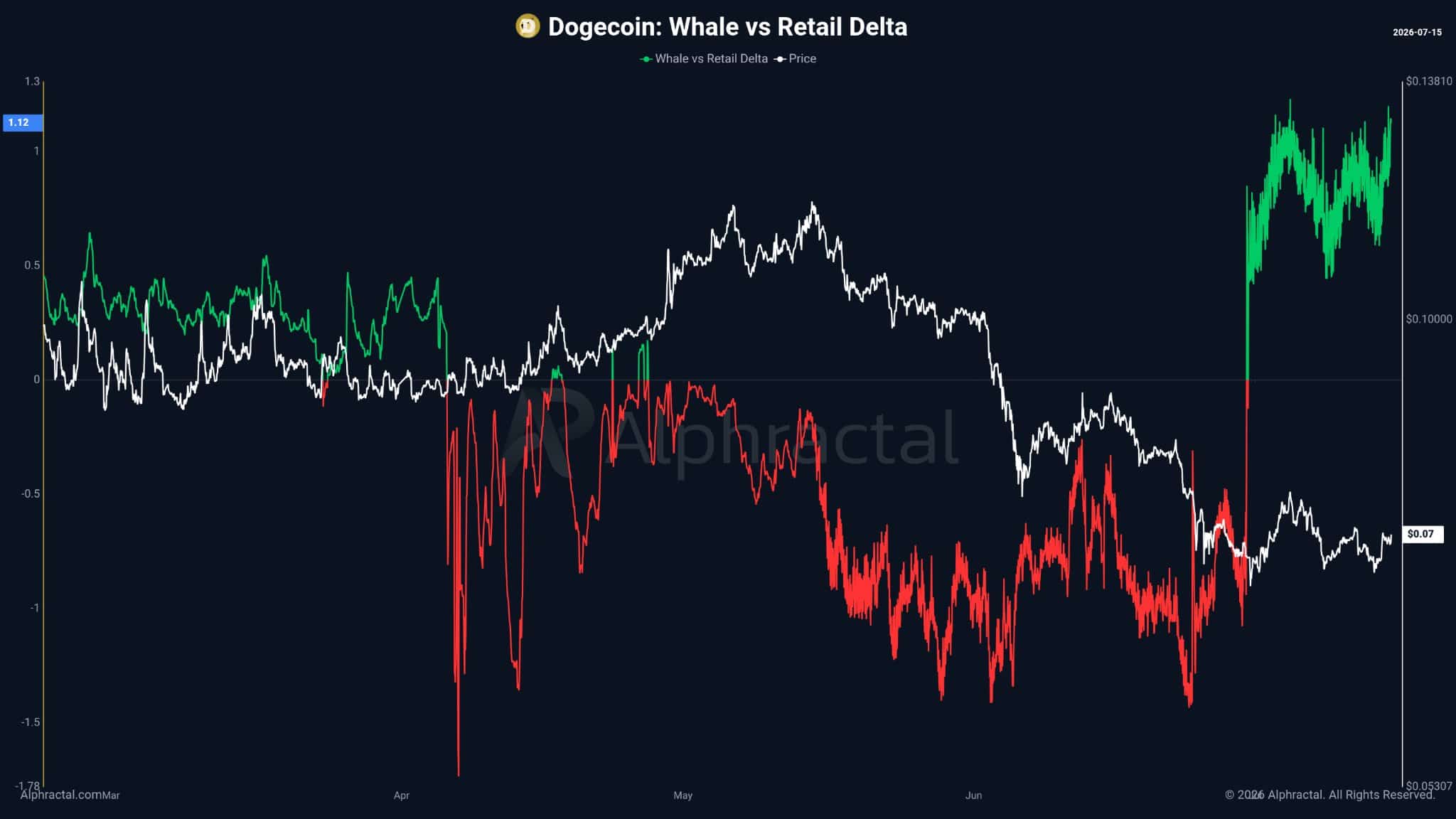
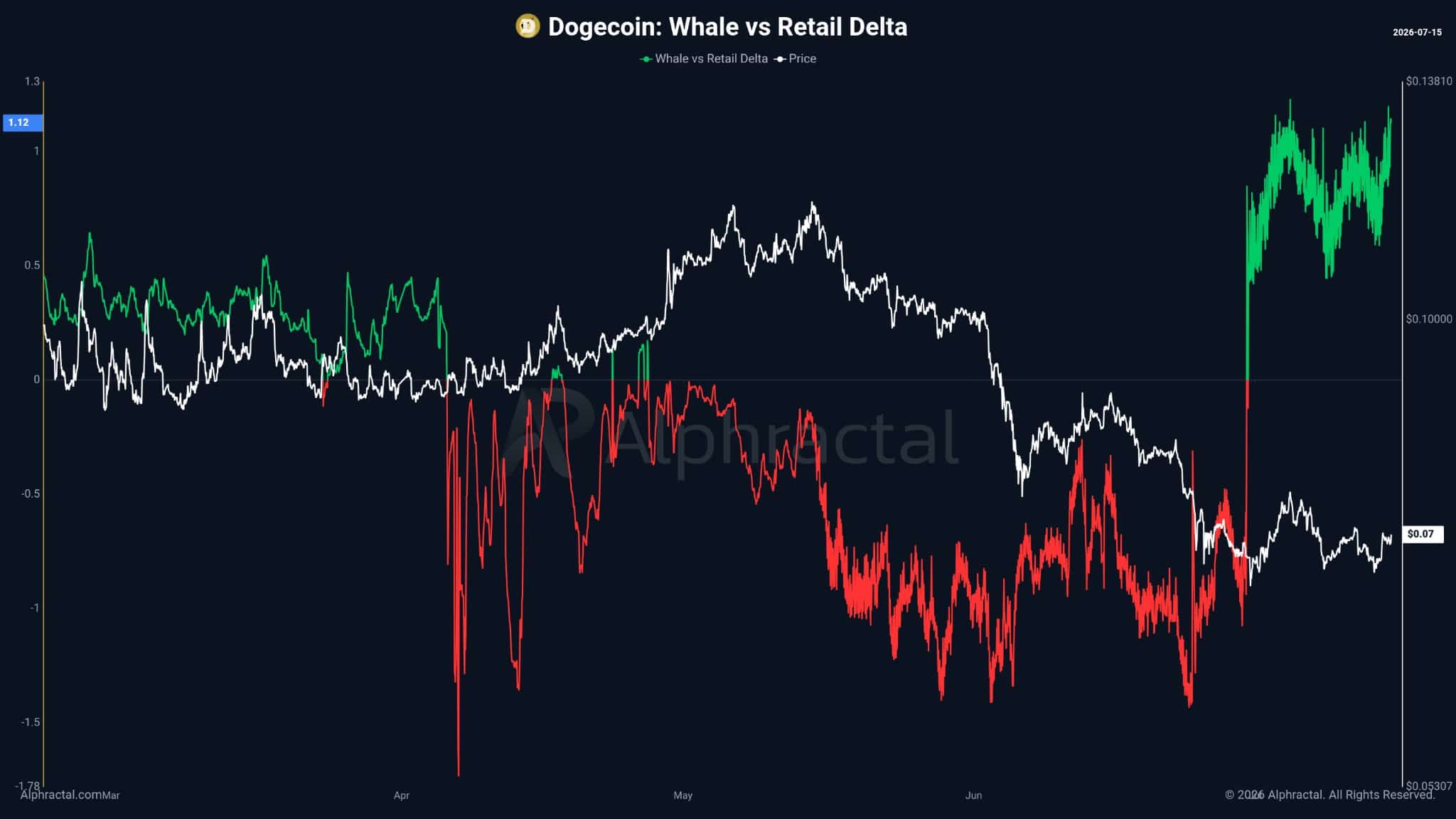
Founder and CEO of crypto intelligence platform Alphractal, Joao Wedson, observed in a post on X that whales were going long on Dogecoin while retail continued to hold short positions.

This sentiment shift occurred as DOGE fell just below the $0.07 round number earlier in July. The analyst believed that this change must persist if the memecoin can change its long-term downtrend measurably.

As things stand, a short squeeze is possible, but sustained demand is needed to help drive the memecoin towards recovery.
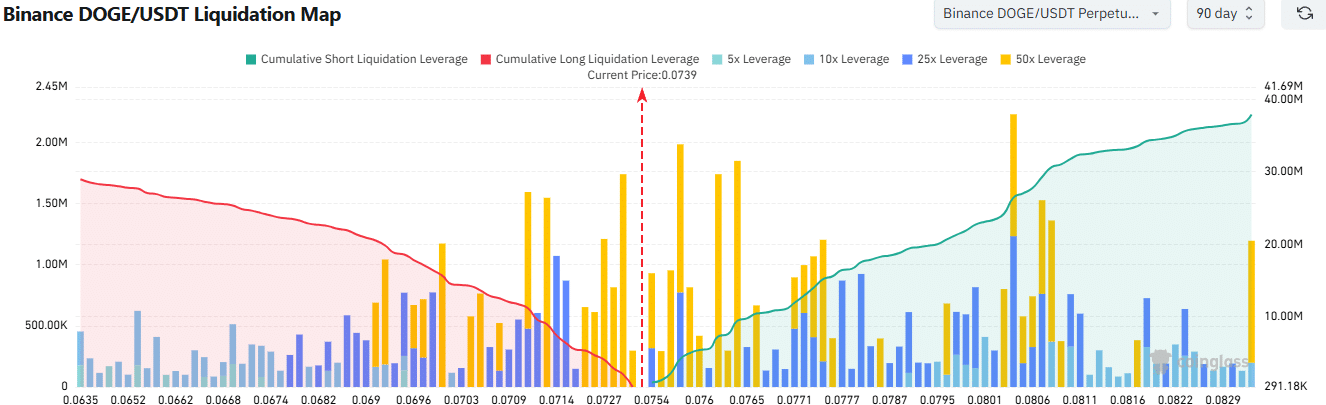
Source: CoinGlass

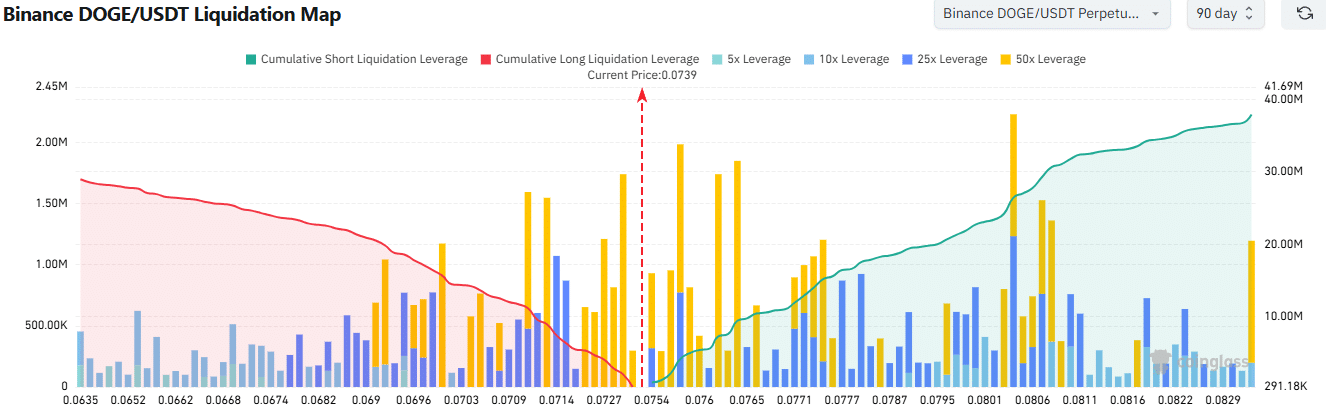
The 3-month liquidation map revealed that a price move toward $0.08 was more likely than a downward drop, based solely on liquidation concentrations.

The cumulative short liquidation leverage was stronger. This meant that a price move higher would force more liquidations, and these market buy orders in the perpetuals market could help Dogecoin climb even higher.

Yet, it is possible that such gains would quickly reverse and turn out to be just a short squeeze.

Let’s see if the price charts agree with the liquidation map.

Whale longs versus bearish structural trends
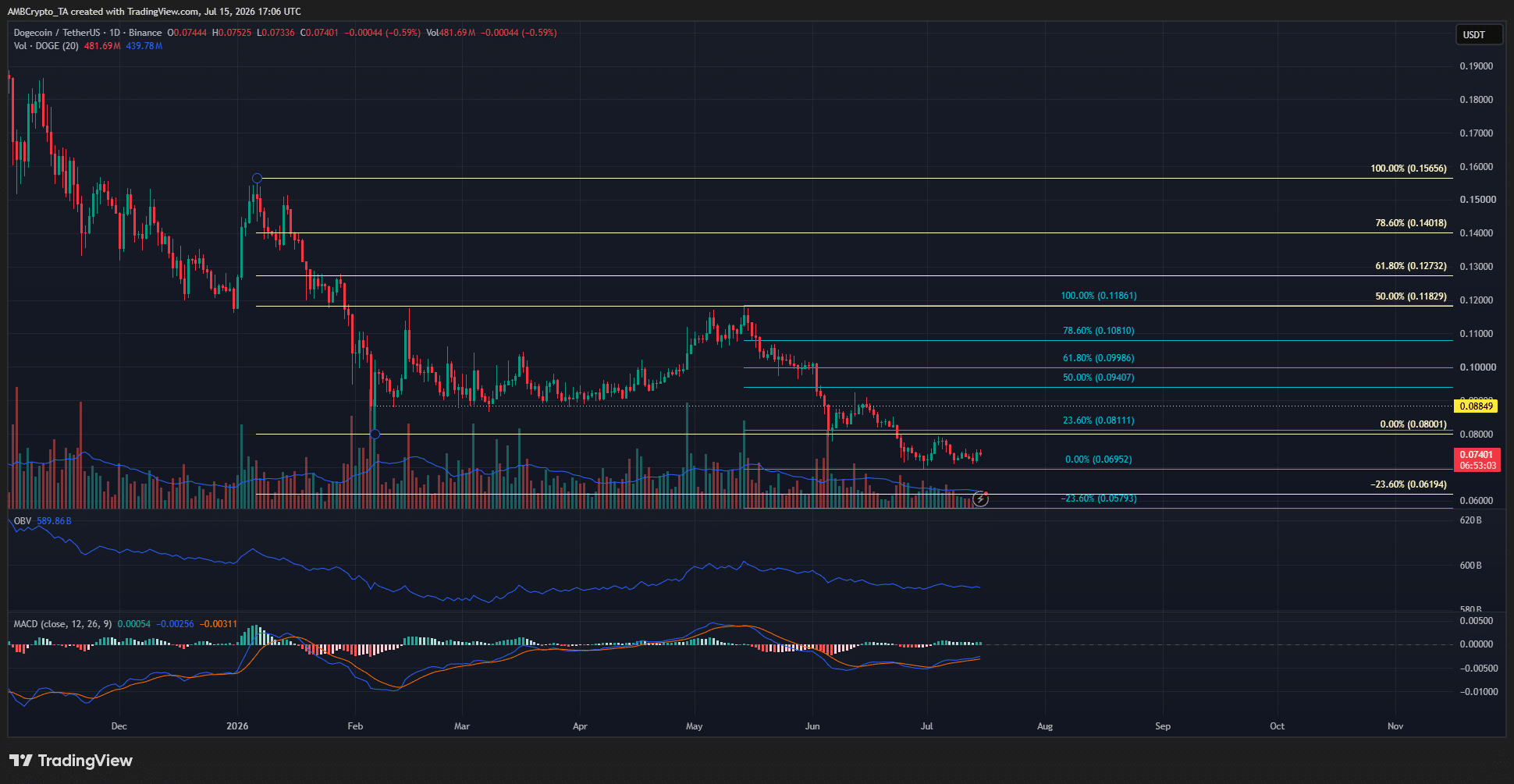
Source: DOGE/USDT on TradingView

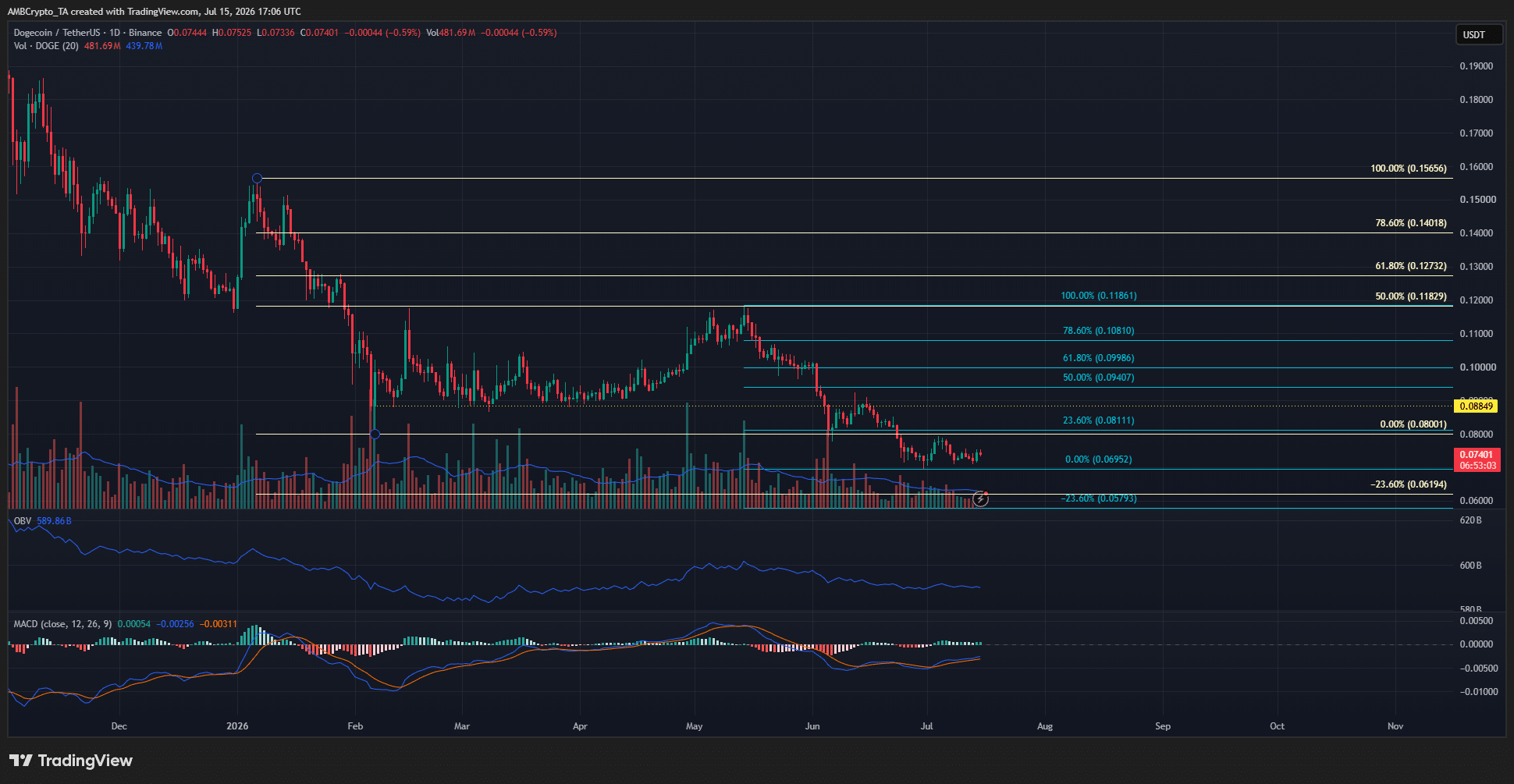
The February low at $0.08 was breached in June, making the $0.118 swing high the level that anchors the downtrend in place. Interestingly, the $0.081 level marked the 23.6% retracement level.

It is a short-term resistance zone, and has acted so in recent weeks. If reclaimed as support, a rally up to $0.108 is possible.

There is also a potential bearish scenario where Bitcoin [BTC] is unable to climb meaningfully past $65k. In which case, Dogecoin might make a final sweep of the $0.08 area before falling to new lows.


Final Summary

  • Whales have been going long on Dogecoin even as retail remained short, a sentiment divergence that could have a say in price trends.
  • A lack of strong buying pressure and the potential of a short squeeze to $0.08 meant a Dogecoin recovery remains unlikely.


Domande pertinenti

QWhat is the main reason that a short squeeze alone may not end Dogecoin's downtrend according to the article?

AA short squeeze may not end Dogecoin's downtrend because sustained demand is needed for a true recovery. The gains from a squeeze could quickly reverse without strong, continuous buying pressure.

QAccording to Joao Wedson's analysis, what is the current sentiment difference between whales and retail traders regarding Dogecoin?

AAccording to Joao Wedson, whales have been going long (taking bullish positions) on Dogecoin, while retail traders have continued to hold short (bearish) positions.

QBased on the liquidation map, why is a price move towards $0.08 considered more likely than a downward drop for Dogecoin?

AA price move towards $0.08 is considered more likely because the cumulative short liquidation leverage is stronger. A price increase would force more liquidations, and the resulting market buy orders could propel the price even higher.

QWhat are the two potential price scenarios for Dogecoin mentioned in the analysis of the price charts?

AThe two potential scenarios are: 1) If the $0.081 resistance is reclaimed as support, a rally up to $0.108 is possible. 2) If Bitcoin fails to climb past $65k, Dogecoin might make a final sweep of the $0.08 area before falling to new lows.

QWhat key resistance level has Dogecoin failed to breach at the start of July and again in recent weeks?

ADogecoin has failed to breach and scale the $0.080-$0.081 resistance zone both at the start of July and in recent weeks.

Letture associate

In Jinjiang, Fujian, a Storage Super Unicorn Lies Quiet

In Fujian's Jinjiang, a city known for sportswear, lies a quiet semiconductor giant: Fujian Jinhua Integrated Circuit Co. (JHICC). Once a promising domestic DRAM manufacturer alongside Yangtze Memory and ChangXin Memory Technologies (CXMT), its journey was derailed in 2018 when the U.S. placed it on an Entity List and filed criminal charges for alleged trade secret theft. This halted production for years. A turning point came in February 2024 when a U.S. federal court found JHICC not guilty. However, it had lost crucial time. While CXMT soared to become a top-valued A-share company in 2024, JHICC, with an estimated valuation of 80 billion RMB, was just restarting. Its current output is primarily customized DDR4 chips, not the advanced DDR5/HBM demanded for AI, but it still benefits from the broader memory chip upcycle. JHICC's story is tied to Chen Zhengkun, a veteran engineer who left Micron to lead the venture. Founded in 2016 with state-backed funding, JHICC partnered with Taiwan's UMC to develop DRAM technology. Rapid progress was cut short by the U.S. actions, which Micron initiated, partly due to its heavy reliance on the Chinese market. Post-sanctions, Chen's team worked to rebuild the production line with reduced reliance on U.S. technology. According to its records, JHICC achieved small-scale production and revenue growth under immense pressure. It now focuses on the stable "niche" DRAM market (e.g., TVs, routers) with a monthly capacity of ~40,000 wafers, aiming for 60,000 by 2026. It holds over 1,000 patents but remains on the Entity List. For Jinjiang, investing in JHICC was a bold industrial leap. The local government provided unwavering financial and logistical support during the crisis, helping the company survive. JHICC has become the anchor for a growing local semiconductor cluster. Though its scale lags behind domestic peers, JHICC's persistence symbolizes a hard-won foothold in a global market long dominated by Samsung, SK Hynix, and Micron. Having missed one boom, it seeks a place in the new AI-driven memory supercycle.

marsbit1 h fa

In Jinjiang, Fujian, a Storage Super Unicorn Lies Quiet

marsbit1 h fa

Trading

Spot
活动图片