Dogecoin Targets Japan In New RWA And Adoption Push

bitcoinistPubblicato 2026-01-09Pubblicato ultima volta 2026-01-09

Introduzione

Dogecoin's corporate arm, House of Doge, has partnered with two Japan-focused firms, abc Co., Ltd. and ReYuu Japan Inc., to drive localized adoption and real-world asset (RWA) initiatives in Japan. The collaboration aims to explore gold-backed stablecoins, regulatory-compliant RWA tokenization under Japan's "green list" framework, and the establishment of a joint fund. This move signals a strategic shift for Dogecoin towards practical utility, including payments and financial products, beyond its meme-centric origins. The partnership emphasizes responsible innovation and ecosystem growth, though specific details on assets, timelines, or merchants were not disclosed. At the time of writing, DOGE was trading at $0.14276.

House of Doge, the corporate arm of the Dogecoin Foundation, says it has struck a partnership framework with two Japan-focused firms to explore localized Dogecoin adoption and real-world asset (RWA) initiatives, putting Japan at the center of its next ecosystem expansion effort.

Dogecoin Plots Japan Expansion

In a Thursday press release dated Jan. 8, House of Doge said it has agreed a tripartite cooperation framework with abc Co., Ltd. and ReYuu Japan Inc. The arrangement is framed as a roadmap for “future collaboration,” rather than a single product launch, but it spells out several lines of work that point toward regulated tokenization and payments-style integrations tailored to the Japanese market.

“This partnership reflects our continued focus on supporting thoughtful, real-world expansion of the Dogecoin ecosystem,” Marco Margiotta, CEO of House of Doge, said in the release. “Japan represents a natural and culturally aligned market for DOGE given its strong embrace of digital innovation and we are pleased to explore opportunities alongside abc and ReYuu Japan that support responsible innovation, real-world utility, and long-term ecosystem growth.”

House of Doge said the agreement outlines potential cooperation areas designed to “leverage the strengths of each party” in support of ecosystem growth. The framework highlights efforts around promoting and adopting gold asset-backed stablecoins, as well as regulatory-oriented work connected to listing RWA tokens under Japan’s “green list” framework. It also references establishing a joint fund within the Dogecoin ecosystem and pushing “next-generation Web3” through real-world use cases.

The inclusion of a “green list” pathway is notable because it foregrounds compliance and market-structure considerations rather than the meme-driven branding that has historically defined DOGE in the public imagination. At the same time, the release does not specify which assets would be tokenized, what a gold-backed stablecoin would look like in practice, or whether any on-chain issuance would be directly tied to Dogecoin versus adjacent infrastructure.

The partners are positioned as complementary: ReYuu Japan is described as supporting business development and localization in Japan, while abc is presented as bringing “token-economy design, smart-contract development, and regulatory alignment,” with a focus on RWA and compliant Web3 integration. House of Doge’s role is framed as ecosystem coordination and infrastructure investment, with the press release casting the partnership as part of a broader international strategy.

Together, the companies say they intend to support “localized and responsible” expansion of Dogecoin-related initiatives in Japan, though the release stops short of naming specific merchants, financial institutions, pilot programs, or timelines.

House of Doge used the announcement to reinforce its broader narrative: that Dogecoin’s next phase is about practical utility; payments, financial products, and tokenization rather than purely cultural relevance. “House of Doge is the official corporate arm of the Dogecoin Foundation, committed to advancing Dogecoin as a widely accepted and decentralized global currency. By investing in the necessary infrastructure to integrate Dogecoin into everyday commerce, House of Doge is building secure, scalable, and efficient systems for real-world use.”

It adds that its scope spans “payments and financial products to real-world asset tokenization and cultural partnerships,” arguing this is “the next era of crypto utility, where Dogecoin goes beyond the meme.”

At press time, DOGE traded at $0.14276.
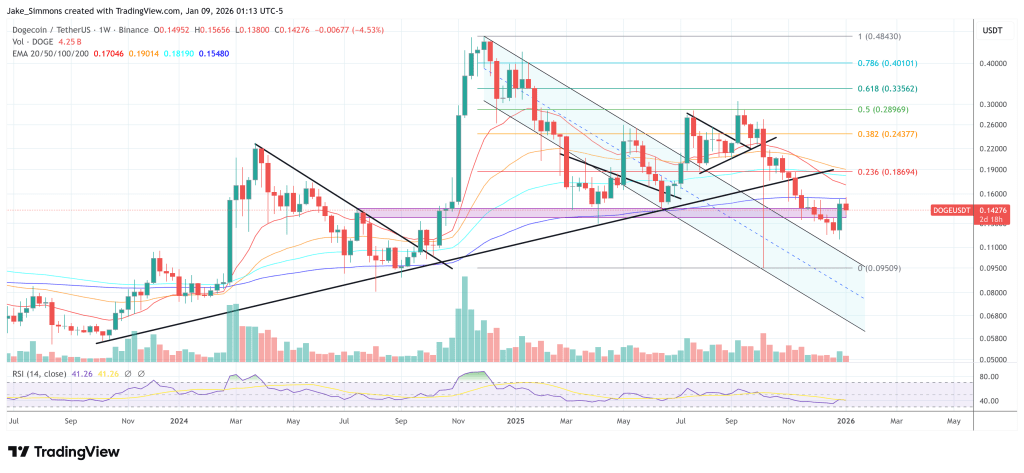
DOGE remains below the 200-week EMA, 1-week chart | Source: DOGEUSDT on TradingView.com

Crypto di tendenza

Domande pertinenti

QWhat is the main focus of the partnership between House of Doge, abc Co., Ltd., and ReYuu Japan Inc. in Japan?

AThe partnership focuses on exploring localized Dogecoin adoption and real-world asset (RWA) initiatives, including promoting gold asset-backed stablecoins, regulatory work for RWA token listings, establishing a joint fund, and pushing next-generation Web3 through real-world use cases in the Japanese market.

QWhich two Japan-focused companies did House of Doge partner with for its expansion efforts?

AHouse of Doge partnered with abc Co., Ltd. and ReYuu Japan Inc. for its expansion efforts in Japan.

QWhat role does ReYuu Japan play in this partnership framework?

AReYuu Japan supports business development and localization efforts in Japan for the partnership.

QHow does House of Doge describe the next phase of Dogecoin's development in this announcement?

AHouse of Doge describes Dogecoin's next phase as being about practical utility, including payments, financial products, and tokenization, moving beyond purely cultural relevance and meme-driven branding.

QWhat specific regulatory framework in Japan is mentioned in relation to listing RWA tokens?

AThe partnership framework highlights regulatory-oriented work connected to listing RWA tokens under Japan's 'green list' framework.

Letture associate

Dialogue with Jia Hang | Looking Back at Two Decades of Chinese Payment Going Global

**Summary: A Conversation with Jia Hang on Two Decades of China's Payment Globalization** Jia Hang, a veteran with over twenty years in payments, reflects on China's attempts to build a global payment network through three key phases: UnionPay (card networks), Alipay+ (digital wallets), and now, stablecoins. His journey began at UnionPay International, aiming to establish China's card network abroad. While successful in following Chinese tourists ("where Chinese go, UnionPay goes"), it struggled to achieve true global scale. The core lesson: card networks like Visa/Mastercard's unassailable advantage isn't just technical standards, but their deeply entrenched **governance and profit-sharing models** that create powerful network effects. Competing as the "same species" is nearly impossible. At Ant Group, he led Alipay+, a strategy to bypass card networks by interconnecting local e-wallets worldwide. While innovative, it faced a similar ceiling. Mobile QR payments and card swipes were essentially **the same species competing for the same pie**, lacking a disruptive value proposition for users or a sustainable new incentive model to replace the card networks' established flywheel. Today, at Singapore's DCS, Jia focuses on stablecoin-based payments. He argues stablecoins represent a fundamental shift. They are not competing with Visa for consumer payments but challenging the **traditional banking and account system for value movement**. Products like "U Cards" (stablecoin-linked payment cards) are transitional, leveraging existing card networks for acceptance while building new rails. The real potential lies in stablecoins enabling seamless, low-cost global value transfer, potentially reorganizing the financial infrastructure around **accounts rather than cards**. Jia believes stablecoin adoption for local retail payments, cross-border transactions, and as high-yield savings vehicles is becoming irreversible. This could gradually reduce reliance on traditional fiat channels, especially in regions with weak currencies or capital controls. The quest for the "next global payment network" continues, now centered on whether stablecoins can successfully bridge Web2 and Web3, establish new governance, and create compelling user value beyond mere cost reduction.

marsbit9 min fa

Dialogue with Jia Hang | Looking Back at Two Decades of Chinese Payment Going Global

marsbit9 min fa

Circle's Stock Price Plunges 76%, Hong Kong Dollar Stablecoin Set to Launch Within Two Weeks

Circle's stock price has plunged approximately 76% from its 2023 peak, reflecting a major market revaluation. Despite this, Circle President Heath Tarbert emphasized the company's focus on long-term execution and its dominant position with USDC's $73 billion circulation across 34 blockchains. The competitive landscape is intensifying. A new consortium-backed stablecoin, Open USD, is attempting to challenge incumbents by sharing reserve yields with partners. More significantly, Visa's new stablecoin platform, initially supporting Open USD while also being compatible with USDC, could erode Circle's network effects. In response, Circle is expanding into real-world payments through partnerships like the one with Japan's JCB. Separately, Tether (USDT) faces a two-year compliance window under new U.S. regulations, requiring it to adjust its reserve composition away from assets like Bitcoin and loans towards cash and U.S. Treasuries. Meanwhile, in Hong Kong, Standard Chartered-backed fintech firm Dian Dian is poised to launch a licensed HKD-pegged stablecoin (HKDAP), moving the industry into a phase where the real test is integrating licensed stablecoins into actual payment flows and corporate treasury systems. The sharp decline in Circle's stock underscores a broader shift: the stablecoin market is moving from a winner-takes-all dynamic to a multi-player competitive arena where execution, compliance, and real-world utility are becoming paramount.

marsbit10 min fa

Circle's Stock Price Plunges 76%, Hong Kong Dollar Stablecoin Set to Launch Within Two Weeks

marsbit10 min fa

Amidst Capital's Encirclement, Decentralization is the Sole Defense for Public Blockchains

In a landscape dominated by power and profit motives, the author argues that decentralization is not merely one desirable feature among many in blockchain design—it is the singular, non-negotiable defense against corporate and capital capture. The article adopts a Machiavellian, realist perspective on human institutions, positing that businesses will inevitably attempt to co-opt any valuable network to protect their profits and dominance. While external attacks like 51% forks are often discussed, the greater existential risk is internal capture—the gradual erosion of a protocol’s neutrality by vested interests, as seen historically with platforms like Visa and Google. The piece critiques permissioned chains, highly centralized “permissionless” layer-1s, and layer-2s without sufficient decentralization (e.g., single sequencers) as inherently vulnerable. These compromised systems, promoted by established financial players, are framed as delaying tactics to stifle truly open networks that threaten existing high-fee, inefficient business models. Real-world examples, such as closed enterprise consortiums that exclude competitors, illustrate how such systems cement oligopolies rather than foster innovation. The author concludes that while decentralized protocols like Ethereum are imperfect and costly to operate, they represent the only viable long-term equilibrium. In a market where value naturally flows to the most secure and neutral settlement layer, only maximally decentralized public blockchains can resist being subsumed by capital and powerful incumbents.

Foresight News20 min fa

Amidst Capital's Encirclement, Decentralization is the Sole Defense for Public Blockchains

Foresight News20 min fa

Who Decides the Rules of Bitcoin? BIP-110 Ignites Governance Debate

Bitcoin's governance is once again at the center of a heated debate, this time ignited by BIP-110, the "Reduced Data Temporary Softfork." This proposal aims to curb non-monetary data (like inscriptions and Runes) by introducing seven new consensus-layer restrictions over a year, such as limiting new output scripts to 34 bytes and restoring the OP_RETURN cap to 83 bytes. The controversy stems from BIP-110's fundamental shift: it moves the battle against "spam" from node relay and miner policies to the consensus layer, rendering currently valid transactions invalid. Supporters, arguing that default policy governance has failed (highlighted by Bitcoin Core v30's relaxation of OP_RETURN limits), see this as necessary to protect node resources and Bitcoin's monetary focus. Opponents, led by figures like Michael Saylor and Adam Back, warn it dangerously centralizes governance. Saylor listed 110 reasons against it, criticizing its low 55% miner activation threshold and potential for chain splits. Back emphasized Bitcoin's "permissionless" ethos, arguing no single group should impose value judgments via consensus rules. Further complicating matters, technical critiques suggest BIP-110 may be technically circumventable, and a "BlockSlop" vulnerability in its upgrade path poses a consensus risk. The debate has drawn in diverse stakeholders: miners (with pools like Ocean signaling support and Foundry polling clients), node operators (like Bitcoin Knots), and new players like corporate treasury holder MicroStrategy (Saylor), whose market influence adds a novel dimension. Ultimately, BIP-110 acts as a governance stress test, exposing the unresolved question: who decides Bitcoin's rules? It pits the authority of miners, node operators, developers, and capital holders against each other, with each side claiming to defend Bitcoin's core principles of neutrality and security.

marsbit37 min fa

Who Decides the Rules of Bitcoin? BIP-110 Ignites Governance Debate

marsbit37 min fa

Trading

Spot

Articoli Popolari

Come comprare PUSH

Benvenuto in HTX.com! Abbiamo reso l'acquisto di Push Protocol (PUSH) semplice e conveniente. Segui la nostra guida passo passo per intraprendere il tuo viaggio nel mondo delle criptovalute.Step 1: Crea il tuo Account HTXUsa la tua email o numero di telefono per registrarti il tuo account gratuito su HTX. Vivi un'esperienza facile e sblocca tutte le funzionalità,Crea il mio accountStep 2: Vai in Acquista crypto e seleziona il tuo metodo di pagamentoCarta di credito/debito: utilizza la tua Visa o Mastercard per acquistare immediatamente Push ProtocolPUSH.Bilancio: Usa i fondi dal bilancio del tuo account HTX per fare trading senza problemi.Terze parti: abbiamo aggiunto metodi di pagamento molto utilizzati come Google Pay e Apple Pay per maggiore comodità.P2P: Fai trading direttamente con altri utenti HTX.Over-the-Counter (OTC): Offriamo servizi su misura e tassi di cambio competitivi per i trader.Step 3: Conserva Push Protocol (PUSH)Dopo aver acquistato Push Protocol (PUSH), conserva nel tuo account HTX. In alternativa, puoi inviare tramite trasferimento blockchain o scambiare per altre criptovalute.Step 4: Scambia Push Protocol (PUSH)Scambia facilmente Push Protocol (PUSH) nel mercato spot di HTX. Accedi al tuo account, seleziona la tua coppia di trading, esegui le tue operazioni e monitora in tempo reale. Offriamo un'esperienza user-friendly sia per chi ha appena iniziato che per i trader più esperti.

561 Totale visualizzazioniPubblicato il 2024.12.13Aggiornato il 2026.06.02

Come comprare PUSH

Discussioni

Benvenuto nella Community HTX. Qui puoi rimanere informato sugli ultimi sviluppi della piattaforma e accedere ad approfondimenti esperti sul mercato. Le opinioni degli utenti sul prezzo di PUSH PUSH sono presentate come di seguito.

活动图片