Elon Musk has confirmed that X’s long-promised payments layer, X Money, is already running inside the company — but Dogecoin, his on-again-off-again favorite meme coin, has barely twitched.
Replying to developer and X feature-watcher Nima Owji on December 10, Musk dropped a characteristically terse update: “It has been launched internally.” Within hours, promoter Mario Nawfal was broadcasting that “X MONEY IS LIVE BEHIND CLOSED DOORS, PUBLIC LAUNCH NEXT,” describing the system as “quietly tested by employees and early users while the rest of the world waits for access.”
It has been launched internally
— Elon Musk (@elonmusk) December 10, 2025
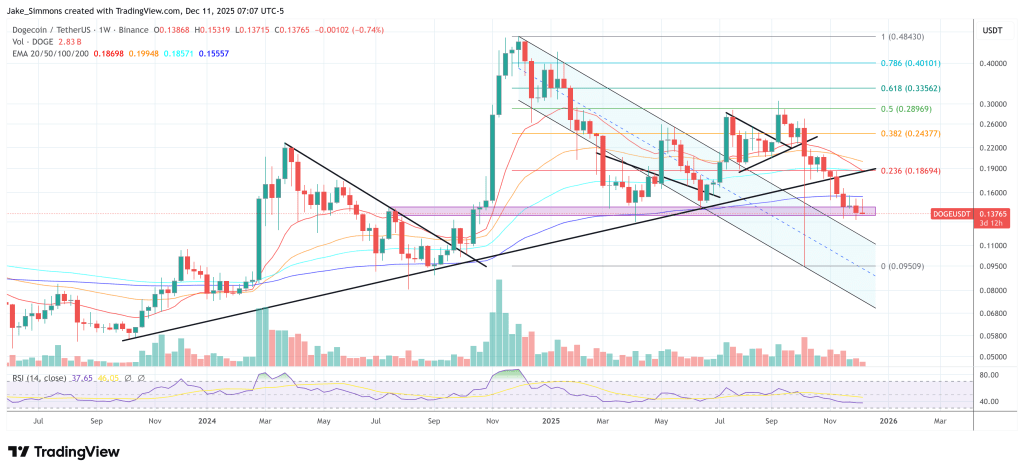
The market, however, did not exactly wait breathlessly. As of press time, Dogecoin traded around $0.137, down less than 0.1% on the day — essentially noise, given an intraday range between roughly $0.137 and $0.150. For a coin that once ripped 20–30% on a single Elon meme, this is... subdued.
Why Is The Dogecoin Price Not Reacting?
The contrast with earlier X Money headlines is stark. When Musk first framed the payments stack as part of a broader relaunch of XChat in mid-November, he boasted that X had “just rolled out an entire new communications stack with encrypted messages, audio/video calls and file transfer,” adding pointedly: “Money comes out soon... X will be the everything app.”
Dogecoin and other high-beta names squeezed higher on that story, if only briefly. Back in May, when Musk confirmed that a beta version of X Money was coming, DOGE jumped from about $0.08 to $0.09 on the announcement — a double-digit percentage move triggered by one more hint that the dog might be wired into X’s rails.
Today’s non-reaction lands against a deeper build-out of X Money in the background. According to a recent job posting, X Money is hiring a technical lead to design a payments platform “from the ground up” for more than 600 million monthly users, with an emphasis on distributed systems and secure transactions.
The description notably does not mention crypto or Dogecoin at all. Notably, X Money already announced a partnership with Visa earlier this year for an “X Money Account” that would fund wallets and peer-to-peer payments, while Solana figures — including ecosystem advisor Nikita Bier, now at X — have publicly signaled they are eager to help.
Crucially, Musk has not exactly gone quiet on Dogecoin in general. On November 3 he posted “It’s time” on X, reviving his old promise to “put a literal Dogecoin on the literal moon” via a SpaceX mission, as reported by Bitcoinist.
In mid-October he waded into the “energy money” debate, backing Bitcoin as impossible to “fake” because it is grounded in energy and then replying with an approving emoji when a Dogecoin community account insisted that “Dogecoin is also based on energy” — his “first explicit nod toward DOGE in a while,” as reported on NewsBTC.
Even more recently, on October 11 and again on November 15, Musk posted Doge-coded content — a Shiba Inu mascot image, then a meme of a Shiba playing a banjo — that historically would have lit up DOGE order books. However, this time, Dogecoin’s response was muted to outright negative.
In other words, the last few times Musk has talked about or referenced Dogecoin on X, the market reaction has been steadily decaying. So when he now says X Money “has been launched internally,” the absence of a pump in DOGE looks less like a mystery and more like a trend.
At press time, DOGE traded at $0.13765.