DOGE Year-End Review: Did Musk's Hundred-Day Reform Work?

marsbitPubblicato 2025-12-31Pubblicato ultima volta 2025-12-31

Introduzione

DOGE Year-End Review: Did Musk's 100-Day Reform Work? The DOGE (Department of Government Efficiency) initiative, led by Elon Musk and Vivek Ramaswamy, aimed to cut bureaucratic waste, reduce regulations, and save $2 trillion to balance the federal budget. Despite ambitious goals, Musk resigned after just 130 days, and DOGE was dissolved by November—10 months into an 18-month plan. DOGE achieved a 9% reduction in federal employees (271,000 jobs cut) and claimed $21.4–25 billion in savings through contract terminations and program closures. However, total federal spending increased from $6.75–7.135 trillion in 2024 to $7.01–7.6 trillion in 2025, a 4–6% rise. Mandatory spending (e.g., Social Security, Medicare) and interest on debt—unaffected by administrative cuts—drove this growth. Independent analyses suggested actual savings were as low as $3 billion, with potential future tax losses from weakened IRS enforcement offsetting gains. Post-Musk, DOGE’s influence waned, and service disruptions emerged. The reform highlighted the fundamental mismatch between corporate efficiency models and government operations, where statutory spending and systemic inertia limit top-down restructuring. The experiment underscored that government cannot be run like a business, as efficiency must balance fairness, stability, and public trust.

Federal employees were successfully reduced by 271,000, a decrease of 9%, setting the largest peacetime layoff record. However, at the same time, total federal expenditures did not decrease but instead increased, soaring from $6.75-7.135 trillion in 2024 to $7.01-7.6 trillion, a net increase of $248-480 billion. This phenomenon of "losing weight but gaining mass" is the core contradiction of the DOGE (Department of Government Efficiency) reform.
This "external advisor" agency, initially led by Elon Musk and Vivek Ramaswamy, promised to use commercial means to dismantle government bureaucracy, cut redundant regulations, reduce wasteful spending, and ultimately save $2 trillion to balance the federal budget. This ambitious plan was expected to last until July 2026, giving them 18 months to transform the government. However, reality proved far harsher than expected: Musk resigned hastily in May, serving only a 130-day term as a special government employee; by November, DOGE quietly dissolved, a full 8 months before the original term was set to end.

This was not an unfinished reform, but a complete abandonment. From launch to disappearance, DOGE's actual lifespan was only about 10 months. When the savings target was clearly unattainable, legal challenges ensued, and disputes with Trump became public, Musk chose to return to his business empire, leaving behind a crumbling agency and a host of unanswered questions. This rapid fall from ambition to disillusionment exposed not only missteps in reform strategy but also the essential, difficult-to-cross chasm between corporate logic and government operations.

I. The Grand Vision vs. The Harsh Reality: A Complete Divergence

DOGE's reform vision was full of Silicon Valley-style idealism. They planned to use lean management principles to terminate hundreds of billions of dollars in inefficient contracts, close redundant facilities, reduce the federal workforce from about 3.015 million to a leaner size, and replace some bureaucratic functions with AI and automation tools. This methodology has proven successful time and again in the business world—why couldn't it be used to transform the government?
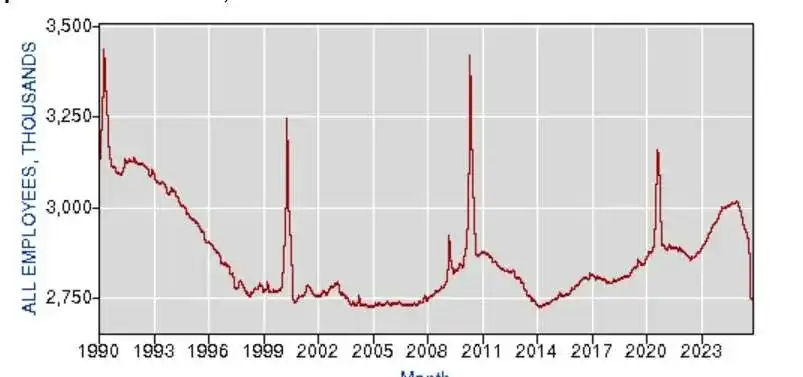
Chart: Federal Employee Count Since 1990

In January 2025, Musk joined DOGE as a special government employee, with a term set for 130 days. In Silicon Valley, 130 days is enough to launch a product prototype, complete a round of financing, or even turn around a startup's fate. In the initial months, DOGE demonstrated dazzling execution. From January to November, federal employees decreased from 3.015 million to 2.744 million, a net reduction of 271,000 positions. This was not only the largest peacetime federal layoff since WWII, but the speed of execution was also staggering. Specific actions included terminating a $290 million refugee facility contract at the Department of Health and Human Services, $190 million in IT redundancy spending at the Treasury Department, and closing hundreds of inefficient agencies and programs, cumulatively undertaking over 29,000 reduction actions. DOGE claimed these measures saved approximately $21.4-25 billion, primarily concentrated in non-defense federal mandatory spending, which decreased by 22.4% year-on-year.
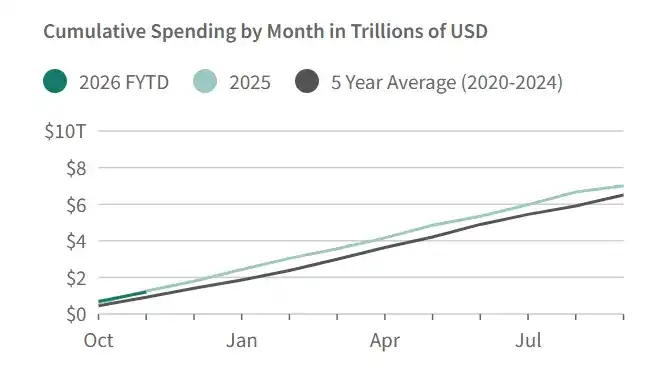
Chart: Cumulative Federal Government Expenditure

But the data on the spending side told a completely different story. Overall federal expenditure rose from about $6.75-7.135 trillion in 2024 to about $7.01-7.6 trillion in 2025, an increase of 4%-6%. Spending in just the first 11 months reached $7.6 trillion, $248 billion more than the same period the previous year. More ironically, some independent analyses suggested that DOGE's claimed savings figures might be severely inflated, with verifiable savings potentially only in the tens of billions, even as low as $3 billion. Due to the weakening of IRS enforcement capabilities, this could lead to at least $350 billion in lost tax revenue over the next decade, making the net effect of the so-called "savings" close to zero or even negative.

Resistance from reality soon became apparent. Federal spending continued to climb; mandatory spending like Social Security, Medicare, and interest on the national debt was completely unaffected by administrative layoffs. By May, multiple pressures converged. Musk's relationship with Trump began to deteriorate, with public disputes between the two. Legal challenges followed, questioning DOGE's authority and procedural legality. Tesla's business was also calling him back—stock price fluctuations, production issues, market competition, all requiring the CEO's attention. Most crucially, the $2 trillion savings target was clearly an impossible mission; staying on a project doomed to fail held no benefit for Musk's personal brand. As soon as his 130-day term ended, Musk announced his return to private enterprise. He did not apply for an extension, did not ask for more resources, but chose a clean break. This decision itself was the loudest admission: transforming the government with business methods was far more difficult than he had thought.

II. The Struggles of the Headless Horseman: Decline from May to November
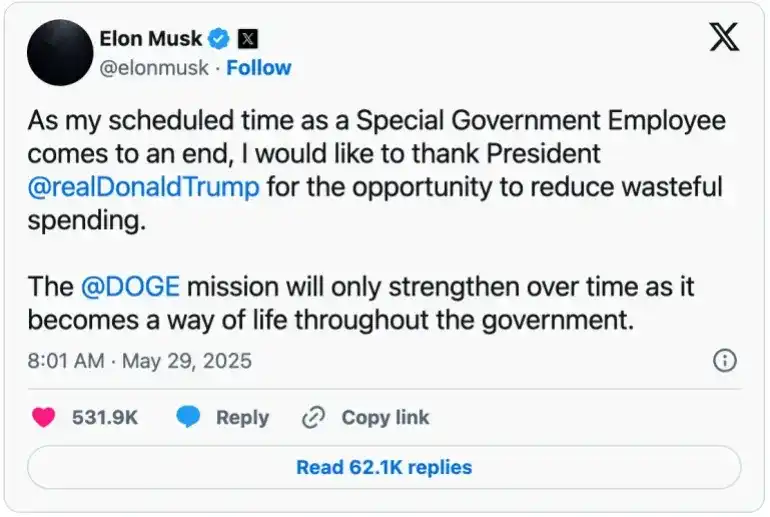
After Musk's departure, DOGE tried to prove it could continue. The White House signaled that the "DOGE spirit" would be integrated into the government's daily operations, becoming part of the "government lifestyle." Some former DOGE employees were embedded in various federal agencies to continue pushing layoffs and cost cuts. Ramaswamy was still nominally leading the agency, trying to maintain the reform momentum.

But DOGE without Musk was like a rocket without an engine; inertia could only last so long. Without the star founder's halo, the agency's attention rapidly declined. Without Musk's direct communication channel with Trump, DOGE's influence within the government was greatly diminished. More importantly, the limitations of the reform became increasingly apparent—those large expenditure items that truly required Congressional legislation to change were utterly beyond DOGE's reach.

During this period, DOGE's achievements became harder to define. Although some layoff actions continued, spending data kept rising. Reports of service disruptions began to increase. Social Security applications were delayed, regulatory gaps appeared, and key positions were left unfilled due to over-cutting. Criticism grew louder: in the name of optimizing efficiency, DOGE was undermining the government's basic operational capacity. Legal challenges also accumulated, questioning whether many of DOGE's actions exceeded executive authority.

By November, several authoritative media outlets began reporting a fact: DOGE had quietly disbanded. Reuters, TIME, CNN, Newsweek, and others used terms like "disbanded," "quietly shut down," and "no longer exists" to describe the agency's fate. There was no formal dissolution announcement, no press conference; DOGE simply vanished from public view. Its charter, originally meant to last until July 2026, was terminated early, with many functions transferred to the Office of Personnel Management or other常规 agencies.

This silent end perhaps speaks volumes more than any failure. Not even a decent farewell, because admitting failure itself was an embarrassment. DOGE went from a revolutionary agency promising to change the government to a brief interlude everyone wanted to forget as quickly as possible.

III. The Underlying Logic of "Reducing Staff Without Saving Money"

1. The Impenetrable Wall of Mandatory Spending
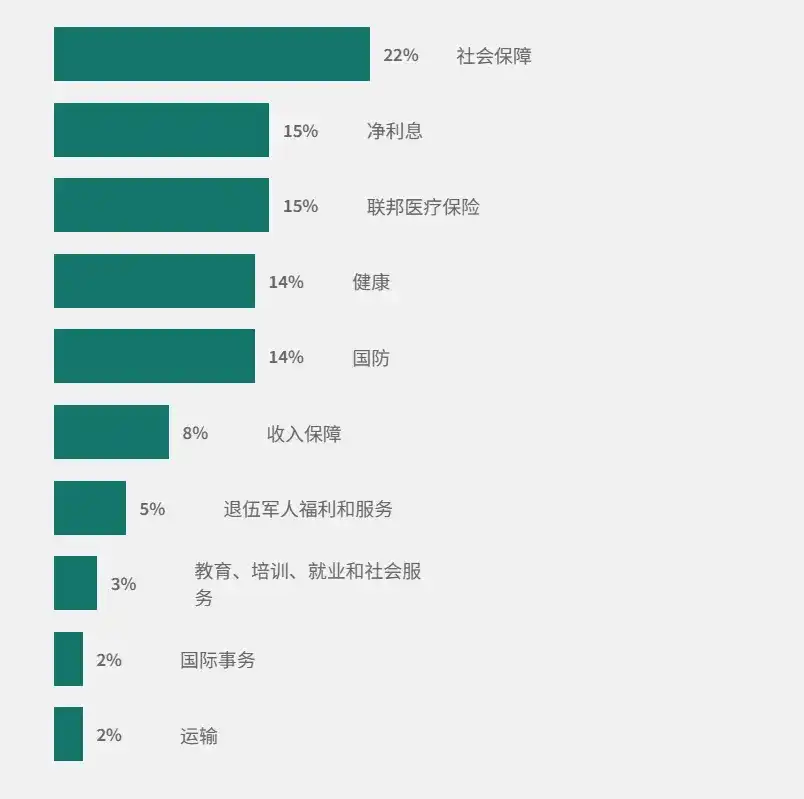
The most fundamental difference between the government fiscal system and a corporation is that over 70% of federal spending is on mandatory programs. These expenditures grow automatically as mandated by law, influenced by demographics, economic cycles, and interest rate fluctuations, completely unaffected by administrative layoffs. The 2025 data clearly shows this rigidity: benefit spending like Social Security and Medicare increased by about $168 billion, driven mainly by an aging population and inflation adjustments; national debt interest costs soared by $71 billion, with the debt scale already expanded to $36-38.3 trillion, making interest expenditure even exceed the defense budget, becoming the federal government's largest single expense.

These rigid expenditures directly offset all of DOGE's savings efforts. No matter how many administrative staff were cut, Social Security payments still had to be made according to statutory formulas, Medicare subsidies still had to be paid based on enrollment, and national debt interest had to be paid on time to maintain national credit. As an executive agency, DOGE could not unilaterally modify benefit programs authorized by Congress, meaning the effort was confined to the "periphery" from the start, unable to touch the "core" of expenditures.

At a deeper level, this rigidity stems from constitutional and legislative frameworks. The government is not a profit-seeking enterprise but a public institution承担ing the function of a social safety net. When a 65-year-old applies for Social Security, the government cannot refuse payment for "cost optimization." This is the essential difference between government and business, and the fundamental reason corporate thinking hit a wall here.

2. The "Offsetting" of Inter-Departmental Spending

DOGE did achieve some results in the discretionary spending area. They terminated 5,200 projects and hundreds of billions of dollars in contracts in departments like Health and Human Services, Education, and the Agency for International Development, saving about $37 billion. But these savings were quickly吞噬ed by growth in other departments. Defense spending increased due to geopolitical tensions, infrastructure investment膨胀ed due to the Trump administration's priorities, and the spillover effects of mandatory spending further pushed up the overall budget.

The result was "local slimming, global expansion." This is similar to the "savings transfer" phenomenon common in corporate mergers and acquisitions—costs cut in one department often reappear in another form elsewhere. But the government lacks the flexible adjustment mechanisms of a company and cannot reconfigure resources as quickly. The 2025 spending growth also included emergency response (increased natural disaster funds) and inflation adjustments (CPI rose about 3%-4%), these external factors further amplified the "offsetting" effect.

Specific data shows that DOGE's savings accounted for only 0.3%-0.5% of total spending, far insufficient to reverse the overall trend. In 2025, mandatory spending increased by $221 billion, discretionary spending increased by $80 billion, and net interest costs increased by $71 billion. When you save a few billion in one pocket but pull out hundreds of billions from three others, the so-called "efficiency improvement" becomes a numbers game.

3. The Cost Inertia and Transition Friction of Agency Operations

Layoffs are never a zero-cost operation, especially in the government system. Implementing the DOGE reform itself generated huge expenses: severance pay, paid leave, rehiring costs after wrongful termination, totaling an estimated $135 billion. This figure already far exceeds many of the "savings" projects claimed by DOGE. More hidden costs came from productivity losses and service disruptions.

The operation of government agencies highly relies on institutional memory and human networks. When large numbers of experienced employees left, Social Security applications began to delay, regulatory gaps appeared, and policy implementation efficiency actually decreased. Although AI and automation were held in high hopes, these tools are far from mature enough to completely replace human judgment. Algorithmic governance might be efficient, but it also brings new problems like data privacy leaks and algorithmic bias. In the process of transitioning from a "public service apparatus" to a "data-driven terminal," the government is losing something difficult to quantify but crucial—legitimacy, social cohesion, and public trust.

A more practical problem is the increase in overtime pay for remaining employees and rising contract outsourcing costs. The government outsourced work previously done internally to private contractors, often at a higher price. In the long run, large-scale brain drain could create a "knowledge gap," affecting policy continuity and professional capacity accumulation.

Conclusion: Who Lost? Reflecting on the Cost and Boundaries of Reform

In this collision of ideals and reality, who ultimately lost? Perhaps first the idealistic reformers, who underestimated the complexity of government operations and mistakenly thought business logic could be directly transplanted into the public sector. Taxpayers might benefit from partial savings in the short term, but face the risk of service cuts and quality decline in the long run. Beneficiaries of public services, especially groups relying on Social Security and Medicare, might suffer from service disruptions and reduced efficiency.

The deeper loser might be the entire system's sustainability and democratic legitimacy. When the government is "optimized" like a business, those values that cannot be measured by numbers—fairness, stability, social cohesion—are quietly being eroded. Opinion polls showed DOGE's approval rating hovering around 40%, reflecting public recognition of efficiency gains coexisting with concerns about service disruptions.

But this collision was not entirely meaningless. If DOGE can push Congress to take action and truly touch core issues like welfare reform and debt control, it could still become a historical turning point. The key is to recognize that the government is not a business; efficiency needs to be balanced with fairness, sustainability, and democratic principles. A business can sacrifice everything for profit, but the government must保留 the last line of defense for society's most vulnerable groups. This is the most important lesson corporate thinking needs to learn, and the most profound insight left to us by this激烈 collision.

Data for this report was compiled and edited by WolfDAO. Please contact us if you have any questions for updates;

Author: Nikka / WolfDAO ( X : @10xWolfdao )

Domande pertinenti

QWhat was the main contradiction in the DOGE reform efforts as described in the article?

AThe main contradiction was that while the DOGE successfully reduced the federal workforce by 271,000 employees (a 9% cut), the total federal spending actually increased by $248-480 billion, from $6.75-7.135 trillion to $7.01-7.6 trillion. This 'slimming down but gaining weight' phenomenon highlighted the core failure of the reform.

QWhy did Elon Musk leave the DOGE after only 130 days?

AElon Musk left due to multiple converging pressures: a deteriorating relationship with Trump, mounting legal challenges questioning DOGE's authority, the need to return to his business empire (Tesla) to address stock volatility and production issues, and the realization that the $2 trillion savings goal was an impossible task that could damage his personal brand.

QWhat happened to the DOGE after Elon Musk's departure?

AAfter Musk left, the DOGE attempted to continue but quickly lost influence and momentum. It was described as losing its engine. It was eventually quietly disbanded in November, about 10 months after its start and 8 months before its original end date, with many of its functions transferred to other agencies like the Office of Personnel Management.

QAccording to the article, what are the fundamental reasons why corporate logic failed within the government?

ACorporate logic failed due to three fundamental reasons: 1) The 'impregnable wall' of mandatory spending (over 70% of the budget) on programs like Social Security and Medicare, which is required by law and unaffected by administrative cuts. 2) The 'see-saw effect' of spending, where savings in one department were swallowed by increases in others like defense and infrastructure. 3) The high cost inertia and transition friction of the reforms themselves, including severance pay, productivity loss, and the inability of AI to fully replace human judgment.

QWhat were some of the hidden costs and negative consequences of the DOGE's workforce reductions?

AHidden costs included an estimated $135 billion in implementation costs (severance, paid leave, rehiring after wrongful termination). Negative consequences included service disruptions (delays in Social Security applications), regulatory vacuums, loss of institutional memory, increased overtime pay for remaining staff, higher costs from outsourcing to contractors, and a long-term 'knowledge gap' affecting policy continuity.

Letture associate

$292 Million KelpDAO Cross-Chain Bridge Hack: Who Should Foot the Bill?

On April 18, 2026, an attacker stole 116,500 rsETH (worth ~$292M) from KelpDAO’s cross-chain bridge in 46 minutes—the largest DeFi exploit of 2026. The stolen assets were deposited into Aave V3 as collateral, causing $177–200M in bad debt and triggering a cascade of losses across nine DeFi protocols. Aave’s TVL dropped by ~$6B overnight. This legal analysis argues that KelpDAO and LayerZero Labs share concurrent liability, with fault apportioned 60%/40%. KelpDAO negligently configured its bridge with a 1-of-1 decentralized verifier network (DVN)—a single point of failure—despite LayerZero’s explicit recommendation of a 2-of-3 setup. LayerZero, which operated the compromised DVN, failed to secure its RPC infrastructure against a known poisoning attack vector. Both protocols’ terms of service cap liability at $200 (KelpDAO) or $50 (LayerZero), but these limits are likely unenforceable due to unconscionability, gross negligence exceptions, and potential securities law invalidation (if rsETH is deemed a security under the Howey test). Aave’s governance also faces fiduciary duty claims for raising rsETH’s loan-to-value ratio to 93%—far above competitors’ 72–75%—without adequately assessing bridge risks, amplifying the systemic fallout. Practical recovery targets include LayerZero Labs (a registered Canadian entity), KelpDAO’s founders, auditors, and identifiable Aave governance delegates. The incident underscores escalating legal risks for DeFi protocols, infrastructure providers, and governance participants.

marsbit18 min fa

$292 Million KelpDAO Cross-Chain Bridge Hack: Who Should Foot the Bill?

marsbit18 min fa

Insider Trading in War: 5 People Involved, the Highest Earner Was Arrested

On April 24, the U.S. Department of Justice arrested U.S. Army Special Forces Staff Sergeant Gannon Ken Van Dyke for insider trading related to the capture of Venezuelan President Nicolás Maduro on January 3. Van Dyke allegedly profited over $400,000 by placing bets on a prediction market, Polymarket, using insider knowledge of the covert operation. According to the indictment, Van Dyke registered an account (0x31a5) on December 26 and made a series of bets predicting Maduro’s capture and U.S. military involvement in Venezuela. He withdrew most of his funds on the day of the operation and attempted to obscure his tracks by transferring assets through crypto and brokerage accounts. This case marks the first time the DOJ has prosecuted insider trading on Polymarket. PolyBeats had previously identified five suspicious accounts, including Van Dyke’s—the highest earner—in January. The other accounts, with profits ranging from $34,000 to $145,000, remain under unofficial scrutiny but have not been charged. Their lower profits, indirect access to information, and unclear legal boundaries may complicate prosecution. Polymarket has since strengthened its market integrity rules, explicitly prohibiting trading based on confidential or insider information. Van Dyke’s arrest, nearly four months after his trades, signals increased regulatory attention and the persistent traceability of blockchain-based transactions.

marsbit20 min fa

Insider Trading in War: 5 People Involved, the Highest Earner Was Arrested

marsbit20 min fa

Bitwise: Bullish on Bitcoin's Performance in the Second Half of the Year, AI and Regulation Will Spark a New Altcoin Season

Bitwise CIO Matt Hougan and Research Lead Ryan Rasmussen express strong bullish sentiment on Bitcoin's long-term prospects, suggesting that its $1 million price target may be too conservative. They argue Bitcoin serves a dual role: as digital gold and a potential global settlement asset, especially amid declining trust in traditional monetary systems. Despite a weak Q1 2026 where nearly all crypto assets and prices saw double-digit declines, the analysts remain optimistic due to strong forward-looking catalysts, including institutional adoption via Bitcoin ETFs from major firms like Morgan Stanley and Goldman Sachs. Geopolitical instability, such as Iran’s mention of using Bitcoin for international payments, increases the value of Bitcoin’s “out-of-the-money call option” as a non-political, global settlement currency. This enhances its appeal beyond a mere store of value. . Additionally, Hougan highlights that a clearer regulatory token framework under current SEC leadership, combined with AI efficiency gains and high-performance blockchains, could fuel a new “altseason” by late 2026. This may lead to a wave of legitimate, value-capturing token projects, unlike the earlier ICO boom. . Bitwise also announced an Avalanche ETF, citing its unique architecture and rapid growth in real-world asset (RWA) tokenization, which has surged 10x to nearly $30 billion in two years. The firm believes Layer 1 blockchains are still early in their growth cycle, with significant potential ahead.

marsbit1 h fa

Bitwise: Bullish on Bitcoin's Performance in the Second Half of the Year, AI and Regulation Will Spark a New Altcoin Season

marsbit1 h fa

Trading

Spot
Futures

Articoli Popolari

Cosa è POO DOGE

Poo Doge: Un Giocatore Innovativo nello Spazio Crypto Introduzione Nel paesaggio in rapida evoluzione delle criptovalute e della tecnologia blockchain, nuovi progetti emergono continuamente per catturare l'attenzione di investitori e appassionati di tecnologia. Uno di questi progetti è Poo Doge ($POO DOGE), lanciato nel 2022 come un'offerta unica all'interno dell'ecosistema Web3. Operando sulla piattaforma Dogechain, Poo Doge si è ritagliato uno spazio come strumento decentralizzato che mira a migliorare il modo in cui gli utenti gestiscono i loro asset digitali. Questo articolo approfondisce gli aspetti fondamentali di Poo Doge, esplorando i suoi obiettivi, funzionalità, creatori e le caratteristiche uniche che lo distinguono in un mercato affollato. Che cos'è Poo Doge? Poo Doge è una criptovaluta decentralizzata progettata specificamente per l'ecosistema Dogechain. Sfruttando la Ethereum Virtual Machine (EVM), funge da tracker di portafogli versatile e user-friendly. L'obiettivo principale di questo progetto è fornire agli utenti la possibilità di monitorare e gestire efficacemente più token all'interno del framework Dogechain. Come valuta decentralizzata, Poo Doge si distingue per la sua attenzione alla sicurezza e alla semplicità nella gestione degli asset. Gli utenti possono tracciare i loro investimenti e gestire i portafogli di token senza le complessità spesso associate alle piattaforme crypto tradizionali. Questo approccio centrato sull'utente nella gestione degli asset è senza pari, soprattutto nel contesto unico di Dogechain, che fornisce un ambiente leggero e guidato dalla comunità. Chi è il Creatore di Poo Doge? Le informazioni relative agli individui specifici o al team responsabile della creazione di Poo Doge rimangono riservate. In un settore dove la trasparenza è spesso pubblicizzata come un valore fondamentale, la mancanza di dettagli pubblici riguardanti il creatore potrebbe sollevare domande tra potenziali utenti e investitori. Tuttavia, questa anonimato non sminuisce gli obiettivi del progetto e l'impatto previsto all'interno dello spazio Web3. Chi sono gli Investitori di Poo Doge? Attualmente, non ci sono informazioni disponibili al pubblico riguardanti investitori specifici o organizzazioni d'investimento che sostengono il progetto Poo Doge. Questa assenza potrebbe suggerire che il progetto sia autofinanziato o che non abbia ancora attirato l'attenzione di entità d'investimento più grandi tipicamente associate a iniziative crypto più estese. Sebbene la mancanza di sostegno identificabile possa essere vista con scetticismo, non è raro per i progetti emergenti, specialmente quelli incentrati sulla tecnologia decentralizzata, iniziare a operare senza un notevole supporto istituzionale. Man mano che Poo Doge continua a svilupparsi e ad espandere la sua base utenti, potrebbe avvenire una maggiore integrazione con potenziali investitori. Come Funziona Poo Doge? Poo Doge opera sui principi della decentralizzazione, sfruttando Dogechain (EVM) per fornire una soluzione definitiva per il tracciamento dei portafogli. Ecco i principali aspetti del funzionamento del progetto: Piattaforma Decentralizzata Essere costruito su un framework decentralizzato significa che Poo Doge è progettato per eliminare punti centrali di fallimento, che sono spesso un rischio nei sistemi bancari e finanziari tradizionali. Questa decentralizzazione non solo aumenta la sicurezza, ma promuove anche la trasparenza, poiché tutte le transazioni sono verificabili sulla blockchain. Tracciamento del Portafoglio La caratteristica distintiva di Poo Doge è il suo ruolo come tracker di portafogli, il primo del suo genere sulla blockchain originale delle meme coin di Dogechain. Questo approccio innovativo consente agli utenti di gestire efficacemente i loro investimenti attraverso vari token. Gli utenti possono ottenere informazioni sulle loro partecipazioni, volatilità e performance storica, permettendo così di prendere decisioni d'investimento più informate. Compatibilità EVM Poo Doge sfrutta la Ethereum Virtual Machine, consentendo integrazioni fluide e interoperabilità con altre blockchain compatibili con EVM. Questa capacità tecnica è cruciale nell'ecosistema crypto interconnesso, consentendo a Poo Doge di fornire funzionalità avanzate, facilitare transazioni cross-chain e attrarre una base utenti più ampia. Timeline di Poo Doge Per comprendere meglio l'evoluzione di Poo Doge all'interno del panorama delle criptovalute, ecco una breve timeline che evidenzia le tappe significative della sua storia: 2022: Poo Doge ($POO DOGE) è stato ufficialmente lanciato, segnando il suo ingresso nel mercato delle criptovalute. Sviluppo nel 2022: Il progetto si è concentrato sulla costruzione e ottimizzazione delle sue operazioni nell'ambiente Dogechain, focalizzandosi sulla sua funzione principale come tracker di portafogli. Offerta di Token: È stata stabilita una fornitura totale di 1.000.000.000.000 token, sebbene si segnali che attualmente non ci siano token in circolazione, suggerendo che il progetto potrebbe essere ancora nella sua fase di sviluppo iniziale. Caratteristiche Uniche Poo Doge si distingue dagli altri progetti in diversi modi importanti: Vantaggio del Primo Arrivato: Essendo il primo tracker di portafogli su Dogechain, Poo Doge occupa uno spazio unico che potrebbe attrarre i primi adottanti e migliorare la sua posizione di mercato. Focalizzato sull'Utente: Il progetto enfatizza la semplicità e l'usabilità, assicurando che anche coloro che potrebbero non avere una vasta conoscenza della blockchain possano gestire efficacemente i propri asset digitali. Decentralizzato e Sicuro: Lavorando all'interno di un framework decentralizzato, gli utenti possono godere di una maggiore sicurezza e della certezza che i loro portafogli siano protetti da potenziali hacker che possono colpire le piattaforme centralizzate. Approccio Guidato dalla Comunità: La dipendenza di Poo Doge dal coinvolgimento e dal feedback della comunità è fondamentale per il suo sviluppo, portando potenzialmente a un prodotto che si allinei più strettamente con le esigenze degli utenti. Conclusione Poo Doge ($POO DOGE) rappresenta uno sviluppo affascinante nel panorama Web3 e delle criptovalute. Sebbene ci siano notevoli lacune nelle informazioni pubblicamente disponibili riguardanti i suoi creatori e investitori, l'approccio innovativo del progetto alla finanza decentralizzata e alla gestione degli asset detiene notevoli promesse. Con la sua attenzione all'esperienza dell'utente e il concetto pionieristico di un tracker di portafogli su Dogechain, Poo Doge è pronto ad attrarre attenzione mentre continua a evolversi. Man mano che il paesaggio delle criptovalute cresce e si matura, iniziative come Poo Doge sottolineano il continuo spostamento verso la decentralizzazione e l'empowerment degli utenti nella finanza, aprendo la strada a una nuova era di gestione degli asset digitali.

366 Totale visualizzazioniPubblicato il 2024.04.05Aggiornato il 2024.12.03

Cosa è POO DOGE

Come comprare DOGE

Benvenuto in HTX.com! Abbiamo reso l'acquisto di Dogecoin (DOGE) semplice e conveniente. Segui la nostra guida passo passo per intraprendere il tuo viaggio nel mondo delle criptovalute.Step 1: Crea il tuo Account HTXUsa la tua email o numero di telefono per registrarti il tuo account gratuito su HTX. Vivi un'esperienza facile e sblocca tutte le funzionalità,Crea il mio accountStep 2: Vai in Acquista crypto e seleziona il tuo metodo di pagamentoCarta di credito/debito: utilizza la tua Visa o Mastercard per acquistare immediatamente DogecoinDOGE.Bilancio: Usa i fondi dal bilancio del tuo account HTX per fare trading senza problemi.Terze parti: abbiamo aggiunto metodi di pagamento molto utilizzati come Google Pay e Apple Pay per maggiore comodità.P2P: Fai trading direttamente con altri utenti HTX.Over-the-Counter (OTC): Offriamo servizi su misura e tassi di cambio competitivi per i trader.Step 3: Conserva Dogecoin (DOGE)Dopo aver acquistato Dogecoin (DOGE), conserva nel tuo account HTX. In alternativa, puoi inviare tramite trasferimento blockchain o scambiare per altre criptovalute.Step 4: Scambia Dogecoin (DOGE)Scambia facilmente Dogecoin (DOGE) nel mercato spot di HTX. Accedi al tuo account, seleziona la tua coppia di trading, esegui le tue operazioni e monitora in tempo reale. Offriamo un'esperienza user-friendly sia per chi ha appena iniziato che per i trader più esperti.

1.3k Totale visualizzazioniPubblicato il 2024.12.11Aggiornato il 2025.03.21

Come comprare DOGE

Cosa è DOGE M

Doge Matrix ($doge m): La Nuova Razza di Criptovaluta Guidata dalla Comunità Introduzione Nel panorama in continua evoluzione delle criptovalute, nuovi progetti emergono costantemente, ciascuno con l'obiettivo di catturare l'interesse di investitori ed appassionati. Uno degli ultimi ingressi in questo dominio è Doge Matrix, rappresentato dal simbolo ticker $doge m. Questo progetto ha attirato attenzione grazie alle sue radici nella popolare cultura dei meme che circonda Dogecoin, stabilendo il suo posto all'interno dello spazio web3. Questo articolo mira a fornire un'analisi completa di Doge Matrix, coprendo la sua panoramica, il creatore, gli investitori, la funzionalità, la cronologia e gli aspetti notevoli. Cos'è Doge Matrix ($doge m)? Doge Matrix è un progetto di criptovaluta guidato dalla comunità che apparentemente si basa sull'ampio appeal di Dogecoin, una valuta digitale nota per il suo mascotte Shiba Inu e le sue origini nei meme. Sebbene gli obiettivi generali di Doge Matrix non siano ampiamente definiti, è caratterizzato da un impegno a sfruttare il coinvolgimento e il supporto della comunità. A differenza delle criptovalute tradizionali che spesso enfatizzano l'utilità o il valore intrinseco attraverso tecnologie sottostanti, Doge Matrix si posiziona all'interno di uno spazio che abbraccia il fenomeno culturale delle criptovalute, particolarmente attraente per coloro che risuonano con l'etica degli asset basati sui meme. Attraendo i punti di forza della comunità di Dogecoin, Doge Matrix opera come parte di un ecosistema più ampio, invitando alla partecipazione e all'impegno degli utenti che condividono un interesse per le criptovalute e il panorama digitale. Chi è il Creatore di Doge Matrix ($doge m)? L'identità del creatore di Doge Matrix rimane sconosciuta. Questa mancanza di trasparenza non è un evento raro nello spazio delle criptovalute, dove alcuni progetti vengono lanciati senza rivelare le identità dei loro fondatori. L'assenza di informazioni riguardanti il team fondatore può sollevare domande tra i potenziali investitori sulla responsabilità e la direzione del progetto. Chi sono gli Investitori di Doge Matrix ($doge m)? Al momento, non ci sono informazioni pubblicamente disponibili che dettagliano gli investitori o le fondazioni di investimento che supportano Doge Matrix. Il progetto sembra fare affidamento principalmente sul supporto della comunità piuttosto che su investimenti istituzionali. Questo modello si allinea con la natura guidata dalla comunità dell'iniziativa, favorendo un ambiente in cui la direzione del progetto è plasmata dai suoi partecipanti piuttosto che essere dettata da un selezionato gruppo di finanziatori. Come Funziona Doge Matrix ($doge m)? I dettagli riguardanti i meccanismi operativi di Doge Matrix sono piuttosto vaghi, riflettendo una tendenza più ampia di progetti nello spazio delle meme coin in cui le funzionalità innovative non sono sempre chiaramente articolate. Tuttavia, Doge Matrix sembra essere progettato per sfruttare l'ecosistema esistente delle criptovalute incoraggiando la partecipazione degli utenti mentre attinge ai riferimenti culturali familiari associati a Dogecoin. Le sue potenzialmente uniche caratteristiche derivano dalle interazioni della comunità piuttosto che dai progressi tecnologici, enfatizzando esperienze condivise e collaborazione tra i detentori di token. Sebbene le esatte innovazioni non siano state esplicitamente delineate, il progetto sembra creare uno spazio in cui i membri della comunità possono impegnarsi, condividere idee e promuovere il potenziale del progetto. Cronologia di Doge Matrix ($doge m) Riflettendo sulla cronologia del progetto, emergono eventi notevoli che hanno definito il suo percorso fino ad ora: 25 Novembre 2024: Doge Matrix ha raggiunto il suo valore massimo storico, segnando un traguardo significativo nella sua storia iniziale. 1 Gennaio 2025: Al contrario, Doge Matrix ha toccato il suo valore minimo storico, illustrando la volatilità spesso associata alle criptovalute, specialmente nelle prime fasi del ciclo di vita di un progetto. In Corso: Il progetto continua ad essere attivamente scambiato e supportato dalla sua comunità, sebbene specifici traguardi o obiettivi futuri debbano ancora essere divulgati. Punti Chiave su Doge Matrix ($doge m) Focus sulla Comunità Al centro di Doge Matrix c'è un impegno per il coinvolgimento della comunità. Il progetto prospera sulla premessa della collaborazione e degli obiettivi condivisi tra i suoi membri, enfatizzando l'importanza dello sforzo collettivo. A differenza dei progetti centralizzati che spesso hanno una struttura di leadership definita, Doge Matrix attualmente mostra un approccio più fluido alla governance, dove la voce di ogni membro della comunità conta. Volatilità Il mercato delle criptovalute è noto per la sua volatilità, e Doge Matrix non fa eccezione. La sua storia dei prezzi riflette fluttuazioni significative tra valori alti e bassi, il che è tipico di molte nuove criptovalute ma sottolinea i rischi associati all'investimento in token emergenti. Mancanza di Informazioni Dettagliate Una delle caratteristiche più sorprendenti di Doge Matrix è la scarsità di informazioni dettagliate riguardanti le sue fondamenta tecnologiche e i meccanismi operativi. Questa ambiguità richiede che i potenziali investitori conducano un'accurata due diligence prima di impegnarsi con il progetto. Conclusione In sintesi, Doge Matrix ($doge m) illustra una nuova ondata di progetti di criptovaluta che si basano fortemente sul coinvolgimento della comunità e sulla rilevanza culturale. Sebbene manchi di alcuni dettagli—come una leadership chiara, obiettivi definiti e funzionalità dettagliate—il progetto è riuscito a generare interesse all'interno della comunità crypto, sfruttando l'appello consolidato della cultura dei meme. Come per qualsiasi investimento nello spazio delle criptovalute, comprendere i rischi intrinseci e condurre una ricerca approfondita è essenziale per i potenziali partecipanti. Doge Matrix si erge come un promemoria della natura dinamica, a volte imprevedibile, dell'industria crypto, caratterizzata da un'evoluzione costante e dall'entusiasmo per le iniziative guidate dalla comunità.

363 Totale visualizzazioniPubblicato il 2025.02.03Aggiornato il 2025.02.03

Cosa è DOGE M

Discussioni

Benvenuto nella Community HTX. Qui puoi rimanere informato sugli ultimi sviluppi della piattaforma e accedere ad approfondimenti esperti sul mercato. Le opinioni degli utenti sul prezzo di DOGE DOGE sono presentate come di seguito.

活动图片