Disrupting the Billion-Dollar Gambling Industry, Prediction Markets Face Crackdown from the Established Order

marsbitPubblicato 2026-01-12Pubblicato ultima volta 2026-01-12

Introduzione

Pioneering prediction markets like Polymarket, Kalshi, and Crypto.com’s Truth Predict are facing regulatory pushback in the U.S., particularly from state authorities overseeing sports betting. On January 9, the Tennessee Sports Wagering Council (SWC) issued cease-and-desist orders to these platforms, accusing them of offering illegal sports gambling products without state licensing, despite being registered with the CFTC as designated contract markets. The conflict stems from the rapid growth of both sectors. Since the federal ban on sports betting was overturned in 2018, 30 states—including Tennessee—have legalized online sports betting, generating billions in wagers and significant tax revenue. In 2024 alone, U.S. sports betting handle reached $148.74 billion, with taxes contributing $2.82 billion. Tennessee collected $97.16 million in taxes from sports betting in 2024. Prediction markets, which trade “event contracts” classified as financial derivatives under CFTC jurisdiction, have surged in popularity. Their 2025 trading volume hit $40 billion, a 400% increase from 2023, with sports-related contracts being the largest category. This growth threatens traditional sportsbooks, whose stocks have underperformed the market. Multiple states—including Maryland, Ohio, and Nevada—have taken action against prediction markets. Kalshi has challenged these actions in court, arguing federal compliance should preempt state regulations, but court rulings have been mixed. The legal bat...

Original | Odaily Planet Daily (@OdailyChina)

Author | Azuma (@azuma_eth)
The booming prediction markets are now facing a real challenge.

On January 9, US local time, the Tennessee Sports Wagering Council (SWC) issued cease-and-desist orders to prediction market platforms such as Kalshi, Polymarket, and Crypto.com, demanding that these platforms stop offering sports event prediction contracts to residents of the state. The reason cited was that these companies were engaged in illegal gambling operations without obtaining a license from the state government.

In the notice, the SWC accused these three firms of illegally offering sports betting products under the guise of "event contracts." Although these platforms are registered with the U.S. Commodity Futures Trading Commission (CFTC) as designated contract markets, according to Tennessee state law, any entity offering sports event betting services in the state must hold a license issued by the SWC.

The SWC demanded that Kalshi, Polymarket, and Crypto.com cease all activities in the state by January 31, close open contracts, and refund resident deposits. Failure to comply by the deadline could result in civil penalties of up to $25,000 per violation and even criminal charges.

The Rapidly Growing Sports Betting Market

To understand why Tennessee is taking such a hard line against prediction market platforms, one must look at the current state of the US sports betting market.

Since the U.S. Supreme Court overturned the federal law prohibiting commercial sports betting, the Professional and Amateur Sports Protection Act (PASPA), on May 14, 2018, individual states have gained the authority to decide whether to legalize sports betting within their jurisdictions. Currently, sports betting in the US is regulated by state-level agencies responsible for licensing, compliance, and enforcement. Each state can set its own tax rates, market entry barriers, and responsible gambling requirements.

According to a report by the sports betting media Legal Sports Report, as of now, 38 US states (including Washington D.C. and Puerto Rico) have allowed the legal operation of sports betting services (both online and offline), with 30 states permitting online sports betting services — Tennessee is one of them and is the first state to allow only online sports betting while prohibiting physical betting venues.

Home to multiple popular leagues such as the NFL, MLB, NBA, and NHL, the US is undoubtedly a sports powerhouse, and sports betting is a gambling service clearly defined and heavily taxed by state governments.

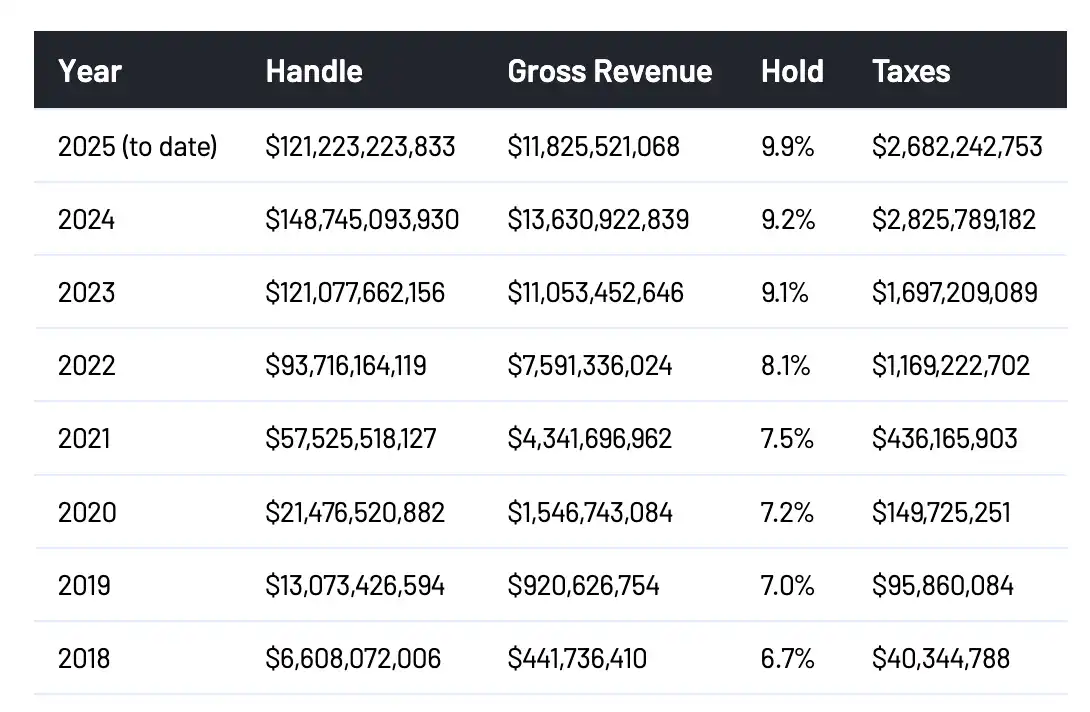
Statistics from another major sports betting media, Sports Book Review (chart below, data as of August 2025), show that since the regulatory relaxation in 2018, the total betting handle (Handle) and tax revenue (Taxes) of the US sports betting market have shown astonishing growth over the past few years — the total market betting handle reached $148.74 billion in 2024, with tax contributions reaching $2.82 billion; in the first 8 months of 2025 alone, the total betting handle ($121.22 billion) and tax revenue ($2.68 billion) have nearly matched the full-year 2024 figures.
Focus on Tennessee: What Does Sports Betting Mean?

Now, let's focus on the protagonist of this incident, Tennessee.

In 2019, Tennessee passed the Tennessee Sports Gaming Act, formally legalizing sports betting. Although the then-Governor Bill Lee had reservations about gambling, he still allowed the bill to pass without exercising his veto power. Between 2021 and 2022, the Tennessee legislature passed laws establishing a dedicated regulatory council to be fully responsible for licensing and oversight. This council was initially called the Sports Wagering Advisory Council and later renamed the Tennessee Sports Wagering Council, the SWC that issued the cease-and-desist orders to Kalshi, Polymarket, and Crypto.com at the beginning of this article.
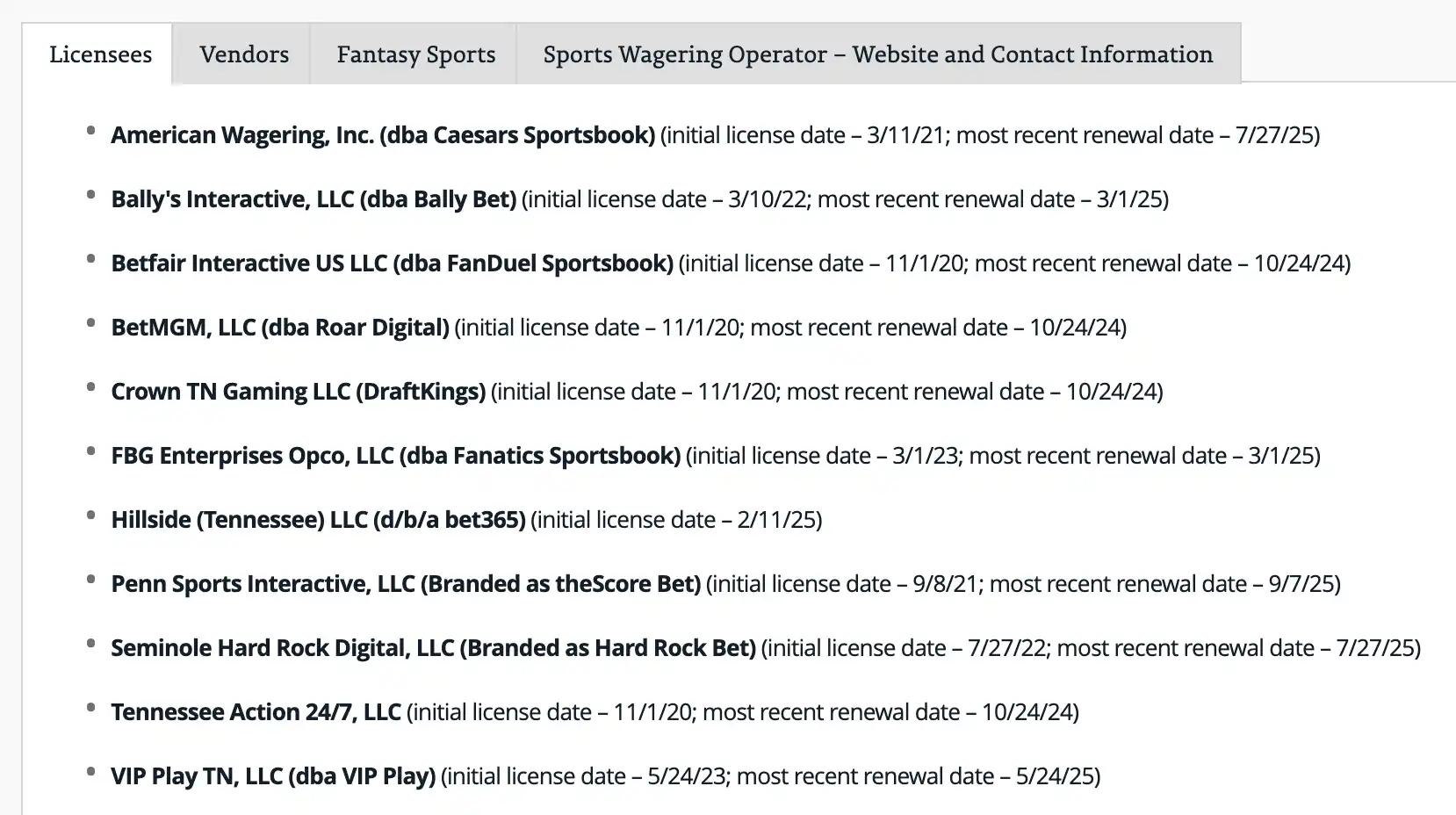
Currently, the SWC is Tennessee's sole sports betting regulatory body, responsible for operational licensing, compliance supervision, rule-making, and enforcement. The SWC stipulates that all sports betting providers must obtain a license from the SWC to offer services in the state. A total of 11 licenses have been issued so far (see chart above); only residents aged 21 and over can access related services, and they must pass geolocation verification to ensure bets are placed within the state; regarding taxation, the state levies a 1.85% tax on the total handle — an earlier scheme based on revenue was replaced in 2023 by taxation based on the total handle.

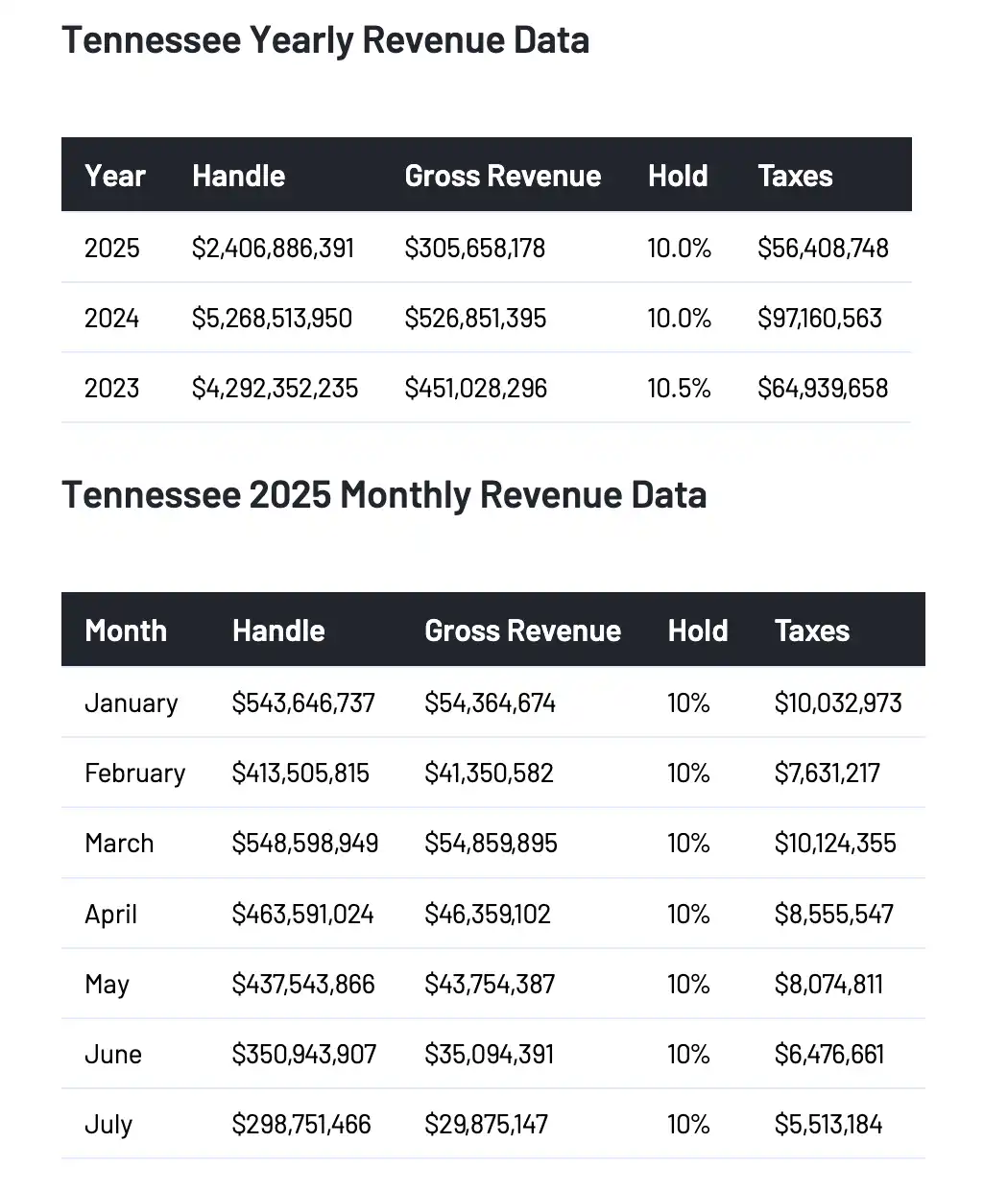
The sports betting market has contributed significant tax revenue to Tennessee. Statistics from Sports Book Review (chart below, data as of July 2025) show that in 2024, the total sports betting handle in Tennessee reached $5.268 billion, with tax contributions amounting to $97.16 million; in the first 7 months of 2025, the total handle has reached $2.4 billion, with tax contributions already reaching $56.4 million.
But this huge and still growing cake is now being gradually eroded by the likes of Polymarket.

How Are Prediction Markets Eroding the Old World?

On December 3, 2025, Polymarket announced that it had obtained CFTC approval to return to the US market after nearly four years; even earlier, Kalshi and Crypto.com's prediction market platform Truth Predict had already opened their doors to US users under CFTC approval.

The current regulatory situation is that sports betting is clearly classified as a gambling service, with regulatory authority belonging to the states, but prediction market platforms like Polymarket are generally regarded as new entities providing "event contract" trading services, and "event contracts" are considered financial derivatives in terms of asset nature, falling under the regulatory purview of the CFTC. This allows prediction markets to bypass the stringent regulations of gambling services — no need for state-level licenses, no need to follow addiction control and other user protection regulations, no need to pay high gambling taxes to the states; but at the same time, they can offer sports event outcome betting services similar to gambling,客观上 forming a certain "regulatory arbitrage."

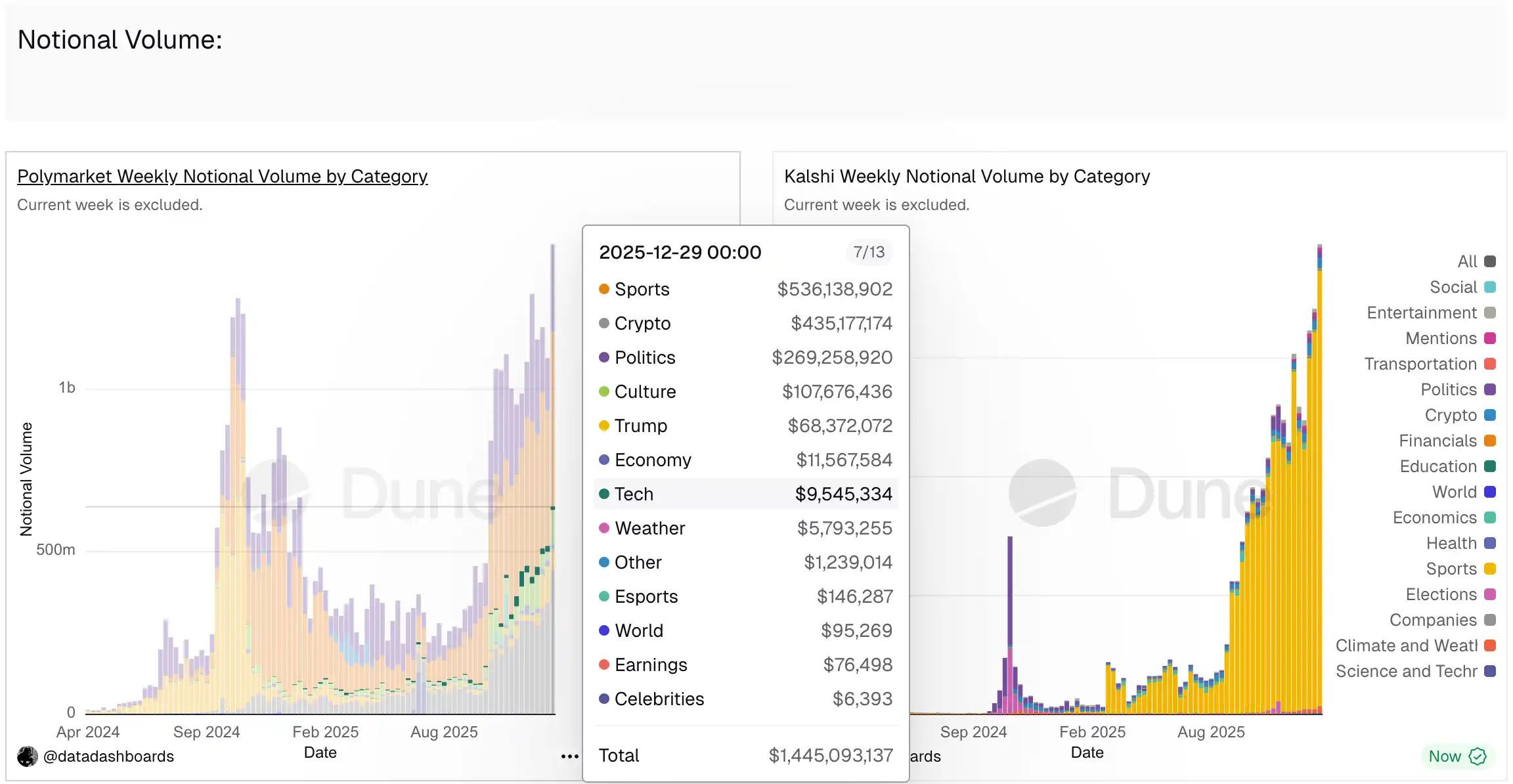
If prediction markets were still just small experimental fields, it might be fine, but the fact is that the growth rate of prediction markets is even more outrageous than that of the already夸张 sports betting market — in 2025, the total trading volume of prediction markets was approximately $40 billion, an increase of about 400% from $9 billion in 2024. Data Dashboards compiled on Dune (chart below) show that sports-related event contracts have long become the category with the highest trading volume share in prediction markets.
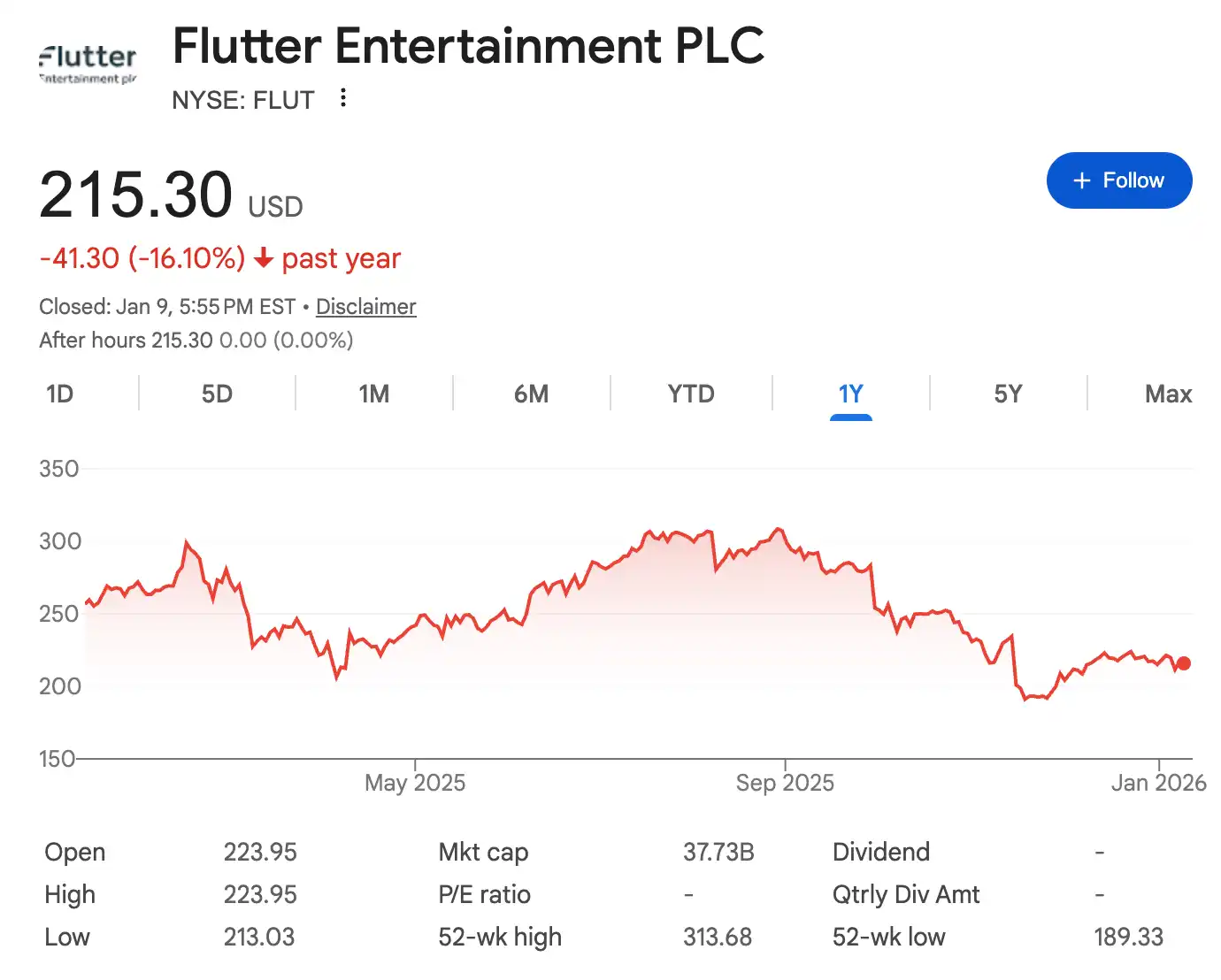
The capital market has long sensed the growing threat of Polymarket to traditional sports betting services. Two giants of the sports betting market, DraftKings and Flutter Entertainment, recorded declines of 11.7% and 16.1% respectively over the past year — during the same period, the US stock market was in a bull market, with the Dow Jones rising 12.97% for the year, the Nasdaq up 20.36%, and the S&P 500 up 16.39%; and the size of the sports betting market continued its eight-year upward trend.
Whether it is Tennessee, which needs sports betting as a source of tax revenue, or the capital forces that actually control the sports betting market, it is difficult for them to agree to let prediction markets, this new player, come and share the pie.

Friction Is Not an Isolated Case; How Do Prediction Markets Fight Back?

In fact, Tennessee's ban on prediction markets is not an isolated incident. Maryland, Ohio, Illinois, New Jersey, Nevada, Montana, Michigan, and Connecticut have all cracked down on prediction markets for similar reasons. Since Polymarket only returned to the US market in December last year, Kalshi has borne the brunt of more regulatory impacts.

In response, Kalshi has filed lawsuits against three states — Nevada, New Jersey, and Maryland — on the grounds that it "has complied with higher-priority federal regulations and does not need to comply with state-level regulations." However, the results have not been ideal.

  • The lawsuit in Nevada was the first to proceed. The district court initially supported Kalshi, but then turned around and ruled against Kalshi last November. Judge Andrew Gordon determined that sports-related event contracts on Kalshi were very similar to sports betting wagers and therefore fell under the regulatory scope of Nevada's gambling laws. Kalshi has appealed to the U.S. Court of Appeals for the Ninth Circuit;
  • In New Jersey, the district court sided with Kalshi, but the state's gaming regulatory agency has appealed to the U.S. Court of Appeals for the Third Circuit;
  • In Maryland, the district court sided with the gaming regulatory agency. Judge Judge Adam B believed that Kalshi failed to prove that "Congress has clearly and manifestly intended to deprive states of the power to regulate gambling." Kalshi has appealed this to the U.S. Court of Appeals for the Fourth Circuit.

The law firm Benesch commented on this, stating that as the national debate continues, similar divisions are expected at the appellate court level, which will lay the groundwork for the Supreme Court to resolve this issue in the coming years... If the appellate courts happen to consistently support Kalshi's position, other prediction markets might emulate its model and proceed with similar businesses before the Supreme Court hears the case; but if the appellate courts reach different conclusions, companies in similar situations may wait for clearer legal signals before taking action. In any case, Kalshi's lawsuit will create a precedent with direct and profound implications for the national sports betting and gambling industry.

In summary, whether prediction markets need to follow state gambling regulations remains an unresolved issue for now. The fundamental contradiction of this issue lies in the similarity of the products and services offered by prediction markets and sports betting, and the differences in regulatory requirements.

This is a tug-of-war over institutional adaptation. Before the appellate courts or even the Supreme Court give a final ruling, the gray area between prediction markets and sports betting will persist for a long time, and regulatory conflicts will be hard to avoid. In the short term, states will likely continue to defend their regulatory authority and tax base through enforcement and litigation; while prediction market platforms will try to use federal compliance and innovation narratives as a shield to fight for more living room.

Recommended Reading:

《Why Prediction Markets Are Truly Not Gambling Platforms》

Domande pertinenti

QWhy did the Tennessee Sports Wagering Council (SWC) issue a cease-and-desist order to prediction market platforms like Kalshi, Polymarket, and Crypto.com?

AThe SWC issued the order because these platforms were offering sports event prediction contracts to Tennessee residents without obtaining a state-required license, which the SWC considers illegal gambling operations under state law.

QWhat is the key regulatory difference that allows prediction markets to operate under federal oversight while traditional sports betting is state-regulated?

APrediction markets are classified as offering 'event contracts,' which are considered financial derivatives and fall under the regulatory jurisdiction of the CFTC (Commodity Futures Trading Commission). In contrast, sports betting is explicitly defined as a gambling service and is regulated at the state level.

QHow significant is the sports betting market in the United States in terms of handle and tax revenue?

AIn 2024, the US sports betting market's total handle was $148.74 billion, contributing $2.82 billion in taxes. For the first eight months of 2025, the handle reached $121.22 billion, with tax contributions of $2.68 billion, nearly matching the full-year 2024 figures.

QWhat legal argument has Kalshi used to challenge state-level bans on its operations, and what has been the outcome so far?

AKalshi has argued that it 'complies with higher-priority federal regulations and does not need to comply with state-level regulations.' The outcomes have been mixed: it lost its case in Nevada and Maryland (with appeals filed) but won at the district court level in New Jersey (which the state has appealed).

QWhat is the fundamental conflict between prediction markets and the established sports betting industry according to the article?

AThe fundamental conflict stems from the similarity in the services offered (betting on sports event outcomes) but the vast difference in regulatory requirements. Prediction markets operate under federal CFTC oversight with lighter restrictions, while sports betting is heavily taxed and regulated, creating a 'regulatory arbitrage' that threatens the tax base and business models of the traditional industry.

Letture associate

Bitcoin Monthly Chart Adjustment Structure Established, HYPE Entry Opportunity Emerges | Exclusive Analysis

Bitcoin Monthly Correction Structure Confirmed, HYPE Entry Opportunity Emerges | Guest Analysis Last week's analysis correctly identified that the $60,000 level for Bitcoin was an intermediate point, not the bottom of the current correction. This was validated on June 5th when the price broke below this key support, dropping to around $59,100. The monthly-level a-b-c three-wave corrective structure from the October 2025 high of $126,200 is now fully established, with the market currently in the c-wave decline phase. The cumulative adjustment time is less than 35 days, indicating the structure is far from complete. This week's focus will be tracking the rebound's strength and resistance performance. The two key resistance zones of $65,000 and $69,500~$70,500 will be crucial observation points for determining the subsequent trend. For HYPE, last week's top warning signal was also validated, with the price falling up to 27% from its $75.87 high. The token has now entered a support zone, presenting a potential short-term entry opportunity. From a strategic standpoint, the medium-term outlook remains bearish, awaiting optimal timing to add short positions upon a rebound. **Key Trading Views Summary:** * **BTC:** The analysis maintains a bearish medium-term bias. Strategy involves building short positions on rebounds towards $65,000 or the $69,500~$70,500 resistance area. A break below the $59,000-$60,000 support could trigger additional short entries. Short-term trading (30% capital) focuses on range-bound opportunities. * **HYPE:** Following a confirmed correction from the $75.87 high, the short-term strategy shifts to "buying on dips." Consider light long positions (under 30%仓位) if the price finds support and shows stabilization signals in the $55-$57 or deeper $47-$49 support zones, contingent on confirming technical signals. The key resistance to watch is the $62.5-$64.57 area. **Risk Management Reminder:** Always set an initial stop-loss immediately upon opening a position. Move the stop-loss to breakeven upon achieving 1% profit, and subsequently trail it to lock in gains. Market conditions change rapidly; this analysis is for informational purposes only and not investment advice.

marsbit16 min fa

Bitcoin Monthly Chart Adjustment Structure Established, HYPE Entry Opportunity Emerges | Exclusive Analysis

marsbit16 min fa

Valuation Surpasses 200 Billion, Kimi Reportedly Raises 13.6 Billion More, Speeds Up Hong Kong IPO

Beijing-based AI unicoth MoonDark (Kimi) is reportedly in talks for a new funding round aiming to raise up to $20 billion (approximately RMB 136 billion), targeting a post-money valuation of $300 billion (approximately RMB 2.035 trillion). If successful, this would mark its third round in six months and a six-fold increase from its $43 billion valuation in December last year. Last month, the company completed a $20 billion funding round led by Meituan Longzhu, reaching a valuation exceeding $200 billion. According to reports, MoonDark has raised over RMB 376 billion across six rounds, making it the most funded large language model startup in China. Founded in 2023 by CEO Yang Zhilin, the company's core product is the Kimi AI Assistant. In April, it launched and open-sourced its flagship model, Kimi K2.6, which has demonstrated performance comparable to top models like GPT-5.4 in certain benchmarks. Recently, it began beta testing for Kimi Work, a local AI agent for knowledge workers. Commercially, the company's Annual Recurring Revenue (ARR) reportedly surpassed $2 billion in April. Regarding its IPO plans, Bloomberg reported in March that MoonDark is preparing for a listing in Hong Kong, though the process remains in early stages. The funding and IPO pace for leading Chinese AI firms has accelerated notably in 2026, mirroring global trends where companies like OpenAI and Anthropic are also setting new fundraising and valuation records. Securing substantial capital is becoming a critical factor in the competitive landscape alongside model capabilities.

marsbit19 min fa

Valuation Surpasses 200 Billion, Kimi Reportedly Raises 13.6 Billion More, Speeds Up Hong Kong IPO

marsbit19 min fa

South Korea's KOSPI Plunges 8.37% at Opening, Triggers Circuit Breaker: The 'Two Stocks' That Powered the Bull Market Recoil in a Single Day

On June 8th, South Korea's KOSPI index plunged 8.37% within minutes of market open, triggering a circuit breaker and halting trading. The crash was driven by a massive sell-off in heavyweight stocks Samsung Electronics and SK Hynix, which each fell 10%. These two chip giants alone account for over half of the KOSPI's total market capitalization and had contributed roughly 70% of the index's gains year-to-date, pushing it to become the world's sixth-largest stock market. The sell-off was ignited by negative guidance from U.S. chipmaker Broadcom on June 3rd, which sparked a global semiconductor stock rout. This shockwave hit South Korean markets on June 5th, with foreign investors leading a sustained exodus. The sharp decline on June 8th was exacerbated by high levels of retail margin debt (over 38 trillion KRW), forced liquidations, leveraged ETFs tied to the top stocks, and automated program trading, creating a vicious cycle. The Korean won also weakened significantly, further fueling foreign capital outflow. South Korean authorities issued emergency statements to calm markets, echoing recent warnings from the central bank governor about the risks of debt-driven investing. While some institutions like Goldman Sachs maintain long-term bullish targets for the KOSPI, the crash exposed the extreme market concentration and fragility behind its historic rally.

marsbit21 min fa

South Korea's KOSPI Plunges 8.37% at Opening, Triggers Circuit Breaker: The 'Two Stocks' That Powered the Bull Market Recoil in a Single Day

marsbit21 min fa

The Compounding Crisis in an Era of High Valuations: Is the US Stock Market Facing a New 'Lost Decade'?

This article analyzes the long-term structural risks in US equity markets, challenging the assumption that "time in the market" always ensures positive returns. Drawing on 155 years of historical data, it identifies three prolonged periods—1929-1954, 1966-1982, and 2000-2013—where real buy-and-hold returns were near zero or negative. Collectively, these "lost decades" represent roughly 35% of market history since 1871 and cause not just delayed wealth accumulation but permanent damage to compound growth paths due to the mathematics of recovering from significant drawdowns. Crucially, the authors argue that current conditions mirror historical precursors to such phases. Multiple valuation indicators, including the CAPE ratio (near its 99th percentile), the Buffett Indicator, and Tobin's Q, signal extreme overvaluation, historically associated with lower future 10-year real returns (averaging 3.6%). The paper debunks the common objection to tactical management—fear of missing the "best days" in the market—by showing that the vast majority of these top-performing days occur during bear markets and crises, often adjacent to the worst days. Therefore, avoiding major drawdowns inherently means missing these volatile surges. A key framework proposed involves monitoring market breadth (advance/decline data), which tends to deteriorate before major indices peak, providing an early warning signal. Combined with high valuations, breadth analysis offers a more robust risk-assessment tool. The conclusion for investors and advisors is not a forecast of an inevitable downturn, but a call to move from complacency to preparedness. The empirical evidence suggests that the conditions preceding lost decades are identifiable. A disciplined, adaptive strategy focused on valuation and breadth signals, rather than precise timing, can help protect long-term compounding from permanent impairment.

marsbit39 min fa

The Compounding Crisis in an Era of High Valuations: Is the US Stock Market Facing a New 'Lost Decade'?

marsbit39 min fa

Trading

Spot
Futures

Articoli Popolari

Come comprare ORDER

Benvenuto in HTX.com! Abbiamo reso l'acquisto di Orderly (ORDER) semplice e conveniente. Segui la nostra guida passo passo per intraprendere il tuo viaggio nel mondo delle criptovalute.Step 1: Crea il tuo Account HTXUsa la tua email o numero di telefono per registrarti il tuo account gratuito su HTX. Vivi un'esperienza facile e sblocca tutte le funzionalità,Crea il mio accountStep 2: Vai in Acquista crypto e seleziona il tuo metodo di pagamentoCarta di credito/debito: utilizza la tua Visa o Mastercard per acquistare immediatamente OrderlyORDER.Bilancio: Usa i fondi dal bilancio del tuo account HTX per fare trading senza problemi.Terze parti: abbiamo aggiunto metodi di pagamento molto utilizzati come Google Pay e Apple Pay per maggiore comodità.P2P: Fai trading direttamente con altri utenti HTX.Over-the-Counter (OTC): Offriamo servizi su misura e tassi di cambio competitivi per i trader.Step 3: Conserva Orderly (ORDER)Dopo aver acquistato Orderly (ORDER), conserva nel tuo account HTX. In alternativa, puoi inviare tramite trasferimento blockchain o scambiare per altre criptovalute.Step 4: Scambia Orderly (ORDER)Scambia facilmente Orderly (ORDER) nel mercato spot di HTX. Accedi al tuo account, seleziona la tua coppia di trading, esegui le tue operazioni e monitora in tempo reale. Offriamo un'esperienza user-friendly sia per chi ha appena iniziato che per i trader più esperti.

232 Totale visualizzazioniPubblicato il 2024.12.10Aggiornato il 2026.06.02

Come comprare ORDER

Discussioni

Benvenuto nella Community HTX. Qui puoi rimanere informato sugli ultimi sviluppi della piattaforma e accedere ad approfondimenti esperti sul mercato. Le opinioni degli utenti sul prezzo di ORDER ORDER sono presentate come di seguito.

活动图片