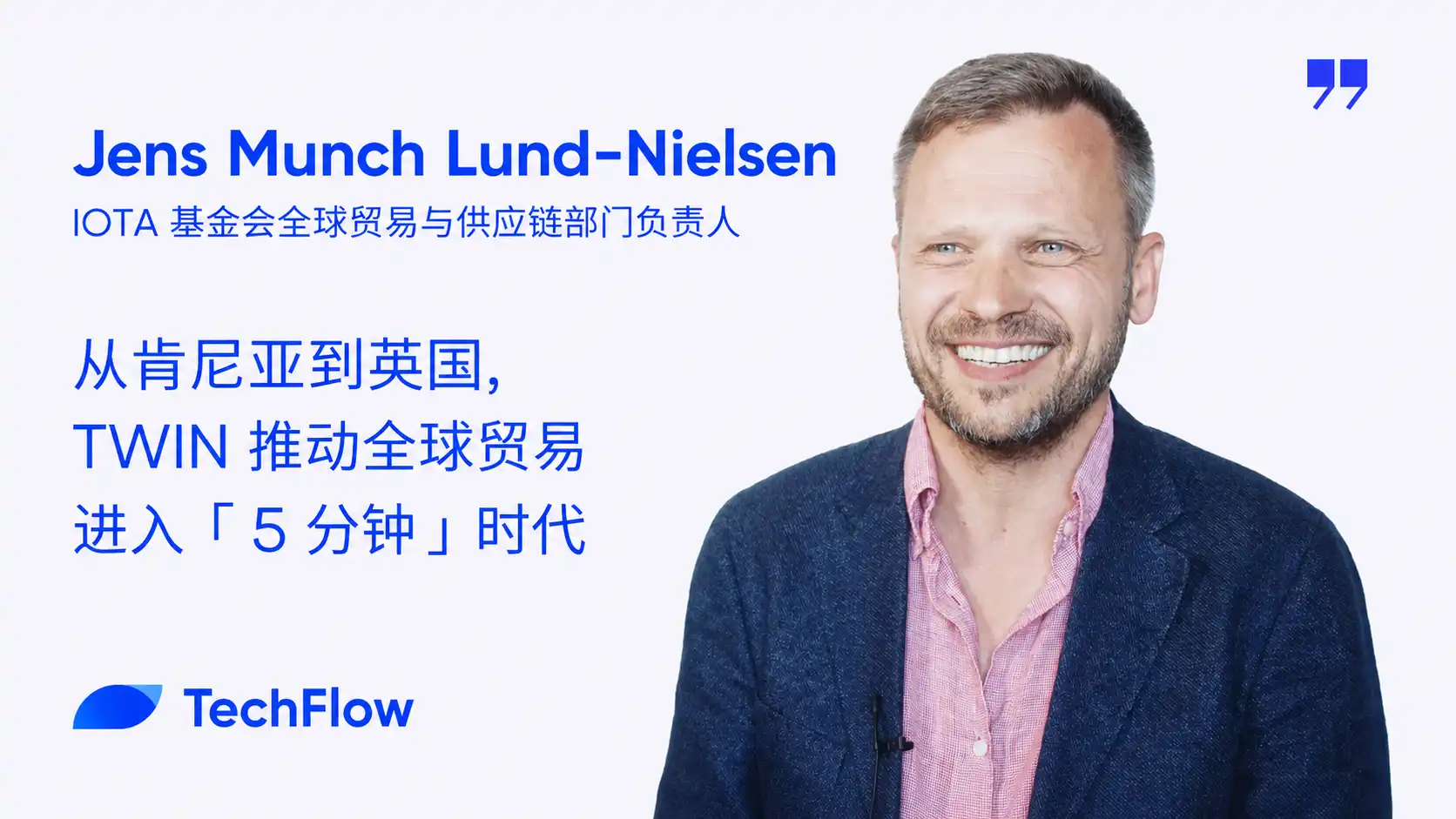
Dialogue with IOTA Foundation's Jens: From Kenya to the UK, TWIN Propels Global Trade into the '5-Minute' Era

marsbitPubblicato 2026-06-30Pubblicato ultima volta 2026-06-30

Introduzione

**Summary: IOTA's TWIN Project is Speeding Up Global Trade** Jens Munch Lund-Nielsen, Head of Global Trade & Supply Chain at the IOTA Foundation, discusses how the TWIN (Trade and Logistics Information Network) project is addressing long-standing inefficiencies in global trade. Traditionally, cross-border trade involves numerous parties, extensive paperwork, and delays spanning weeks. TWIN, built on IOTA's decentralized, scalable, and low-cost infrastructure, aims to replace this fragmented, paper-based system with a real-time, trusted, and interconnected digital collaboration layer. As a neutral digital public infrastructure, TWIN allows governments, businesses, and ports to exchange verifiable data and documents without ceding control to a single entity. This solves a core coordination problem that previous, proprietary platforms failed to address due to a lack of trust and neutrality. Key real-world implementations include: * **TLIP in East Africa:** Reduced document retrieval times for flower, coffee, and tea exports from 6-7 hours to ~30 minutes, cutting administrative work by 50-60%. * **UK Ecosystem of Trust Trials:** Provided border agencies with much earlier visibility (up to 20+ hours) of incoming chilled poultry shipments from Poland, enabling better resource planning. * Other pilots focus on supply chain traceability for fruits/vegetables, port efficiency, and critical mineral sourcing. TWIN ensures interoperability across jurisdictions by adopting globa...

Author: Deep Tide TechFlow

As early as 2015, institutions including the World Economic Forum (WEF) and Barclays predicted:

Blockchain holds immense transformative potential within the high-friction global trade system.

Previously, a cross-border trade transaction typically involved 30 stakeholders, 36 documents, and 240 paper copies circulating over weeks; now, flowers exported from Kenya to Europe can have their trade documents obtained in less than 5 minutes.

This is the efficiency being progressively achieved by the blockchain protocol project IOTA through TWIN, a global trade digital collaboration infrastructure.

Since its launch in May 2025, TWIN has made breakthrough progress across three continents: in Africa, processing over 184,000 invoices through TLIP; piloting within UK border infrastructure; and currently negotiating pilot projects with government and enterprise in Asia.

On the occasion of TWIN's first anniversary, we had an in-depth conversation with Jens Munch Lund-Nielsen, Head of Global Trade & Supply Chain at the IOTA Foundation.

Before joining the IOTA Foundation, Jens worked in the strategy office of Maersk, one of the world's largest shipping companies, focusing on digital trade and public-private partnerships. There, he witnessed firsthand how the global trade system truly operates: vast but inefficient, high-friction and fragmented, with no single party able to truly coordinate everyone.

This experience gave Jens a clearer realization: global trade needs an open, neutral, decentralized infrastructure that supports multiple participants—governments, enterprises, ports—to exchange trusted data in real-time within the same system. This also became the core reason Jens chose to join the IOTA Foundation:

To drive TWIN's development, to move global trade from paper-based, siloed processes towards truly real-time, trusted, and interconnected digital collaboration workflows.

In this content, let's follow Jens's insights to see what, in the eyes of this seasoned trade professional, the real answer has been for the over-decade-long stagnation of global trade digitalization.
From Paper to Chain: Building a Global Trade Digital Collaboration Infrastructure

Deep Tide TechFlow: Before delving into TWIN, could you first briefly introduce yourself, including your background in global trade, and what was the opportunity that led you to join the TWIN project?

Jens:

Hello everyone, I am Jens Munch Lund-Nielsen, currently serving as Head of Global Trade & Supply Chain at the IOTA Foundation.

My background is primarily focused on technology, trade facilitation, and digital trade, with a particular emphasis on building digital products and supporting their global rollout and implementation.

Before joining IOTA, I served as Head of Digital Trade within Maersk's strategy office, focusing on integrating trade facilitation, public-private partnerships, and digital solutions into global supply chains.

The opportunity to work on TWIN appealed to me because I saw it as a unique chance to address long-standing structural inefficiencies in global trade through trusted digital systems and interoperable technology.

Deep Tide TechFlow: For those unfamiliar with the project, how would you describe TWIN? What is its core essence?

Jens:

At its essence, TWIN is a neutral digital infrastructure for global trade.

Today's trade system operates on fragmented systems and paper-based processes because no single party can coordinate all participants.

TWIN changes this: it provides a common foundational layer where businesses, governments, and various organizations can exchange data, documents, and assets in real-time and securely.

TWIN is an open, interoperable network that connects existing systems, reinforces trust through verifiable data, and enables cross-jurisdictional compliance without relying on a centralized owner.

Built on IOTA, TWIN combines distributed ledger technology with decentralized identity systems, ensuring each participant always retains control over their own data while enabling global collaboration.

Simply put:

TWIN is the infrastructure that moves global trade from paper-based, siloed operations towards real-time, trusted, and interconnected digital collaboration workflows.

Deep Tide TechFlow: What specific problem in global trade is TWIN dedicated to solving? Why has this problem remained unsolved for so long?

Jens:

Fundamentally, TWIN addresses a core coordination problem in global trade: the lack of a common, trusted infrastructure that all participants can use to seamlessly exchange data.

Today, trade still heavily relies on paper documents and fragmented systems. Information is repeatedly entered, delayed, and often inconsistent as it moves between exporters, importers, banks, ports, and customs authorities. This creates inefficiencies, increases risks, and limits supply chain transparency.

This problem has persisted, not due to a lack of technology, but due to a lack of 'neutrality'.

Most previous attempts at trade digitalization have essentially involved building permissioned platforms, often driven by specific companies, regions, or interest groups. While these solutions may be technically viable, they face a structural issue:

Other participants are often reluctant to adopt infrastructure perceived as 'controlled by others.' Without widespread trust and adoption, these systems fail to achieve the network effect scale required for global trade.

TWIN takes a different path. It offers an open, neutral, decentralized infrastructure where no single party owns or controls the entire system. This allows all participants to share data while retaining their sovereignty and meeting their respective regulatory requirements.

Scalable, Low-Cost, Decentralized: IOTA Underpins the TWIN Architecture

Deep Tide TechFlow: Why was IOTA chosen as the underlying infrastructure for TWIN?

Jens:

IOTA was chosen as the underlying infrastructure for TWIN because it meets the core requirements of a global trade system: scalability, cost-efficiency, and neutrality.

Built on a DAG architecture, IOTA offers high scalability, capable of processing a massive volume of transactions and data exchanges in parallel, which is crucial for global trade where millions of events, documents, and updates occur continuously across supply chains.

It also provides extremely low transaction costs, which is vital in trade scenarios due to the high-frequency interactions involved. If every document update, verification, or data exchange incurred a significant fee, costs would quickly become prohibitive at scale.

Beyond the technology itself, IOTA brings over a decade of experience building real-world infrastructure and a solid track record of delivery through collaboration with governments, enterprises, and standardization bodies.

Furthermore, and importantly, IOTA is designed as an open, neutral infrastructure, not controlled by a single corporate entity. This aligns perfectly with the fundamental needs of global trade, where trust and sovereignty are key prerequisites for adoption by diverse stakeholders.

Deep Tide TechFlow: How should we understand the relationship between TWIN and IOTA? Is TWIN an application layer, an ecosystem, or something more macro?

Jens:

The most appropriate way to understand TWIN is as a digital public infrastructure for global trade—a shared data and coordination layer connecting governments, businesses, and existing platforms.

Simply put, TWIN enables parties to exchange verified, immutable data across borders in real-time without relinquishing control.

IOTA sits underneath as the underlying infrastructure layer. It provides the decentralized trust layer, ensuring data integrity, auditability, and interoperability at scale.

From African Flowers to European Poultry: TWIN's Real-World Trade Scenario Implementations

Deep Tide TechFlow: What are the most concrete, real-world application scenarios currently being explored or implemented through TWIN?

Jens:

TWIN is already deployed in multiple real-world trade scenarios, effectively demonstrating how shared digital infrastructure reduces friction, increases transparency, and enhances efficiency in global supply chains.

The Trade and Logistics Information Pipeline (TLIP) project connects East African exporters, logistics service providers, and government agencies to a shared data pipeline. In pilot projects covering flower, coffee, and tea exports, document retrieval time for inspection purposes reduced from 6-7 hours to about 30 minutes, administrative workload decreased by 50%-60%, and exporters saved approximately $400 monthly on document processing costs.

TWIN was also tested in the UK government's 'Ecosystem of Trust Trials', involving around 2000 consignments of chilled poultry meat shipped from Poland to the UK. Border agencies gained earlier visibility of arriving goods (port health officials received data up to 20+ hours earlier than standard processes), enabling more effective resource allocation.

The UK's 'Digital Trade Testbed' will also trial TWIN to support the exchange of digital international trade information between UK ports and key border agencies.

Other implementation scenarios include:

The RESULD (Responsible Supply Chain and Logistics Due Diligence) project integrates TWIN for tracing fruit and vegetable supply chains between Kenya, the Netherlands, and the UK;

The MISSION (Maritime Instantaneous Optimisation) project is trialing TWIN to improve port operational efficiency;

Salus leverages TWIN to bring traceability to critical mineral supply chains, turning shipping and trade documents into verifiable digital assets for financial institutions to use in risk assessment and issuing trade finance;

Furthermore, the ADAPT project, led by the African Continental Free Trade Area Secretariat in collaboration with the IOTA Foundation, the Tony Blair Institute for Global Change, and the World Economic Forum, is advancing the development of a digital trade backbone for Africa, drawing on IOTA's architecture and TWIN's experience.

Deep Tide TechFlow: What are the typical reactions from governments and enterprises when they first encounter TWIN? Which areas currently show the highest acceptance?

Jens:

Upon encountering TWIN, governments and enterprises generally recognize its significant value.

On the government side, departments most directly involved in trade, such as Trade Ministries and Customs authorities under Finance Ministries, clearly perceive TWIN's immense potential to improve internal clearance processes, strengthen border control, and obtain better access to trusted data to prevent unauthorized or non-compliant goods from entering.

Within the private sector, the highest participation currently comes from transport service providers and freight forwarders, as they already handle a large volume of border and documentation processes on behalf of producers and growers. The broader industry also shows a similar level of anticipation and interest in the value TWIN can create.

At the same time, a crucial point to emphasize is: TWIN's true value derives from the network itself. The more participants connected to TWIN, the greater the value created by the entire system for all involved.

Deep Tide TechFlow: Trade is highly fragmented across different jurisdictions. How does TWIN handle interoperability between different systems, standards, and regulatory environments?

Jens:

International interoperability is one of TWIN's most critical value drivers, operating on multiple levels, a significant part of which involves ensuring systems 'speak the same language'.

To this end, we adopt globally recognized standards, such as data models from the United Nations Centre for Trade Facilitation and Electronic Business (UN/CEFACT) and the World Customs Organization (WCO), further supported and refined through the International Chamber of Commerce's Digital Standards Initiative (ICC DSI).

In terms of identity, interoperability is primarily driven by national identity registries. Through TWIN ID, we can connect a company's national-level digital identity with international standards, such as the Legal Entity Identifier (LEI) issued by the Global Legal Entity Identifier Foundation (GLEIF), which is also a partner in this initiative.

From a technical perspective, we also observe increasing convergence around standards like Decentralized Identifiers (DIDs) and Verifiable Credentials as defined by the World Wide Web Consortium (W3C).

Finally, legal interoperability is equally important. The United Nations Commission on International Trade Law (UNCITRAL) Model Law on Electronic Transferable Records (MLETR) framework is driving the legal recognition of digital trade documents, though its adoption depends on government ratification in each country.

Our experience is that work can begin even in countries that have not yet ratified MLETR; in such cases, we also assist governments in advancing this process, especially given the growing importance of this framework for trade finance scenarios.

Bridging Digital Silos, Filling the $2.5 Trillion Trade Finance Gap

Deep Tide TechFlow: How do you see global trade evolving over the next 5 to 10 years? What role will decentralized infrastructure play in this transformation?

Jens:

The international trade industry is vast and has been undergoing digital transformation over the past 10 to 15 years, with governments and enterprises upgrading their systems around standardized data models and the use of REST APIs. The missing piece today is connecting these 'digital silos' in a way that respects data sovereignty, data integrity, and controlled data sharing.

We are currently advancing projects in over eight countries, working closely with governments, and continue to see strong interest in this area. Therefore, I am optimistic:

In the coming years, a trusted 'connective layer' linking these systems will truly materialize and scale. Its potential impact on global trade, finance, and international trade agreements could be profound, making it an area especially worthy of attention.

Deep Tide TechFlow: If TWIN achieves large-scale success, what do you imagine its 'end state' would look like? Compared to today, how would global trade operate differently?

Jens:

Simply put, as global trade moves towards fully digital collaboration, many outdated processes will be replaced. Key areas like discovering new business partners or accessing financing will look fundamentally different from today.

Currently, there is an estimated $2.5 trillion trade finance gap globally, preventing many businesses from accessing the capital they need to participate efficiently in global trade.

With digital infrastructure solutions like TWIN, trusted data and verifiable digitalized processes could help unlock access to capital at scale, potentially reshaping the entire industry landscape and improving conditions for traders worldwide.

Crypto di tendenza

Domande pertinenti

QWhat is TWIN, and what core problem in global trade does it aim to solve?

ATWIN is a neutral, open digital infrastructure for global trade built on IOTA. Its core essence is to provide a common foundational layer where businesses, governments, and ports can exchange real-time, secure, and verifiable data and assets. It aims to solve the long-standing coordination problem in global trade: the reliance on fragmented systems and paper-based processes. This fragmentation arises because no single party can coordinate all participants. TWIN offers a decentralized solution, allowing seamless data exchange without a centralized controller, bridging the 'digital silos' and moving trade towards real-time, trusted, and interconnected digital collaboration.

QWhy was IOTA chosen as the underlying infrastructure for TWIN?

AIOTA was chosen for TWIN due to its scalability, cost-efficiency, and neutrality, which are critical for global trade. IOTA's Directed Acyclic Graph (DAG) architecture enables high scalability for handling massive volumes of concurrent transactions and data exchanges typical in supply chains. It offers extremely low transaction costs, essential for frequent trade interactions. Furthermore, IOTA's decade of experience in building real-world infrastructure and its status as an open, neutral protocol not controlled by any single entity aligns perfectly with the need for trust and sovereignty among diverse global trade stakeholders.

QCan you provide specific examples of real-world applications where TWIN is currently being deployed or tested?

AYes. TWIN is deployed in several real-world scenarios: 1) The Trade & Logistics Information Pipeline (TLIP) in East Africa connects exporters, logistics providers, and governments. In pilot projects for flowers, coffee, and tea, it reduced document retrieval time from 6-7 hours to ~30 minutes, cut administrative work by 50-60%, and saved exporters about $400 monthly. 2) It was tested in the UK's 'Ecosystem of Trust Trials' for chilled poultry shipments from Poland, giving border agencies visibility up to 20 hours earlier. 3) It's part of the UK's 'Digital Trade Testbed' for exchanging digital trade information between ports and border agencies. Other applications include the RESULD project for fruit/veg traceability, MISSION for port efficiency, Salus for critical mineral supply chain traceability and trade finance, and ADAPT for building a digital trade backbone in Africa.

QHow does TWIN handle interoperability between different jurisdictions, systems, and regulatory environments?

ATWIN ensures international interoperability on multiple levels. It adopts globally recognized data standards from bodies like UN/CEFACT and the World Customs Organization (WCO). For identity, it leverages national digital identity registries and aligns them with international standards like the Legal Entity Identifier (LEI) through its TWIN ID system. Technically, it converges around standards like W3C's Decentralized Identifiers (DIDs) and Verifiable Credentials. Legally, it supports frameworks like the UNCITRAL Model Law on Electronic Transferable Records (MLETR) to give digital trade documents legal recognition, while also assisting governments in adopting such laws where they are not yet in place.

QWhat potential impact could a successful, large-scale adoption of TWIN have on the future of global trade, particularly regarding trade finance?

ASuccessful large-scale adoption of TWIN could fundamentally transform global trade into a fully digitized, collaborative process. A key impact would be in addressing the global trade finance gap, estimated at $2.5 trillion. By providing trusted, verifiable data and digital processes, TWIN could unlock access to capital for businesses currently excluded. This would enable more efficient participation in global trade, reshape industry dynamics, and improve conditions for traders worldwide. Ultimately, the 'end state' would see outdated processes replaced, facilitating easier discovery of new business partners and revolutionizing access to financing.

Letture associate

The Strategy That Would Never Sell Bitcoin Opened a Permanent Sales Channel

MicroStrategy, a company long known for its "never sell Bitcoin" mantra, announced a "Digital Credit Capital Framework" allowing it to sell up to $1.25 billion worth of Bitcoin. Surprisingly, its stock (MSTR) rose nearly 7% pre-market. This shift, coming just a month after a small, "ad-hoc" sale of 32 BTC for dividends, transitions from a temporary action to a formal, institutional tool. The framework outlines four clear purposes for potential sales: bolstering USD reserves, paying preferred stock dividends/interest, and repurchasing its own preferred and common stock. The key driver for this change is the immense financial pressure from MicroStrategy's complex capital structure, specifically its massive $8.5 billion perpetual preferred stock (STRC). STRC features a variable interest rate that has been reset upward eight times in a year to 12% in an attempt to stabilize its price. However, the stock has fallen over 25% below its face value. Combined with other preferred stocks and convertible notes, MicroStrategy's total annual fixed obligations now stand at $1.76 billion, equating to a daily burn of roughly $4.8 million. While its $2.55 billion in USD reserves and the new $1.25 billion BTC sales framework provide a two-year+ runway, a dangerous feedback loop exists. Falling Bitcoin prices would force the sale of more BTC to meet fixed obligations, potentially creating further sell-side pressure and lowering MSTR's asset valuation multiple. This, in turn, limits its ability to raise cash through stock issuance. The market's positive reaction likely stems from relief; the framework replaces fears of a forced, disorderly sell-off with a structured plan. However, it does not resolve the underlying high-cost capital structure, leaving the company's long-term health heavily dependent on Bitcoin's price performance.

marsbit15 min fa

The Strategy That Would Never Sell Bitcoin Opened a Permanent Sales Channel

marsbit15 min fa

OpenClaw and Cursor Just Invaded Phones! Agents Are Now in Your Pocket

AI Agents have officially arrived on mobile. In a landmark move, both OpenClaw and Cursor launched native mobile apps on the same day, fundamentally shifting how AI assistants are accessed and controlled. OpenClaw has released full-featured native apps for iOS and Android. Its "local-first" architecture, developed by the OpenClaw Foundation, keeps user data private by running the agent on a user's private Gateway. The mobile app now allows seamless remote control and approval of the agent's actions directly from a smartphone, with access to device capabilities like the camera, GPS, and contacts. Simultaneously, Cursor, the AI-powered coding tool, launched a public beta of its native iOS app. It enables developers to start and manage cloud-based AI coding agents from their phones. These agents can work asynchronously for extended periods—debugging, writing code, and creating pull requests—while developers are away from their computers. The app sends notifications for key decisions, allowing users to review and merge PRs from anywhere. Together, these releases signal a major shift: AI agents are no longer confined to desktop browsers or terminals. They are becoming persistent, autonomous assistants that work independently in the cloud, with humans transitioning from constant operators to mobile supervisors who approve key steps. The era of pocket-sized, on-demand AI is now here.

marsbit27 min fa

OpenClaw and Cursor Just Invaded Phones! Agents Are Now in Your Pocket

marsbit27 min fa

Trading

Spot

Articoli Popolari

Cosa è $S$

Comprendere SPERO: Una Panoramica Completa Introduzione a SPERO Mentre il panorama dell'innovazione continua a evolversi, l'emergere delle tecnologie web3 e dei progetti di criptovaluta gioca un ruolo fondamentale nel plasmare il futuro digitale. Un progetto che ha attirato l'attenzione in questo campo dinamico è SPERO, denotato come SPERO,$$s$. Questo articolo mira a raccogliere e presentare informazioni dettagliate su SPERO, per aiutare gli appassionati e gli investitori a comprendere le sue basi, obiettivi e innovazioni nei domini web3 e crypto. Che cos'è SPERO,$$s$? SPERO,$$s$ è un progetto unico all'interno dello spazio crypto che cerca di sfruttare i principi della decentralizzazione e della tecnologia blockchain per creare un ecosistema che promuove l'impegno, l'utilità e l'inclusione finanziaria. Il progetto è progettato per facilitare interazioni peer-to-peer in modi nuovi, fornendo agli utenti soluzioni e servizi finanziari innovativi. Al suo interno, SPERO,$$s$ mira a responsabilizzare gli individui fornendo strumenti e piattaforme che migliorano l'esperienza dell'utente nello spazio delle criptovalute. Questo include la possibilità di metodi di transazione più flessibili, la promozione di iniziative guidate dalla comunità e la creazione di percorsi per opportunità finanziarie attraverso applicazioni decentralizzate (dApps). La visione sottostante di SPERO,$$s$ ruota attorno all'inclusività, cercando di colmare le lacune all'interno della finanza tradizionale mentre sfrutta i vantaggi della tecnologia blockchain. Chi è il Creatore di SPERO,$$s$? L'identità del creatore di SPERO,$$s$ rimane piuttosto oscura, poiché ci sono risorse pubblicamente disponibili limitate che forniscono informazioni dettagliate sul suo fondatore o fondatori. Questa mancanza di trasparenza può derivare dall'impegno del progetto per la decentralizzazione—un ethos che molti progetti web3 condividono, dando priorità ai contributi collettivi rispetto al riconoscimento individuale. Centrando le discussioni attorno alla comunità e ai suoi obiettivi collettivi, SPERO,$$s$ incarna l'essenza dell'empowerment senza mettere in evidenza individui specifici. Pertanto, comprendere l'etica e la missione di SPERO rimane più importante che identificare un creatore singolo. Chi sono gli Investitori di SPERO,$$s$? SPERO,$$s$ è supportato da una varietà di investitori che vanno dai capitalisti di rischio agli investitori angelici dedicati a promuovere l'innovazione nel settore crypto. Il focus di questi investitori generalmente si allinea con la missione di SPERO—dando priorità a progetti che promettono avanzamenti tecnologici sociali, inclusività finanziaria e governance decentralizzata. Queste fondazioni di investitori sono tipicamente interessate a progetti che non solo offrono prodotti innovativi, ma contribuiscono anche positivamente alla comunità blockchain e ai suoi ecosistemi. Il supporto di questi investitori rafforza SPERO,$$s$ come un concorrente degno di nota nel dominio in rapida evoluzione dei progetti crypto. Come Funziona SPERO,$$s$? SPERO,$$s$ impiega un framework multifunzionale che lo distingue dai progetti di criptovaluta convenzionali. Ecco alcune delle caratteristiche chiave che sottolineano la sua unicità e innovazione: Governance Decentralizzata: SPERO,$$s$ integra modelli di governance decentralizzati, responsabilizzando gli utenti a partecipare attivamente ai processi decisionali riguardanti il futuro del progetto. Questo approccio favorisce un senso di proprietà e responsabilità tra i membri della comunità. Utilità del Token: SPERO,$$s$ utilizza il proprio token di criptovaluta, progettato per servire varie funzioni all'interno dell'ecosistema. Questi token abilitano transazioni, premi e la facilitazione dei servizi offerti sulla piattaforma, migliorando l'impegno e l'utilità complessivi. Architettura Stratificata: L'architettura tecnica di SPERO,$$s$ supporta la modularità e la scalabilità, consentendo un'integrazione fluida di funzionalità e applicazioni aggiuntive man mano che il progetto evolve. Questa adattabilità è fondamentale per mantenere la rilevanza nel panorama crypto in continua evoluzione. Coinvolgimento della Comunità: Il progetto enfatizza iniziative guidate dalla comunità, impiegando meccanismi che incentivano la collaborazione e il feedback. Nutrendo una comunità forte, SPERO,$$s$ può affrontare meglio le esigenze degli utenti e adattarsi alle tendenze di mercato. Focus sull'Inclusione: Offrendo basse commissioni di transazione e interfacce user-friendly, SPERO,$$s$ mira ad attrarre una base utenti diversificata, inclusi individui che potrebbero non aver precedentemente interagito nello spazio crypto. Questo impegno per l'inclusione si allinea con la sua missione generale di empowerment attraverso l'accessibilità. Cronologia di SPERO,$$s$ Comprendere la storia di un progetto fornisce preziose intuizioni sulla sua traiettoria di sviluppo e sui traguardi. Di seguito è riportata una cronologia suggerita che mappa eventi significativi nell'evoluzione di SPERO,$$s$: Fase di Concettualizzazione e Ideazione: Le idee iniziali che formano la base di SPERO,$$s$ sono state concepite, allineandosi strettamente con i principi di decentralizzazione e focus sulla comunità all'interno dell'industria blockchain. Lancio del Whitepaper del Progetto: Dopo la fase concettuale, è stato rilasciato un whitepaper completo che dettaglia la visione, gli obiettivi e l'infrastruttura tecnologica di SPERO,$$s$ per suscitare interesse e feedback dalla comunità. Costruzione della Comunità e Prime Interazioni: Sono stati effettuati sforzi attivi di outreach per costruire una comunità di early adopters e potenziali investitori, facilitando discussioni attorno agli obiettivi del progetto e ottenendo supporto. Evento di Generazione del Token: SPERO,$$s$ ha condotto un evento di generazione del token (TGE) per distribuire i propri token nativi ai primi sostenitori e stabilire una liquidità iniziale all'interno dell'ecosistema. Lancio della Prima dApp: La prima applicazione decentralizzata (dApp) associata a SPERO,$$s$ è stata attivata, consentendo agli utenti di interagire con le funzionalità principali della piattaforma. Sviluppo Continuo e Partnership: Aggiornamenti e miglioramenti continui alle offerte del progetto, inclusi partnership strategiche con altri attori nello spazio blockchain, hanno plasmato SPERO,$$s$ in un concorrente competitivo e in evoluzione nel mercato crypto. Conclusione SPERO,$$s$ rappresenta una testimonianza del potenziale del web3 e delle criptovalute di rivoluzionare i sistemi finanziari e responsabilizzare gli individui. Con un impegno per la governance decentralizzata, il coinvolgimento della comunità e funzionalità progettate in modo innovativo, apre la strada verso un panorama finanziario più inclusivo. Come per qualsiasi investimento nello spazio crypto in rapida evoluzione, si incoraggiano potenziali investitori e utenti a ricercare approfonditamente e a impegnarsi in modo riflessivo con gli sviluppi in corso all'interno di SPERO,$$s$. Il progetto mostra lo spirito innovativo dell'industria crypto, invitando a ulteriori esplorazioni delle sue innumerevoli possibilità. Mentre il percorso di SPERO,$$s$ è ancora in fase di sviluppo, i suoi principi fondamentali potrebbero effettivamente influenzare il futuro di come interagiamo con la tecnologia, la finanza e tra di noi in ecosistemi digitali interconnessi.

97 Totale visualizzazioniPubblicato il 2024.12.17Aggiornato il 2024.12.17

Cosa è $S$

Cosa è AGENT S

Agent S: Il Futuro dell'Interazione Autonoma in Web3 Introduzione Nel panorama in continua evoluzione di Web3 e criptovalute, le innovazioni stanno costantemente ridefinendo il modo in cui gli individui interagiscono con le piattaforme digitali. Uno di questi progetti pionieristici, Agent S, promette di rivoluzionare l'interazione uomo-computer attraverso il suo framework agentico aperto. Aprendo la strada a interazioni autonome, Agent S mira a semplificare compiti complessi, offrendo applicazioni trasformative nell'intelligenza artificiale (AI). Questa esplorazione dettagliata approfondirà le complessità del progetto, le sue caratteristiche uniche e le implicazioni per il dominio delle criptovalute. Cos'è Agent S? Agent S si presenta come un innovativo framework agentico aperto, progettato specificamente per affrontare tre sfide fondamentali nell'automazione dei compiti informatici: Acquisizione di Conoscenze Specifiche del Dominio: Il framework apprende in modo intelligente da varie fonti di conoscenza esterne ed esperienze interne. Questo approccio duale gli consente di costruire un ricco repository di conoscenze specifiche del dominio, migliorando le sue prestazioni nell'esecuzione dei compiti. Pianificazione su Lungo Orizzonte di Compiti: Agent S impiega una pianificazione gerarchica potenziata dall'esperienza, un approccio strategico che facilita la suddivisione e l'esecuzione efficiente di compiti complessi. Questa caratteristica migliora significativamente la sua capacità di gestire più sottocompiti in modo efficiente ed efficace. Gestione di Interfacce Dinamiche e Non Uniformi: Il progetto introduce l'Interfaccia Agente-Computer (ACI), una soluzione innovativa che migliora l'interazione tra agenti e utenti. Utilizzando Modelli Linguistici Multimodali di Grandi Dimensioni (MLLM), Agent S può navigare e manipolare senza sforzo diverse interfacce grafiche utente. Attraverso queste caratteristiche pionieristiche, Agent S fornisce un framework robusto che affronta le complessità coinvolte nell'automazione dell'interazione umana con le macchine, preparando il terreno per innumerevoli applicazioni nell'AI e oltre. Chi è il Creatore di Agent S? Sebbene il concetto di Agent S sia fondamentalmente innovativo, informazioni specifiche sul suo creatore rimangono elusive. Il creatore è attualmente sconosciuto, il che evidenzia sia la fase embrionale del progetto sia la scelta strategica di mantenere i membri fondatori sotto anonimato. Indipendentemente dall'anonimato, l'attenzione rimane sulle capacità e sul potenziale del framework. Chi sono gli Investitori di Agent S? Poiché Agent S è relativamente nuovo nell'ecosistema crittografico, informazioni dettagliate riguardanti i suoi investitori e sostenitori finanziari non sono documentate esplicitamente. La mancanza di approfondimenti pubblicamente disponibili sulle fondazioni di investimento o sulle organizzazioni che supportano il progetto solleva interrogativi sulla sua struttura di finanziamento e sulla roadmap di sviluppo. Comprendere il supporto è cruciale per valutare la sostenibilità del progetto e il suo potenziale impatto sul mercato. Come Funziona Agent S? Al centro di Agent S si trova una tecnologia all'avanguardia che gli consente di funzionare efficacemente in contesti diversi. Il suo modello operativo è costruito attorno a diverse caratteristiche chiave: Interazione Uomo-Computer Simile a Quella Umana: Il framework offre una pianificazione AI avanzata, cercando di rendere le interazioni con i computer più intuitive. Mimando il comportamento umano nell'esecuzione dei compiti, promette di elevare le esperienze degli utenti. Memoria Narrativa: Utilizzata per sfruttare esperienze di alto livello, Agent S utilizza la memoria narrativa per tenere traccia delle storie dei compiti, migliorando così i suoi processi decisionali. Memoria Episodica: Questa caratteristica fornisce agli utenti una guida passo-passo, consentendo al framework di offrire supporto contestuale mentre i compiti si sviluppano. Supporto per OpenACI: Con la capacità di funzionare localmente, Agent S consente agli utenti di mantenere il controllo sulle proprie interazioni e flussi di lavoro, allineandosi con l'etica decentralizzata di Web3. Facile Integrazione con API Esterne: La sua versatilità e compatibilità con varie piattaforme AI garantiscono che Agent S possa adattarsi senza problemi agli ecosistemi tecnologici esistenti, rendendolo una scelta attraente per sviluppatori e organizzazioni. Queste funzionalità contribuiscono collettivamente alla posizione unica di Agent S all'interno dello spazio crittografico, poiché automatizza compiti complessi e multi-fase con un intervento umano minimo. Man mano che il progetto evolve, le sue potenziali applicazioni in Web3 potrebbero ridefinire il modo in cui si svolgono le interazioni digitali. Cronologia di Agent S Lo sviluppo e le tappe di Agent S possono essere riassunti in una cronologia che evidenzia i suoi eventi significativi: 27 Settembre 2024: Il concetto di Agent S è stato lanciato in un documento di ricerca completo intitolato “Un Framework Agentico Aperto che Usa i Computer Come un Umano”, mostrando le basi per il progetto. 10 Ottobre 2024: Il documento di ricerca è stato reso pubblicamente disponibile su arXiv, offrendo un'esplorazione approfondita del framework e della sua valutazione delle prestazioni basata sul benchmark OSWorld. 12 Ottobre 2024: È stata rilasciata una presentazione video, fornendo un'idea visiva delle capacità e delle caratteristiche di Agent S, coinvolgendo ulteriormente potenziali utenti e investitori. Questi indicatori nella cronologia non solo illustrano i progressi di Agent S, ma indicano anche il suo impegno per la trasparenza e il coinvolgimento della comunità. Punti Chiave su Agent S Man mano che il framework Agent S continua a evolversi, diversi attributi chiave si distinguono, sottolineando la sua natura innovativa e il potenziale: Framework Innovativo: Progettato per fornire un uso intuitivo dei computer simile all'interazione umana, Agent S porta un approccio nuovo all'automazione dei compiti. Interazione Autonoma: La capacità di interagire autonomamente con i computer attraverso GUI segna un passo avanti verso soluzioni informatiche più intelligenti ed efficienti. Automazione di Compiti Complessi: Con la sua metodologia robusta, può automatizzare compiti complessi e multi-fase, rendendo i processi più veloci e meno soggetti a errori. Miglioramento Continuo: I meccanismi di apprendimento consentono ad Agent S di migliorare dalle esperienze passate, migliorando continuamente le sue prestazioni e la sua efficacia. Versatilità: La sua adattabilità attraverso diversi ambienti operativi come OSWorld e WindowsAgentArena garantisce che possa servire un'ampia gamma di applicazioni. Man mano che Agent S si posiziona nel panorama di Web3 e delle criptovalute, il suo potenziale per migliorare le capacità di interazione e automatizzare i processi segna un significativo avanzamento nelle tecnologie AI. Attraverso il suo framework innovativo, Agent S esemplifica il futuro delle interazioni digitali, promettendo un'esperienza più fluida ed efficiente per gli utenti in vari settori. Conclusione Agent S rappresenta un audace passo avanti nell'unione tra AI e Web3, con la capacità di ridefinire il modo in cui interagiamo con la tecnologia. Sebbene sia ancora nelle sue fasi iniziali, le possibilità per la sua applicazione sono vaste e coinvolgenti. Attraverso il suo framework completo che affronta sfide critiche, Agent S mira a portare le interazioni autonome al centro dell'esperienza digitale. Man mano che ci addentriamo nei regni delle criptovalute e della decentralizzazione, progetti come Agent S giocheranno senza dubbio un ruolo cruciale nel plasmare il futuro della tecnologia e della collaborazione uomo-computer.

561 Totale visualizzazioniPubblicato il 2025.01.14Aggiornato il 2025.01.14

Cosa è AGENT S

Come comprare S

Benvenuto in HTX.com! Abbiamo reso l'acquisto di Sonic (S) semplice e conveniente. Segui la nostra guida passo passo per intraprendere il tuo viaggio nel mondo delle criptovalute.Step 1: Crea il tuo Account HTXUsa la tua email o numero di telefono per registrarti il tuo account gratuito su HTX. Vivi un'esperienza facile e sblocca tutte le funzionalità,Crea il mio accountStep 2: Vai in Acquista crypto e seleziona il tuo metodo di pagamentoCarta di credito/debito: utilizza la tua Visa o Mastercard per acquistare immediatamente SonicS.Bilancio: Usa i fondi dal bilancio del tuo account HTX per fare trading senza problemi.Terze parti: abbiamo aggiunto metodi di pagamento molto utilizzati come Google Pay e Apple Pay per maggiore comodità.P2P: Fai trading direttamente con altri utenti HTX.Over-the-Counter (OTC): Offriamo servizi su misura e tassi di cambio competitivi per i trader.Step 3: Conserva Sonic (S)Dopo aver acquistato Sonic (S), conserva nel tuo account HTX. In alternativa, puoi inviare tramite trasferimento blockchain o scambiare per altre criptovalute.Step 4: Scambia Sonic (S)Scambia facilmente Sonic (S) nel mercato spot di HTX. Accedi al tuo account, seleziona la tua coppia di trading, esegui le tue operazioni e monitora in tempo reale. Offriamo un'esperienza user-friendly sia per chi ha appena iniziato che per i trader più esperti.

1.1k Totale visualizzazioniPubblicato il 2025.01.15Aggiornato il 2026.06.02

Come comprare S

Discussioni

Benvenuto nella Community HTX. Qui puoi rimanere informato sugli ultimi sviluppi della piattaforma e accedere ad approfondimenti esperti sul mercato. Le opinioni degli utenti sul prezzo di S S sono presentate come di seguito.

活动图片