DEXE’s 130% surge enters consolidation zone – Breakout or exhaustion?

ambcryptoPubblicato 2026-03-30Pubblicato ultima volta 2026-03-30

Introduzione

DEXE's price surged 13.36% in a single day, opening near $7.165 and closing around $8.119, signaling a return of demand after a prolonged period of weakness. The rally, which began with a base formed above $1.744 in early February, saw the price move above key EMAs (100 EMA at $4.525 and 200 EMA near $5.261), indicating a shift to a stronger upward trend. This was supported by increased volume and improving market confidence. The RSI remains high at 76.24, and the CMF at 0.21 indicates steady capital inflows. However, the price is now testing a critical zone between $8.1 and $8.3, where further gains depend on sustained buying pressure. Open Interest in derivatives surged from $6.94 million to $19.92 million over the past month, reflecting growing trader conviction and leveraged positions that support the uptrend. Currently, DEXE is consolidating between $7.30 and $7.80, as buyers pause and early positions take profits. Holding the $7.33 level (23.6% Fibonacci retracement) is crucial for maintaining the bullish structure. A break above $8.36 could extend the rally, while a loss of support may lead to a pullback toward $6.17. The trend remains strong but faces increased volatility risk if momentum weakens.

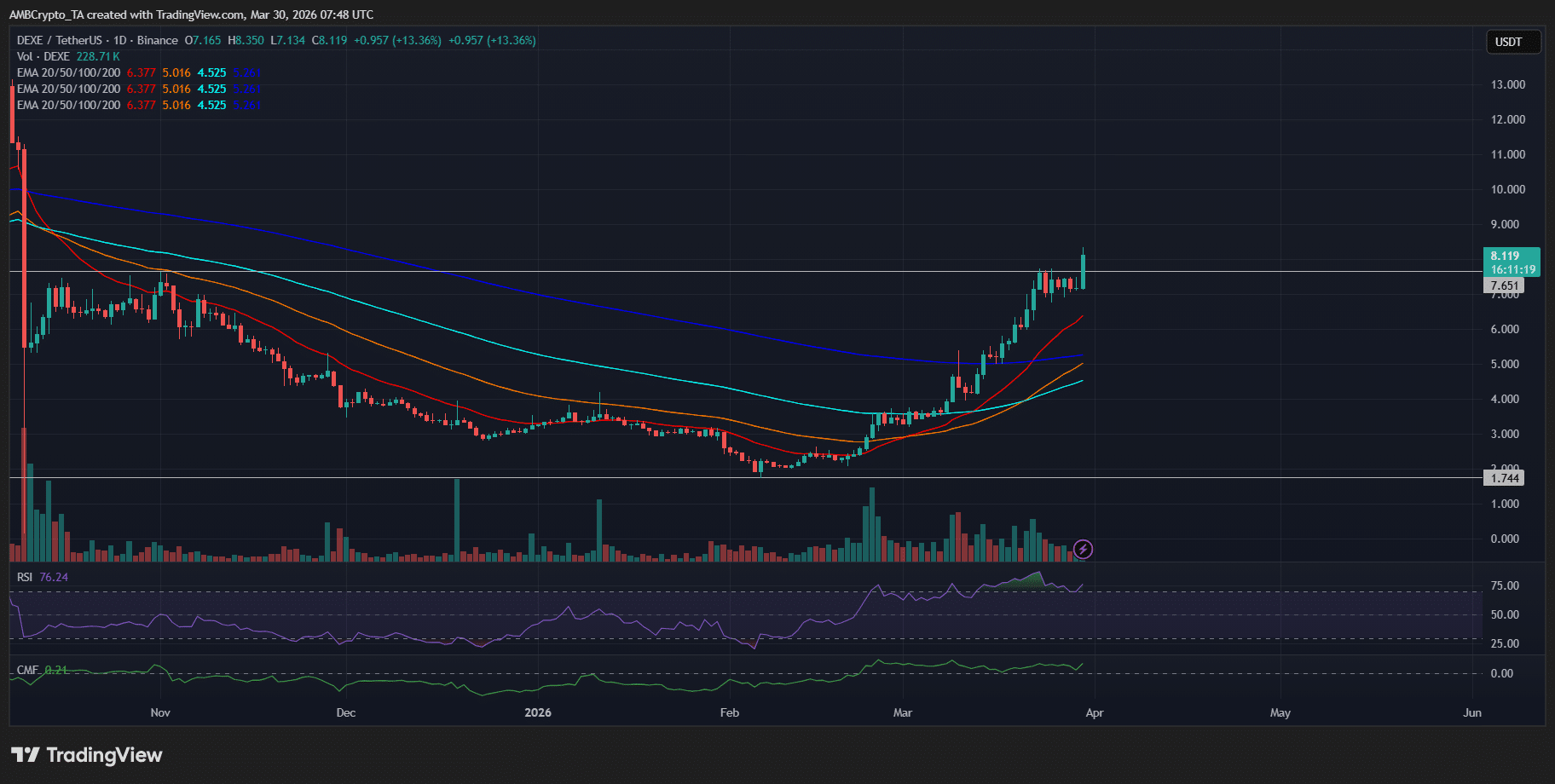
Dexe’s [DEXE] price action shows demand returning after a long period of weakness. Price opened the uptrend near $7.165, dipped to $7.134, then rose sharply to $8.350 before closing around $8.119, gaining 13.36% in a day.

This move follows a base formed above $1.744 in early February, where selling pressure eased and buyers began to take control.
Source: TradingView

As confidence improved, price moved above the 100 EMA at $4.525 and the 200 EMA near $5.261, which signals a shift from a weak trend to a stronger upward structure. This move also came with higher volume, showing that more participants are entering the market.

DEXE exhibits strong momentum, with RSI hovering around 76.24, while CMF at 0.21 shows steady capital inflows. As the price tests the $8.1–$8.3 range, further gains depend on continued buying strength.
DEXE’s Open Interest expansion reinforces the trend

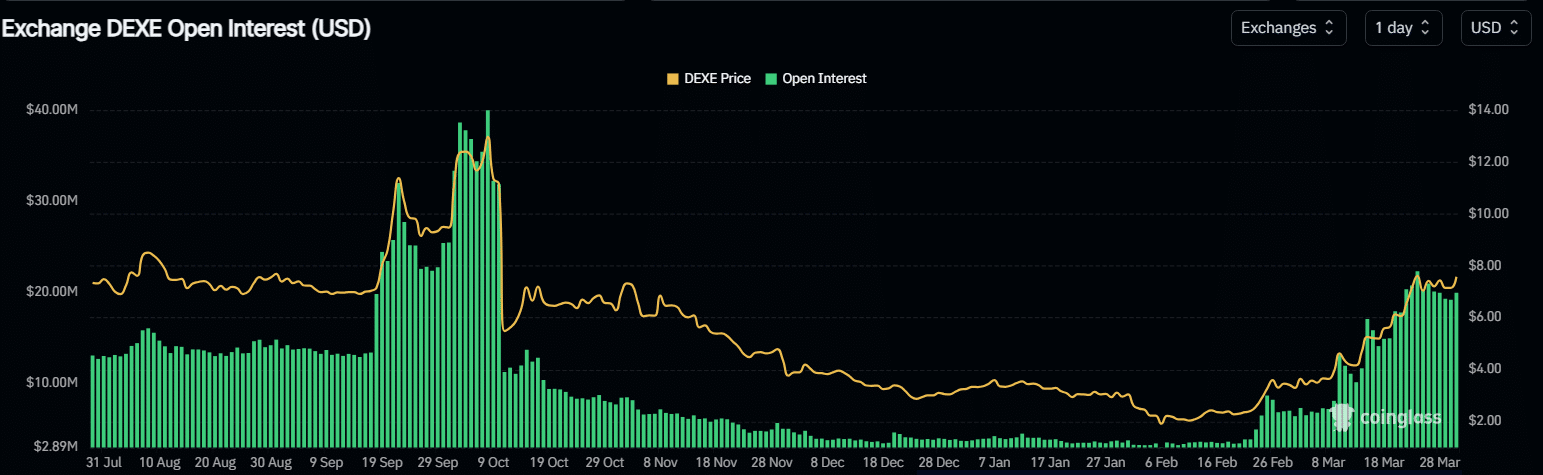
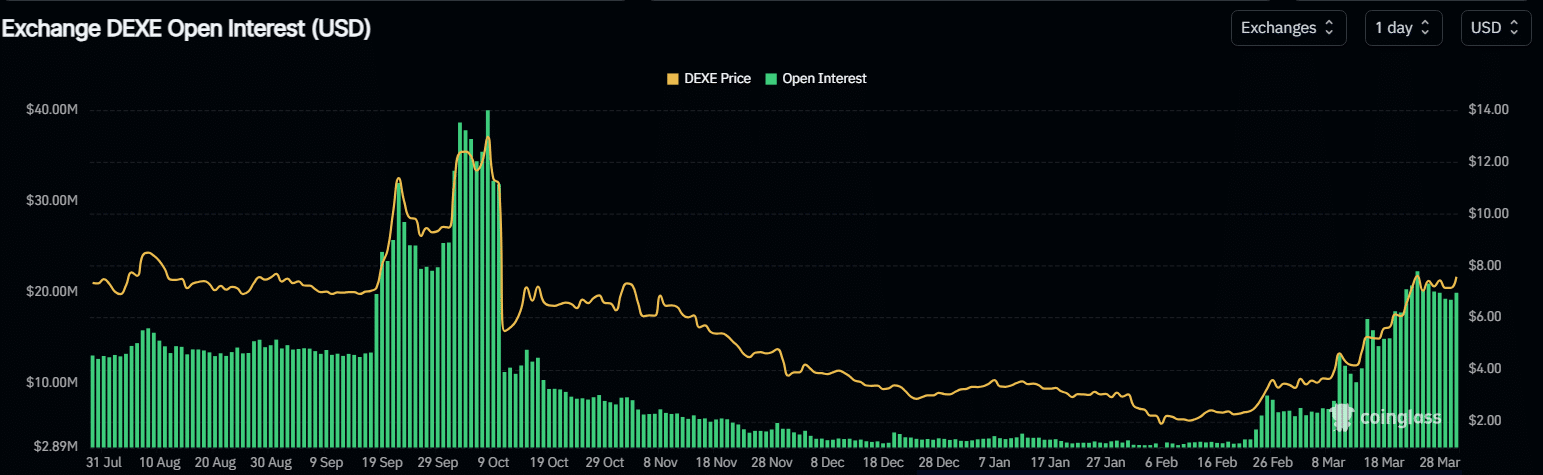
The move toward the $8 region is now attracting more activity, as derivatives traders increase their positions. Open Interest has risen from $6.94 million to $19.92 million in a month, showing that positions are growing alongside price rather than declining.

Source: CoinGlass

This increase signals stronger conviction, as traders use leverage to expand exposure while momentum improves. As more positions enter the market, they help support the uptrend by absorbing supply and maintaining upward pressure.

However, this support depends on continued inflows. If participation slows or reverses, positions may close quickly, which can pressure price.

For now, rising Open Interest supports the trend but also increases the risk of higher volatility if momentum weakens.

Consolidation tests trend continuation

DEXE’s rally now shows a clear change in behavior as momentum shifts from expansion into decision-making.

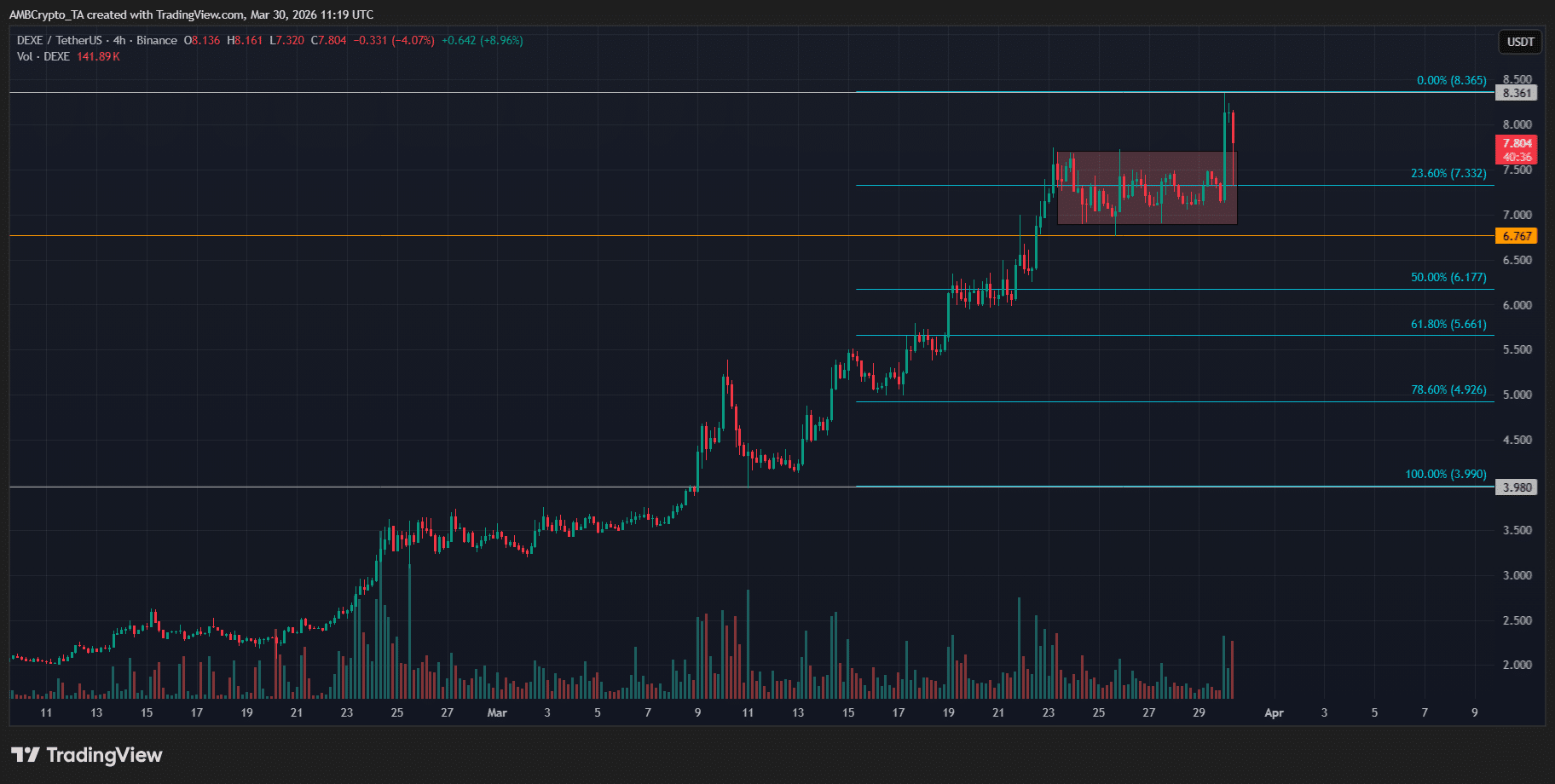
After driving quickly toward $8.36, the price pulls back and compresses between $7.30 and $7.80, which signals that buyers are stepping back while early positions begin to take profit.

This pause emerges because the market is testing whether demand can absorb supply at higher levels.

Source: TradingView

The earlier move carried price through key Fibonacci zones at $6.17 (50%) and $5.66 (61.8%), which confirms strong underlying demand.

Now, attention shifts to the 23.6% level near $7.33, where buyers are actively defending structure. Holding this level shows strength, as it keeps higher lows intact and maintains control.

If buyers regain momentum and push above $8.36, the trend can extend. However, if support weakens, the move risks rotating back toward $6.17, where deeper demand may re-enter.


Final Summary

  • Dexe’s trend strengthens as Open Interest surges 187%, but continuation depends on sustained demand holding above $7.30.
  • DEXE’s consolidation tests strength, with a break above $8.36 signaling upside, while loss of support risks a pullback toward $6.17.

Domande pertinenti

QWhat was the percentage gain in DEXE's price in a single day, and what were the key levels it moved between?

ADEXE gained 13.36% in a day, opening near $7.165, dipping to $7.134, then rising sharply to $8.350 before closing around $8.119.

QWhat technical indicators are mentioned as signaling a shift to a stronger upward trend for DEXE?

AThe price moving above the 100 EMA at $4.525 and the 200 EMA near $5.261, accompanied by higher volume, signaled a shift from a weak trend to a stronger upward structure.

QHow much did Open Interest (OI) increase over the past month, and what does this suggest about trader sentiment?

AOpen Interest surged from $6.94 million to $19.92 million, a 187% increase, indicating stronger conviction among derivatives traders and their use of leverage to expand exposure as momentum improved.

QWhat is the significance of the $7.33 price level for DEXE according to the Fibonacci retracement analysis?

AThe $7.33 level corresponds to the 23.6% Fibonacci retracement level. Holding this level is crucial as it shows buyers are actively defending the structure, keeping higher lows intact, and maintaining control.

QWhat are the two potential price scenarios for DEXE mentioned in the article's final summary?

AIf buyers push above $8.36, the uptrend can extend. However, if support weakens and is lost, the price risks a pullback toward the $6.17 level.

Letture associate

Cryptocurrency & Stock Market Indicator丨SpaceX Discloses Holding 18,712 Bitcoins Worth $1.18 Billion; Strategy Spends $100 Million Two Weeks in a Row to Scoop Up BTC at Low Levels (June 16)

"Coin-Stock Barometer: SpaceX discloses holding 18,712 Bitcoin worth $1.18B; Strategy spends another $100M accumulating BTC (June 16) SpaceX has officially disclosed holding 18,712 Bitcoin in its S-1 filing, valued at ~$1.18B, becoming the 8th largest public company Bitcoin holder. Its average cost is ~$35,000 per BTC. In weekly BTC treasury news, Strategy (formerly MicroStrategy) purchased another 1,587 BTC (~$100M) last week, increasing its total to 846,842 BTC. Mara Holdings added 1,000 BTC. However, Metaplanet and others made no purchases. Nakamoto sold ~600 BTC to repay ~$45M in debt. Global public companies (excluding miners) now hold 1,121,341 BTC. In other crypto treasury developments: - Metaplanet acquired Siiibo Securities to build a Bitcoin-focused financial ecosystem in Japan. - Bitmine increased its ETH holdings by 76,881 last week. - SharpLink's cumulative ETH staking rewards surpassed 21,119 ETH. - Forward Industries' acquisition offers for two SOL treasury companies, including Brera Holdings (holding 2.1M SOL), were rejected. - Tron Inc.'s TRX holdings surpassed 700 million. - Avalanche Treasury Co. (AVAT) begins trading on Nasdaq. - AIFC detailed plans to use WLFI tokens for collateral/loans. Market perspectives on U.S. stocks vary. 'White-Haired Stock God' Serenity sees the current cycle as retail-to-institution transfers, where negative reports may signal institutional accumulation. Morgan Stanley suggests a rotation from tech to cyclical stocks could occur. Citrini believes the U.S. stock market hasn't peaked but expects frequent 10-15% pullbacks in the coming months."

marsbit7 min fa

Cryptocurrency & Stock Market Indicator丨SpaceX Discloses Holding 18,712 Bitcoins Worth $1.18 Billion; Strategy Spends $100 Million Two Weeks in a Row to Scoop Up BTC at Low Levels (June 16)

marsbit7 min fa

Do Robots Also Need Encrypted Wallets? Stablecoin Giant Tether Bets on German Company NEURA Robotics

Do Robots Need Crypto Wallets? Stablecoin Giant Tether Bets on German Firm NEURA Robotics German robotics company NEURA Robotics has secured up to $1.4 billion in what is claimed to be the largest-ever funding round in the full-stack robotics industry, valuing the company at $7 billion. The Series C round attracted major investors like Tether, Qualcomm, Amazon, NVIDIA, Bosch, and the European Investment Bank. NEURA, founded in 2019, initially focused on AI-powered collaborative robots (cobots) for industrial automation, later expanding to autonomous mobile robots, service robots, and humanoid robots. Its core strategy is evolving from a hardware manufacturer to the operator of "Neuraverse," a platform designed to enable different robots to share learned experiences and data, creating network effects. A key, crypto-focused aspect of this investment is Tether's involvement. Tether plans to integrate its open-source Wallet Development Kit (WDK) into NEURA's robot platforms. This would embed self-custody wallet functionality, allowing robots to autonomously handle payments and settlements for tasks under pre-set rules—envisioning use cases in logistics or Robotics-as-a-Service (RaaS) models. This move could position stablecoins and crypto wallets as potential "machine payment infrastructure." Additionally, the partnership will see Tether's QVAC (QuantumVerse Automatic Computer) edge-AI framework tested and deployed within Neuraverse. This aims to enable low-latency, offline-capable AI decision-making directly on robots, reducing reliance on cloud computing for critical, time-sensitive operations. The investment underscores Tether's broader ambition to expand beyond being just a stablecoin issuer into AI, energy, and digital infrastructure, with NEURA's robotics network serving as a testbed for merging crypto-based financial layers with edge-based intelligence for the future of automation.

marsbit24 min fa

Do Robots Also Need Encrypted Wallets? Stablecoin Giant Tether Bets on German Company NEURA Robotics

marsbit24 min fa

AMD Launches Compact AI Host, Directly Challenging NVIDIA DGX Spark

In June 2026, AMD announced the Ryzen AI Halo, a compact AI developer desktop to rival NVIDIA's DGX Spark. Both feature 128GB unified memory for running 200B+ parameter models locally. Priced from $2,949 to $3,999, AMD undercuts NVIDIA's $3,999+ DGX Spark. The core divergence lies in architecture and philosophy. Ryzen AI Halo uses an x86-based Ryzen AI Max+ 395 APU (CPU+GPU+NPU), runs standard Windows/Linux, and emphasizes general-purpose PC flexibility. DGX Spark uses an ARM-based Grace Blackwell Superchip, runs a custom DGX OS, and includes a high-speed ConnectX-7 NIC for cluster prototyping, anchoring it to NVIDIA's full-stack CUDA ecosystem. AMD's ROCm software has improved, with simpler installation and support for major frameworks, but still lags behind CUDA's 17-year maturity in community support and cutting-edge library availability. AMD's broader strategy focuses on becoming a viable second-source supplier. Key moves include acquiring design capabilities via ZT Systems (while outsourcing manufacturing) and securing two major 6GW GPU supply deals with OpenAI and Meta in late 2025/early 2026. These contracts validate AMD's role in diversifying the AI supply chain, rather than outright beating NVIDIA. NVIDIA counters with a tightly integrated stack from desktop (DGX Spark) to data center, emphasizing seamless scalability and enterprise software subscriptions (AI Enterprise). In summary, Ryzen AI Halo represents AMD's pragmatic path: offering a cost-effective, open-ecosystem alternative for developers wary of vendor lock-in, while its large data center contracts aim to capture share from customers seeking a second GPU supplier. The choice boils down to a familiar, flexible PC environment with potential software gaps (AMD) versus a premium, optimized, but locked-in ecosystem (NVIDIA).

marsbit24 min fa

AMD Launches Compact AI Host, Directly Challenging NVIDIA DGX Spark

marsbit24 min fa

Sharplink CEO: One Million Ethereum Developers, Who Can Compete?

Etherean Ecosystem: One Million Developers and a Formidable Moat The Ethereum network has surpassed a significant milestone: over one million unique lifetime developers, with approximately 232,000 active in the past year. This vast and growing talent pool is Ethereum's core advantage, far more critical than transient metrics like speed or transaction fees. The central question is not which blockchain is fastest, but where the best builders choose to build long-term. Ethereum's answer lies in a decade-long accumulation of infrastructure, standards, tools, liquidity, and collaborative culture that is exceptionally difficult to replicate. It has become the default operating system for programmable finance. This massive developer base is actively working on complex, high-risk challenges that deepen Ethereum's strategic moat: * **Glamsterdam Upgrade (2026):** Focused on core protocol scalability (ePBS, parallel execution) while preserving core values like credible neutrality. * **Synchronous Composability:** Aims to make numerous Rollups interoperate like a single chain, directly addressing fragmentation concerns. * **Quantum Resistance:** Ethereum leads mainstream ecosystems in coordinated preparation for post-quantum cryptography, with a targeted migration plan around 2029. This developer advantage is self-reinforcing, fueled by: * **Deep Composability:** Applications interact like interoperable financial Lego bricks via shared standards (e.g., EVM, Solidity). * **Credible Neutrality:** Secured by over 900,000 validators, making it trusted by major institutions. * **Modularity:** Rollups (Base, Arbitrium, etc.) expand, rather than fracture, the ecosystem into a tightly connected modular internet economy. * **Culture:** Attracts top-tier researchers and standard-setters who guide the entire industry. In essence, while other chains generate activity, Ethereum is consolidating as the trusted, long-term coordination layer for internet-native finance. Its future is being built now by the architects of the next-generation financial infrastructure.

Odaily星球日报1 h fa

Sharplink CEO: One Million Ethereum Developers, Who Can Compete?

Odaily星球日报1 h fa

Trading

Spot
Futures

Articoli Popolari

Come comprare DEXE

Benvenuto in HTX.com! Abbiamo reso l'acquisto di DeXe (DEXE) semplice e conveniente. Segui la nostra guida passo passo per intraprendere il tuo viaggio nel mondo delle criptovalute.Step 1: Crea il tuo Account HTXUsa la tua email o numero di telefono per registrarti il tuo account gratuito su HTX. Vivi un'esperienza facile e sblocca tutte le funzionalità,Crea il mio accountStep 2: Vai in Acquista crypto e seleziona il tuo metodo di pagamentoCarta di credito/debito: utilizza la tua Visa o Mastercard per acquistare immediatamente DeXeDEXE.Bilancio: Usa i fondi dal bilancio del tuo account HTX per fare trading senza problemi.Terze parti: abbiamo aggiunto metodi di pagamento molto utilizzati come Google Pay e Apple Pay per maggiore comodità.P2P: Fai trading direttamente con altri utenti HTX.Over-the-Counter (OTC): Offriamo servizi su misura e tassi di cambio competitivi per i trader.Step 3: Conserva DeXe (DEXE)Dopo aver acquistato DeXe (DEXE), conserva nel tuo account HTX. In alternativa, puoi inviare tramite trasferimento blockchain o scambiare per altre criptovalute.Step 4: Scambia DeXe (DEXE)Scambia facilmente DeXe (DEXE) nel mercato spot di HTX. Accedi al tuo account, seleziona la tua coppia di trading, esegui le tue operazioni e monitora in tempo reale. Offriamo un'esperienza user-friendly sia per chi ha appena iniziato che per i trader più esperti.

178 Totale visualizzazioniPubblicato il 2024.12.12Aggiornato il 2026.06.02

Come comprare DEXE

Discussioni

Benvenuto nella Community HTX. Qui puoi rimanere informato sugli ultimi sviluppi della piattaforma e accedere ad approfondimenti esperti sul mercato. Le opinioni degli utenti sul prezzo di DEXE DEXE sono presentate come di seguito.

活动图片