DEXE dumps 15% as seller dominance surges – Warning sign?

ambcryptoPubblicato 2026-04-09Pubblicato ultima volta 2026-04-09

Introduzione

DEXE experienced a sharp decline of 15.27%, dropping to $7.6, despite a broader crypto market rebound. The altcoin lost the $8 support level, falling as low as $7.3, and moved below the Parabolic SAR, indicating strong bearish pressure. The drop was driven by increased profit-taking, a surge in seller dominance, and a significant rise in trading volume dominated by selling activity. Open Interest declined slightly while Derivatives Volume spiked, suggesting aggressive position closures. Futures net flow turned negative, reflecting strong bearish sentiment. A recovery above $7.9 could lead to a rebound toward $9.2, but failure may result in a further decline toward $7 or even $5.1.

DEXE fell sharply even as the broader crypto market rebounded on easing global tensions and ceasefire talks.

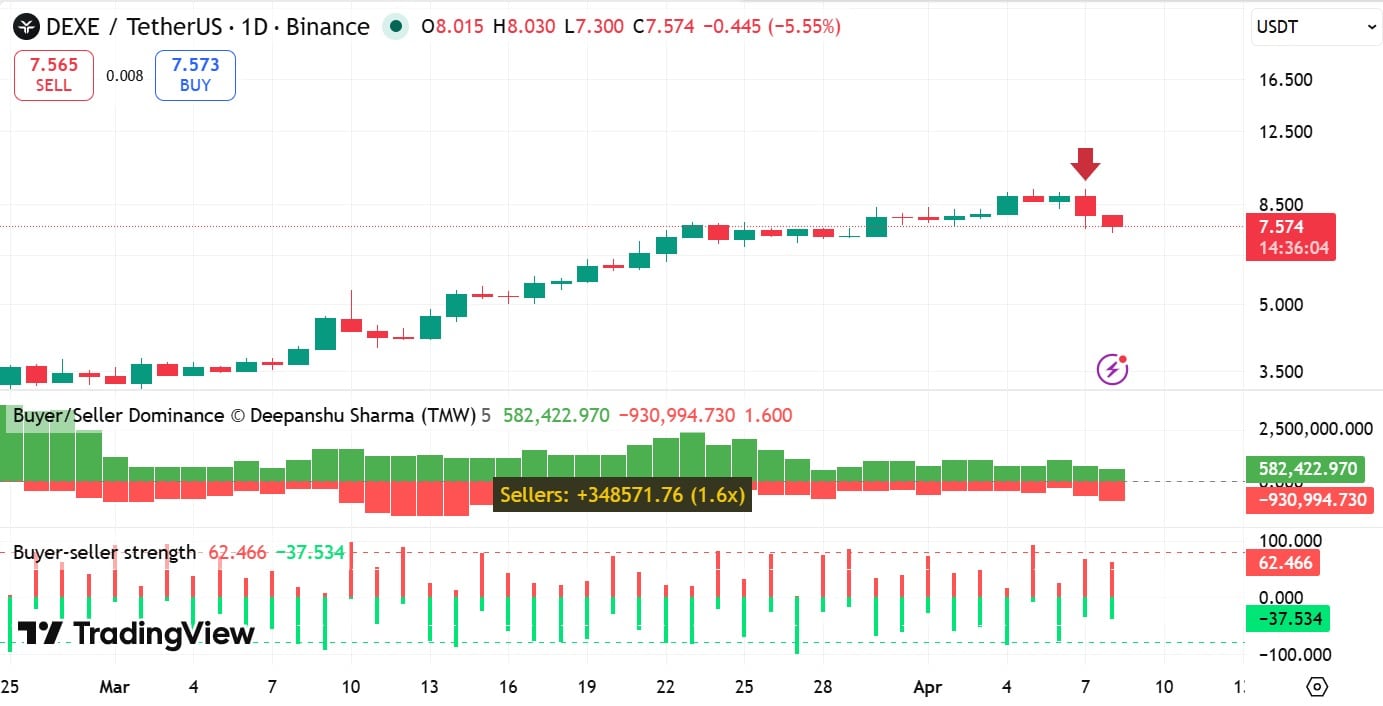
The altcoin dropped from $9.2 to $7.3 after losing the $8 support level. At press time, Dexe [DEXE] traded at $7.6, down 15.27% daily. The weekly loss stood near 8%.

The drop pushed the altcoin below its Parabolic SAR, signaling strong downside pressure.

Why did DEXE turn bearish?

DEXE erased its weekly gains as traders exited positions and sentiment flipped bearish.

The token had traded in an uptrend through March and the past week. That move attracted profit-taking near recent highs.
Source: TradingView

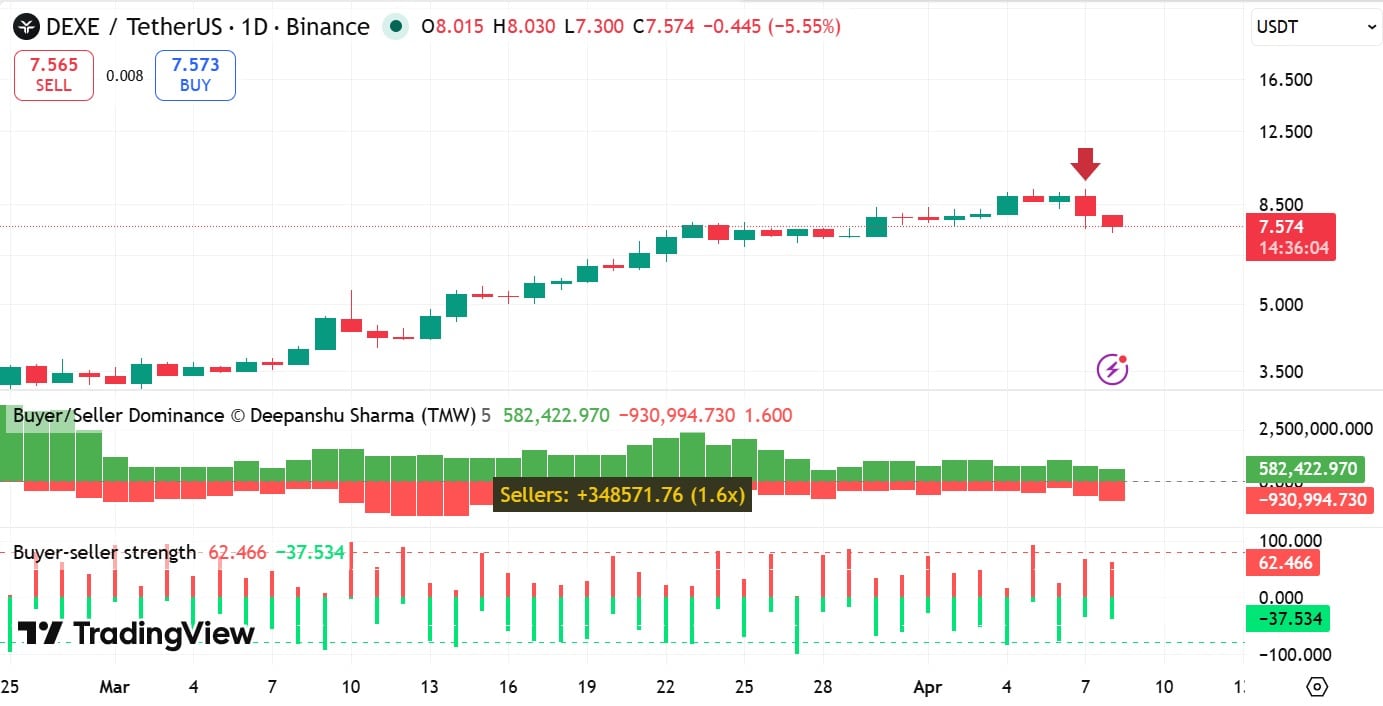
Seller Dominance rose to 930k, while Buyer Dominance dropped to 582k.

At the same time, Sellers’ Strength climbed to 62 as Buyers’ Strength fell to 37. This shift confirmed rising sell-side pressure.

That move aligned with a 109% surge in trading volume, largely driven by selling activity. Sustained selling pressure typically weakens price structure.

Are DEXE traders exiting derivatives positions?

As the market started to cool and retraced, investors withdrew capital from futures markets to reduce exposure.

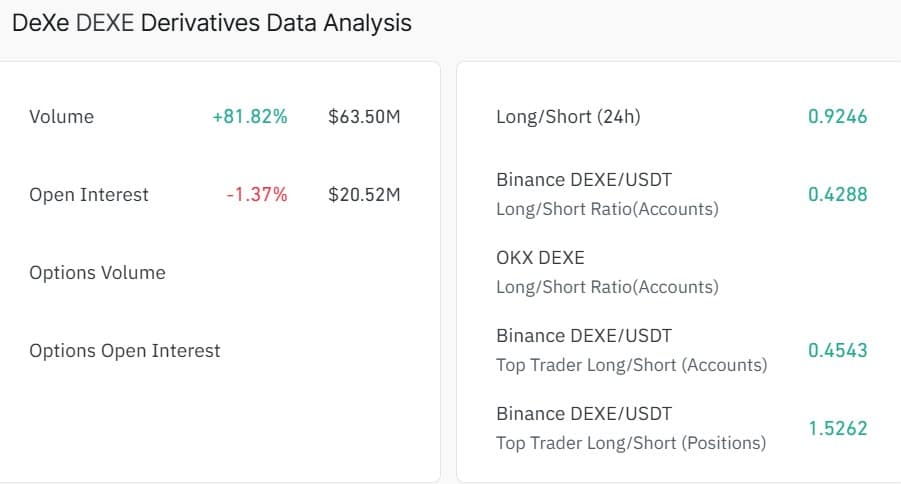
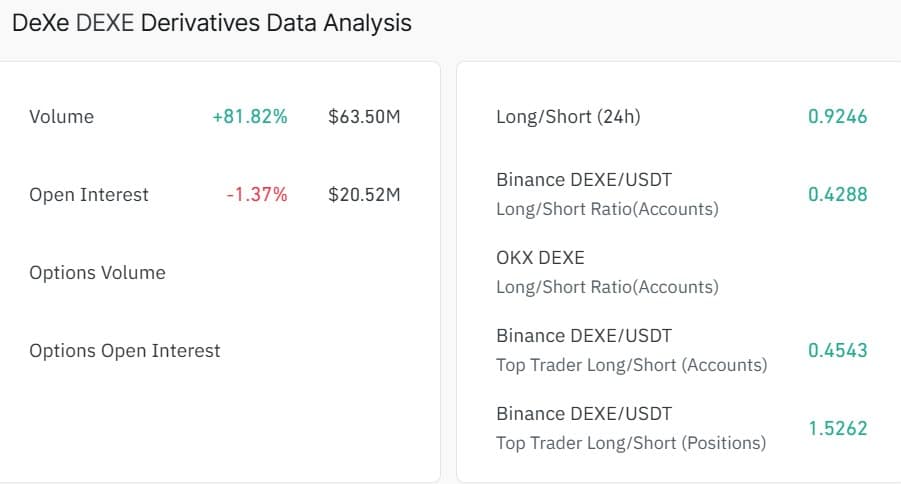
According to CoinGlass data, Open Interest [OI] dropped 1.37% to $20 million while Derivatives Volume rose 80%. The mismatch suggested increased selling activity in the derivatives market and a reduction in positions.
Source: CoinGlass

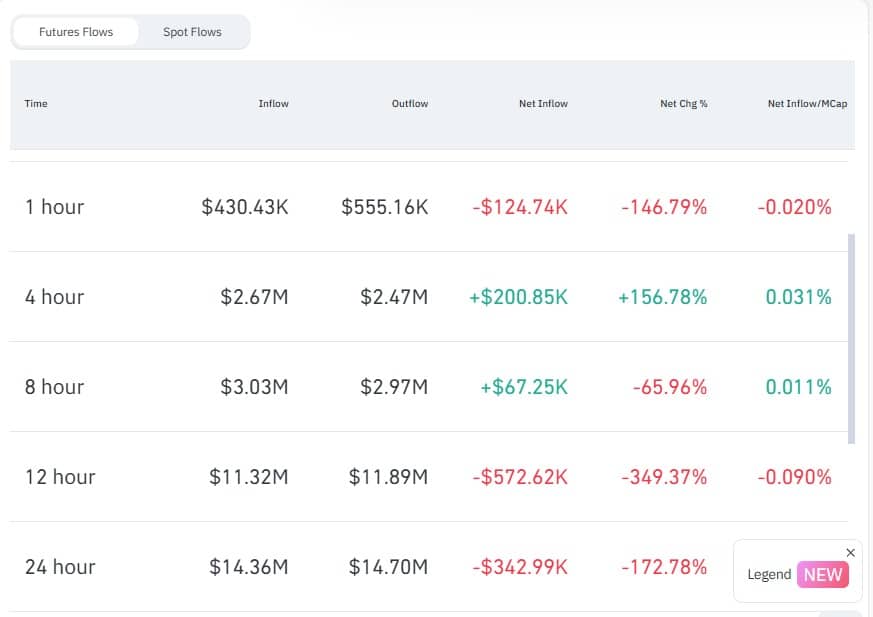
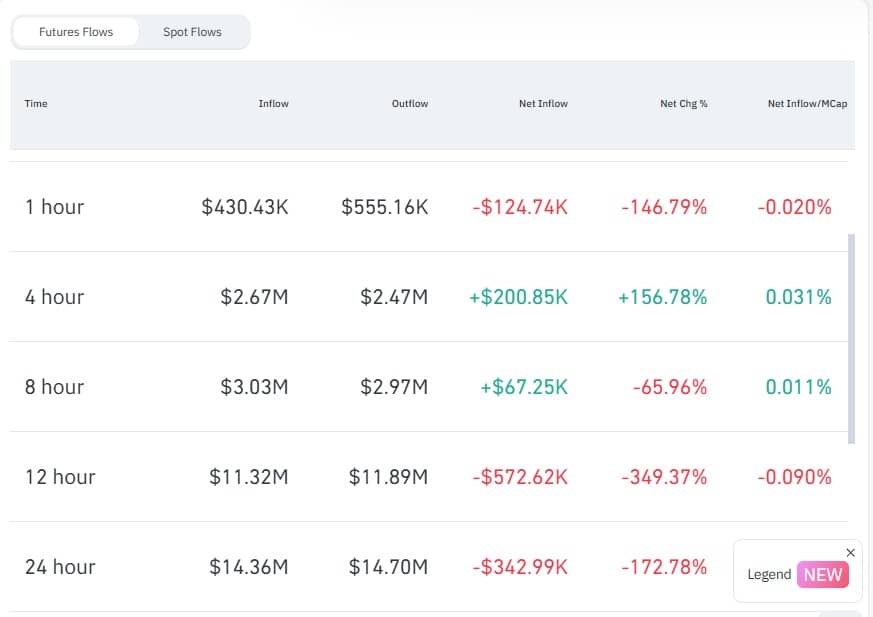
At the same time, Futures outflows increased, rising to $14.7 million, while inflows dropped to $14.36 million. As a result, the futures net flow declined by 172% to -$342k, indicating aggressive selling activity.

This suggested that most traders in the futures market reduced exposure and closed their positions. In most cases, when traders close their positions aggressively during a downtrend, it shows strong bearish sentiment.
Source: CoinGlass

What comes next for DEXE?

Momentum indicators reflected a weakening structure after the recent drop.

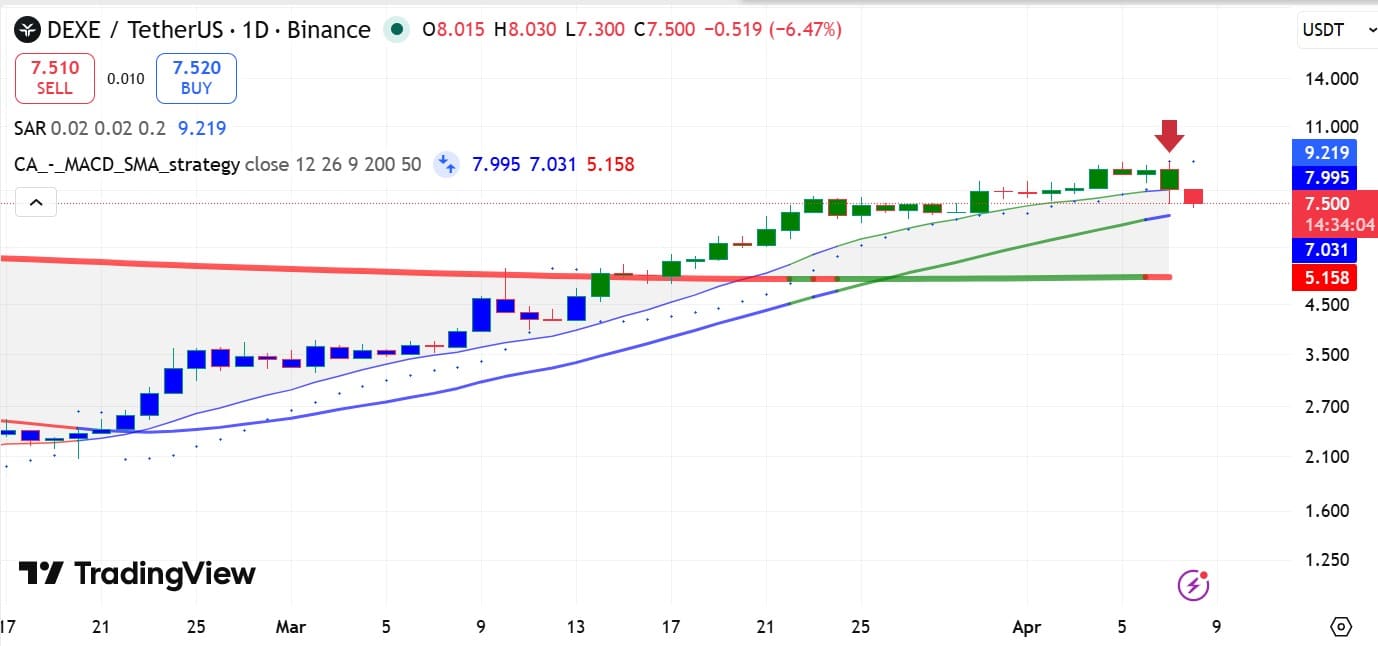
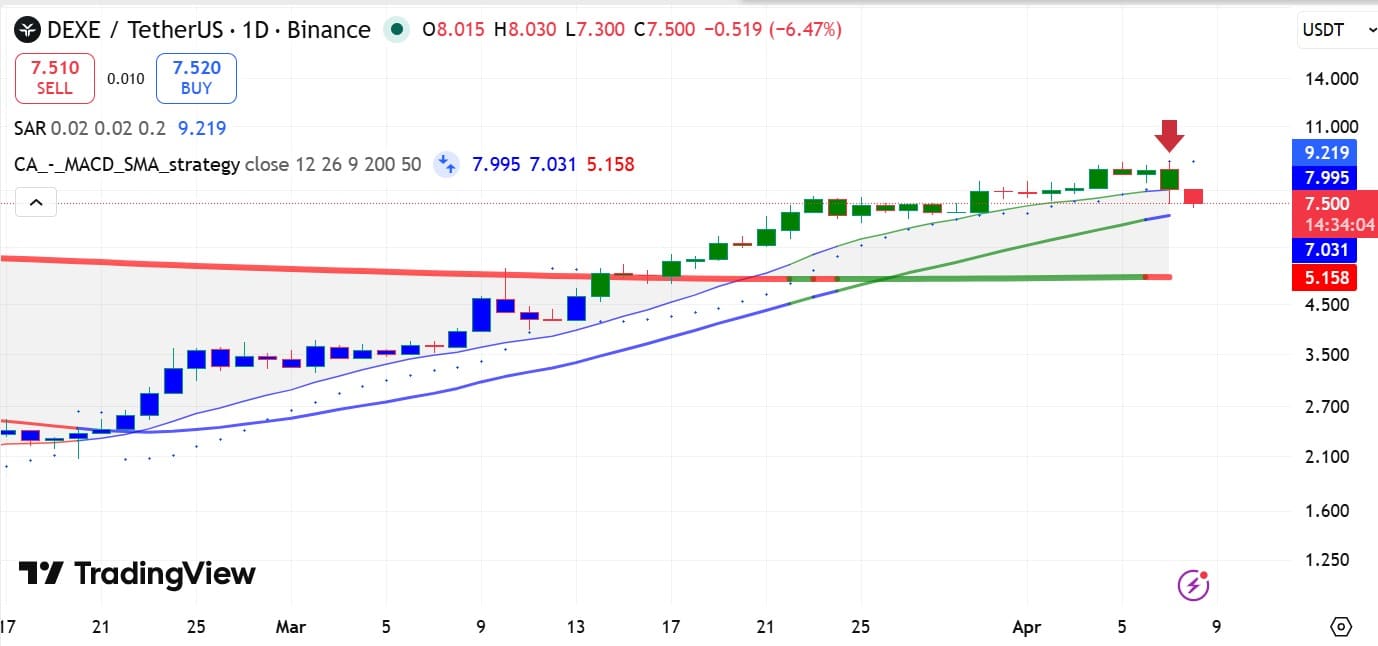
The MACD and SMA showed price pulling back toward short-term Moving Averages. This pointed to slowing momentum after the rally.
Source: TradingView

Even so, DEXE remained within a broader uptrend despite the pullback.

A daily close above $7.9 could support a recovery toward $9.2. Failure to reclaim that level may lead to a retest of $7. If selling continues, $5.1 remains the next downside level.


Final Summary

  • DEXE lost the $8 support and dropped sharply, confirming a clear shift in the short-term trend.
  • A move above $7.9 could support recovery, while failure increases the risk of revisiting $7 and lower levels.


Domande pertinenti

QWhat was the daily percentage drop in DEXE's price as mentioned in the article?

ADEXE dropped 15.27% daily.

QWhat key support level did DEXE lose that contributed to its sharp decline?

ADEXE lost the $8 support level.

QAccording to the article, what does the surge in Seller Dominance and drop in Buyer Dominance indicate?

AThe surge in Seller Dominance to 930k and drop in Buyer Dominance to 582k indicates rising sell-side pressure and a bearish sentiment.

QWhat does the decline in Open Interest (OI) alongside a rise in Derivatives Volume suggest about market activity?

AThe decline in Open Interest by 1.37% to $20 million while Derivatives Volume rose 80% suggests increased selling activity in the derivatives market and a reduction in positions.

QWhat are the potential price targets for DEXE if it fails to reclaim the $7.9 level?

AIf DEXE fails to reclaim the $7.9 level, it may retest $7, and if selling continues, the next downside level is $5.1.

Letture associate

Codex Goal Mode Usage Guide: How to Make AI Continuously Pursue a Specific Objective

"Codex Goal Mode: How to Make AI Work Continuously Toward a Specific Goal" OpenAI's Codex "goal mode" (/goal) transforms the AI from a reactive code assistant into a proactive execution agent capable of working autonomously for hours or even days to achieve a defined objective. To maximize its effectiveness, follow these key principles: 1. **Define Clear, Verifiable Exit Criteria:** The goal prompt should be a concise, measurable success condition, not a lengthy specification. Use quantifiable metrics like "reduce build time by 30%" or "achieve 100% test parity." 2. **Provide Initial Guidance and Tools:** Direct Codex toward likely problem areas and specify available tools (e.g., browsers, testing environments) to prevent it from exploring unproductive paths. 3. **Enable Progress Measurement:** Equip Codex with ways to track advancement, such as creating comparison tools for visual tasks or evaluation sets, ensuring it can gauge its own progress. 4. **Use a Realistic Execution Environment:** For tasks like performance optimization, provide access to environments that closely mimic production (e.g., similar configs, databases) to yield valid results. 5. **Be Cautious with Visual Goals:** Avoid vague "pixel-perfect" instructions. Instead, supplement visual references with functional checklists or design system specifications to prevent Codex from obsessing over minor details. 6. **Implement Progress Tracking:** For long-running tasks, have Codex commit code to draft PRs, update progress documents, or send Slack updates to maintain visibility into its work. 7. **Review and Consolidate Results:** Once the goal is met, instruct Codex to review its work, clean up ineffective experimental code, and reflect on what strategies succeeded or failed. Ultimately, using goal mode shifts the developer's role from writing prompts to managing a persistent engineering agent—defining objectives, establishing metrics, configuring environments, and conducting final reviews.

marsbit1 h fa

Codex Goal Mode Usage Guide: How to Make AI Continuously Pursue a Specific Objective

marsbit1 h fa

From Ethereum to AI's 'CROPS': What Exactly Is This 'Slow Variable' That Vitalik Has Repeatedly Emphasized?

Recently, Vitalik Buterin has frequently emphasized the concept of "CROPS," first outlined in the Ethereum Foundation's March mandate as core principles guiding its focus: Censorship Resistance, Capture Resistance, Open Source, Privacy, and Security. CROPS represents Ethereum's commitment to providing foundational capabilities for user sovereignty—enabling asset ownership, identity expression, and coordination without reliance on centralized platforms or surrendering ultimate control. This framework is gaining new urgency with the rise of AI, particularly AI agents managing digital assets and automating transactions. While AI offers convenience, it risks centralizing user data, intent, and control if dependent on opaque, centralized services. Vitalik argues for "CROPS AI"—AI that is open, privacy-preserving, secure, and capable of local execution to maintain user agency. He highlights convergence between "CROPS Ethereum access layers" and "CROPS AI," such as using zero-knowledge proofs for private remote LLM calls and Ethereum RPC reads, ensuring users can access services without exposing sensitive information. Ultimately, CROPS is not just an abstract ideal but a practical guide for Ethereum's development and AI integration. It addresses the critical long-term question: as digital systems grow more powerful, how can users retain control over their privacy, assets, and autonomy? In an AI-driven era, these principles may define Ethereum's enduring value—prioritizing verifiable, secure, and user-centric design over short-term optimizations like speed and cost alone.

marsbit1 h fa

From Ethereum to AI's 'CROPS': What Exactly Is This 'Slow Variable' That Vitalik Has Repeatedly Emphasized?

marsbit1 h fa

Trading

Spot
Futures

Articoli Popolari

Come comprare DEXE

Benvenuto in HTX.com! Abbiamo reso l'acquisto di DeXe (DEXE) semplice e conveniente. Segui la nostra guida passo passo per intraprendere il tuo viaggio nel mondo delle criptovalute.Step 1: Crea il tuo Account HTXUsa la tua email o numero di telefono per registrarti il tuo account gratuito su HTX. Vivi un'esperienza facile e sblocca tutte le funzionalità,Crea il mio accountStep 2: Vai in Acquista crypto e seleziona il tuo metodo di pagamentoCarta di credito/debito: utilizza la tua Visa o Mastercard per acquistare immediatamente DeXeDEXE.Bilancio: Usa i fondi dal bilancio del tuo account HTX per fare trading senza problemi.Terze parti: abbiamo aggiunto metodi di pagamento molto utilizzati come Google Pay e Apple Pay per maggiore comodità.P2P: Fai trading direttamente con altri utenti HTX.Over-the-Counter (OTC): Offriamo servizi su misura e tassi di cambio competitivi per i trader.Step 3: Conserva DeXe (DEXE)Dopo aver acquistato DeXe (DEXE), conserva nel tuo account HTX. In alternativa, puoi inviare tramite trasferimento blockchain o scambiare per altre criptovalute.Step 4: Scambia DeXe (DEXE)Scambia facilmente DeXe (DEXE) nel mercato spot di HTX. Accedi al tuo account, seleziona la tua coppia di trading, esegui le tue operazioni e monitora in tempo reale. Offriamo un'esperienza user-friendly sia per chi ha appena iniziato che per i trader più esperti.

174 Totale visualizzazioniPubblicato il 2024.12.12Aggiornato il 2026.06.02

Come comprare DEXE

Discussioni

Benvenuto nella Community HTX. Qui puoi rimanere informato sugli ultimi sviluppi della piattaforma e accedere ad approfondimenti esperti sul mercato. Le opinioni degli utenti sul prezzo di DEXE DEXE sono presentate come di seguito.

活动图片