Design, Development, Legal, Sports... Polymarket Launches 'Full-Stack' Talent Grab

Odaily星球日报Pubblicato 2026-04-15Pubblicato ultima volta 2026-04-15

Introduzione

Polymarket, a leading prediction market platform, is aggressively expanding its team across multiple domains following competitor Kalshi's recent $22 billion valuation funding round. Key hires and strategic acquisitions are central to its growth strategy. Design remains a priority, with the design lead actively recruiting to strengthen the platform's distinctive blue-and-white branding. Engineering recruitment is also intensive, highlighted by the acquisition of API platform Dome, whose co-founders joined Polymarket, and the hiring of a former Aave engineering VP. Multiple senior engineering roles are currently open. For its US platform, Polymarket is bolstering legal and compliance expertise, adding a former RBC Capital Markets veteran as Legal Counsel. In a significant move, it hired a former Fanatics CBO to lead sports business development, which sparked a non-compete lawsuit from Fanatics, revealing complex industry entanglements. Further hires include a former Coinbase institutional product lead to handle institutional liquidity sales, a marketing head from MrBeast's team, and a Citadel veteran for exchange upgrades. Polymarket is also recruiting for HR and a Head of Markets, indicating the talent competition in the prediction market space is far from over.

Original|Odaily Planet Daily(@OdailyChina)

Author|Wenser(@wenser 2010 )

After Kalshi completed a new funding round in March with a valuation of $22 billion, Polymarket, one of the two giants in the prediction market, couldn't sit still.

Apart from the news that it was previously seeking funding with a $20 billion valuation, Polymarket has also been busy recruiting new team members recently for platform development and business expansion. From the list of new team members joining Polymarket, we might get a glimpse of the focus and突围 directions of this former prediction market霸主, now the "perennial runner-up".

Odaily Planet Daily will provide a梳理 and analysis based on Polymarket's recruitment information in this article.

Design Remains a Top Priority: Design Lead Posted Recruitment Plan in January

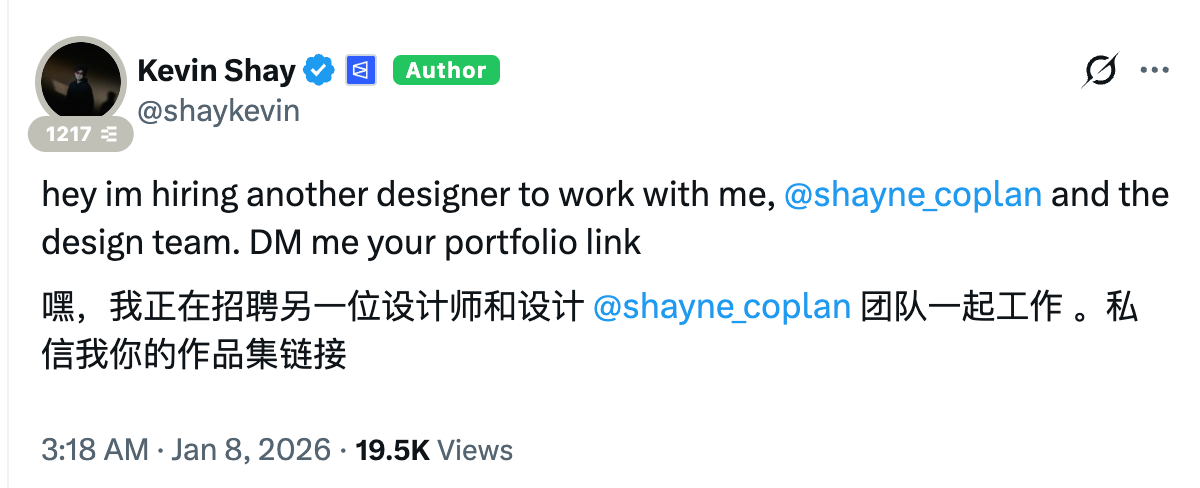
In January of this year, Polymarket's Head of Design, Kevin Shay, posted a tweet stating that he was recruiting designers. Apart from distinguishing itself from Kalshi's green and white UI, Polymarket's blue and white UI remains an important design language and iconic symbol. Its previously opened pop-up grocery store in New York also used corresponding blue and white elements in its design. In the crucial battle for brand突围, design is still a top priority for Polymarket's development.

Additionally, according to the official recruitment page, there are currently 2 design-related positions still open.
Development Engineers Continuously Recruited: Emphasizing Both Talent Acquisition and External Recruitment

As the business cornerstone of platform development, developers are also a key driving force behind Polymarket's recent business expansion. The strategy adopted by Polymarket's talent recruitment team is to emphasize both talent acquisition and external recruitment.

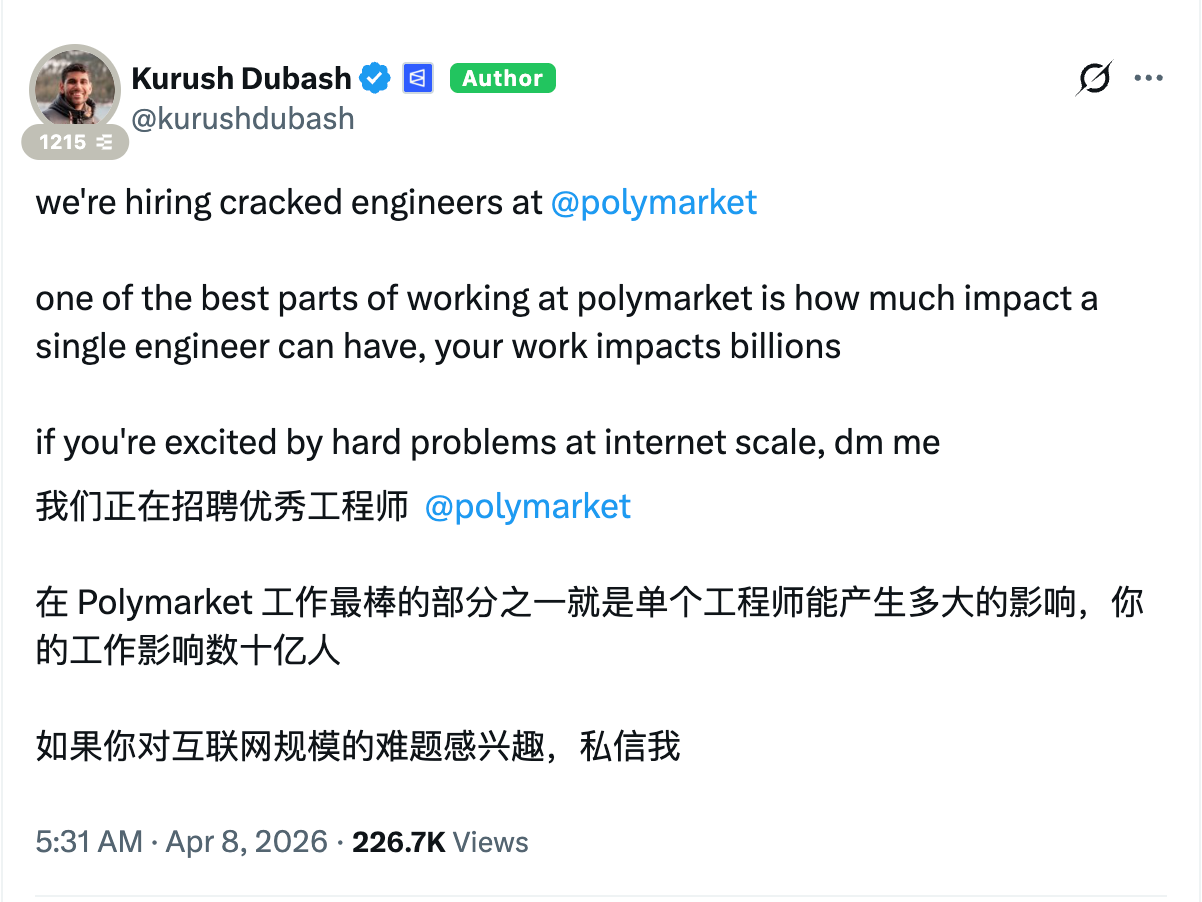
Kurush Dubash & Kunal Roy, Two Co-founders of Dome

In February, the prediction market API platform Dome was officially acquired by Polymarket. Subsequently, Dome's two co-founders, Kurush Dubash and Kunal Roy, also joined Polymarket. In April, they posted tweets recruiting top engineers, beginning to show a "person-to-person"火热 recruitment phenomenon.

It is worth mentioning that Polymarket also acquired the executive search firm Lunch in the same month; many of the executives and team members mentioned later were contacted and recruited by the leaders of this company; in March, Polymarket also acquired the DeFi infrastructure startup Brahma, and most of its team members have also been integrated into the Polymarket team.
Josh Stevens, Vice President of Engineering

On March 24th, former Aave engineer and senior vice president Josh announced that he had joined Polymarket. And just half a month later, he was already posting again on his personal account to recruit engineers. It seems that the developer gap at the rapidly developing Polymarket is much larger than outsiders might imagine.
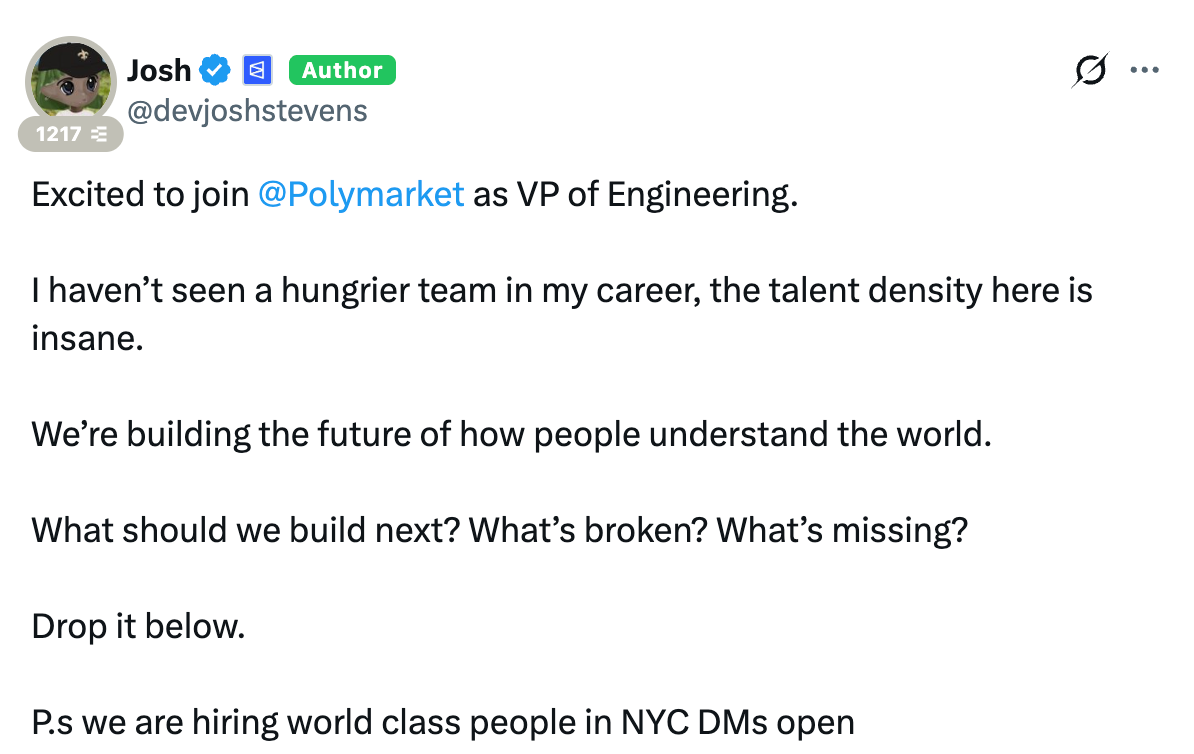
Joining announcement tweet in March
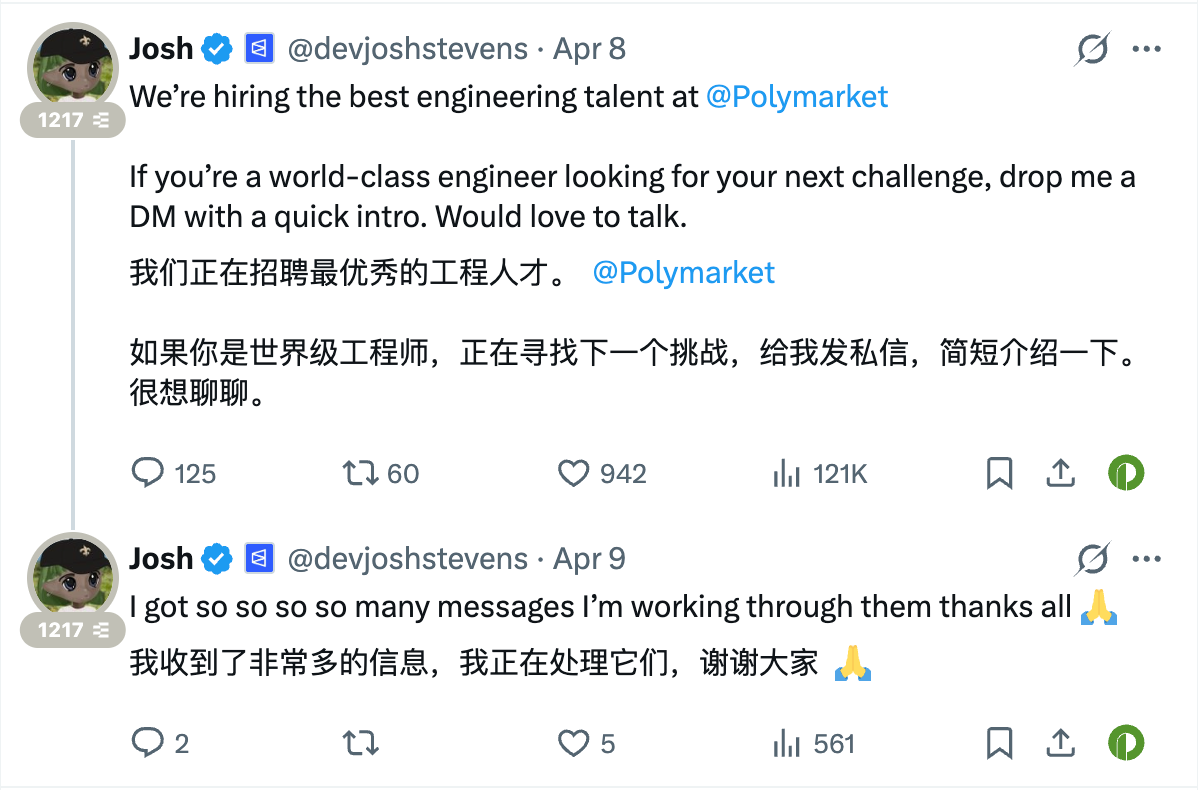
Posting recruitment information again in early April

Additionally, according to the official recruitment page information, the developer positions currently being recruited by Polymarket include Senior Backend Engineer (US Platform), C/C++ Senior Engineer (US Platform), Smart Contract Developer, Mobile AI Engineer, and Senior Platform Infrastructure Engineer. Interested friends can try applying.

Compliance, Legal, and Sports Betting Talent: Personnel Reserves for Polymarket's US Platform

Last November, by acquiring the US-compliant trading platform QCX, Polymarket finally managed to return to the US market. Facing the increasingly stringent regulatory environment in the US market and the regulatory contradictions between federal agencies and state/local courts, Polymarket has had to once again strengthen its talent reserves in legal and compliance aspects.

Matthew Lischin, Legal Counsel for Polymarket US Platform

In February 2026, after ending his 13-year tenure at RBC Capital Markets (the investment banking division of Royal Bank of Canada), Matthew Lischin finally joined Polymarket as the Head of North America Global Markets Legal Team. Public information shows that he will focus on the legal compliance of complex financial products such as equity derivatives and margin loans.

It is worth mentioning that when he posted on LinkedIn announcing his departure from RBC, Polymarket's Chief Legal Officer, Neal Kumar, left a comment to communicate. Perhaps due to this opportunity, Lischin later posted确认 joining the Polymarket US platform as Legal Counsel,直言: "The wish has finally come true!"

Ari Borod, Former Fanatics Executive Becomes President of Sports Business Development

In February 2026, after ending his 4-year tenure as Chief Commercial Officer (CBO) and other positions at the well-known sports betting platform Fanatics, Ari Borod subsequently plunged into Polymarket, the prediction market霸主 and rising star in sports betting.

Unexpectedly, due to his sensitive career experience, it also triggered a non-compete lawsuit from his former employer Fanatics. Although the lawsuit was eventually settled out of court, it must be said that in the process of the prediction market's growth, friction with traditional industries like sports betting may not only exist at the regulatory level but also at the talent争夺 level.

Public information shows that Ari Borod led the strategic transformation of Fanatics from fan merchandise to sports betting business. Earlier, he served as Chief Commercial Officer and Chief Operating Officer at The Action Network and worked at FanDuel for six years, rising from Assistant General Counsel to Vice President of Sports at Fanatics.

However, in the non-compete lawsuit filed by Fanatics in a Florida court, court documents revealed another shocking thing - Fanatics founder Michael Rubin and Fanatics Betting and Gaming CEO Matt King personally hold shares in Kalshi. It just goes to show that real business warfare is everywhere. Furthermore, even more laughably, Fanatics had previously been involved in a non-compete lawsuit for hiring Mike Hermalyn, former Senior Vice President of Growth at DraftKings. It seems因果循环,报应不爽 (karma is a cycle, retribution is not pleasant).

Institutional Liquidity Awaits Introduction: Former Coinbase Institutional Product Lead

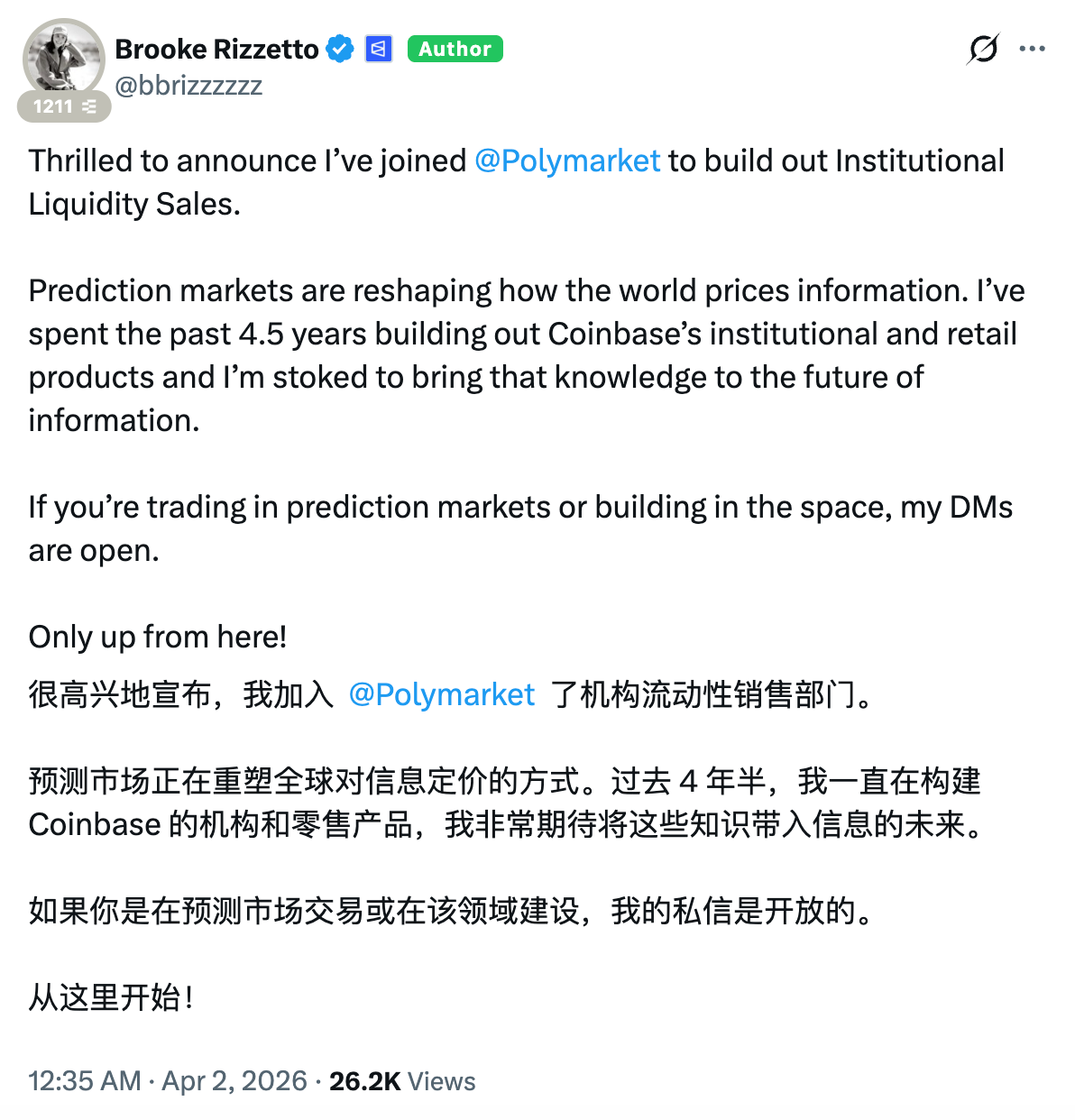
On April 2nd, former Coinbase Head of Institutional & Retail Products, Brooke Rizzetto, officially announced joining Polymarket, stating that she would later be responsible for "institutional liquidity sales." After working at Coinbase for over 4 years, Brooke Rizzetto began seeking new ways of information pricing and liquidity introduction from the prediction market赛道.
In addition to the above personnel, other team members recently joining Polymarket include former "MrBeast (YouTube's top influencer Beast Mr.)" viral marketing lead Josh Tucker, and Citadel hedge fund veteran of 8 years Mukilan Ashok,主要负责 marketing, exchange platform upgrades and other business.

Furthermore, Polymarket's Head of People Recruitment, Matthew Kendall Clark, recently pointed out in a post that they are currently recruiting Personnel Recruitment Staff and Polymarket Head of Markets. This "talent arms race" among prediction market platforms is clearly still in the land-grabbing stage, far from over.

For more information about Polymarket's recruitment, please check its official recruitment page.

Domande pertinenti

QWhat is the valuation of Kalshi after its latest funding round in March, as mentioned in the article?

AKalshi was valued at $22 billion after its latest funding round in March.

QWhich two key strategies is Polymarket using to recruit developers for its platform expansion?

APolymarket is using talent acquisition and external recruitment as its key strategies to recruit developers.

QWho was hired as the President of Sports Business Development at Polymarket, and what controversy was associated with this hire?

AAri Borod was hired as the President of Sports Business Development, and his hiring led to a non-compete lawsuit from his former employer, Fanatics, which was eventually settled out of court.

QWhat specific role will Brooke Rizzetto, formerly of Coinbase, take on at Polymarket?

ABrooke Rizzetto will be responsible for institutional liquidity sales at Polymarket.

QWhich two companies did Polymarket acquire to support its talent recruitment and platform development efforts?

APolymarket acquired Dome, a prediction market API platform, and Brahma, a DeFi infrastructure startup, to support its talent recruitment and platform development.

Letture associate

AI Investors' 2026 Anxiety: When Models Devour Everything, What Moat Is Left for Startups?

In 2026, a wave of investor anxiety questions the defensibility of AI startups as models improve, fearing that most companies are just "thin wrappers" destined to be absorbed by foundation models or chipmakers. The author argues against this despair, positing that true moats lie not in benchmark performance but in areas models cannot easily reach. The logic of despair is that if models excel at all measurable tasks, only compute and cutting-edge model weights hold lasting value. However, the essay contends that the most valuable work is inherently "untrainable." Benchmarks measure what can be measured and thus optimized for, but real-world correctness often resides in private, complex systems. Examples include legacy codebases, intricate legal transactions, or hospital workflows. This kind of correctness is proprietary, costly to establish, and cannot be validated quickly—it requires time and trust within an organization. As models commodify visible, measurable tasks from both above (labs absorbing scaffolding) and below (saturation by cheaper models), value shifts to "untrainable ground." This encompasses work where correctness is a private truth, locked behind integration barriers, licenses, liability frameworks, and entrenched user habits. Trust and adoption are slow, human-centric processes that smarter models cannot accelerate. Successful companies defend their position by embedding deeply into client operations, owning the definition of "good" within a specific domain (e.g., Harvey in law, OpenEvidence in medicine), and pricing on outcomes rather than tokens. While labs compete fiercely, they are incentivized to keep the application layer vibrant. The future belongs not to those competing on generic benchmarks but to those navigating unscoreable terrain, doing the "unsexy work" of translation between models and messy human realities. The most cited benchmark scores are thus maps of territory about to become worthless, signaling who will lose the right to define what counts as good.

marsbit16 min fa

AI Investors' 2026 Anxiety: When Models Devour Everything, What Moat Is Left for Startups?

marsbit16 min fa

Trump's Crypto Empire: A $2.3 Billion Wealth Transfer Experiment

In June 2026, Reuters investigations revealed that since Donald Trump's return to the White House, his family has accumulated roughly $2.3 billion in profits from four core crypto ventures: World Liberty Financial (WLFI), the $TRUMP meme coin, American Bitcoin, and ALT5 Sigma (later renamed AI Financial). Coincidentally, overall investor losses in these projects were estimated to be a similar amount. The businesses, spanning DeFi, stablecoins, meme coins, Bitcoin mining, and digital payments, largely relied not on technological innovation but on converting the political influence and notoriety of the Trump brand into financial assets sold to the market. This marks a dramatic shift from Trump's earlier skepticism of cryptocurrencies. The ventures operated on a similar logic: leveraging the Trump name to generate market hype and trust, attracting investment through token sales or public listings, and enabling the family to capture profits upfront through equity, token allocations, and fees, while later entrants often bore the brunt of the risk as markets cooled. WLFI, the most profitable venture, generated an estimated $1.6 billion for the family, primarily through sales of its locked, illiquid governance token and its USD1 stablecoin. The $TRUMP meme coin, a direct monetization of the presidential IP, brought in over $600 million for Trump-linked entities before its price crashed nearly 97% from its peak. American Bitcoin gained a "Trump stock" premium for its mining operations, and ALT5 Sigma/AI Financial combined Trump, AI, and crypto themes for a temporary valuation surge. The episode underscores how political influence can be packaged into financial assets, creating substantial wealth for promoters while highlighting the risks for investors who base decisions on hype and brand allegiance over fundamental business models and cash flows.

marsbit56 min fa

Trump's Crypto Empire: A $2.3 Billion Wealth Transfer Experiment

marsbit56 min fa

CFTC Proposes New Rules for Prediction Markets, Redefining Which Events Can Be Listed and Who Can Participate

The U.S. Commodity Futures Trading Commission (CFTC) has proposed new rules to establish a clearer regulatory framework for prediction markets. The proposal aims to modify how "event contracts" are reviewed, creating a structured process to determine if contracts involving terrorism, assassination, war, or illegal activities violate the public interest. This moves away from a blanket ban toward a case-by-case assessment of whether a contract's subject matter is acceptable for financial trading. A key focus is distinguishing between predicting the impact of risks and predicting the occurrence of harm. The proposal suggests that many sports-based prediction markets—such as those on game outcomes, scores, or season standings—may be permissible as they can provide price discovery and meaningful information. However, markets on easily manipulated events like specific player injuries, referee calls, or outcomes of youth sports would face stricter scrutiny. The rules directly target insider trading and manipulation risks, highlighting cases where individuals with non-public information or the ability to influence an event's outcome could unfairly profit. This underscores a shift toward ensuring market fairness. The proposal does not end the regulatory debate, particularly with state gambling regulators who argue that sports prediction markets are essentially sports betting and should fall under state jurisdiction. Nonetheless, the CFTC's action signals a move toward formalizing prediction markets, pushing the industry from a phase of rapid, often unregulated expansion into a more institutionalized, rule-based environment that more closely resembles traditional financial markets.

marsbit1 h fa

CFTC Proposes New Rules for Prediction Markets, Redefining Which Events Can Be Listed and Who Can Participate

marsbit1 h fa

Trading

Spot
Futures
活动图片





