Deribit Obtains Broker-Dealer License in Dubai via Coinbase

cryptonews.ruPubblicato 2026-08-18Pubblicato ultima volta 2026-08-18

Introduzione

Deribit has secured a broker-dealer license in Dubai from the Virtual Assets Regulatory Authority (VARA), enabling its spot orders for buying, selling, and trading to be routed directly to Coinbase for execution. This integration provides Deribit's primarily professional trader base with access to Coinbase's deeper centralized order book liquidity. It also paves the way for Deribit to expand beyond its traditional Bitcoin and Ether derivatives, potentially adding hundreds of new assets. Coinbase CEO Brian Armstrong hailed the license as a sign of the UAE embracing modern finance. This marks Deribit's second VARA approval, following its 2025 headquarters establishment in Dubai. The integration follows Coinbase's completed acquisition of Deribit in August 2025 for approximately $2.9 billion, positioning Coinbase as a leader in the crypto derivatives market. The move highlights the UAE's progressive regulatory framework, which is attracting crypto firms and stands in contrast to slower developments in the US and Europe. While not affecting US operations, the deal strengthens Coinbase's "universal exchange" model and boosts its reported trading volumes.

The broker-dealer license issued to Deribit by the Dubai Virtual Assets Regulatory Authority (VARA) means that the exchange's spot orders to buy, sell, and trade are now routed directly to the Coinbase exchange for execution. This integration provides Deribit's predominantly professional trader base with access to Coinbase's centralized order book—a significantly deeper pool of liquidity than the platform had on its own.

Furthermore, it opens up possibilities for expansion far beyond Deribit's traditional domain (that is, bitcoin and ether derivatives), with the new integration expected to eventually bring hundreds of additional assets onto the platform. Client funds can remain within Deribit's own ecosystem, even when being used as collateral for derivative trading.

Coinbase co-founder and CEO Brian Armstrong called this a "significant moment for both Deribit and Coinbase," adding that the clearance demonstrates that "the UAE is truly embracing modern finance and digital assets."
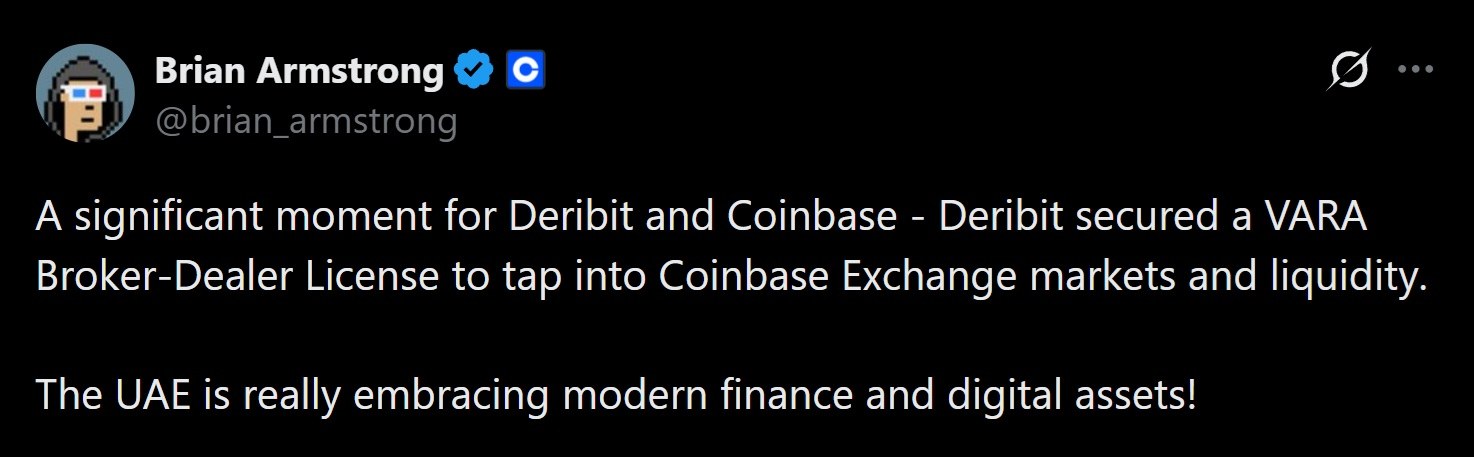
Image source: X

This marks the second clearance Deribit has received from VARA in less than two years. The exchange became the first cryptocurrency derivatives platform to receive VARA approval when it opened its global headquarters in Dubai in early 2025, and it had already been offering spot trading since January of that year under a separate VARA exchange license.

Bitcoin.com News reported on Coinbase's initial agreement to acquire Deribit for roughly $2.9 billion, a deal structured as approximately $700 million in cash plus 11 million shares of Coinbase class A common stock, and later reported that Coinbase completed the deal in August 2025, becoming the undisputed leader in the global cryptocurrency derivatives market.

At the deal's close, Deribit was seeing a monthly trading volume of $185 billion and held an open interest of roughly $60 billion—figures that made the company a clear prize in the derivatives market, which Coinbase had been trying to enter for years.

A Big Bet on the UAE

VARA's approval comes as several other exchanges are also eyeing Dubai as a testing ground for regulated cryptocurrency derivatives and spot trading, significantly outpacing the adoption of similar comprehensive regulatory frameworks in the U.S. or Europe.

For Coinbase, connecting Deribit's liquidity directly to its own order book is also a step towards the "universal exchange" model the company has been building since completing the acquisition, bringing spot trading, futures, options, and now deeper access to offshore liquidity under one roof.

However, this integration does not change how Deribit operates in the U.S. market, as the VARA license is exclusively for activity regulated in Dubai. But it clearly signals where Coinbase sees its near-term growth, which is not in obtaining new U.S. clearances—a process still moving slowly and fraught with political debate—but in accumulating regulatory wins in jurisdictions like the UAE, which have already established clear digital asset licensing frameworks.

Every additional Deribit client connected to Coinbase liquidity also bolsters Coinbase's own trading volume metrics—a figure closely watched by investors as the company reports quarterly derivatives trading volume growth alongside its more mature spot business.


Domande pertinenti

QWhat is the significance of Deribit obtaining a broker-dealer license from Dubai's VARA?

AThe license allows Deribit's spot orders to be routed directly to Coinbase for execution, giving Deribit's user base access to Coinbase's deep centralized order book and liquidity pool.

QWhat key benefit does the Coinbase-Deribit integration provide to Deribit's clients?

AClients' funds can remain within Deribit's own ecosystem, even when being used as collateral for trading derivatives on the platform.

QHow much was the Coinbase acquisition of Deribit valued at, and what was the deal structure?

AThe acquisition was valued at approximately $2.9 billion, structured as around $700 million in cash plus 11 million shares of Coinbase's Class A common stock.

QAccording to the article, what does Dubai's regulatory advancement signal compared to the US and Europe?

AIt indicates that the UAE is significantly outpacing the US and Europe in adopting comprehensive regulatory frameworks for digital assets and embracing modern finance.

QWhy is the integration strategically important for Coinbase's business model and growth?

AIt is a step towards Coinbase's 'universal exchange' model, expands its reach into regulated offshore liquidity (like the UAE), and boosts its reported trading volume metrics, which are closely watched by investors.

Letture associate

Treasury Secretary's Move to Suppress Treasury Yields Ignites 'Currency Debasement Trade'! Gold Hits Three-Month High, Bitcoin Surges Over 25% in a Single Week

US Treasury Secretary Besant's efforts to lower long-term Treasury yields by announcing expanded buybacks had only a brief market impact. However, this move fueled a "currency devaluation trade," weakening the US dollar while boosting both gold (to a three-month high) and Bitcoin (up over 25% for the week). Analysts attribute this reaction to deepening market concerns over the massive US fiscal deficit and structural pressures keeping long-term rates elevated, including fierce competition for capital from global government borrowing and massive AI sector financing. Despite the Treasury's actions, fundamental forces like growth, inflation, and capital demand are seen as limiting its ability to sustainably suppress yields. Bitcoin's strong positive correlation with gold has reinforced its narrative as a hedge against devaluation. While equity markets have shown resilience, some strategists warn that Treasury yields nearing 5% increase pressure on the dollar and high-leverage assets. Figures like Ray Dalio have advised reducing bond exposure in favor of gold and some Bitcoin, citing US debt risks. Market opinions are divided on the sustainability of the devaluation trade, with some noting the lack of a near-term catalyst for its next leg higher. The underlying tension between the Treasury's desire for lower borrowing costs and the Federal Reserve's focus on inflation and reducing market intervention remains a key theme. Upcoming events like Nvidia's earnings and the Jackson Hole symposium will test whether AI profits can continue supporting stocks and if the Fed aligns more with Washington's preference for easier financial conditions.

华尔街日报34 min fa

Treasury Secretary's Move to Suppress Treasury Yields Ignites 'Currency Debasement Trade'! Gold Hits Three-Month High, Bitcoin Surges Over 25% in a Single Week

华尔街日报34 min fa

Alexander Shokhin: Business Needs an Interest Rate Below 10% and the Dollar at 90-95 Rubles

Alexander Shokhin, head of the Russian Union of Industrialists and Entrepreneurs (RSPP), has advocated for potentially using "non-market" tools to keep the ruble within a target exchange rate corridor. This, he argues on August 21, would help avoid excessive volatility, though he called the topic a separate discussion. Shokhin had previously raised the idea of a currency corridor in late May, noting the ruble's current exchange rate is not fully market-driven due to a limited currency segment and reduced foreign currency demand. He stated that many business community colleagues propose fixing a corridor, even through non-market methods, to ensure predictability. The business community's key targets, as outlined by Shokhin in late December 2025, are a Central Bank key rate of 12%, inflation of 4–5%, and a US dollar exchange rate of 90–95 rubles by the end of 2026. A turning point for investment, he said, would be lowering the rate to 12% with 6% inflation, though truly comfortable business conditions would require a rate below 10%. He stressed the critical importance of currency predictability for corporate investment decisions. From a data analysis perspective, the idea of a ruble corridor is not new. A similar mechanism was used in Russia from 1995 to 1998, where the central bank held the dollar within fixed boundaries through regular interventions. This regime lasted three years before ending abruptly during the 1998 default, illustrating the fragility of rigid targets under external shocks. The macro-economic link is clear: stricter corridors require more reserves to defend against currency pressure. The key unresolved technical aspect is the specific sources and volume of such interventions given the current market's limited liquidity. Whether this discussion remains theoretical or leads to concrete corridor parameters will be seen in the coming months.

cryptonews.ru2 h fa

Alexander Shokhin: Business Needs an Interest Rate Below 10% and the Dollar at 90-95 Rubles

cryptonews.ru2 h fa

Trading

Spot
活动图片