Democrats Take Steps to Block the CLARITY Act Due to Protracted Ethics Negotiations

cryptonews.ruPubblicato 2026-08-05Pubblicato ultima volta 2026-08-05

Introduzione

Democratic senators are planning to block a procedural vote to advance the CLARITY Act, a major digital asset bill, due to stalled negotiations on a bipartisan ethics agreement. The Democrats had made this ethics deal a condition for their support. They submitted the agreement text to the White House but have received no response, leading them to withhold the votes needed to proceed. The ethics dispute centers on proposed restrictions for federal officials profiting from digital assets while in office, a measure seen as targeting former President Trump's family crypto ventures. Democrats have rejected the current bill's provisions as insufficient. With time running out before a Friday recess, Senate Majority Leader John Thune insists on holding the vote. However, rules require a one-day delay after filing a cloture motion, making passage this week unlikely without immediate Democratic support. Republicans hold 53 seats and need about seven Democratic votes to reach the 60-vote threshold, which they currently lack. Industry supporters have flooded Congress with over 1 million calls backing the bill. Crypto markets are already reacting; prediction market odds for the CLARITY Act being signed in 2026 have fallen to 23%, and Bitcoin has remained stagnant around $64,000. If the vote fails or is delayed, the bill will be pushed back to at least September, reigniting the ethics fight ahead of the midterm elections.

Democratic senators intend to prevent the closure of debate on the 'Clarity Act'. The reason appears to be a lack of visible progress from the White House on a bipartisan ethics agreement, which Democrats had set as a condition for their votes on the digital assets bill.

The senators have already sent the text of the bipartisan ethics agreement to the White House, but, since no response has been received, the procedural vote is apparently set to fail. Senator Ruben Gallego (Democrat from Arizona), who helped draft the compromise ethics agreement alongside Senator Tom Tillis (Republican from North Carolina), did not hide his disappointment, adding:

"We are clearly here trying to engage in constructive dialogue. At this stage, if they are not making contact, it tells me they don't want this to happen."

The ethics dispute has been plaguing the bill for several weeks, with Democrats wanting to impose mandatory restrictions on federal officials profiting from digital assets while in office (this language is directly aimed at the cryptocurrency businesses of President Trump's family). As a result, they rejected the provision in the current 616-page text as insufficient.

Thune Digs In as Time Runs Out

Senate Majority Leader John Thune (Republican from South Dakota) continues to insist on holding a procedural vote before senators leave Washington, but time is running out. Fox Business correspondent Eleanor Terrett reported that on Tuesday evening, Thune did not file a cloture motion to end debate on the motion to proceed, citing procedural issues related to the interim budget (though she noted that a lack of the necessary votes "likely also played a role").
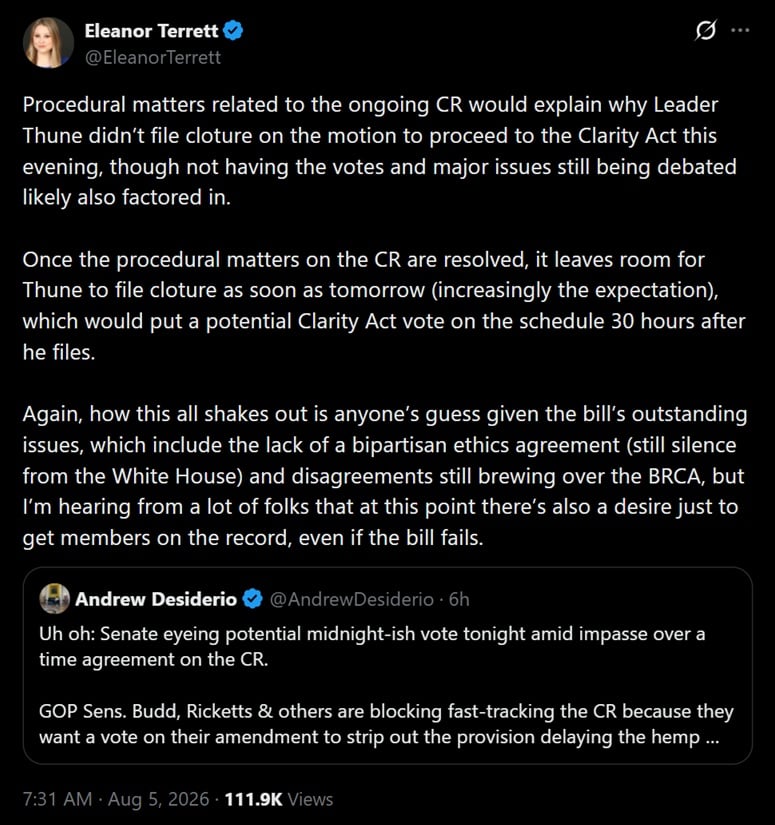
Image Source: X

Since Senate rules require one day between filing a cloture motion and the initial vote, each day without filing the motion brings the bill closer to Friday's recess without a chance of passage. Republicans have 53 seats, meaning roughly seven Democratic votes are needed to reach the 60-vote threshold, which the bill currently lacks.

The pressure campaign from the bill's supporters continues unabated. Senator Cynthia Lummis (Republican from Wyoming) this week called on Democratic senators not to block the bill, calling it legislation that protects consumers and keeps the cryptocurrency industry in the US. Industry supporters have flooded Congress with over 1 million constituent calls in support of the bill.

Markets Lower Odds

Cryptocurrency markets are already pricing in this setback: this week, Polymarket odds for the Clarity Act being signed in 2026 fell from 27% to just 23%, especially after the Senate removed the bill from its schedule on Monday. Bitcoin, which bulls had hoped would return above its highs thanks to a regulatory breakthrough, has instead hovered around the $64,000 mark all week.
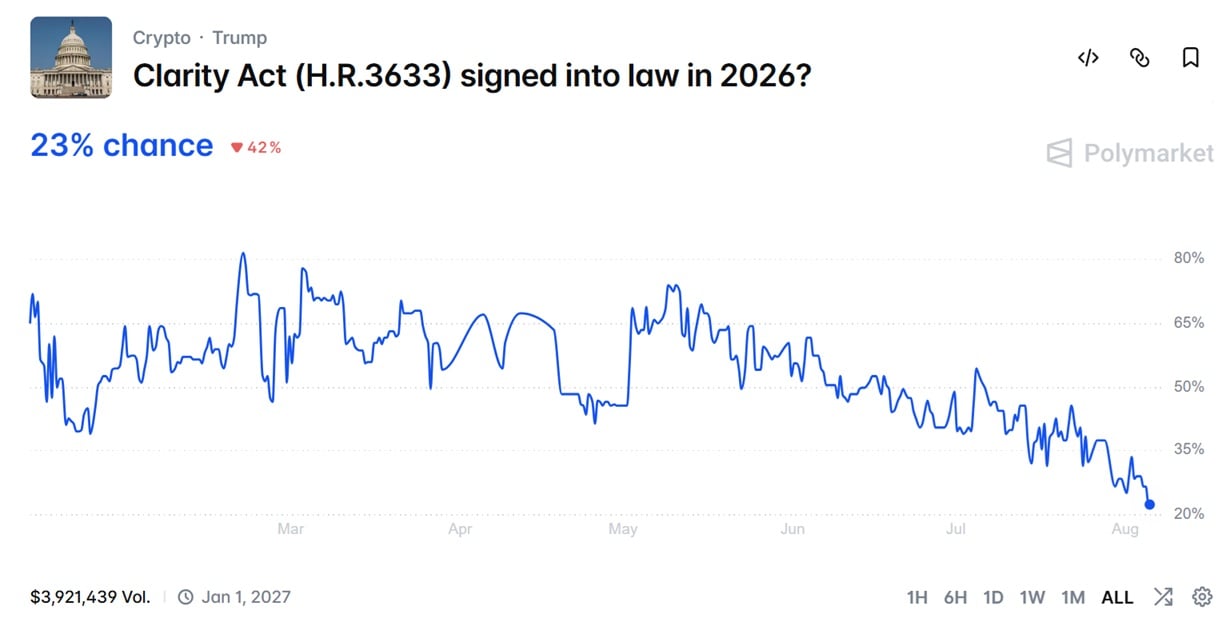
If Thune files the cloture motion on Wednesday, a vote could still occur before the Friday deadline; if the vote fails or never happens, the bill will be postponed until at least September, when the ethics standoff will resume against the backdrop of the approaching midterm elections.

end-content

Domande pertinenti

QWhy are Senate Democrats moving to block the CLARITY Act?

ABecause the White House has not shown progress on a bipartisan ethics agreement that Democrats made a condition for their votes on the digital asset bill.

QWhat is the specific ethics provision that Democrats are demanding in the digital asset bill?

ADemocrats want mandatory restrictions preventing federal officials from profiting from digital assets while in office, a provision targeting the Trump family's cryptocurrency ventures.

QWho is Senator John Thune and what procedural action is he trying to take?

ASenator John Thune (R-South Dakota) is the Majority Leader who is pushing for a cloture vote to end debate and allow the CLARITY Act to proceed before the Friday recess.

QWhat is the current market sentiment regarding the CLARITY Act's passage according to the article?

AMarket sentiment has soured; betting market Polymarket lowered the odds of the CLARITY Act being signed in 2026 from 27% to 23%, and Bitcoin's price has stalled.

QWhat will happen to the CLARITY Act if a cloture vote fails or doesn't occur by Friday?

AIf the cloture vote fails or doesn't happen before the Friday recess, the bill will be delayed until at least September.

Letture associate

Circle Reports Growth in USDC Metrics and Announces Arc Mainnet Launch on September 16

Circle reported growth in USDC metrics and announced the public mainnet launch of its Arc blockchain on September 16. The company's Q2 2026 financials showed positive results, with total revenue and reserve yield reaching $701 million (up 7% YoY) and net income hitting $48 million. The circulating supply of USDC reached $73.3 billion, while on-chain transaction volume surged 151% YoY to $14.8 trillion. A key announcement was the imminent launch of the Arc mainnet, a blockchain designed for institutional and programmable finance. Its inaugural validators include major financial institutions like BlackRock, Visa, Mastercard, ICE, DTCC, and Standard Chartered. Circle also secured final OCC approval for the Circle National Trust, enabling federally regulated custody of digital assets. Regarding USDC adoption, Visa data indicated it facilitated nearly 70% of stablecoin transaction volume in June 2026. Its market share among all stablecoins stood at 27%. Circle highlighted new integrations with institutions like BNY Mellon, Grupo Bind in Argentina, and JCB in Japan. The company is also focusing on an "agent economy," noting over 900 paid services are available on its recently launched Circle Agent Stack, with 99.3% of x402 protocol payments settled in USDC. Consequently, Circle raised its 2026 services and infrastructure revenue forecast from $150-$170 million to $310-$330 million.

cryptonews.ru1 h fa

Circle Reports Growth in USDC Metrics and Announces Arc Mainnet Launch on September 16

cryptonews.ru1 h fa

Trading

Spot
活动图片