DeFi Soars, Meme Breaks Through! Huobi HTX New Assets Weekly Review (1.19—1.25): RIVER Surges 393%, Multi-Sector Heat Resonates

marsbitPubblicato 2026-01-30Pubblicato ultima volta 2026-01-30

Introduzione

The cryptocurrency market showed signs of recovery and increased risk appetite from January 19 to 25, with capital inflow into high-potential sectors. Huobi HTX’s newly listed assets demonstrated significant gains, led by RIVER (River), a chain-abstracted stablecoin system, which surged by 393%. The Chinese meme token "我踏马来了" (based on a viral tweet) also rose 192%. Multiple sectors saw notable activity: - In DeFi, established projects like AUCTION grew by 34%. - Layer-1 project HANA increased by 157%, while Taiko (an Ethereum-equivalent ZK-Rollup) rose 47% in the Layer-2 segment. B2 Network, a Bitcoin Layer-2 solution, gained 19%. - Privacy and AI narratives remained strong, with Oasis Network (ROSE) up 44% and Kite AI (KITE) rising 40%. Huobi HTX emphasized its role in identifying high-quality assets early across diverse sectors—including DeFi, memes, public chains, privacy, AI, and BitcoinFi—enabling users to capture opportunities as market sentiment continues to improve.

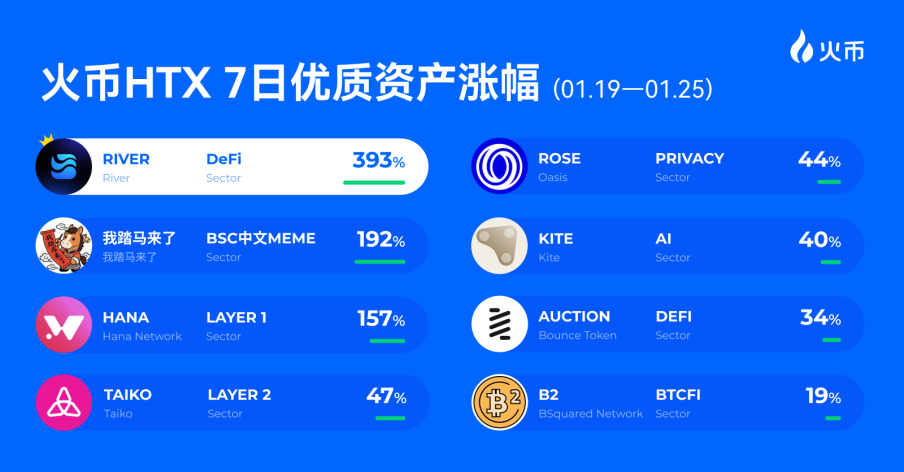
Over the past week (January 19th to January 25th), the crypto market gradually warmed up amidst fluctuations, with a partial recovery in risk appetite. Funds began to re-concentrate on niche sectors with strong narratives and practical application prospects. Data shows that the new assets recently launched on Huobi HTX have released significant wealth effects. As a newly listed project, RIVER surged up to 393% after its listing on Huobi HTX, while the Chinese Meme project "我踏马来了" (I'm F*cking Coming) also saw a substantial increase of 192% post-listing.

As the market gradually recovers, Huobi HTX, through strict project screening and a forward-looking listing pace, continues to provide users with potential asset choices for "earlier discovery and faster participation." Opportunities across multiple sectors are also being realized more quickly on the platform.

DeFi and Meme Sectors: Sentiment Returns, Leading Assets Surge Strongly

RIVER (River): Topped the platform with a weekly peak increase of 393%. River is building a chain-abstract stablecoin system that connects assets, liquidity, and yields across multiple blockchains. Notably, RIVER maintained active trading momentum even after the significant rise. Huobi HTX has simultaneously launched an Earn product with a 10% annualized yield, further expanding the income dimension beyond price performance.

AUCTION (Auction): A veteran DeFi project, up 34% this week. Bounce aims to provide individuals and projects with various types of auctions. The BOT token, the governance token of the bounce.finance platform, has been swapped for AUCTION at a 1:100 ratio. In an environment of overall capital回流 (returning funds), assets with mature mechanisms and application foundations are once again attracting market attention.

我踏马来了 (I'm F*cking Coming): A Chinese Meme project on the BSC ecosystem, originating from a tweet of the same name by He Yi, achieved a weekly gain of 192%. Driven by community dissemination and sentiment, Meme projects with stronger regional and cultural attributes possess higher explosive potential during the market recovery phase.
Public Chains and Scaling: L1, L2 Steadily Advance, BTCFi Ecosystem Actively Explored

HANA (Hana Network): Belongs to the Layer 1 sector, up 157% this week. Hana Network was launched by a Japanese team in December 2022. It builds new interfaces to bring users into cryptocurrency, including streaming and trading platforms. Against the backdrop of the evolving new public chain narrative, its technical roadmap and ecosystem planning are gradually gaining market recognition.

TAIKO (Taiko): Belongs to the Layer 2 sector, with a weekly increase of 47%. Taiko is a fully open-source, permissionless Ethereum-equivalent ZK Rollup designed to natively scale Ethereum. The market maintains long-term expectations for Ethereum scaling solutions.

B2 (B2 Network): Belongs to the BTCFi / Layer2 sector, up 19% this week. B2 Network is a next-generation Layer 2 scaling solution built on Bitcoin (BTC), aiming to significantly enhance Bitcoin's performance and scalability without compromising its foundational security. This sector is still in its early stages of development and possesses long-term potential.

Privacy Computing and AI Sectors: Structural Opportunities Continue to Unfold

ROSE (Oasis): A representative asset in the privacy sector, up 44% this week. Oasis Network is a secure and scalable blockchain platform designed to redefine decentralized finance (DeFi) and promote the broader adoption of blockchain technology beyond early users. Against the backdrop of increasing data security and compliance demands, the mid-to-long-term value of the privacy computing sector continues to attract attention.

KITE (Kite AI): An AI sector asset, with a weekly gain of 40%. Kite is building the first AI payment blockchain—a foundational infrastructure enabling autonomous AI agents to operate within it. After a phase of adjustment, the AI narrative continues to hold sustained appeal for quality projects.

High-Quality New Listings Continue to Deliver, Huobi HTX's Asset Selection Strength Highlighted

Overall, in the past week, new assets listed on Huobi HTX showed synchronized strength across multiple sectors, including high-volatility DeFi and Meme, as well as mid-to-long-term directions like public chains, privacy, AI, and BTCFi. As the market gradually recovers, Huobi HTX continues to provide users with a more diverse selection of potential high-quality assets through strict screening and forward-looking布局 (layout). As market sentiment further repairs, the structural行情 (market conditions) of multi-sector resonance remain worthy of持续关注 (ongoing attention).

About Huobi HTX

Huobi HTX was established in 2013. After 12 years of development, it has evolved from a cryptocurrency exchange into a comprehensive blockchain business ecosystem encompassing digital asset trading, financial derivatives, research, investment, incubation, and other services.

Huobi HTX, as a leading global Web3 gateway, adheres to a development strategy of global expansion, ecological prosperity, wealth effect, and security & compliance, providing comprehensive, secure, and reliable value and services to global virtual currency enthusiasts.

To learn more about Huobi HTX, please visit https://www.htx.com/ or HTX Square, and follow us on X, Telegram, and Discord. For further inquiries, please contact [email protected].


Domande pertinenti

QWhich newly listed asset on Huobi HTX had the highest weekly gain, and what was the percentage increase?

ARIVER (River) had the highest weekly gain, with an increase of 393%.

QWhat is the main focus of the project RIVER (River)?

ARIVER is building a chain-abstracted stablecoin system that connects assets, liquidity, and yields across multiple blockchains.

QWhich Chinese Meme project saw significant growth after listing on Huobi HTX, and what was its inspiration?

AThe Chinese Meme project '我踏马来了' (I'm F*cking Coming) saw a 192% increase. It was inspired by a tweet of the same name by He Yi.

QWhat type of project is TAIKO, and what is its core technology?

ATAIKO is a Layer 2 project. It is a fully open-source, permissionless Ethereum-equivalent ZK-Rollup designed to natively scale Ethereum.

QWhich asset from the AI sector was highlighted, and what is its project's goal?

AKITE (Kite AI) was highlighted, with a 40% weekly gain. The project is building the first AI payment blockchain, a foundational infrastructure for autonomous AI agents to operate.

Letture associate

TechFlow Intelligence Bureau: Chip Stocks Lose Trillions in a Single Day, Bitcoin Falls Below $60,000, US-Iran Conflict Escalates

**Daily Tech & Markets Roundup: AI Advances, Market Turmoil, and Geopolitical Tensions** **AI / LLMs**: Anthropic's internal report on AI self-improvement sparked serious discussions about Recursive Self-Improvement (RSI). Meanwhile, debate continues on AI coding tools after Claude was accused of introducing bugs into the rsync codebase. In positive news, DeepSeek V4 Flash impressed in local deployment tests, and GitHub Copilot now supports custom endpoints for local models. A surprising research turn suggests removing chain-of-thought prompting can sometimes improve LLM performance. **Crypto / Web3**: Bitcoin plunged below $60,000, with its RSI hitting levels last seen during the COVID-19 crash, driven by strong U.S. jobs data reviving interest rate hike fears. Discussions highlight Ethereum DeFi's continued lack of a smooth consumer payment layer. **Chips / Hardware**: Chip stocks suffered a massive sell-off, with the Philadelphia Semiconductor Index posting its worst single-day drop in six years, erasing over a trillion dollars in value. Marvell, Micron, AMD, and Intel were among the biggest losers. **Tech Companies**: A leaked Microsoft document revealing goals to make Copilot "addictive" drew criticism. LinkedIn founder Reid Hoffman left Microsoft's board to focus full-time on his AI agent startup, Manus. Google was revealed to be paying SpaceX $920 million monthly for AI training compute. **Markets & Macro**: A blowout U.S. jobs report (172k vs. 80k expected) crushed hopes for near-term rate cuts, sending Treasury yields soaring and triggering a broad market sell-off. CEOs from Kraft, McDonald's, and Whirlpool simultaneously warned U.S. consumers are exhausting their savings. **Geopolitics**: U.S.-Iran tensions escalated with missile/drone interceptions and U.S. strikes on Iranian radar sites, keeping the critical Strait of Hormuz largely closed since late February and posing ongoing oil supply risks. **The Bottom Line**: The strong jobs data acted as a single trigger for correlated sell-offs across equities, crypto, and chips. Underlying the volatility is a stark contradiction between robust employment data and warnings of consumer weakness, alongside geopolitical risks that could reignite inflation, leaving markets to price in a fraught macro outlook with no clear "soft landing" path.

marsbit1 h fa

TechFlow Intelligence Bureau: Chip Stocks Lose Trillions in a Single Day, Bitcoin Falls Below $60,000, US-Iran Conflict Escalates

marsbit1 h fa

It Took Me a Year to See the Bitter Truth About Agent Payments

After a year building infrastructure for the Agent economy, engaging with major players like Stripe, Visa, and Coinbase, the author shares a sobering analysis of the current state of Agent payments. The core finding is a stark lack of genuine, immediate demand across most envisioned use cases. The article breaks down four key market segments: 1. **Agent-to-Merchant (Consumer Shopping):** For most product categories (e.g., clothing, electronics), conversational AI shopping is a step backwards from visual e-commerce interfaces. While agents excel at understanding needs, they can't replace side-by-side product comparison. Real merchant interest is defensive "Agent Engine Optimization," not driven by current customer demand. Potential exists for high-frequency, low-decision purchases (like food delivery) or navigating complex store UIs, but these require massive B2C distribution channels dominated by giants like Amazon. 2. **Agent-to-API (Developer Services):** Developers already have subscriptions and billing relationships for APIs (compute, data). Prepaid balances solve micro-payment issues for low transaction volumes. A deeper structural problem is that major SaaS vendors' business models rely on enterprise contracts, resisting granular pay-per-call pricing. While protocols like MPP and x402 serve the long tail of niche services, this market is small and developers are historically low-willingness-to-pay. 3. **Agent-to-Agent:** This remains largely theoretical with minimal transaction volume. While it represents a long-term bet on a fundamentally new transaction infrastructure (sub-second, micro-penny to million-dollar, multi-party settlements), it does not constitute a present market. 4. **Agent-to-Finance:** This is the only category with existing, paying demand. Integrating AI into financial workflows (trading, portfolio management) is a natural evolution and enables new capabilities like autonomous rebalancing. However, competition favors established, regulated institutions. The "real problem" is not moving money between agents, but the broader challenge of **coordination**—orchestrating work between agents and humans, verifying outcomes, and settling results. Payment is just one component of settlement, which is itself part of coordination. Companies that solve the coordination layer will subsume payment, not the other way around. While well-funded incumbents build defensively for a long-term future, startups must find where the market is today—which, for the author's team, lies outside these four categories in an area of real, growing, and underserved activity.

marsbit2 h fa

It Took Me a Year to See the Bitter Truth About Agent Payments

marsbit2 h fa

It Took Me a Year to See the Hard Truth About Agent Payments

**Title: It Took Me a Year to See the Hard Truth About Agent Payments** Over the past year, I've worked on infrastructure for the Agent economy, engaging with major players like Stripe, Visa, Coinbase, and numerous startups. The findings reveal a stark reality: genuine, widespread demand for Agent-based payments does not yet exist. **Key Observations:** * **Agent-to-Merchant (Shopping):** The user experience for AI shopping often falls short, especially for visual product discovery. While AI excels at understanding needs, conversational interfaces can't yet replace browsing and comparing multiple products visually. Current merchant interest is largely defensive ("Agent Engine Optimization") for a future that hasn't arrived. High-frequency, low-friction purchases (like food delivery) are potential fits, but lack open APIs and face high AI inference costs. Simpler, more affordable, or cross-language interactions for complex UIs are a niche opportunity but require massive consumer distribution to scale. * **Agent-to-API (Developer Tools):** Developer payment needs for APIs (computing, data, models) are already met through subscriptions and prepaid credits. The core challenge is not payment friction but supplier economics: most large SaaS providers prefer enterprise contracts over micropayments for API calls. Protocols like MPP and x402 suit the long-tail of smaller services but cater to a developer market historically reluctant to pay for these tools. Major infrastructure needs at the top of the stack are already being addressed. * **Agent-to-Agent (Machine Commerce):** This is a long-term vision with almost no current transaction volume. While a future with high-speed, high-frequency, multi-party machine-to-machine transactions would require novel infrastructure, it remains theoretical. The market is not here yet. * **Agent-to-Finance:** This is the only category with clear, present demand. Financial professionals and DeFi users already pay for tools, and AI augmentation is a natural evolution. Autonomous AI agents can enable entirely new financial strategies. However, competition is fierce from established, regulated incumbents who can more easily layer AI onto their existing products. **The Core Insight:** Companies, especially giants with long time horizons, are building defensively for a potential future of mass machine commerce. For them, early investment is a low-cost hedge. For startups, the current market reality is different. The primary challenge isn't just moving money between agents (payments). The larger, unsolved problem is **orchestration** – coordinating work between agents and humans, verifying outcomes, and then settling. Payment is just a part of settlement, which is just a part of orchestration. Companies that solve the orchestration problem will subsume payments, not the other way around. After a year of building, we see the real, growing, and underserved market opportunity lies in this broader domain of orchestration.

链捕手2 h fa

It Took Me a Year to See the Hard Truth About Agent Payments

链捕手2 h fa

Trading

Spot
Futures

Articoli Popolari

Cosa è MEME 2.0

Memecoin 2.0: L'Ascesa di $MEME 2.0 nel Mondo delle Criptovalute Introduzione Nel panorama in continua evoluzione delle criptovalute, è emerso un nuovo contendente. Memecoin 2.0, simboleggiato come $MEME 2.0, porta il concetto di meme coin a un livello emozionante. Come prodotto derivato dal Memecoin originale, questo progetto ha catturato l'attenzione della comunità crypto spostando il focus da incentivi finanziari tipici a un'esperienza coinvolgente e divertente. Operando sulla blockchain di Ethereum, Memecoin 2.0 ridefinisce audacemente l'impegno della comunità nella sfera crypto. Che cos'è Memecoin 2.0, $MEME 2.0? Alla base, Memecoin 2.0 è un progetto di criptovaluta che dà priorità allo spirito di comunità e al divertimento associato alla cultura meme. A differenza delle criptovalute convenzionali, che si concentrano su casi d'uso pratici e benefici tangibili, Memecoin 2.0 si distingue abbracciando il lato più leggero della moneta digitale. Il progetto esiste senza promesse di utilità, una roadmap strutturata o ritorni finanziari, concentrandosi invece sulla creazione di una comunità vibrante incentrata sui meme e sul divertimento condiviso. Facendo così, attinge alla crescente tendenza della cultura meme nello spazio online, rendendola un giocatore unico nel mondo degli asset digitali. Creatore di Memecoin 2.0, $MEME 2.0 Nonostante ricerche approfondite sulle origini di Memecoin 2.0, l'identità esplicita del suo creatore rimane sconosciuta. Questa anonimità non è rara nella comunità crypto, dove molti progetti sono guidati da individui o gruppi che preferiscono rimanere dietro le quinte. La mancanza di informazioni pubblicamente disponibili sul creatore potrebbe essere vista come una mossa strategica, mettendo in evidenza l'impegno della comunità piuttosto che la notorietà individuale all'interno dello spazio. Investitori di Memecoin 2.0, $MEME 2.0 Le informazioni riguardanti gli investitori o il supporto finanziario per Memecoin 2.0 sono scarse. Questa assenza di dettagli potrebbe suggerire che il progetto sia autofinanziato o che il suo focus sulla comunità piuttosto che sulle strutture d'investimento tradizionali abbia attratto un tipo diverso di sostenitore. Poiché il mondo delle meme coin coinvolge tipicamente un maggior coinvolgimento di base piuttosto che investimenti istituzionali, questo approccio si allinea con l'etica dei progetti guidati dalla comunità. Come funziona Memecoin 2.0, $MEME 2.0? Memecoin 2.0 opera interamente sulla blockchain di Ethereum, capitalizzando le sue robuste caratteristiche di sicurezza e scalabilità. Sfruttando i punti di forza di Ethereum, Memecoin 2.0 può offrire un ambiente sicuro per le interazioni degli utenti garantendo che le transazioni siano sia efficienti che convenienti. Uno degli attributi unici di Memecoin 2.0 risiede nella sua struttura guidata dalla comunità. Il valore e la popolarità del token $MEME 2.0 derivano dalla partecipazione attiva dei suoi utenti, piuttosto che dalla utilità intrinseca. Questo design rinforza il focus del progetto sull'aspetto dell'intrattenimento delle criptovalute, implicando che la risata e l'impegno della comunità siano le vere monete che guidano il suo successo. Inoltre, il progetto si inserisce all'interno dell'ecosistema più ampio delle meme coin, dove il valore di ciascuna meme coin oscilla in base alla cultura, alle tendenze e all'impegno della comunità piuttosto che ai principi economici tradizionali. Cronologia di Memecoin 2.0, $MEME 2.0 Per comprendere meglio l'evoluzione e le pietre miliari di Memecoin 2.0, ecco una cronologia che evidenzia eventi significativi nella sua storia: 2024: L'inizio di Memecoin 2.0 è riconosciuto come un ramo del Memecoin originale, affermandosi all'interno del contesto fiorente delle meme coin mentre opera sulla blockchain di Ethereum. 13 luglio 2024: Memecoin 2.0 si posiziona ufficialmente come una meme coin incentrata sulla comunità sulla rete Ethereum, enfatizzando il suo approccio centrato sull'intrattenimento che invita gli utenti a impegnarsi e partecipare alla sua crescita. Punti Chiave su Memecoin 2.0, $MEME 2.0 Diverse caratteristiche critiche definiscono Memecoin 2.0: Approccio Centrico alla Comunità: La missione principale di Memecoin 2.0 è creare un'esperienza comunitaria divertente e coinvolgente, capitalizzando il piacere collettivo derivante dalla cultura memetica. Costruita su Ethereum: Operare sulla blockchain di Ethereum fornisce al progetto un'infrastruttura essenziale che garantisce sicurezza e scalabilità. Mancanza di Utilità o Roadmap: In una marcata deviazione dalle criptovalute tradizionali, Memecoin 2.0 non promette alcuna caratteristica utilitaria o ritorni finanziari, riaffermando il suo impegno per il coinvolgimento della comunità e l'impegno sociale. Focus sulla Cultura Memetica: Abbracciando gli aspetti umoristici e culturali del fenomeno meme, Memecoin 2.0 offre una piattaforma per gli utenti per interagire con la crypto offline e online. Ulteriore Contesto: L'Importanza delle Meme Coin Le meme coin sono emerse come una classe distinta di criptovaluta, spesso guidata dall'umorismo e da un approccio spensierato al trading. Queste monete generalmente mancano di significative utilità o roadmap di sviluppo, attirando gli utenti con la promessa di divertimento, interazione comunitaria e rilevanza culturale. Nel panorama del più ampio ecosistema crypto, le meme coin rianimano l'importanza dell'impegno della comunità, opponendosi ad approcci esclusivamente orientati al profitto. Progetti come Memecoin 2.0 danno il via a un'era in cui l'intrattenimento può armonizzarsi con le aspirazioni finanziarie, trasformando la blockchain in un parco giochi per la creatività e l'interazione sociale. Conclusione Memecoin 2.0, o $MEME 2.0, incarna una nuova ondata di criptovaluta che dà priorità all'impegno della comunità rispetto a rigidi strutture finanziarie. Con un focus sull'umorismo e l'interazione sociale, capitalizza sulla fascinazione circondante la cultura meme. Operando sulla blockchain di Ethereum, Memecoin 2.0 sfrutta le capacità della tecnologia mantenendo fermo il suo impegno per il valore ricreativo della valuta digitale. Mentre lo spazio delle criptovalute continua a evolversi, Memecoin 2.0 serve come testimonianza della nozione che il futuro degli asset digitali potrebbe ben dipendere da esperienze condivise, risate e solidi legami comunitari. Nel mondo imprevedibile delle crypto, forse la gioia può essere altrettanto preziosa quanto il guadagno finanziario tradizionale.

93 Totale visualizzazioniPubblicato il 2024.04.04Aggiornato il 2024.12.03

Cosa è MEME 2.0

Come comprare MEME

Benvenuto in HTX.com! Abbiamo reso l'acquisto di Memeland (MEME) semplice e conveniente. Segui la nostra guida passo passo per intraprendere il tuo viaggio nel mondo delle criptovalute.Step 1: Crea il tuo Account HTXUsa la tua email o numero di telefono per registrarti il tuo account gratuito su HTX. Vivi un'esperienza facile e sblocca tutte le funzionalità,Crea il mio accountStep 2: Vai in Acquista crypto e seleziona il tuo metodo di pagamentoCarta di credito/debito: utilizza la tua Visa o Mastercard per acquistare immediatamente MemelandMEME.Bilancio: Usa i fondi dal bilancio del tuo account HTX per fare trading senza problemi.Terze parti: abbiamo aggiunto metodi di pagamento molto utilizzati come Google Pay e Apple Pay per maggiore comodità.P2P: Fai trading direttamente con altri utenti HTX.Over-the-Counter (OTC): Offriamo servizi su misura e tassi di cambio competitivi per i trader.Step 3: Conserva Memeland (MEME)Dopo aver acquistato Memeland (MEME), conserva nel tuo account HTX. In alternativa, puoi inviare tramite trasferimento blockchain o scambiare per altre criptovalute.Step 4: Scambia Memeland (MEME)Scambia facilmente Memeland (MEME) nel mercato spot di HTX. Accedi al tuo account, seleziona la tua coppia di trading, esegui le tue operazioni e monitora in tempo reale. Offriamo un'esperienza user-friendly sia per chi ha appena iniziato che per i trader più esperti.

291 Totale visualizzazioniPubblicato il 2024.12.12Aggiornato il 2026.06.02

Come comprare MEME

Discussioni

Benvenuto nella Community HTX. Qui puoi rimanere informato sugli ultimi sviluppi della piattaforma e accedere ad approfondimenti esperti sul mercato. Le opinioni degli utenti sul prezzo di MEME MEME sono presentate come di seguito.

活动图片