DeFi Hacked Again, Losing $292 Million: Is Even Aave No Longer Safe?

Odaily星球日报Pubblicato 2026-04-18Pubblicato ultima volta 2026-04-18

Introduzione

On April 19, DeFi suffered another major security breach, with liquid staking protocol Kelp DAO losing approximately 116,500 rsETH (worth around $292 million) due to an exploit in its LayerZero-based bridge contract. The attack originated from a compromised private key on the source chain, allowing the hacker to initiate unauthorized transfer via a single validator. The attacker used the stolen rsETH as collateral on lending platforms including Aave, Compound, and Euler to borrow more liquid assets like wETH, resulting in over $236 million in debt—$196 million from Aave alone. Aave quickly froze its rsETH markets and announced it would explore covering potential bad debt through its Umbrella safety module, which holds about $50 million in WETH. This incident follows a $280 million exploit on Solana’s Drift Protocol earlier in April, raising further concerns about DeFi security. Even established protocols like Aave are now indirectly exposed, prompting warnings for users to diversify holdings and limit exposure to smart contract risks. Investigations are ongoing.

Original | Odaily Planet Daily (@OdailyChina)

Author | Azuma (@azuma_eth)

On April 19th, Beijing time, DeFi security suffered another major blow.

On-chain data shows that around 1:35 this morning, the rsETH bridge contract of Kelp DAO, the second-largest liquid staking protocol based on LayerZero, was suspected to be exploited by hackers, resulting in a loss of 116,500 rsETH, valued at approximately $292 million.

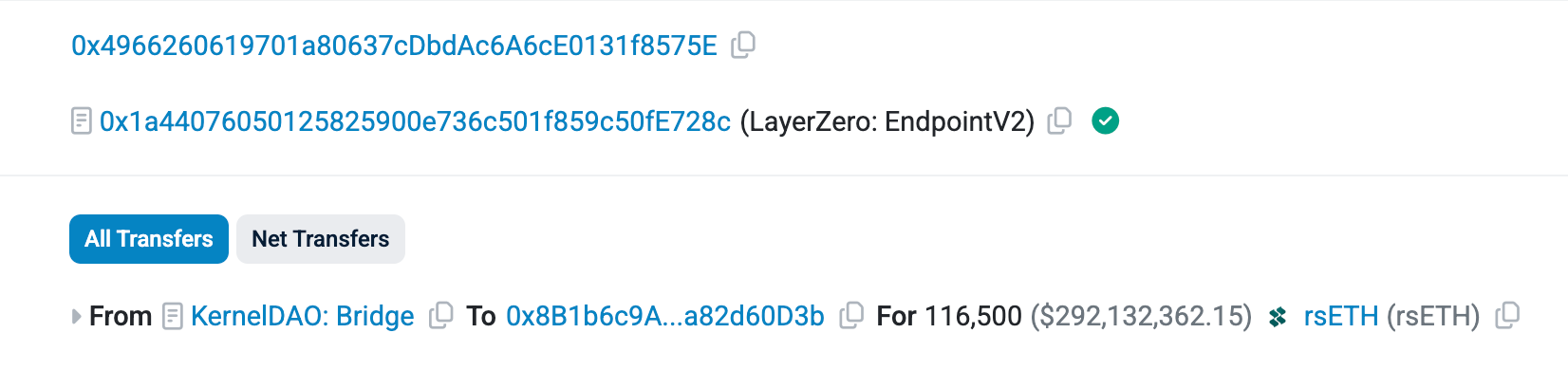
Further tracing the on-chain records, the attacker's address received 1 ETH in initial funds from the mixing protocol Tornado Cash about 10 hours before the incident. Subsequently, this address called the lzReceive function on the LayerZero EndpointV2 contract. This call triggered Kelp's bridge contract, transferring 116,500 rsETH to another attacker address.
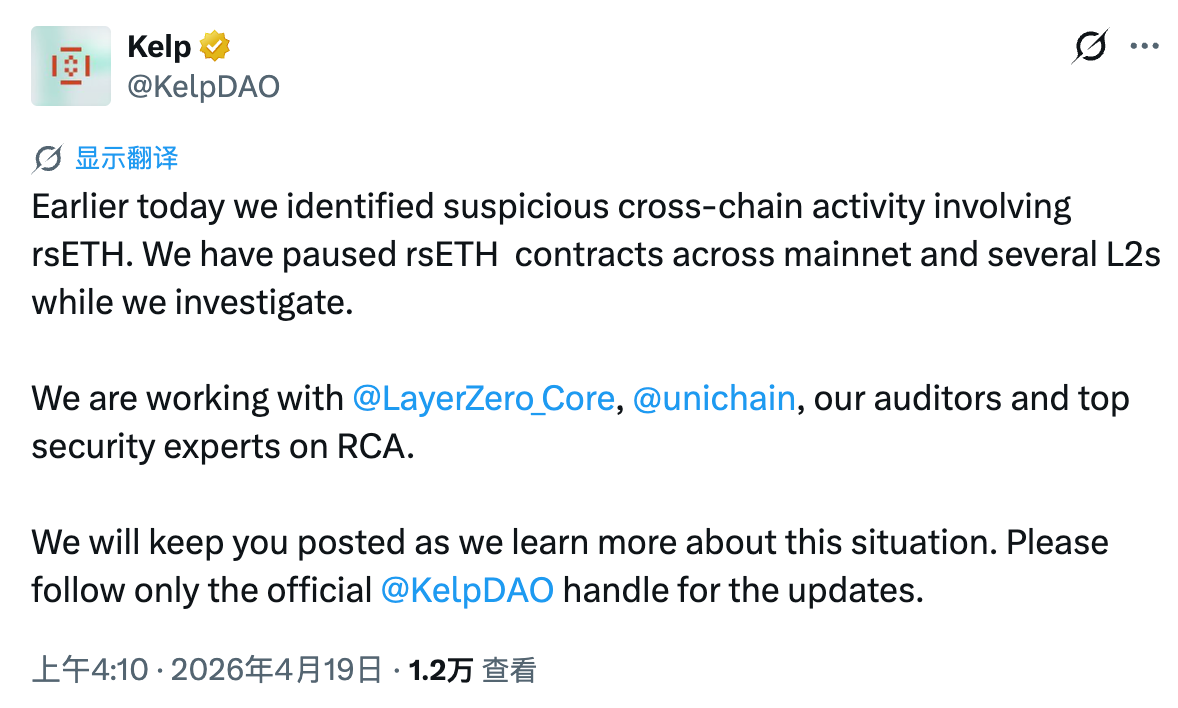
About two and a half hours after the incident, Kelp DAO officially confirmed the attack on X: "Earlier today, we detected suspicious cross-chain activity involving rsETH. During the investigation, we have paused the rsETH contracts on the mainnet and multiple Layer 2s. Our auditors are working with security experts from LayerZero and Unichain to closely monitor the situation. We will keep you updated on the latest developments. Please follow official channels."
After the incident, various DeFi projects and security agencies analyzed the cause. An analysis by D2 Finance was frequently cited within the community — LayerZero Scan marked the source's counterpart as Kelp DAO, meaning the message came from a legitimately deployed endpoint contract by Kelp itself, and this path had previously recorded 308 message nonces. Therefore, the root cause of this attack was a "compromise of the source chain private key."

Steven Enamakel, a developer at TinyHumans AI, added that the contract was secured by only a 1/1 validator set (DVN), meaning a single erroneous transaction from the validator was enough to cause the issue.

Hacker Escapes via Aave, Suspected Bad Debt Incurred

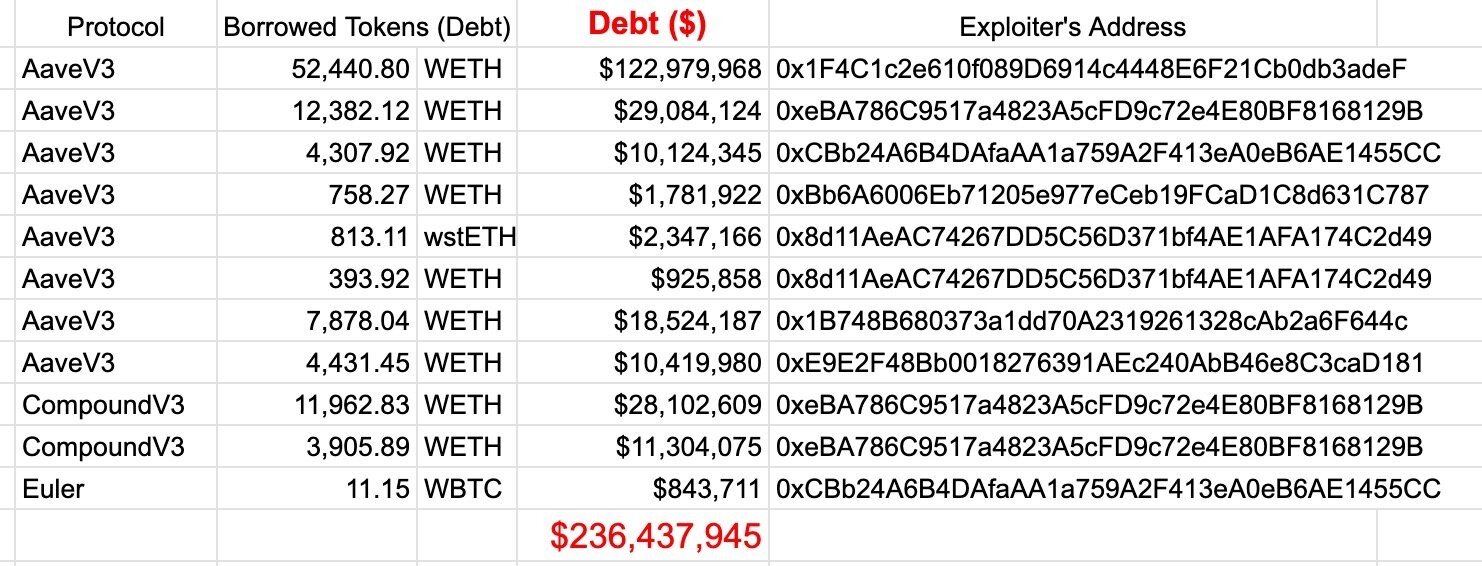
Due to the limited trading liquidity of rsETH itself, the hacker's chosen escape strategy was to route through lending protocols like Aave, using the stolen rsETH as collateral to borrow more liquid wETH.

According to monitoring by PeckShield Alert, as of 4:30 this morning, the hacker's address had deposited the stolen rsETH into lending protocols including Aave V3, Compound V3, and Euler, borrowing a significant amount of WETH, with a total debt exceeding $236 million — of which Aave alone accounted for $196 million, Compound $39.4 million, and Euler only $840,000.
Following the incident, Aave promptly froze the rsETH market on Aave V3 and V4. The team subsequently issued an official statement on X: "Aave contracts have NOT been exploited. The exploit is related to rsETH. Freezing rsETH is to prevent new rsETH deposits and borrowing against rsETH collateral while the situation is assessed. We are reviewing the borrows of rsETH that occurred on Aave post-exploit and will share more details as soon as possible."

Shortly after the initial statement, Aave updated the post, adding: "Should the protocol accrue bad debt from this incident, we will explore avenues to cover the shortfall."

As of the time of writing, the specific amount of bad debt caused by this incident is still unclear.

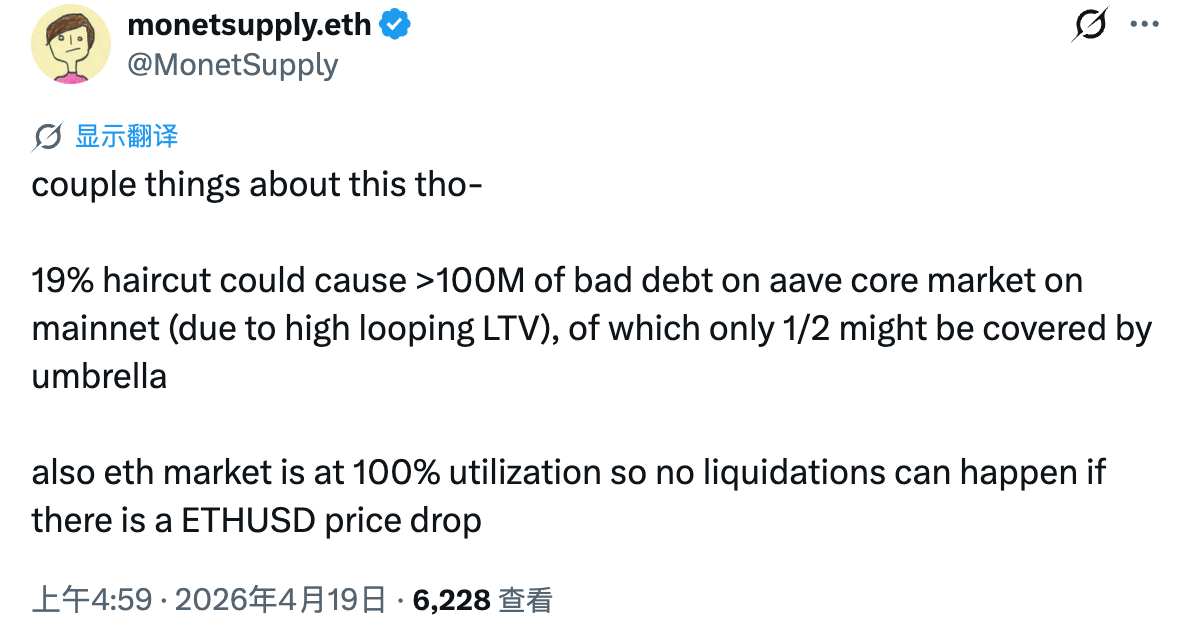
monetsupply.eth, Head of Strategy at Aave's direct competitor Spark, stated that if rsETH experiences a 19% devaluation (the stolen amount represents 19% of the total rsETH supply), Aave could potentially incur over $100 million in bad debt due to highly leveraged recursive borrowing.
However, Marc Zeller, founder of the representative Aave governance team Aave Chan Initiative (ACI) (who has announced his departure from Aave in July due to governance disagreements), offered a different perspective. Zeller initially advised users to quickly withdraw WETH from Aave V3 to avoid losses and confirmed that the USDC and USDT markets on Aave were unaffected. In response to another user's speculation that "bad debt could reach hundreds of millions," he stated: "Far less than that figure."
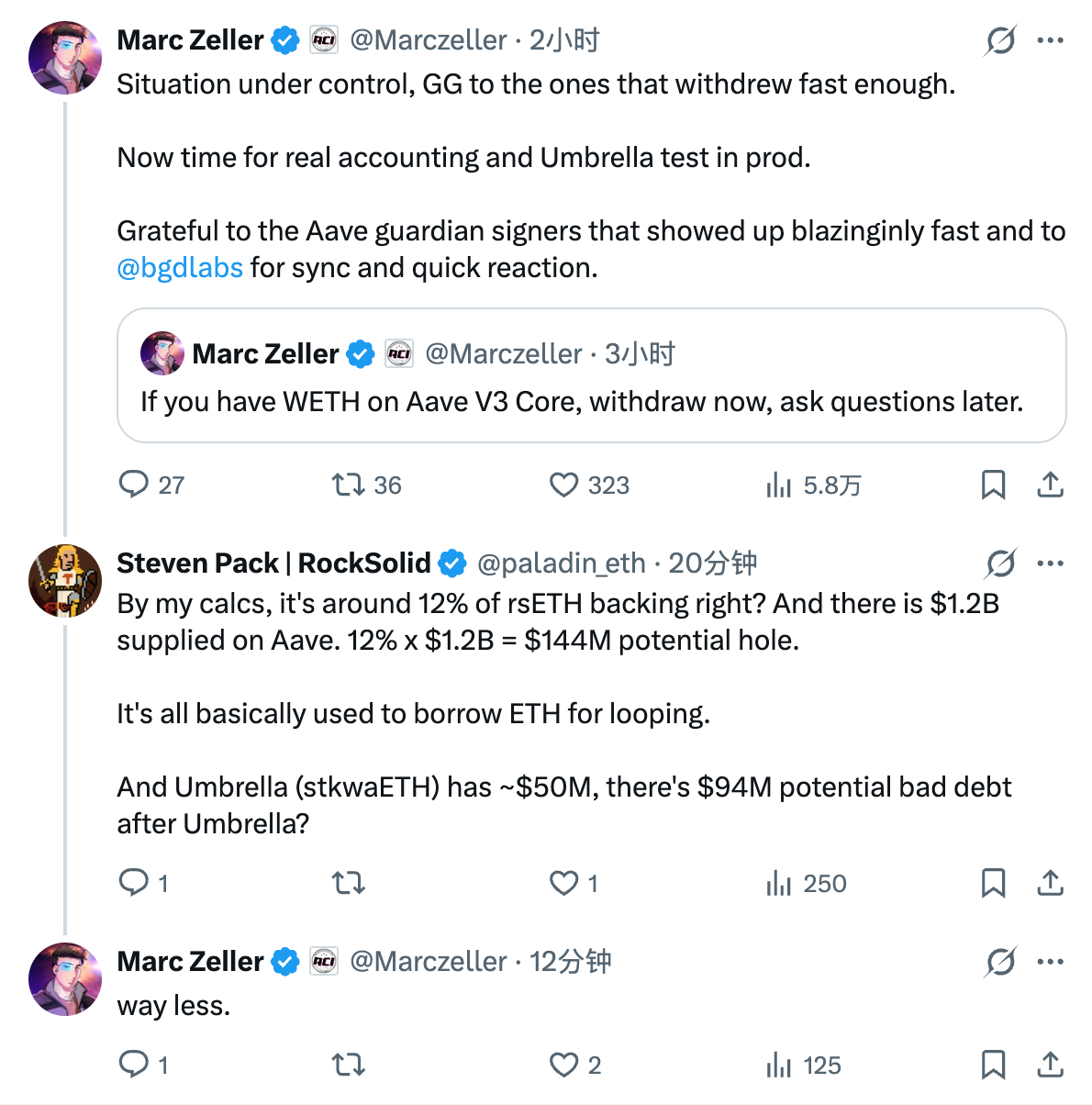
But Marc Zeller also mentioned that it was time to test Umbrella in a real production environment. Umbrella refers to Aave's automatic safety module, essentially a pool of funds to handle bad debt. Users can deposit assets into it for higher incentives, but the pool also bears potential losses if the protocol incurs bad debt.

Aave protocol data shows that Umbrella currently holds approximately $50 million worth of WETH that could be used to address potential bad debt from this incident, but it is uncertain whether this will be sufficient to cover the shortfall.

Affected by this event, AAVE's price fell sharply by nearly 10% in the short term, trading at around 104.6 USDT at the time of writing.

Another Hundred-Million-Dollar Security Incident in April

This is not the first massive security incident this month.

As early as April 1st, the Solana ecosystem derivatives trading protocol Drift Protocol was attacked, losing up to $280 million (see 《April Fool's Joke? Drift Protocol Hacked for Over $280 Million, Possibly Becoming Solana Ecosystem's Second Largest DeFi Heist》).

Afterwards, Drift Protocol directly blamed "North Korean hackers" for the theft, but fortunately, institutions like Tether pledged $147.5 million for user compensation, giving users some hope for reimbursement.

Just over ten days later, another, even bigger hacking incident erupted. How will this one be resolved?

Is There Any Safe Place Left in DeFi?

Security issues in DeFi are intensifying.

On one hand, there are continuous hacking incidents; on the other, there are persistent security threats posed by AI like Mythos (refer to 《Odaily Interview with Yu Xian: How Does the Leak of Anthropic's Nuclear-Grade New Model Affect Crypto Security Offense and Defense?》). For DeFi users, the previous countermeasure was to concentrate funds towards well-audited, reputable top-tier protocols. But now, even a top-tier protocol like Aave, which retail users subconsciously considered extremely unlikely to have problems, is indirectly affected. Where can users move their funds?

Personally, it is currently not advisable to keep large amounts of funds on-chain. If there is a genuine need, please ensure proper diversification and isolation of positions.

As of the time of writing, many details about this incident remain unclear. Odaily will continue to follow the developments of the event. Please stay tuned.


Domande pertinenti

QWhat was the total value of rsETH stolen in the Kelp DAO attack?

AThe attack resulted in the theft of 116,500 rsETH, valued at approximately $292 million.

QWhich lending protocol did the hacker use to borrow WETH using the stolen rsETH as collateral?

AThe hacker used Aave V3, Compound V3, and Euler to borrow WETH, with Aave V3 accounting for the largest debt of $196 million.

QWhat was identified as the root cause of the Kelp DAO bridge contract exploit?

AThe root cause was identified as a compromise of the source chain private key, allowing the attacker to send a malicious message from a legitimate Kelp-deployed endpoint contract.

QWhat is the name of Aave's automatic security module designed to cover potential bad debt, and how much WETH does it currently hold?

AAave's automatic security module is called Umbrella, and it currently holds approximately $50 million worth of WETH to cover potential bad debt from this incident.

QHow did Aave respond to the incident involving the hacker using its protocol?

AAave froze the rsETH market on its Aave V3 and V4 platforms to prevent new deposits and collateralized loans. The team also stated it would explore ways to cover any deficit if the protocol accumulated bad debt from the event.

Letture associate

As Consensus Accelerates, What Are Young Investors Betting On?

Title: As Consensus Forms Faster, What Are Young Investors Betting On? In the rapid evolution of tech investment, a new generation of young investors is navigating a landscape where AI, robotics, commercial aerospace, and quantum computing are advancing simultaneously. Traditional investment logic based on financial models is giving way to a need for deep technical understanding and the ability to act before industry consensus forms. An analysis of trends from the "WAIC FUTURE TECH" list of young investment leaders reveals key shifts in focus. The first major trend is the movement of AI from the digital screen into the physical world. Investment is shifting from large language models and chatbots towards embodied AI, robotics, AI hardware, and edge computing. While demonstrations generate excitement, the real challenge lies in achieving scalable, reliable, and cost-effective delivery in complex real-world environments like factories and logistics. Success depends not just on algorithms but on the integration of sensors, actuators, and control systems. Second, the competitive focus for large models is moving beyond raw capability toward building an "intelligence flywheel." The goal is to create self-reinforcing systems where user interaction generates data, improving the model, which in turn enhances the user experience and attracts more engagement. Companies that successfully embed AI into workflows to create these closed-loop systems can build lasting value that isn't easily erased by the next model upgrade. Third, facing a potential bottleneck in high-quality human-generated data, investors are looking at new underlying technologies. Reinforcement learning and self-play, as demonstrated by AlphaGo Zero, offer paths for AI to generate its own experience. Scientific foundation models, which aim to build general AI capabilities for fields like life sciences and materials discovery, represent a non-consensus direction that could unlock new frontiers of knowledge and data. Finally, in deep-tech areas like quantum computing, commercial aerospace, and space-based infrastructure, patient capital is essential. These fields have long, uncertain development and validation cycles involving complex engineering, supply chains, and regulations. Investment here requires a long-term view, focusing on foundational team capabilities and the eventual emergence of market demand, even if commercial returns are distant. Collectively, these trends illustrate how young investors are adapting to a new era. They are learning to make earlier, technically-informed judgments, balance hype with real-world viability, and provide the patient capital needed to build the deep-tech foundations of the future.

marsbit11 min fa

As Consensus Accelerates, What Are Young Investors Betting On?

marsbit11 min fa

Can Japan Buy Growth with AI? Will the Bond Market Believe It?

Japan's cabinet has introduced the 2026 Basic Policy on Economic and Fiscal Management and Reform, shifting its primary fiscal target. The new framework moves away from the traditional annual primary balance goal and instead prioritizes a stable reduction of the debt-to-GDP ratio. This change is tied to a strategy of increased "responsible proactive fiscal" spending, aiming to boost long-term growth through investments in strategic sectors like AI, semiconductors, energy, and robotics. The government estimates total public and private investment in 62 key technologies could exceed 370 trillion yen by 2040. The market reaction has been mixed and cautious. While equity markets may respond to policy signals, bond markets are focused on fiscal credibility. Concerns center on whether the weakening of the clear primary balance anchor could lead to looser fiscal discipline. If investors doubt that these strategic investments will generate sufficient productivity gains, tax revenue, and nominal growth to outpace rising interest costs, they may demand higher yields on Japanese Government Bonds (JGBs). Recent volatility in the yen and JGB yields, with the 10-year yield briefly reaching 2.9%, reflects this skepticism. The success of this new framework hinges on two factors: whether Japan can achieve a nominal growth rate consistently higher than its long-term interest rates, and whether future budgets demonstrate disciplined control over bond issuance. The government's narrative is that strategic investment is essential to break Japan's cycle of low growth, aging, and labor shortages. However, the bond market will continuously assess the credibility of this plan, pricing the risk that it may represent fiscal expansion rather than a viable growth strategy.

marsbit48 min fa

Can Japan Buy Growth with AI? Will the Bond Market Believe It?

marsbit48 min fa

Misjudged A-Shares: Resilience, Expectations, and Confidence

China's A-share market recently faced selling pressure, especially in tech sectors, initially triggered by a global tech sell-off that began in South Korea. However, the article argues this is a case of "mistaken injury" and highlights the market's underlying resilience. This resilience stems from three main pillars: **1) Tech Sector Fundamentals:** Unlike Korea's market dominated by a few memory chip stocks, China's tech sector is diversified across computing, communications, electronics, and semiconductors, supported by dual narratives of global AI supply chains and domestic substitution. Core areas like optical modules and fiber optics continue to show strong earnings growth. **2) "National Team" Support:** State-backed institutions and large corporations have made significant market purchases and announced buybacks, providing liquidity and signaling confidence. This is seen as a stabilizing policy signal, often associated with market bottoms. **3) Broader Market Pillars:** Other major sectors are showing endogenous recovery momentum. Consumer stocks benefit from stabilizing CPI and signs of sector recovery (e.g., liquor price hikes). Cyclical sectors like aluminum have high earnings, potential price increases due to tight supply, and low valuations. The financial sector offers stable dividends and low valuations. The conclusion is that the sell-off was driven by external contagion, not a collapse in fundamentals. With strong policy support and recovering momentum across key sectors, the A-share market possesses the toughness to regain stability.

marsbit1 h fa

Misjudged A-Shares: Resilience, Expectations, and Confidence

marsbit1 h fa

Trading

Spot
活动图片




