DeFi 借贷的不可能两角

marsbitPubblicato 2026-04-29Pubblicato ultima volta 2026-04-29

作者:Anthony Bowman

编译:佳欢,ChainCatcher

固定利率借贷在链上有着真实的需求。显而易见的应对是发行固定利率贷款,但市场上并无匹配的固定利率放贷需求。

绝大多数链上资金都在追逐收益,并渴望即时流动性。因此,发行固定利率贷款仅仅是将利率风险从借款人转移至贷款人身上。而当贷款人是一个承诺即时流动性的金库时,便会产生资产负债错配。

在可变利率借贷中,利率随资金利用率和市场状况浮动,借款人直接为这种波动买单。这是切实存在的成本,但清晰透明,平仓时随之终止。

假设某贷款人持有一笔利率为3%的6个月期固定贷款。若利率上升,如今同样的贷款收益将达到5%。按市值计价(MTM),旧贷款的价值便缩水了。同等风险下有更高收益的新贷款可选,没人会按旧贷款的摊销值买单。

单笔独立贷款的市值计价损失仅停留在账面,因为贷款人可持有至到期并获全额偿付。唯有将该贷款置于需要持续定价的体系中时,它才会变得极具危险性。

Morpho的V2金库是目前公开的最具代表性的设计,它将固定利率贷款纳入了承诺即时流动性的金库体系中。
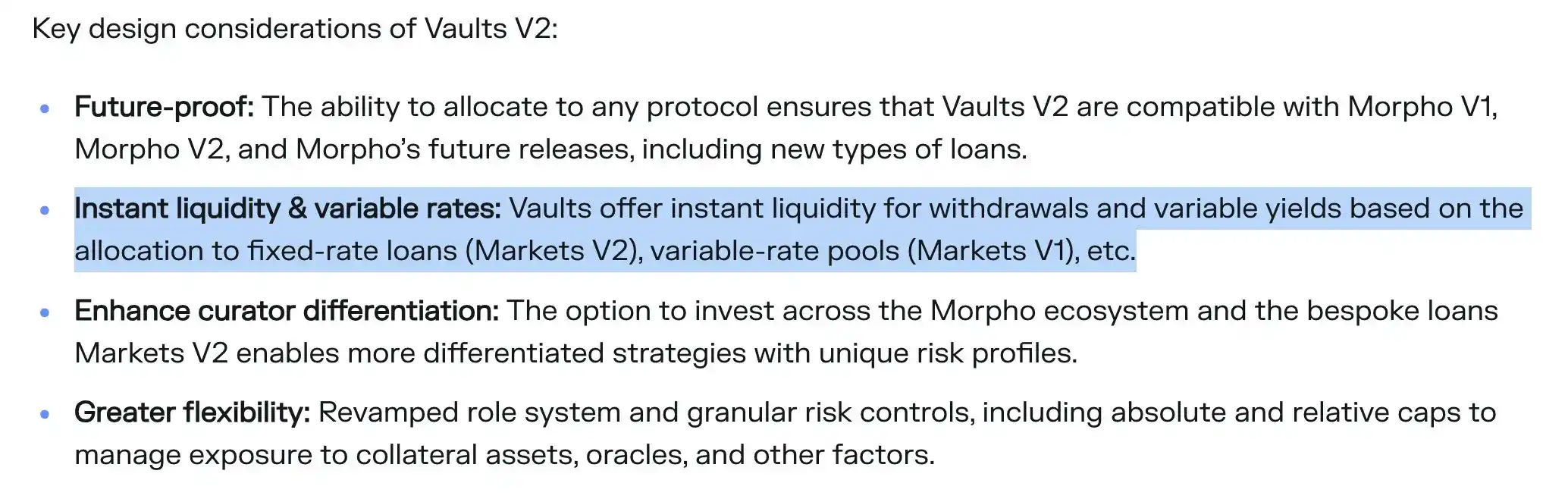
摘自:Morpho固定利率市场:释放链上贷款的潜力

从公开信息来看,该设计包含三个组件:

Morpho Blue: 现有的可变利率借贷协议。放贷方将资金存入隔离市场,借款方支付随资金利用率浮动的利率,头寸可随时开立与平仓。

Morpho Midnight: 通过零息债券(ZCBs)实现的固定利率、固定期限借贷。借贷双方由意图引擎撮合,每笔贷款均为具备特定抵押品、期限和利率的债券。这些零息债券无需许可,支持任意抵押品、期限和参数组合。

Morpho V2金库: 由策展人管理的金库,根据收益率将存款分配至Blue与Midnight之中。存款人按照金库的份额价格进行存取。
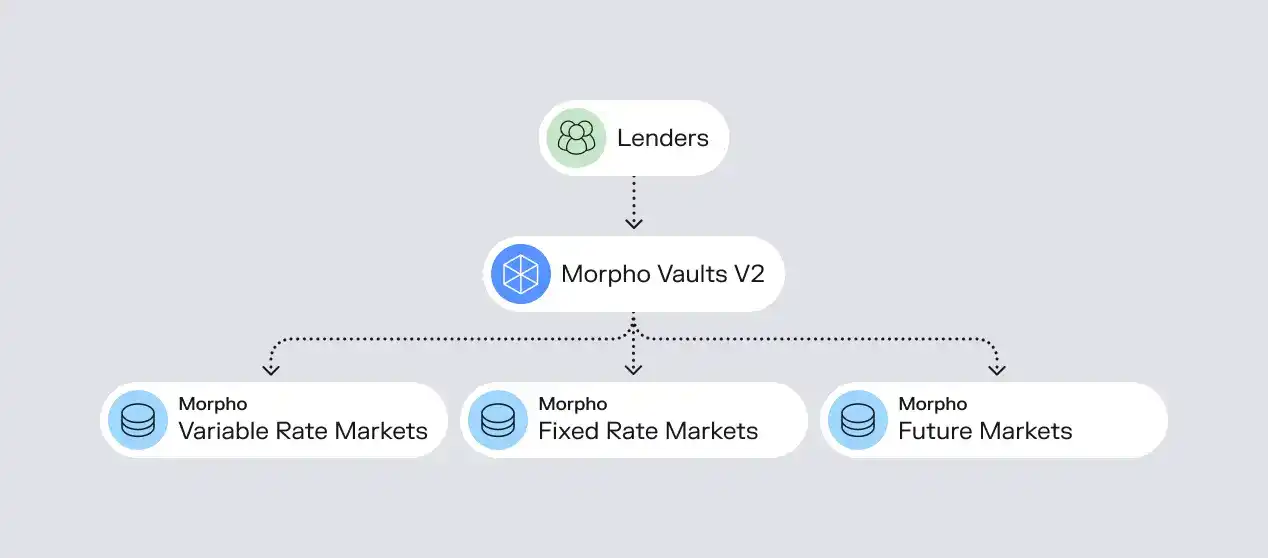
图像来自Morpho V2金库文档

设想两个相互竞争的以USDC计价的金库:金库A将资金同时分配给Blue和Midnight,金库B仅分配给Blue。金库A将30%分配给Blue(可变,3%),70%分配给Midnight(固定,3%)。
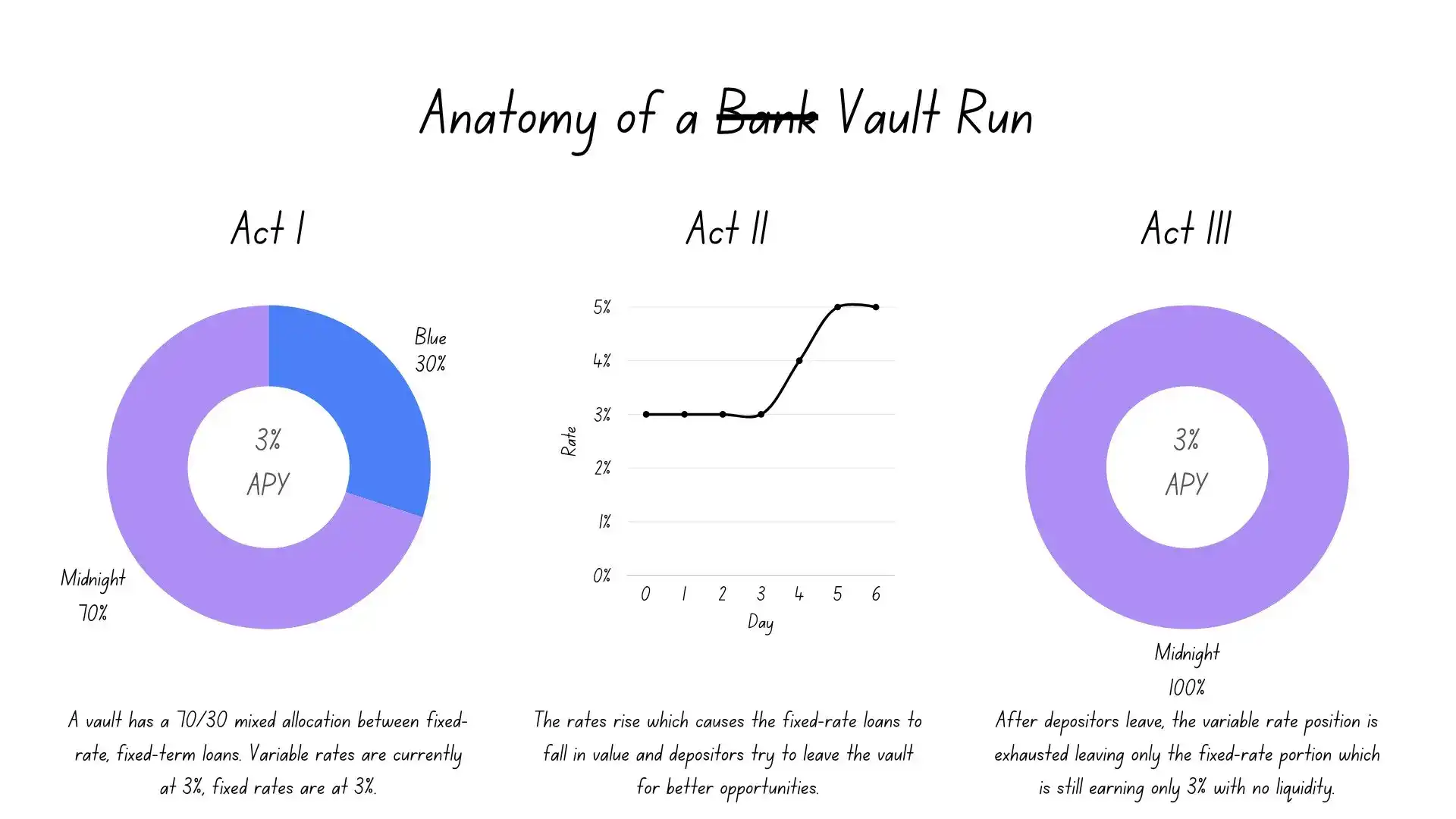
一次利率冲击将可变利率推高至5%,Midnight的头寸依旧锁定在3%。金库A的混合收益率升至3.6%(5%×30%+3%×70%)。纯可变利率的金库B则升至5%。这140个基点的落差便为金库挤兑创造了条件与动机。

金库A的存款人无需去计算市值计价损失,甚至不必知晓其存在。收益率差距本身就是协调机制。资金从A流向B以追逐更高利率,并通过A唯一具备流动性的部分(即可变利率模块)撤出。

这会率先抽干账面收益最高的部分,致使金库A的混合收益率进一步跌落,并加速挤兑。剩下的则是一地缺乏流动性、低于市场利率且只能苦等到期的固定贷款。

如今反转局势。当利率下行,金库A的固定头寸高于市场水平,存款人坐拥按市值计价的收益,却无法将其留住。金库B的存款人嗅到金库A更高的混合收益率,便会涌入存款以图分一杯羹。

新资金以当前份额价格入场,按比例分配到现有账面。这意味着新钱对那些高于市场利率的头寸,享有与原始存款人相同的比例权益。这部分收益便被生生稀释。

左右都是死路。利率涨:存款人跑路,金库挤兑。利率跌:收益被新人稀释

根本问题在于债券的计价方式。尽管零息债券摊销的会计处理手段各异,但暂且不论这一点,真正的问题在于外部利率变动改变了债券的实际价值,而基于摊销的定价未能反映出这一事实。

若以摊销价值对债券进行计价,上述的非对称性便会接踵而至。显见的解决途径是打造一个二级市场,理论上这将允许金库以真实价格为债券计价。

然而,围绕具有任意抵押品、期限和参数的无许可零息债券,是无法形成二级市场的,因为每一种债券实则都是独一无二的,缺乏可供计价的流动性基准。

退一步讲,即便真的形成了二级市场,以此对金库定价也只是以一个问题掩盖一个更糟的问题。份额价格将受制于定制化、流动性稀薄债券的外部交易数据。任何能够影响这些数据的人,都能操纵份额价格,并在金库进出时套利。

表达能力拉满的零息债券与承诺即时流动性的金库,在结构上是相悖的。或许在该架构内部存有某种化解之道,但我尚未得见相关描述,也十分好奇Morpho是否已备有对策。

不过,我个人认为,直接发行固定贷款并非解法,至少在当前超额抵押借贷的短期前景中是如此。若借款人想要固定利率而贷款人渴望即时流动性,那么利率风险就必须转移给愿意承接这种定向风险敞口的人。

若底层的可变利率基准曲线能够愈发高效稳健,利率风险的买方就能提供更优质的固定利率。一如我在此文所探讨的,我们远未触及可变利率市场设计的最终形态。

Letture associate

He Just Raised 2.7 Billion, and Li Fei-Fei Also Invested

Pete Florence, a former senior research scientist at Google DeepMind and a key contributor to the Vision-Language-Action (VLA) model architecture, is deliberately distancing his startup, Generalist AI, from the trendy "world model" label. He argues that the industry should prioritize concrete goals over buzzwords. His goal is to create robots that can perform a vast range of unseen tasks with high speed and success rates, without needing task-specific training data. Recently, his company raised $400 million (¥2.7 billion) at a $2 billion valuation. Notable investors include NVIDIA's NVentures, Bezos Expeditions, NFDG, as well as Xiaomi co-founder Lin Bin, Zoom founder Eric Yuan, and renowned AI scientist Fei-Fei Li. Florence's approach stems from his academic background at MIT under Professor Russ Tedrake, focusing on understanding the physical world. After joining DeepMind, he developed models like Transporter Network and co-created the VLA framework. He left in 2025 to found Generalist AI. The company has launched two models: GEN-0, which demonstrated that scaling laws apply to physical motion, and GEN-1. GEN-1 was trained on over 500,000 hours of physical interaction data collected via a specialized wearable device. It achieves a 99% success rate on precise mechanical tasks like folding boxes and maintains performance three times faster than its predecessor. Florence believes GEN-1 is reaching a commercial utility threshold similar to the GPT-3 inflection point. The substantial funding round, following GEN-1's release, signifies strong investor confidence in Generalist AI's practical, goal-driven path to creating versatile, useful robots, regardless of the "world model" terminology.

marsbit7 min fa

He Just Raised 2.7 Billion, and Li Fei-Fei Also Invested

marsbit7 min fa

Two Legends Lost in Three Days: Is Google's AI Talent Dam Cracking?

In three days, Google lost two AI legends. On June 18, Noam Shazeer, co-author of the seminal "Attention is All You Need" paper and Gemini co-lead, left for OpenAI. Just 48 hours later, John Jumper, 2024 Nobel laureate and AlphaFold lead, departed DeepMind for Anthropic. This follows Andrej Karpathy joining Anthropic in May. These moves highlight a structural trend: top AI talent is concentrating at mission-driven, pre-IPO firms like OpenAI and Anthropic, while Google becomes a primary source. The exodus stems from a core mission mismatch. Google's ad-centric model often subordinates AI research to product and revenue goals, creating friction for pioneers like Shazeer, who returned in 2024 only to leave again. In contrast, OpenAI and Anthropic offer singular focus on pushing AI boundaries, whether towards AGI or safety-aligned models, which deeply appeals to top researchers like Jumper. Financial incentives amplify the pull. With both OpenAI and Anthropic nearing IPO, employees stand to gain immensely from equity, an upside Google's mature stock cannot match. Furthermore, the 2023 merger of Google Brain and DeepMind, intended to consolidate strength, has instead created cultural tension and slowed the path from research to product, as evidenced by Gemini's pace. This talent redistribution is reshaping the AI landscape. While Google retains vast data and compute resources, its true crisis is the quiet, continuous loss of the people who define the field's future. The real moat in AI is not infrastructure, but the concentration of brilliant minds—a battle Google is currently losing.

marsbit2 h fa

Two Legends Lost in Three Days: Is Google's AI Talent Dam Cracking?

marsbit2 h fa

Behind the AI Report Card, Lies a Chinese 'Exam Setter'

Beyond the familiar performance charts like MMLU-Pro and MMMU, which major AI models strive to ace, stands a key "examiner": Chinese-Canadian researcher Wenhu Chen. An assistant professor at the University of Waterloo and founder of TIGERLab, Chen addresses the crucial need for more rigorous AI evaluation. As models like GPT-4 began scoring near-perfect results on older benchmarks like MMLU, it became difficult to distinguish their true capabilities. In response, Chen introduced MMLU-Pro in 2024, featuring harder, more reasoning-focused questions with more answer choices, successfully reintroducing meaningful performance gaps. His work extends to multi-modal evaluation with MMMU and its enhanced version, MMMU-Pro. These benchmarks test a model's ability to understand and reason with complex information from images, charts, and text across diverse academic subjects, exposing the significant challenges even top models face in genuine comprehension. Chen's background in complex QA, table reasoning, and his experience at Google DeepMind on projects like Gemini inform his approach. He understands that effective benchmarks must anticipate how models might "cheat" by memorizing data or avoiding visual analysis. His lab also actively researches video understanding and generation models (e.g., UniVideo, Vamba), ensuring his evaluation work is grounded in practical model-building challenges. Now at Meta's Super Intelligence Lab, Chen continues his focus on multi-modal data and evaluation, representing the deep yet often unseen contributions of Chinese talent in shaping the fundamental tools of the AI industry.

marsbit2 h fa

Behind the AI Report Card, Lies a Chinese 'Exam Setter'

marsbit2 h fa

Alliance Co-founder's Letter to Entrepreneurs: Written at the Moment Cursor Sold for $600 Billion

Alliance Co-founder's Letter to Entrepreneurs: On Cursor's $60 Billion Sale Many aspiring founders see massive exits like Cursor's $60B sale and wonder why they can't achieve the same, often concluding opportunities are exhausted. But great companies aren't built in obvious, crowded spaces. Cursor, like Stripe, Figma, and Shopify before it, started with a non-consensus belief about the future. Before ChatGPT, they believed AI would transform knowledge work. They focused on a genuinely exciting domain, became their own customer, and obsessed over power users. Their journey involved years of "glass-chewing" effort before the market was ready. The pattern is consistent: identify a long-term technological shift, find a missed entry point, and execute for years before the trend becomes obvious. First-generation products (PayPal, Adobe, Amazon) prove a market exists. Second-generation winners (Stripe, Figma, Shopify) rebuild that market around new insights, technology, or changing customer behaviors. Founders must identify their phase in the cycle. Early entrants like Coinbase or Cursor focus on making new technology usable for power users. Later entrants find the "yin" to the established "yang"—the blind spots incumbents miss as they grow distant from individual users. The key is deep market immersion. Use every product in your space. Talk to users. Build an audience. Stop looking for ideas and start *seeing* them everywhere. Then, choose one. The idea must offer a 10x improvement or solve a "hair-on-fire" pain point—something severe enough that users are already crafting workarounds. When building, avoid feature bloat. Ask: why would someone switch? Great startups rarely force new behaviors; they improve familiar workflows with drastically lower friction (e.g., Cursor forked VS Code instead of creating a new editor). Distribution is the underestimated moat. Before product-market fit, achieve distribution-market fit. How do customers discover new tools? Founders like those at Airbnb, Stripe, and Cursor did unscalable, manual work to recruit early users. The final, unteachable ingredient is resilience. Cursor built for years pre-market, faced rejection, and persisted. So did Airbnb, Nvidia, and Rain (which launched post-FTX collapse). The lesson isn't that these founders were smarter, but that they stayed in the game long enough for their insights to compound. Framework: Spot technological cycles. Cultivate unique insight. Obsess over your market. Talk to customers. Find a hair-on-fire problem. Build the simplest wedge. Win your distribution channel. Above all, don't quit when it gets hard. Most people won't do these things consistently. The few who do build the next generation of great companies. Go build.

marsbit2 h fa

Alliance Co-founder's Letter to Entrepreneurs: Written at the Moment Cursor Sold for $600 Billion

marsbit2 h fa

Trading

Spot
Futures
活动图片