Deciphering Messari's 100,000-Word Annual Report (Part 1): Why Did Market Sentiment Collapse Completely in 2025?

深潮Pubblicato 2025-12-22Pubblicato ultima volta 2025-12-22

Introduzione

This article analyzes the 2025 crypto market sentiment collapse, as detailed in Messari's extensive annual report. Despite no major exchange failures, systemic collapses, or regulatory crises, the Crypto Fear & Greed Index hit a historic low of 10. The report argues this extreme pessimism stems not from industry failure, but from a structural shift in market participation and rewards. Key insights include: - Institutional investors thrived due to ETFs, regulated custody (DATs), and clearer frameworks, while retail traders suffered from vanishing alpha, ineffective narratives, and underperformance against Bitcoin. - The emotional crash reflects an identity mismatch: the market now rewards long-term holders and institutional capital, not short-term speculators. - The root cause is the failure of the traditional monetary system, where soaring global government debt forces savers to bear the cost via inflation, financial repression, or negative real rates. Crypto, especially Bitcoin, offers a predictable, non-sovereign alternative. - Bitcoin’s dominance rose to 57.3%, as it became recognized as "money" due to its stability, predictability, and institutional adoption (ETFs, corporate treasuries), not technical superiority. - Layer-1 blockchains (excluding Bitcoin) struggled, with valuations disconnected from declining revenues. They can no longer rely on "becoming money" narratives now that Bitcoin occupies that role, forcing a revaluation based on utility and cash flows, not spe...

Author: Merkle3s Capital

This article is based on the annual report The Crypto Theses 2026 released by Messari in December 2025. The full report exceeds 100,000 words, with an official estimated reading time of 401 minutes.

This content is supported by Block Analytics Ltd X Merkle 3s Capital. The information herein is for reference only and does not constitute any investment advice or offer. We are not responsible for the accuracy of the content, nor for any consequences arising therefrom.

Introduction | The Worst Year for Sentiment, But Not the Most Fragile Year for the System

If we only look at sentiment indicators, the crypto market in 2025 could almost be pronounced "dead."
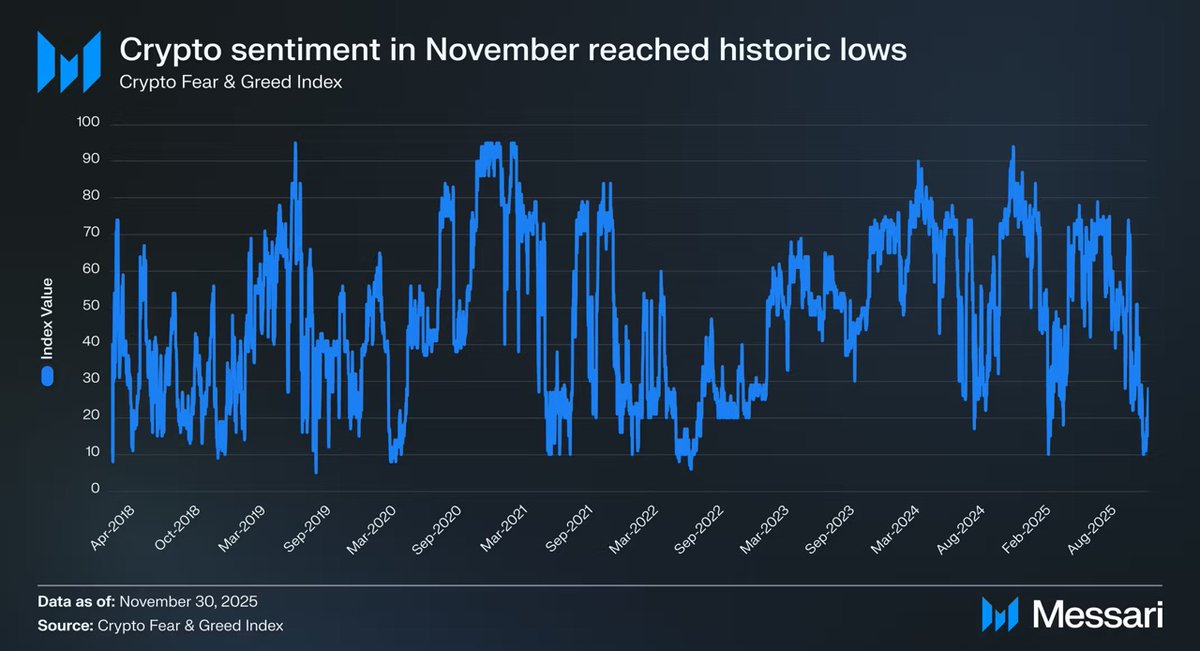
In November 2025, the Crypto Fear & Greed Index fell to 10, entering the "Extreme Fear" zone.

Historically, there have been very few moments when sentiment has fallen to this level:

March 2020: Liquidity stampede triggered by the global pandemic

May 2021: Cascading leveraged liquidations

May–June 2022: Systemic collapse of Luna and 3AC

2018–2019: Industry-wide bear market

These periods all share a commonality: the industry itself was failing, and the future was highly uncertain.

But 2025 does not fit this characteristic.

No major exchange misappropriated user assets.

No Ponzi projects with market caps of hundreds of billions of dollars dominated the narrative.

The total market capitalization did not fall below the previous cycle's high.

Stablecoin supply反而 reached a new all-time high.

Regulatory and institutionalization processes continued to advance.

At the "factual level," this is not a year of industry collapse.

However, at the "perceptual level," it might be the most painful year for many practitioners, investors, and long-time users.

Why Did Sentiment Collapse?

Messari presents a highly impactful contrast at the beginning of the report:

If you were participating in crypto asset allocation from a Wall Street office building, 2025 might have been the best year since you entered the industry. But if you were staying up late staring at charts on Telegram and Discord, searching for Alpha, this was probably the year you missed the "old days" the most.

The same market, two almost diametrically opposite experiences.

This is not a random mood swing, nor a simple bull-bear transition.

It is a deeper structural misalignment:

The market is changing its participants, but most people are still participating in the new system with their old identities.

This Is Not a Market Recap

This article does not intend to discuss short-term price movements, nor does it attempt to answer "will it go up next?".

It is more like a structural explanation:

Why did market sentiment slide to a historically low point while institutions, capital, and infrastructure were continuously strengthening?

Why did many people feel they "chose the wrong track," yet the system itself did not fail?

In this 100,000-word report, Messari chooses to start from an extremely fundamental question:

If crypto assets are ultimately a form of "money," then who deserves to be treated as money?

Understanding this is the prerequisite for understanding the complete collapse of market sentiment in 2025.

Chapter 1 | Why Was Sentiment Abnormally Low?

If we only look at the outcome, the sentiment collapse of 2025 is almost "incomprehensible."

In the absence of exchange blow-ups, systemic credit collapses, or core narrative failures, the market nonetheless provided sentiment feedback near its historical lows.

Messari's judgment is very direct: This is an extreme case of "severe decoupling between sentiment and reality."

1. Sentiment indicators have entered a "historical anomaly zone"

The Crypto Fear & Greed Index falling to 10 is not an ordinary correction signal.

In the past decade, this value has only appeared at a very few moments, and each time it appeared, it was accompanied by a real and profound industry-level crisis:

Breakdown of the funding system

Collapse of credit chains

Market doubt about "whether the future exists"

But these problems did not appear in 2025.

No core infrastructure failed.

No mainstream assets were liquidated to zero.

No systemic events occurred that could shake the industry's legitimacy.

Statistically, this sentiment reading does not match any known historical template.

2. The market did not fail; "personal experience" failed

The collapse of sentiment did not come from the market itself, but from the subjective experience of the participants.

Messari repeatedly emphasizes an overlooked fact in the report:

2025 was a year where the institutional experience was far better than the retail experience.

For institutions, this was an extremely clear, even comfortable environment:

ETFs provided low-friction, low-risk allocation channels

DATs (Digital Asset Treasuries) became stable, predictable long-term buyers

Regulatory frameworks began to clarify, and compliance boundaries became gradually visible

But for a large number of participants under the old structure, this year was exceptionally brutal:

Alpha significantly decreased

Narrative rotation failed

Most assets underperformed BTC over the long term

The relationship between "effort" and "results" was completely broken

The market did not reject people; it just changed the reward mechanism.

3. "Not making money" was misinterpreted as "the industry is failing"

The real trigger for sentiment was not the price drop, but the cognitive gap.

In past cycles, the implicit assumption of Crypto was:

As long as you are diligent enough, early enough, and aggressive enough, you can achieve超额回报 (excess returns).

But 2025 was the first time this assumption was systematically broken.

Most assets no longer gained premiums for "storytelling"

L1 ecosystem growth no longer automatically translated into token returns

High volatility no longer meant high returns

The result was that many participants began to develop an illusion:

If I didn't make money, then the entire industry must have a problem.

Messari's conclusion is恰恰相反 (precisely the opposite):

The industry is becoming more like a mature financial system, not a machine that continuously produces speculative红利 (dividends).

4. The essence of the sentiment collapse is identity misplacement

Considering all phenomena, the implicit answer given by Messari is only one:

The sentiment collapse of 2025 is essentially an identity misplacement.

The market is tilting towards "asset allocators," "long-term holders," and "institutional participants"

But a large number of participants still exist as "short-term alpha seekers"

When the system's reward logic changes, and the participation method does not adjust simultaneously, sentiment is bound to collapse first.

This is not a problem of personal ability, but the friction cost of switching roles in the era.

Summary | Sentiment did not tell you the truth

The market sentiment of 2025 truly reflected the pain of the participants, but it did not accurately reflect the state of the system.

Sentiment collapse ≠ Industry failure

Increased pain ≠ Value disappearance

It only提示 (indicated) one thing:

The old way of participating is quickly becoming obsolete.

And understanding this is the prerequisite for entering the next chapter.

Chapter 2 | The Real Root of Sentiment Collapse: The Monetary System is Failing

If we only stay at the market structure level, the sentiment collapse of 2025 is still not fully explained.

The real problem is not:

Alpha decreased

BTC is too strong

Institutions entered

These are only surface phenomena.

The deeper judgment given by Messari in the report is:

The collapse of market sentiment essentially stems from a long-ignored fact—the monetary system we are in is continuously putting pressure on savers.

A chart that must be faced: Global government debt is out of control
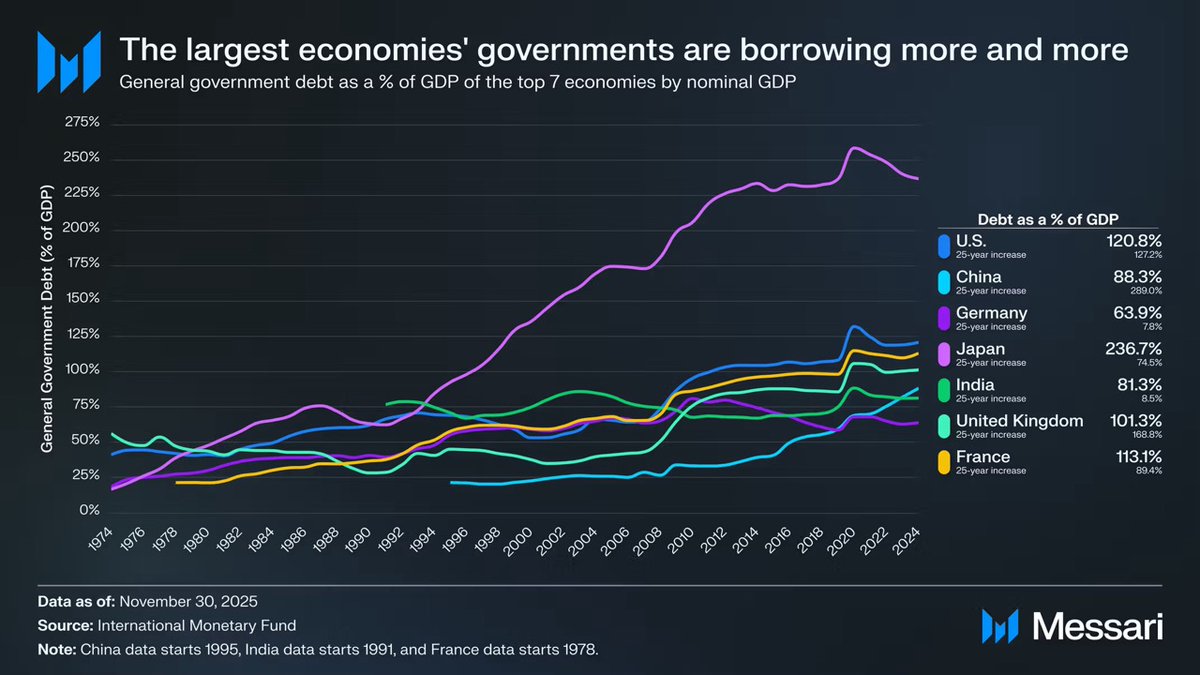
This chart is not a macroeconomic background decoration, but the logical starting point of the entire Cryptomoney argument.

Over the past 50 years, the ratio of government debt to GDP in major global economies has shown a highly consistent, almost irreversible upward trend:

🇺🇸 US: 120.8%

🇯🇵 Japan: 236.7%

🇫🇷 France: 113.1%

🇬🇧 UK: 101.3%

🇨🇳 China: 88.3%

🇮🇳 India: 81.3%

🇩🇪 Germany: 63.9%

This is not the result of governance failure in a particular country, but a common outcome spanning systems, political structures, and development stages.

Whether democratic countries, authoritarian states, developed economies, or emerging markets, government debt has consistently outpaced economic growth in the long run.

What this chart really shows is not "high debt," but "savings are being systematically sacrificed"

When government debt growth consistently outpaces economic output, the system can only maintain stability in three ways:

Inflation

Long-term low real interest rates

Financial repression (capital controls, withdrawal restrictions, regulatory intervention)

Regardless of which path is adopted, the ultimate cost will be borne by the same group:

Savers.

Messari uses an extremely restrained but weighty sentence in the report:

When debt grows faster than economic output, the costs fall most heavily on savers.

Why did sentiment collapse集中 (concentratedly) in 2025?

Because 2025 is the year when more and more participants clearly realized this for the first time.

Before this:

"Inflation is only temporary"

"Cash is always safe"

"Fiat currency is stable in the long run"

And reality is constantly否定 (negating) these assumptions.

When people发现 (discover):

>Hard work ≠ Wealth preservation

The act of saving itself is continuously shrinking in value

The difficulty of asset allocation has increased significantly

The collapse of sentiment does not come from Crypto, but from the shaken confidence in the entire financial system.

Crypto is just the place where this impact is felt first.

The significance of Cryptomoney is not "higher returns"

This is also a point that Messari repeatedly emphasizes but is极易 (extremely easy) to misinterpret.

Cryptomoney does not exist to promise higher returns.

Its core value lies in:

Predictable rules

Monetary policy not arbitrarily changed by a single entity

Assets can be self-custodied

Value can be transferred cross-border without permission

In other words, what it provides is not a "money-making tool," but:

In a world of high debt and low certainty, it重新赋予 (re-grants) individuals the right to choose their money.

The sentiment collapse is actually a form of "清醒" (clarity/awakening)

When you place this debt chart alongside the 2025 market sentiment, you find a counterintuitive conclusion:

Extreme pessimism in sentiment does not mean industry failure, but means more and more people are beginning to realize that the problems of the old system are real.

The problem with Crypto has never been that it is "useless."

The real problem is: It no longer produces easy excess returns for everyone.

Summary | From sentiment, to structure, to money itself

This chapter addresses a fundamental question:

Why, in the absence of a systemic crash, did market sentiment fall to a historical low?

The answer is not in the price charts, but in the monetary structure.

Sentiment collapse, is the表象 (surface manifestation)

Paradigm shift, is the process

Monetary system imbalance, is the root cause

And this is precisely why Messari chose to start the entire report from "money" rather than from "applications."

Chapter 3 | Why Only BTC is Treated as "Real Money"

If you have read this far, it is easy to have a question:

If the problem lies in the monetary system, then why is the answer BTC, and not something else?

Messari's judgment in the report is exceptionally clear:

BTC is no longer on the same competitive dimension as other Crypto assets.

1. Money is not a technical problem, but a consensus problem

This is the first key to understanding BTC.

Messari repeatedly emphasizes a fact easily overlooked by engineers in the original text:

Money is a social consensus, not a technical optimization problem.

In other words:

Money is not about "who is faster"

Not "who is cheaper"

Nor "who has more functions"

But who is treated as a store of value, long-term and stably.

From this perspective, Bitcoin's victory is not mysterious.

2. Three years of data have written the answer on its face
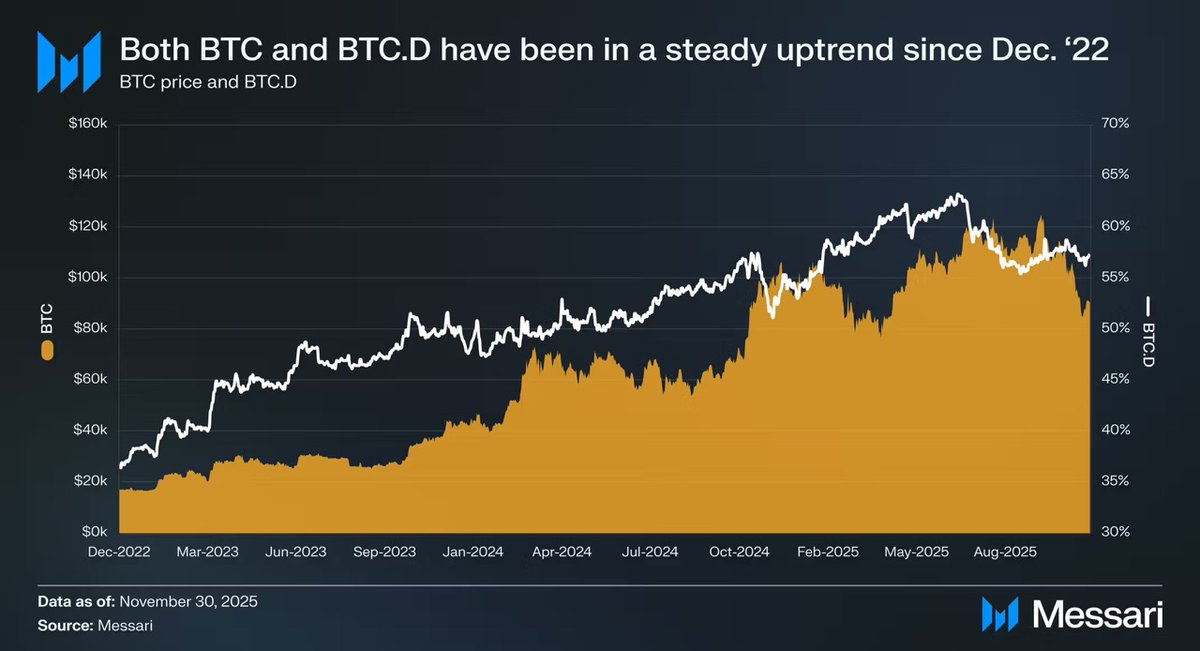
From December 1, 2022, to November 2025:

BTC rose 429%

Market cap from $318 billion → $1.81 trillion

Entered the top 10 global asset rankings

And more importantly, the relative performance:

BTC.D (Bitcoin Dominance) from 36.6% → 57.3%

In a cycle that "theoretically should have seen altcoins soar," funds instead continuously flowed back to BTC

This is not an偶然 (accidental) result of a market cycle; this is the market reclassifying assets.

3. ETFs and DATs are essentially "institutionalizing consensus"

Messari's evaluation of ETFs is very restrained, but the conclusion is extremely weighty.

The Bitcoin ETF is not simply "new buying pressure"; what it truly changes is:

Who is buying + Why they are buying + How long they can hold

ETFs made BTC a compliant asset

DATs made BTC part of corporate balance sheets

National reserves elevated BTC to a "strategic asset" level

When BTC is held by these actors, it is no longer:

"A high-volatility risky asset that can be abandoned at any time"

But rather:

A monetary asset that must be held long-term and cannot afford to make mistakes

Money, once treated this way, finds it difficult to go back.

4. Why BTC becomes more like money the more "boring" it is

This might be the most counterintuitive point of 2025.

BTC has no applications

No narrative rotation

No ecosystem stories

Not even "new things"

But precisely because of this, it meets all the characteristics of "money":

It does not rely on future promises

It does not need growth narratives

It does not require a team to deliver continuously

It only needs to not fail.

And in a world of high debt and low certainty, "not failing" is itself a scarce asset.

5. BTC's strength is not a market failure

The pain of many people comes from an illusion:

"BTC's strength indicates something is wrong with the market."

Messari's judgment is恰恰相反 (precisely the opposite):

BTC's strength is the market becoming more rational.

When the system begins to reward:

Stability

Predictability

Long-term credibility

Then all strategies relying on "high volatility for high returns" will appear increasingly painful.

This is not BTC's problem; this is a problem of participation methods.

Summary | BTC didn't win; it was selected

BTC did not "defeat" other assets.

It was just repeatedly verified by the market in an era of continuous monetary system failure as:

The asset that needs the least explanation

The asset that relies the least on trust

The asset that needs the fewest promises about the future

This is not the result of a market cycle,

But a confirmation of role.

Chapter 4 | When the Market Only Needs One Kind of "Money," the L1 Story Begins to Fail

After confirming that BTC has been selected by the market as the "primary Cryptomoney," one question is unavoidable:

If the answer for money already exists, what is left for Layer 1?

Messari does not give a direct conclusion, but after reading this section, a trend is very clear:

L1 valuations are being forced to move from "future narratives" back to "real-world constraints."

1. A harsh but true fact: 81% of the market cap is in the "money" narrative
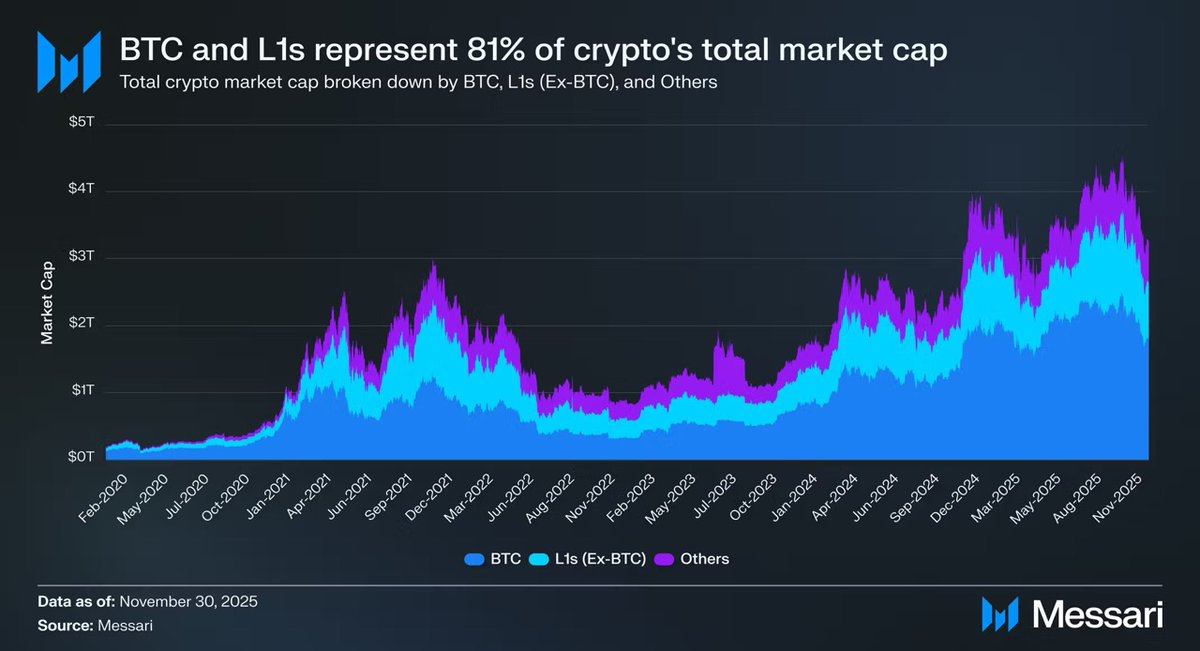
As of the end of 2025, the entire crypto market capitalization is approximately $3.26T:

BTC: $1.80T

Other L1s: approx. $0.83T

Remaining assets: less than $0.63T

Combined:

Approximately 81% of crypto asset market cap is being valued by the market as "money" or "potential money."

What does this mean?

It means L1 valuations are早已 (long) no longer based on the pricing logic of "application platforms,"

But on the pricing logic of "does it qualify to be money?"

2. The problem is: Most L1s do not qualify

The data provided by Messari is very direct and very冷酷 (cold).
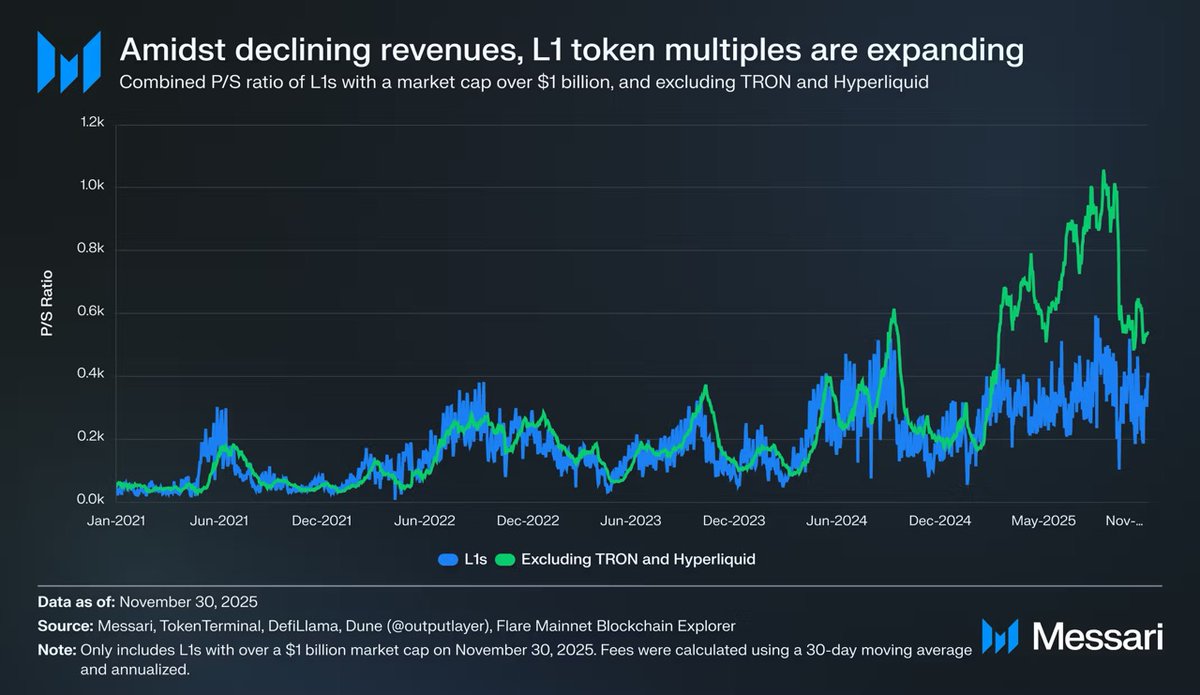
After excluding outliers with abnormally high revenue like TRON and Hyperliquid:

L1 overall revenue持续下滑 (continuously declined)

But valuation multiples却在 (instead)持续抬升 (continuously rose)

The adjusted P/S ratios are as follows:

2021: 40x

2022: 212x

2023: 137x

2024: 205x

2025: 536x

Meanwhile, total L1 revenue:

2021: $12.3B

2022: $4.9B

2023: $2.7B

2024: $3.6B

2025 (annualized): $1.7B

This is a scissors gap that cannot be reasonably explained by "future growth."

3. L1s are not "undervalued"; they are "reclassified"

The pain of many people stems from a misunderstanding:

"Were L1s wrongfully sold off by the market?"

Messari's judgment is恰恰相反 (precisely the opposite):

The market did not wrongfully sell off L1s; it is reducing their 'monetary imagination space.'

If an asset:

Cannot store value stably

Cannot be held long-term

And cannot provide certain cash flow

Then it ultimately only has one pricing method left:

High-beta risky asset.

4. The example of Solana actually explains everything

SOL was one of the few L1s that outperformed BTC in 2025.

But Messari points out a highly damaging fact:

SOL ecosystem data grew 20–30 times

The price only outperformed BTC by an additional 87%

In other words:

To achieve "significant excess returns" against BTC, an L1 needs ecosystem爆发 (explosion) on an order-of-magnitude scale.

This is not "not trying hard enough"; it's that the回报函数 (return function) has been rewritten.

5. When BTC becomes "money," the burden on L1s actually becomes heavier

This is a structural change that many people have not realized.

Before BTC's monetary status was clear:

L1s could tell the story of "becoming money in the future"

The market was willing to pay upfront for this possibility

Now:

BTC has solidified its position

The market is no longer willing to pay the same premium for a "second money"

Thus, L1s face a more difficult question:

If not money, then what exactly are you?

Summary | The problem for L1s is not competition, but positioning

L1s did not "lose to BTC."

What they lost is:

In the dimension of money

The market no longer needs more answers

And once the shelter of the "monetary narrative" is lost, all valuations must重新接受 (re-accept)现实约束 (real-world constraints).

This is the direct source of the sentiment collapse for many participants in 2025.

Domande pertinenti

QAccording to the article, why did the crypto market sentiment crash to a historical low in 2025 despite the absence of major systemic failures?

AThe sentiment crash was not due to industry failure but a structural shift where the market's reward mechanism changed, favoring institutional participants and long-term holders over short-term alpha seekers. This created a cognitive dissonance and identity mismatch for many participants who were still operating under the old paradigm.

QWhat fundamental issue does the article identify as the root cause of the 2025 market sentiment collapse?

AThe root cause is the failure of the traditional monetary system, where global government debt has grown faster than economic output for decades, systematically sacrificing savers through inflation, low real interest rates, and financial repression. This eroded confidence in the entire financial system.

QHow does the article explain Bitcoin's (BTC) dominant performance and its role in the 2025 market?

ABTC was increasingly treated as 'money' due to its predictable rules, non-discretionary monetary policy, self-custody, and permissionless cross-border transfer. It was institutionalized through ETFs and corporate treasuries, making it a long-term hold for stability and certainty in a high-debt world, rather than a high-risk, high-return asset.

QWhat does the article suggest about the valuation and narrative of Layer 1 (L1) blockchains in 2025?

AL1 valuations were forced to shift from 'future money narratives' to 'real-world constraints' as BTC solidified its role as the primary cryptomoney. Without the 'monetary narrative,' L1s faced reclassification as high-beta risk assets, requiring massive ecosystem growth to outperform BTC, which most failed to achieve.

QWhy does the article claim that 2025 was a year of 'identity mismatch' for crypto participants?

AThe market shifted towards rewarding institutional configurers, long-term holders, and regulated participants, but many individuals continued to participate as short-term alpha seekers. When the old strategies of narrative chasing and high leverage failed, their subjective experience of pain and lack of returns led to emotional collapse, despite the industry itself becoming more mature and robust.

Letture associate

Google and Amazon Simultaneously Invest Heavily in a Competitor: The Most Absurd Business Logic of the AI Era Is Becoming Reality

In a span of four days, Amazon announced an additional $25 billion investment, and Google pledged up to $40 billion—both direct competitors pouring over $65 billion into the same AI startup, Anthropic. Rather than a typical venture capital move, this signals the latest escalation in the cloud wars. The core of the deal is not equity but compute pre-orders: Anthropic must spend the majority of these funds on AWS and Google Cloud services and chips, effectively locking in massive future compute consumption. This reflects a shift in cloud market dynamics—enterprises now choose cloud providers based on which hosts the best AI models, not just price or stability. With OpenAI deeply tied to Microsoft, Anthropic’s Claude has become the only viable strategic asset for Google and Amazon to remain competitive. Anthropic’s annualized revenue has surged to $30 billion, and it is expanding into verticals like biotech, positioning itself as a cross-industry AI infrastructure layer. However, this funding comes with constraints: Anthropic’s independence is challenged as it balances two rival investors, its safety-first narrative faces pressure from regulatory scrutiny, and its path to IPO introduces new financial pressures. Globally, this accelerates a "tri-polar" closed-loop structure in AI infrastructure, with Microsoft-OpenAI, Google-Anthropic, and Amazon-Anthropic forming exclusive model-cloud alliances. In contrast, China’s landscape differs—investments like Alibaba and Tencent backing open-source model firm DeepSeek reflect a more decoupled approach, though closed-source models from major cloud providers still dominate. The $65 billion bet is ultimately about securing a seat at the table in an AI-defined future—where missing the model layer means losing the cloud war.

marsbit1 h fa

Google and Amazon Simultaneously Invest Heavily in a Competitor: The Most Absurd Business Logic of the AI Era Is Becoming Reality

marsbit1 h fa

Computing Power Constrained, Why Did DeepSeek-V4 Open Source?

DeepSeek-V4 has been released as a preview open-source model, featuring 1 million tokens of context length as a baseline capability—previously a premium feature locked behind enterprise paywalls by major overseas AI firms. The official announcement, however, openly acknowledges computational constraints, particularly limited service throughput for the high-end DeepSeek-V4-Pro version due to restricted high-end computing power. Rather than competing on pure scale, DeepSeek adopts a pragmatic approach that balances algorithmic innovation with hardware realities in China’s AI ecosystem. The V4-Pro model uses a highly sparse architecture with 1.6T total parameters but only activates 49B during inference. It performs strongly in agentic coding, knowledge-intensive tasks, and STEM reasoning, competing closely with top-tier closed models like Gemini Pro 3.1 and Claude Opus 4.6 in certain scenarios. A key strategic product is the Flash edition, with 284B total parameters but only 13B activated—making it cost-effective and accessible for mid- and low-tier hardware, including domestic AI chips from Huawei (Ascend), Cambricon, and Hygon. This design supports broader adoption across developers and SMEs while stimulating China's domestic semiconductor ecosystem. Despite facing talent outflow and intense competition in user traffic—with rivals like Doubao and Qianwen leading in monthly active users—DeepSeek has maintained technical momentum. The release also comes amid reports of a new funding round targeting a valuation exceeding $10 billion, potentially setting a new record in China’s LLM sector. Ultimately, DeepSeek-V4 represents a shift toward open yet realistic infrastructure development in the constrained compute landscape of Chinese AI, emphasizing engineering efficiency and domestic hardware compatibility over pure model scale.

marsbit2 h fa

Computing Power Constrained, Why Did DeepSeek-V4 Open Source?

marsbit2 h fa

Trading

Spot
Futures

Articoli Popolari

Cosa è $S$

Comprendere SPERO: Una Panoramica Completa Introduzione a SPERO Mentre il panorama dell'innovazione continua a evolversi, l'emergere delle tecnologie web3 e dei progetti di criptovaluta gioca un ruolo fondamentale nel plasmare il futuro digitale. Un progetto che ha attirato l'attenzione in questo campo dinamico è SPERO, denotato come SPERO,$$s$. Questo articolo mira a raccogliere e presentare informazioni dettagliate su SPERO, per aiutare gli appassionati e gli investitori a comprendere le sue basi, obiettivi e innovazioni nei domini web3 e crypto. Che cos'è SPERO,$$s$? SPERO,$$s$ è un progetto unico all'interno dello spazio crypto che cerca di sfruttare i principi della decentralizzazione e della tecnologia blockchain per creare un ecosistema che promuove l'impegno, l'utilità e l'inclusione finanziaria. Il progetto è progettato per facilitare interazioni peer-to-peer in modi nuovi, fornendo agli utenti soluzioni e servizi finanziari innovativi. Al suo interno, SPERO,$$s$ mira a responsabilizzare gli individui fornendo strumenti e piattaforme che migliorano l'esperienza dell'utente nello spazio delle criptovalute. Questo include la possibilità di metodi di transazione più flessibili, la promozione di iniziative guidate dalla comunità e la creazione di percorsi per opportunità finanziarie attraverso applicazioni decentralizzate (dApps). La visione sottostante di SPERO,$$s$ ruota attorno all'inclusività, cercando di colmare le lacune all'interno della finanza tradizionale mentre sfrutta i vantaggi della tecnologia blockchain. Chi è il Creatore di SPERO,$$s$? L'identità del creatore di SPERO,$$s$ rimane piuttosto oscura, poiché ci sono risorse pubblicamente disponibili limitate che forniscono informazioni dettagliate sul suo fondatore o fondatori. Questa mancanza di trasparenza può derivare dall'impegno del progetto per la decentralizzazione—un ethos che molti progetti web3 condividono, dando priorità ai contributi collettivi rispetto al riconoscimento individuale. Centrando le discussioni attorno alla comunità e ai suoi obiettivi collettivi, SPERO,$$s$ incarna l'essenza dell'empowerment senza mettere in evidenza individui specifici. Pertanto, comprendere l'etica e la missione di SPERO rimane più importante che identificare un creatore singolo. Chi sono gli Investitori di SPERO,$$s$? SPERO,$$s$ è supportato da una varietà di investitori che vanno dai capitalisti di rischio agli investitori angelici dedicati a promuovere l'innovazione nel settore crypto. Il focus di questi investitori generalmente si allinea con la missione di SPERO—dando priorità a progetti che promettono avanzamenti tecnologici sociali, inclusività finanziaria e governance decentralizzata. Queste fondazioni di investitori sono tipicamente interessate a progetti che non solo offrono prodotti innovativi, ma contribuiscono anche positivamente alla comunità blockchain e ai suoi ecosistemi. Il supporto di questi investitori rafforza SPERO,$$s$ come un concorrente degno di nota nel dominio in rapida evoluzione dei progetti crypto. Come Funziona SPERO,$$s$? SPERO,$$s$ impiega un framework multifunzionale che lo distingue dai progetti di criptovaluta convenzionali. Ecco alcune delle caratteristiche chiave che sottolineano la sua unicità e innovazione: Governance Decentralizzata: SPERO,$$s$ integra modelli di governance decentralizzati, responsabilizzando gli utenti a partecipare attivamente ai processi decisionali riguardanti il futuro del progetto. Questo approccio favorisce un senso di proprietà e responsabilità tra i membri della comunità. Utilità del Token: SPERO,$$s$ utilizza il proprio token di criptovaluta, progettato per servire varie funzioni all'interno dell'ecosistema. Questi token abilitano transazioni, premi e la facilitazione dei servizi offerti sulla piattaforma, migliorando l'impegno e l'utilità complessivi. Architettura Stratificata: L'architettura tecnica di SPERO,$$s$ supporta la modularità e la scalabilità, consentendo un'integrazione fluida di funzionalità e applicazioni aggiuntive man mano che il progetto evolve. Questa adattabilità è fondamentale per mantenere la rilevanza nel panorama crypto in continua evoluzione. Coinvolgimento della Comunità: Il progetto enfatizza iniziative guidate dalla comunità, impiegando meccanismi che incentivano la collaborazione e il feedback. Nutrendo una comunità forte, SPERO,$$s$ può affrontare meglio le esigenze degli utenti e adattarsi alle tendenze di mercato. Focus sull'Inclusione: Offrendo basse commissioni di transazione e interfacce user-friendly, SPERO,$$s$ mira ad attrarre una base utenti diversificata, inclusi individui che potrebbero non aver precedentemente interagito nello spazio crypto. Questo impegno per l'inclusione si allinea con la sua missione generale di empowerment attraverso l'accessibilità. Cronologia di SPERO,$$s$ Comprendere la storia di un progetto fornisce preziose intuizioni sulla sua traiettoria di sviluppo e sui traguardi. Di seguito è riportata una cronologia suggerita che mappa eventi significativi nell'evoluzione di SPERO,$$s$: Fase di Concettualizzazione e Ideazione: Le idee iniziali che formano la base di SPERO,$$s$ sono state concepite, allineandosi strettamente con i principi di decentralizzazione e focus sulla comunità all'interno dell'industria blockchain. Lancio del Whitepaper del Progetto: Dopo la fase concettuale, è stato rilasciato un whitepaper completo che dettaglia la visione, gli obiettivi e l'infrastruttura tecnologica di SPERO,$$s$ per suscitare interesse e feedback dalla comunità. Costruzione della Comunità e Prime Interazioni: Sono stati effettuati sforzi attivi di outreach per costruire una comunità di early adopters e potenziali investitori, facilitando discussioni attorno agli obiettivi del progetto e ottenendo supporto. Evento di Generazione del Token: SPERO,$$s$ ha condotto un evento di generazione del token (TGE) per distribuire i propri token nativi ai primi sostenitori e stabilire una liquidità iniziale all'interno dell'ecosistema. Lancio della Prima dApp: La prima applicazione decentralizzata (dApp) associata a SPERO,$$s$ è stata attivata, consentendo agli utenti di interagire con le funzionalità principali della piattaforma. Sviluppo Continuo e Partnership: Aggiornamenti e miglioramenti continui alle offerte del progetto, inclusi partnership strategiche con altri attori nello spazio blockchain, hanno plasmato SPERO,$$s$ in un concorrente competitivo e in evoluzione nel mercato crypto. Conclusione SPERO,$$s$ rappresenta una testimonianza del potenziale del web3 e delle criptovalute di rivoluzionare i sistemi finanziari e responsabilizzare gli individui. Con un impegno per la governance decentralizzata, il coinvolgimento della comunità e funzionalità progettate in modo innovativo, apre la strada verso un panorama finanziario più inclusivo. Come per qualsiasi investimento nello spazio crypto in rapida evoluzione, si incoraggiano potenziali investitori e utenti a ricercare approfonditamente e a impegnarsi in modo riflessivo con gli sviluppi in corso all'interno di SPERO,$$s$. Il progetto mostra lo spirito innovativo dell'industria crypto, invitando a ulteriori esplorazioni delle sue innumerevoli possibilità. Mentre il percorso di SPERO,$$s$ è ancora in fase di sviluppo, i suoi principi fondamentali potrebbero effettivamente influenzare il futuro di come interagiamo con la tecnologia, la finanza e tra di noi in ecosistemi digitali interconnessi.

75 Totale visualizzazioniPubblicato il 2024.12.17Aggiornato il 2024.12.17

Cosa è $S$

Cosa è AGENT S

Agent S: Il Futuro dell'Interazione Autonoma in Web3 Introduzione Nel panorama in continua evoluzione di Web3 e criptovalute, le innovazioni stanno costantemente ridefinendo il modo in cui gli individui interagiscono con le piattaforme digitali. Uno di questi progetti pionieristici, Agent S, promette di rivoluzionare l'interazione uomo-computer attraverso il suo framework agentico aperto. Aprendo la strada a interazioni autonome, Agent S mira a semplificare compiti complessi, offrendo applicazioni trasformative nell'intelligenza artificiale (AI). Questa esplorazione dettagliata approfondirà le complessità del progetto, le sue caratteristiche uniche e le implicazioni per il dominio delle criptovalute. Cos'è Agent S? Agent S si presenta come un innovativo framework agentico aperto, progettato specificamente per affrontare tre sfide fondamentali nell'automazione dei compiti informatici: Acquisizione di Conoscenze Specifiche del Dominio: Il framework apprende in modo intelligente da varie fonti di conoscenza esterne ed esperienze interne. Questo approccio duale gli consente di costruire un ricco repository di conoscenze specifiche del dominio, migliorando le sue prestazioni nell'esecuzione dei compiti. Pianificazione su Lungo Orizzonte di Compiti: Agent S impiega una pianificazione gerarchica potenziata dall'esperienza, un approccio strategico che facilita la suddivisione e l'esecuzione efficiente di compiti complessi. Questa caratteristica migliora significativamente la sua capacità di gestire più sottocompiti in modo efficiente ed efficace. Gestione di Interfacce Dinamiche e Non Uniformi: Il progetto introduce l'Interfaccia Agente-Computer (ACI), una soluzione innovativa che migliora l'interazione tra agenti e utenti. Utilizzando Modelli Linguistici Multimodali di Grandi Dimensioni (MLLM), Agent S può navigare e manipolare senza sforzo diverse interfacce grafiche utente. Attraverso queste caratteristiche pionieristiche, Agent S fornisce un framework robusto che affronta le complessità coinvolte nell'automazione dell'interazione umana con le macchine, preparando il terreno per innumerevoli applicazioni nell'AI e oltre. Chi è il Creatore di Agent S? Sebbene il concetto di Agent S sia fondamentalmente innovativo, informazioni specifiche sul suo creatore rimangono elusive. Il creatore è attualmente sconosciuto, il che evidenzia sia la fase embrionale del progetto sia la scelta strategica di mantenere i membri fondatori sotto anonimato. Indipendentemente dall'anonimato, l'attenzione rimane sulle capacità e sul potenziale del framework. Chi sono gli Investitori di Agent S? Poiché Agent S è relativamente nuovo nell'ecosistema crittografico, informazioni dettagliate riguardanti i suoi investitori e sostenitori finanziari non sono documentate esplicitamente. La mancanza di approfondimenti pubblicamente disponibili sulle fondazioni di investimento o sulle organizzazioni che supportano il progetto solleva interrogativi sulla sua struttura di finanziamento e sulla roadmap di sviluppo. Comprendere il supporto è cruciale per valutare la sostenibilità del progetto e il suo potenziale impatto sul mercato. Come Funziona Agent S? Al centro di Agent S si trova una tecnologia all'avanguardia che gli consente di funzionare efficacemente in contesti diversi. Il suo modello operativo è costruito attorno a diverse caratteristiche chiave: Interazione Uomo-Computer Simile a Quella Umana: Il framework offre una pianificazione AI avanzata, cercando di rendere le interazioni con i computer più intuitive. Mimando il comportamento umano nell'esecuzione dei compiti, promette di elevare le esperienze degli utenti. Memoria Narrativa: Utilizzata per sfruttare esperienze di alto livello, Agent S utilizza la memoria narrativa per tenere traccia delle storie dei compiti, migliorando così i suoi processi decisionali. Memoria Episodica: Questa caratteristica fornisce agli utenti una guida passo-passo, consentendo al framework di offrire supporto contestuale mentre i compiti si sviluppano. Supporto per OpenACI: Con la capacità di funzionare localmente, Agent S consente agli utenti di mantenere il controllo sulle proprie interazioni e flussi di lavoro, allineandosi con l'etica decentralizzata di Web3. Facile Integrazione con API Esterne: La sua versatilità e compatibilità con varie piattaforme AI garantiscono che Agent S possa adattarsi senza problemi agli ecosistemi tecnologici esistenti, rendendolo una scelta attraente per sviluppatori e organizzazioni. Queste funzionalità contribuiscono collettivamente alla posizione unica di Agent S all'interno dello spazio crittografico, poiché automatizza compiti complessi e multi-fase con un intervento umano minimo. Man mano che il progetto evolve, le sue potenziali applicazioni in Web3 potrebbero ridefinire il modo in cui si svolgono le interazioni digitali. Cronologia di Agent S Lo sviluppo e le tappe di Agent S possono essere riassunti in una cronologia che evidenzia i suoi eventi significativi: 27 Settembre 2024: Il concetto di Agent S è stato lanciato in un documento di ricerca completo intitolato “Un Framework Agentico Aperto che Usa i Computer Come un Umano”, mostrando le basi per il progetto. 10 Ottobre 2024: Il documento di ricerca è stato reso pubblicamente disponibile su arXiv, offrendo un'esplorazione approfondita del framework e della sua valutazione delle prestazioni basata sul benchmark OSWorld. 12 Ottobre 2024: È stata rilasciata una presentazione video, fornendo un'idea visiva delle capacità e delle caratteristiche di Agent S, coinvolgendo ulteriormente potenziali utenti e investitori. Questi indicatori nella cronologia non solo illustrano i progressi di Agent S, ma indicano anche il suo impegno per la trasparenza e il coinvolgimento della comunità. Punti Chiave su Agent S Man mano che il framework Agent S continua a evolversi, diversi attributi chiave si distinguono, sottolineando la sua natura innovativa e il potenziale: Framework Innovativo: Progettato per fornire un uso intuitivo dei computer simile all'interazione umana, Agent S porta un approccio nuovo all'automazione dei compiti. Interazione Autonoma: La capacità di interagire autonomamente con i computer attraverso GUI segna un passo avanti verso soluzioni informatiche più intelligenti ed efficienti. Automazione di Compiti Complessi: Con la sua metodologia robusta, può automatizzare compiti complessi e multi-fase, rendendo i processi più veloci e meno soggetti a errori. Miglioramento Continuo: I meccanismi di apprendimento consentono ad Agent S di migliorare dalle esperienze passate, migliorando continuamente le sue prestazioni e la sua efficacia. Versatilità: La sua adattabilità attraverso diversi ambienti operativi come OSWorld e WindowsAgentArena garantisce che possa servire un'ampia gamma di applicazioni. Man mano che Agent S si posiziona nel panorama di Web3 e delle criptovalute, il suo potenziale per migliorare le capacità di interazione e automatizzare i processi segna un significativo avanzamento nelle tecnologie AI. Attraverso il suo framework innovativo, Agent S esemplifica il futuro delle interazioni digitali, promettendo un'esperienza più fluida ed efficiente per gli utenti in vari settori. Conclusione Agent S rappresenta un audace passo avanti nell'unione tra AI e Web3, con la capacità di ridefinire il modo in cui interagiamo con la tecnologia. Sebbene sia ancora nelle sue fasi iniziali, le possibilità per la sua applicazione sono vaste e coinvolgenti. Attraverso il suo framework completo che affronta sfide critiche, Agent S mira a portare le interazioni autonome al centro dell'esperienza digitale. Man mano che ci addentriamo nei regni delle criptovalute e della decentralizzazione, progetti come Agent S giocheranno senza dubbio un ruolo cruciale nel plasmare il futuro della tecnologia e della collaborazione uomo-computer.

421 Totale visualizzazioniPubblicato il 2025.01.14Aggiornato il 2025.01.14

Cosa è AGENT S

Come comprare S

Benvenuto in HTX.com! Abbiamo reso l'acquisto di Sonic (S) semplice e conveniente. Segui la nostra guida passo passo per intraprendere il tuo viaggio nel mondo delle criptovalute.Step 1: Crea il tuo Account HTXUsa la tua email o numero di telefono per registrarti il tuo account gratuito su HTX. Vivi un'esperienza facile e sblocca tutte le funzionalità,Crea il mio accountStep 2: Vai in Acquista crypto e seleziona il tuo metodo di pagamentoCarta di credito/debito: utilizza la tua Visa o Mastercard per acquistare immediatamente SonicS.Bilancio: Usa i fondi dal bilancio del tuo account HTX per fare trading senza problemi.Terze parti: abbiamo aggiunto metodi di pagamento molto utilizzati come Google Pay e Apple Pay per maggiore comodità.P2P: Fai trading direttamente con altri utenti HTX.Over-the-Counter (OTC): Offriamo servizi su misura e tassi di cambio competitivi per i trader.Step 3: Conserva Sonic (S)Dopo aver acquistato Sonic (S), conserva nel tuo account HTX. In alternativa, puoi inviare tramite trasferimento blockchain o scambiare per altre criptovalute.Step 4: Scambia Sonic (S)Scambia facilmente Sonic (S) nel mercato spot di HTX. Accedi al tuo account, seleziona la tua coppia di trading, esegui le tue operazioni e monitora in tempo reale. Offriamo un'esperienza user-friendly sia per chi ha appena iniziato che per i trader più esperti.

836 Totale visualizzazioniPubblicato il 2025.01.15Aggiornato il 2025.03.21

Come comprare S

Discussioni

Benvenuto nella Community HTX. Qui puoi rimanere informato sugli ultimi sviluppi della piattaforma e accedere ad approfondimenti esperti sul mercato. Le opinioni degli utenti sul prezzo di S S sono presentate come di seguito.

活动图片














