David Hoffman: Ethereum in the New World Order

marsbitPubblicato 2026-01-26Pubblicato ultima volta 2026-01-26

Introduzione

David Hoffman, founder of Bankless, reflects on the 2026 Davos Forum, where crypto leaders gathered amidst a significant shift in global order. U.S. Secretary Howard declared "globalization has failed," while Canada’s Minister Mark noted the "fracturing, not transformation" of the rules-based international system. Hoffman argues that the post-WWII order, upheld by fragile institutions like the UN, is collapsing as the U.S. abandons multilateralism under Trump’s "America First" policy, reverting to a might-makes-right reality. In this fragmented landscape, Hoffman sees decentralized crypto protocols like Bitcoin and Ethereum as emerging higher-order structures that can unify a divided world. They don’t replace nation-states but provide a neutral, rules-based coordination layer for global cooperation. Bitcoin enforces accountability through its decentralized, algorithmic "if-then" logic, while Ethereum’s Turing-complete smart contracts extend this principle further. Despite current crypto market pessimism, Hoffman believes these protocols could deliver the rules-based order that traditional institutions failed to sustain—potentially making Ethereum the unexpected foundation for a new global system.

Author: David Hoffman, Founder of Bankless

Compiled by: Hu Tao, ChainCatcher

This year's Davos Forum was truly spectacular.

It brought together many heavyweight figures from the cryptocurrency industry, including Brian Armstrong, Jeremy Allaire, CZ, and Larry Fink.

Although cryptocurrency was a focal point of this forum, what truly captured attention was the Trump administration's clear statement regarding a phased shift in the global order.

Two significant speeches at the Davos Forum highlighted this point. U.S. Secretary of Commerce Howard delivered a speech titled "Globalization Has Failed," while Canadian Prime Minister Mark responded by saying, "The rules-based international order is experiencing a rupture, not a transformation."

Rules-Based International Order vs. Law of the Jungle

Since World War II, the international community has maintained a certain degree of order and cooperation. Although the United Nations has relatively little power, it is highly respected in the decision-making of various countries and plays a pivotal role.

"International law" once truly existed, but mainly because we all believed in it. We collectively赋予 it meaning.

The Trump administration decided to puncture this shared illusion.

Trump believes that this "rules-based international order" exists only because the United States allows it to exist. As the most powerful nation with the strongest military force, this means that we are the ones who truly构建 this "rules-based international order," and Trump's "America First" philosophy means he no longer wants to play nice with the rest of the world.

According to Trump, as elaborated in Lutnick's speech, this model does not serve the best interests of the United States, so we are now taking a different path.
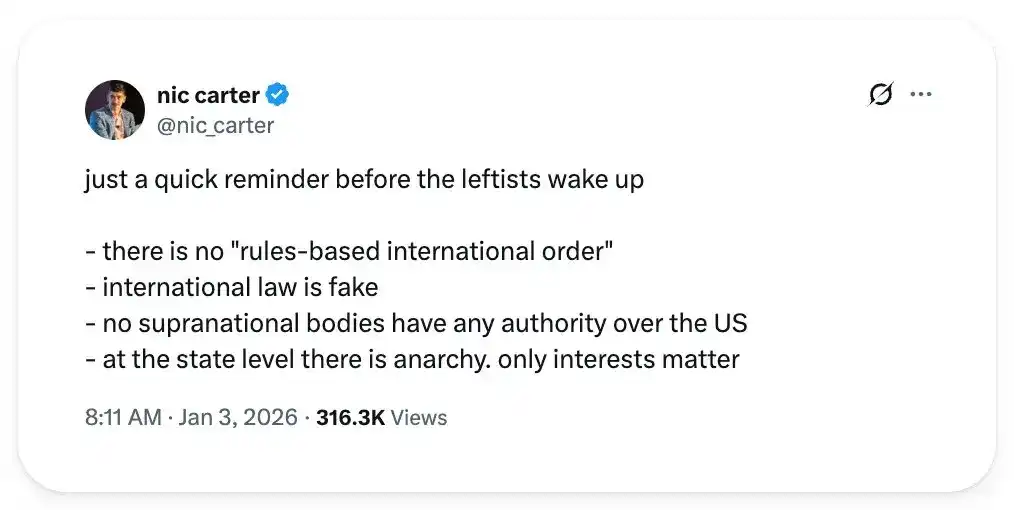
Nic Carter is right—the state is the highest level of organization that humanity has created. Before the nation-state, religion and monarchy were the highest levels of organizational structure that humans could create, and before that were feudal systems and tribes.

We attempted to build higher-level organizational structures through "common agreements" with institutions like the United Nations, but these agreements ultimately proved very fragile and had minimal impact on the world.

Therefore, our current situation is this: by 2026, the United States has abandoned the attempt to build a higher-level unified organizational structure and claims that we are better off going it alone.

It is worth mentioning that "pariah states" like Russia and Iran have恰恰 thrived by relying on a weak international order. They have always adhered to the law of the strong and exploited the weaknesses of the "rules-based international order" to expand their power, committing human rights violations that the United Nations merely condemns.

Although it is regrettable to see the attempts at global cooperation ultimately fail, at least we can finally be frank in pointing out that countries like Russia never truly followed these rules.

Bitcoin, Ethereum, and Decentralized Crypto Protocols

Decentralized crypto protocols are powerful and autonomous "higher-level organizational structures" that failed to materialize from the "rules-based international order" paradigm.

Trump's分裂 of the unified international community is precisely the situation that Ethereum aims to balance.

When the unified world falls apart and degenerates into regional powers, Ethereum reunites it in cyberspace.

These protocols do not enforce laws or protect their members. They do not replace nation-states. However, they are a ubiquitous, autonomous coordination layer for the people of the world to unite.

The conversation between Brian Armstrong and the Governor of the Bank of France exemplifies this power. The central bank governor made the mistake that all central bank governors make: misunderstanding and underestimating Bitcoin. Brian corrected him, pointing out that "Bitcoin has no issuer—it is a decentralized protocol...", and then he went on to elaborate on Bitcoin's most important role in unifying the world: "...[Bitcoin] is actually the most effective accountability mechanism for deficit spending."

No, we cannot establish a "rules-based international order" through voluntary coordination and cooperation among nations. But can we obtain a "rules-based international order" from a decentralized, cryptography-based internet protocol?

Bitcoin operates on "if...then..." statements. In my opinion, that sounds like a "rules-based international order." Doesn't Ethereum extend the same principle to Turing-complete smart contracts?

Despite the current atmosphere of despair and negativity in the cryptocurrency industry, I still firmly believe that we are far from tapping the potential of smart contracts.

So, perhaps we won't get a "rules-based international order" from the United Nations.

Perhaps we will get it from an unexpected place.

Perhaps we will get it from Ethereum.

Crypto di tendenza

Domande pertinenti

QWhat is the main argument David Hoffman makes about the role of Ethereum in the context of a failing international order?

ADavid Hoffman argues that as the unified global order fragments into regional powers, Ethereum serves as a decentralized, autonomous coordination layer in cyberspace that can unify the world by providing a 'rules-based international order' through its cryptographic protocols and smart contracts, unlike the failed attempts of institutions like the UN.

QAccording to the article, how did the Trump administration's stance impact the 'rules-based international order'?

AThe Trump administration rejected the 'rules-based international order' by claiming it only existed because the U.S. allowed it, and with its 'America First' policy, it no longer wanted to cooperate under this framework, effectively puncturing the collective illusion of global cooperation and international law.

QWhat example does the article provide to illustrate the power of decentralized crypto protocols like Bitcoin in holding governments accountable?

AThe article cites Brian Armstrong's conversation with the French Central Bank governor, where Armstrong corrected the governor's misunderstanding by stating that Bitcoin is a decentralized protocol without an issuer and serves as 'the most effective accountability mechanism for deficit spending,' enforcing rules through its 'if-then' operational logic.

QWhy does the author believe that decentralized crypto protocols are superior to traditional international institutions like the UN?

AThe author believes decentralized crypto protocols are superior because they are robust, autonomous higher-level organizational structures that exist ubiquitously in cyberspace, enforcing rules through code and cryptography, whereas traditional institutions like the UN rely on fragile voluntary coordination and have minimal real-world impact.

QWhat historical context does the article provide about the evolution of human organizational structures before nation-states?

AThe article references Nic Carter's view that nation-states are the highest form of organization humans have created, preceded by religions and monarchies, and before that, feudal systems and tribes, highlighting the failed attempts to create higher-level structures through agreements like the UN.

Letture associate

Must-Watch Events Next Week|CLARITY Act Could Face Senate Vote; SpaceX, Circle to Report Earnings (8.3-8.9)

**Summary: Key Events and Developments to Watch (August 3-9)** The upcoming week is marked by significant financial disclosures, key legislative deadlines, and notable product updates. **Major Financial Events:** Several companies are scheduled to release their Q2 2026 earnings. American Bitcoin (ABTC) will report on August 3, followed by SpaceX and Hut 8 Mining Corp. on August 4, and Circle on August 5. Notably, a significant portion of SpaceX shares (up to 12% of total shares) will be unlocked on August 6 following their earnings release. **Key Legislative Deadline:** The U.S. Senate faces an August 7 deadline to secure 60 votes for the CLARITY Act, a bipartisan bill aiming to establish a federal regulatory framework for cryptocurrencies. The Senate may hold a full vote on the bill during the week. **Economic Data:** The U.S. July Non-Farm Payrolls report will be released on August 7, providing crucial labor market data. **Technology & Product Updates:** * **Shutdowns:** DeFi portfolio tracker Zapper and wallet app Ctrl Wallet will cease operations on August 3. * **Upgrades:** LayerZero will deprecate its v1 relayers on August 3. XRP Ledger's new version 3.3.0, featuring five new functions, is expected next week. * **AI:** Elon Musk announced that the advanced Grok 4.6 AI model is set for release around August 7. * **Bitcoin:** The BIP-110 forced signaling for a potential Bitcoin network change is scheduled to begin around August 8. **Other Notable Events:** Chinese robotics firm Unitree Tech has set its preliminary price inquiry for its IPO for August 5. South Korean exchange Upbit will delist AQT and AERGO tokens on August 3.

marsbit1 h fa

Must-Watch Events Next Week|CLARITY Act Could Face Senate Vote; SpaceX, Circle to Report Earnings (8.3-8.9)

marsbit1 h fa

Stocks Are Plummeting More Sharply Than Cryptocurrencies. Where Has the Money Gone?

Stock Markets Plunge Deeper Than Cryptocurrencies: Where Did the Money Go? In late July, Seoul's Kospi index triggered circuit breakers for two consecutive days, plummeting over 40% from its June high. The collapse was led by heavyweight stocks like SK Hynix, whose record profits still disappointed investors, and devastating leveraged ETFs, with one major product losing over 83% of its value. This signaled a global, forced deleveraging targeting the most crowded trades. Interestingly, while stocks exhibited extreme volatility akin to crypto markets, Bitcoin rose nearly 15% in July after a prior steep drop. Analysis shows the money fleeing equities did not flow into Bitcoin. Instead, Bitcoin had already absorbed its sell-off in May-June, when U.S. spot Bitcoin ETFs saw historic outflows. The true safe-haven beneficiary was gold, whose price rose over 20% year-on-year, highlighting a decoupling between Bitcoin and gold as "digital gold." The sell-off was a targeted unwinding of leveraged positions in tech and semiconductors, accelerated by broker-dealer risk management and shifts in the AI narrative, including new competition from Chinese memory chipmakers. The retreat path was clear: from high-valuation tech stocks to cash and U.S. Treasuries, then to gold. For Bitcoin to attract sustained institutional inflows, conditions like eased global liquidity pressure, a "soft-landing" Fed rate cut, and U.S. regulatory clarity via legislation like the stalled CLARITY Act are needed. Currently, Bitcoin is not a safe haven but an already-cleared asset. Its low correlation with tech stocks, however, makes it a potential diversification play for institutional portfolios once the storm passes. The money isn't here yet, but the positioning is underway.

marsbit1 h fa

Stocks Are Plummeting More Sharply Than Cryptocurrencies. Where Has the Money Gone?

marsbit1 h fa

In Conversation with Ray Dalio: We Are Currently in an AI Bubble, with 1% of My Portfolio in Bitcoin

Ray Dalio, founder of Bridgewater Associates, warns in an interview that the current AI boom shows classic bubble characteristics, which could lead to significant economic downturns as seen in past cycles like 1929 or 2000. He explains that speculative enthusiasm, fueled by debt and overvaluation, often precedes a crash when rising rates or taxation force asset sales, causing widespread losses and recession. Dalio also outlines his "Big Cycle" theory, describing an approximate 80-year pattern where widening wealth gaps, massive government deficits, and shifting geopolitical power (like China's rise) create internal conflict and global instability. He emphasizes that we are in a late-cycle, transitional phase where traditional powers like the US and UK face decline. For personal wealth protection, Dalio advises diversification beyond cash into assets like stocks, bonds, real estate, and particularly gold, which he prefers over Bitcoin. While he holds about 1% of his portfolio in Bitcoin as a non-printable hard asset, he views gold as more secure from technological or governmental threats. Regarding AI's impact, Dalio believes it will disproportionately benefit capital owners, worsening inequality by replacing both physical and cognitive labor. He suggests that human intuition and emotional intelligence, combined with AI, will be key for future workers. On taxation, Dalio argues that wealth taxes are impractical and risk triggering asset sell-offs, reducing productive investment. He points to the UK as a cautionary example of debt, low productivity, and political strife. Geopolitically, Dalio foresees a more regionalized world, with the US showing weakness in prolonged conflicts like with Iran, akin to past imperial declines. The ideal outcome, he suggests, is coexisting powerful blocs (e.g., Americas, China-Asia Pacific) without major war.

marsbit4 h fa

In Conversation with Ray Dalio: We Are Currently in an AI Bubble, with 1% of My Portfolio in Bitcoin

marsbit4 h fa

Trading

Spot

Articoli Popolari

Come comprare ORDER

Benvenuto in HTX.com! Abbiamo reso l'acquisto di Orderly (ORDER) semplice e conveniente. Segui la nostra guida passo passo per intraprendere il tuo viaggio nel mondo delle criptovalute.Step 1: Crea il tuo Account HTXUsa la tua email o numero di telefono per registrarti il tuo account gratuito su HTX. Vivi un'esperienza facile e sblocca tutte le funzionalità,Crea il mio accountStep 2: Vai in Acquista crypto e seleziona il tuo metodo di pagamentoCarta di credito/debito: utilizza la tua Visa o Mastercard per acquistare immediatamente OrderlyORDER.Bilancio: Usa i fondi dal bilancio del tuo account HTX per fare trading senza problemi.Terze parti: abbiamo aggiunto metodi di pagamento molto utilizzati come Google Pay e Apple Pay per maggiore comodità.P2P: Fai trading direttamente con altri utenti HTX.Over-the-Counter (OTC): Offriamo servizi su misura e tassi di cambio competitivi per i trader.Step 3: Conserva Orderly (ORDER)Dopo aver acquistato Orderly (ORDER), conserva nel tuo account HTX. In alternativa, puoi inviare tramite trasferimento blockchain o scambiare per altre criptovalute.Step 4: Scambia Orderly (ORDER)Scambia facilmente Orderly (ORDER) nel mercato spot di HTX. Accedi al tuo account, seleziona la tua coppia di trading, esegui le tue operazioni e monitora in tempo reale. Offriamo un'esperienza user-friendly sia per chi ha appena iniziato che per i trader più esperti.

279 Totale visualizzazioniPubblicato il 2024.12.10Aggiornato il 2026.06.02

Come comprare ORDER

Discussioni

Benvenuto nella Community HTX. Qui puoi rimanere informato sugli ultimi sviluppi della piattaforma e accedere ad approfondimenti esperti sul mercato. Le opinioni degli utenti sul prezzo di ORDER ORDER sono presentate come di seguito.

活动图片













