Data Estimates Show Polymarket's Annual Revenue Could Easily Exceed 100 Million, Under the Assumption That...

marsbitPubblicato 2026-01-28Pubblicato ultima volta 2026-01-28

Introduzione

Polymarket, a prediction market platform, has begun charging fees on its "15-minute crypto up/down" markets since January 6, with a variable rate structure where fees are higher when odds are near 50% (up to 1.56%) and lower near 0% or 100%. After three weeks of implementation, data shows the platform has accumulated approximately $2.19 million in fee revenue, averaging about $730,000 per week. This translates to a projected annual revenue of around $38 million if current trading activity remains stable. The platform is expected to extend this fee model to other markets beyond crypto price movements. Analysis of the past week’s trading volume shows that the "15-minute crypto up/down" segment accounted for $159 million, or about 9.1% of Polymarket’s total weekly volume of $1.75 billion. If similar fees were applied across all markets, the platform revenue could theoretically reach around $418 million annually. It is important to note that these are estimates based on limited data and current trading behavior. Actual revenue may vary due to factors such as future growth, potential adjustments to fee structures, and differences in user activity across market types. Nevertheless, the move demonstrates Polymarket’s transition toward a sustainable revenue model, with significant growth potential ahead, especially with major events like the 2026 World Cup and U.S. midterm elections likely to drive further engagement.

Original | Odaily Planet Daily (@OdailyChina)

Author | Azuma (@azuma_eth)

On January 6th of this year, Polymarket officially began charging transaction fees for markets related to "15-minute cryptocurrency price movements." The specific fee rate varies with the real-time odds of the market — the closer the odds are to 0% or 100%, the lower the fee; conversely, the closer the odds are to 50%, the higher the fee, with a maximum of 1.56%.
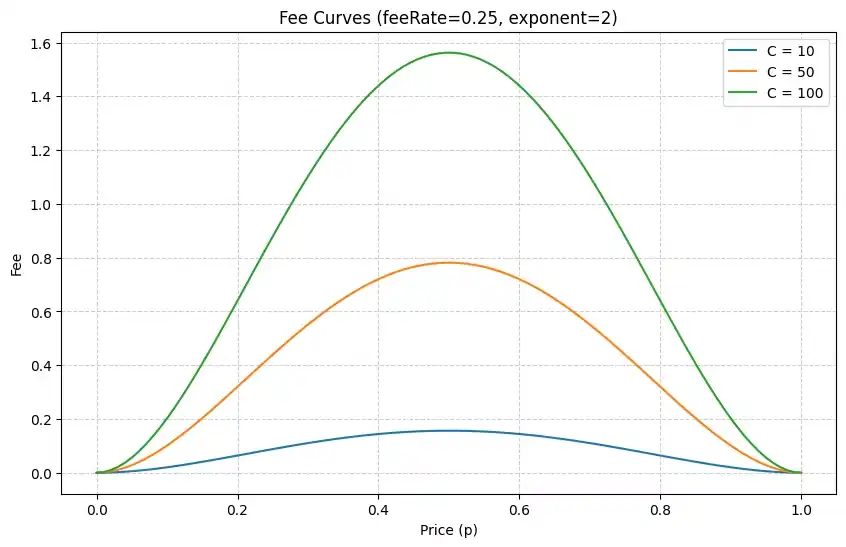
This marks the first time, outside of the U.S. market (where Polymarket charges a 0.01% fee), that Polymarket has ended its completely free model and started charging transaction fees for a specific type of market. Now, three weeks later, there is a sufficient observable data sample, making it time to conduct a rough estimate of Polymarket's revenue potential.

First, let's look at the most direct measure: the scale of fee revenue. According to data compiled by Gate Research on Duna, since the introduction of these fees, Polymarket has accumulated approximately $2.19 million in fee revenue, averaging about $730,000 per week. Based on this data, if the trading volume and activity structure of the relevant markets remain unchanged, it is projected to generate approximately $38 million in annual revenue for Polymarket.
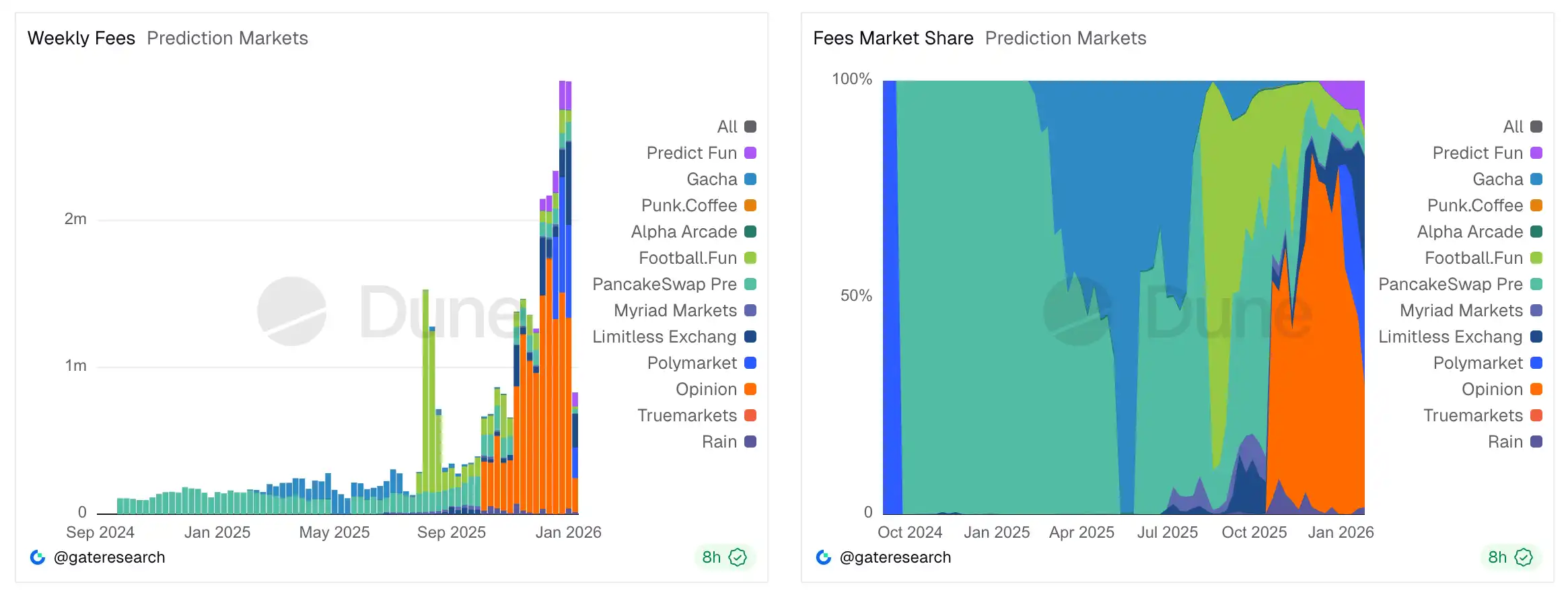
It is foreseeable that Polymarket's fee-charging scope will not be limited to just the "15-minute cryptocurrency price movements" category. Prior to officially charging fees for this category, Polymarket had long maintained a completely free model while also subsidizing market liquidity out of its own pocket. At the end of last year, Coplan himself admitted that Polymarket was operating at a loss... But we have seen too many such "burning cash" stories in the internet market. As Polymarket's user habits and market position gradually solidify, it would not be surprising to see fees introduced for more markets in the future.

  • Odaily Note: For more on Polymarket's revenue issues, refer to Odaily's recent Tea Talk column "Odaily Editorial Tea Talk (January 7th)."

Assuming Polymarket continues to apply the current fee standards to other markets in the future, we might gauge the theoretical revenue ceiling for Polymarket at the current trading volume level by comparing the trading volume of the "15-minute cryptocurrency price movements" market with Polymarket's total platform trading volume. The more markets that charge fees, the higher the revenue.

Data obtained by Odaily shows that the total trading volume of the "15-minute cryptocurrency price movements" market on Polymarket over the past week was approximately $159 million (among the four major tokens, BTC accounted for $114 million, ETH for $30.29 million, SOL for $8.93 million, and XRP for $5.73 million). This represents about 9.1% of Polymarket's total trading volume of approximately $1.75 billion over the past week. Based on this ratio, if Polymarket introduces a similar fee model across all markets under the current trading volume and structure, it is projected to generate $418 million in annual revenue for the platform.

It should be noted that the above are all estimates by Odaily based on historical data. In reality, Polymarket's actual revenue situation will inevitably deviate due to various variables — first, Polymarket has only been charging fees for three weeks, so the sample size is still relatively small; second, Polymarket may not adopt a similar fee mechanism for other markets, and differences in user trading habits across markets will also lead to variations in the final fee results under a dynamic fee mechanism; third, and most crucially, Polymarket is still in a strong growth phase. It is expected that with the further popularization of the prediction market concept, coupled with potential highlights like the 2026 World Cup and mid-term elections, the platform's trading volume will continue to grow in the future.

Even considering these uncertainties, one trend is already quite clear — Polymarket is demonstrating the revenue potential of this entirely new format of prediction markets. It is no longer just a novel innovative concept but a truly sustainable, self-generating business with immensely imaginative profit space.


Domande pertinenti

QWhat is the estimated annual revenue Polymarket could generate from its current fee structure on '15-minute crypto up/down' markets, based on recent data?

ABased on recent data, Polymarket is estimated to generate approximately $38 million in revenue annually from its fee structure on '15-minute crypto up/down' markets, assuming trading volume and activity remain constant.

QWhat was the article's method for estimating Polymarket's potential total annual revenue if fees were applied to all markets?

AThe article estimated potential total annual revenue by comparing the trading volume of the '15-minute crypto up/down' markets (9.1% of total volume) to the platform's total weekly trading volume ($1.75 billion). It then scaled the current fee revenue from that segment proportionally, projecting an annual figure of approximately $418 million.

QAccording to the article, what is a key factor that could lead to even higher future revenue for Polymarket beyond current estimates?

AA key factor for potential higher future revenue is Polymarket's strong growth trajectory. The article specifically mentions the further popularization of the prediction market concept and potential major events like the 2026 World Cup and midterm elections as catalysts for continued increases in platform volume.

QHow does Polymarket's fee structure for the '15-minute crypto up/down' markets work?

AThe fee varies with the real-time odds of a market. Fees are lower when the odds are closer to 0% or 100% and higher when the odds are closer to 50%, with a maximum fee of 1.56%.

QWhat significant change did Polymarket implement on January 6th regarding its business model?

AOn January 6th, Polymarket began charging trading fees on its '15-minute cryptocurrency up/down' markets. This marked the first time the platform ended its completely free model for a specific market type outside of the US (which has a separate 0.01% fee).

Letture associate

The Verdict in Choi Tae-won's Divorce Case: Revealing the Inheritance Undercurrent Behind SK Hynix's Trillion-Won Empire

SK Group Chairman Chey Tae-won's high-profile divorce case, involving a record 1.38 trillion won settlement, has drawn attention to the succession plans for Korea's second-largest conglomerate, especially its crown jewel, SK hynix. Unlike traditional chaebol scripts centered on the eldest son, Chey's three children from his marriage to former President Roh Tae-woo's daughter, Roh Soh-yeong, are carving distinct, non-traditional paths. Eldest daughter Chey Yun-jung (b. 1989) is seen as the most evident successor. With a scientific and consulting background, she holds executive roles at SK bioscience and SK Inc.'s growth support department, focusing on future strategy and biopharma. Her marriage is to an AI infrastructure entrepreneur, not a traditional business alliance. Second daughter Chey Min-jung (b. 1991) took a unique route, voluntarily serving as a South Korean naval officer, including an anti-piracy deployment. She later worked on policy and strategy for SK hynix in Washington D.C. before co-founding an AI-driven healthcare startup. She married a former U.S. Marine Corps officer, connecting her to U.S. defense and policy circles—networks crucial for a global semiconductor giant. The only son, Chey In-geun (b. 1995), who studied physics like his father, worked briefly at SK E&S before joining McKinsey. Despite fitting the traditional "heir" profile as the eldest son, he remains silent and holds no public position or shares in SK, suggesting the old succession playbook is obsolete. As SK hynix's valuation soars, becoming a geopolitical asset in the AI era, the heirs' legitimacy is no longer automatic. They must prove themselves in fields like AI biotech, global policy, and strategic consulting. Their marriages also reflect new elite networks in tech and defense, not old political alliances. Their inheritance is the complex challenge of navigating a globalized, tech-driven world, not just a corporate throne.

marsbit10 h fa

The Verdict in Choi Tae-won's Divorce Case: Revealing the Inheritance Undercurrent Behind SK Hynix's Trillion-Won Empire

marsbit10 h fa

From OpenSea to OpenRouter: Is Alex Atallah Repeating His 'Exit at the Peak' Playbook?

From OpenSea to OpenRouter: Is Alex Atallah Repeating His "Exit at the Peak" Playbook? According to the Wall Street Journal, payments giant Stripe is in talks to acquire the AI model aggregation platform OpenRouter in a potential deal valuing the company near $100 billion. This would mark founder Alex Atallah's second creation of a company reaching a $100 billion valuation, following his co-founding of NFT marketplace OpenSea. OpenRouter, founded just over three years ago, has grown rapidly by acting as a unified gateway for developers to access over 400 AI models. It currently has about 10 million users and processes over 200 trillion tokens monthly. While the platform's annualized revenue is around $50 million, its valuation has skyrocketed from $1.3 billion in March 2026. The potential acquisition by Stripe, a company OpenRouter's founder once likened it to, represents a major expansion into AI infrastructure for the payments leader. This move echoes Atallah's previous timing with OpenSea, where he departed before the NFT market's significant downturn. For OpenRouter, selling now may be strategic. Despite its scale, its business model—charging a 5-5.5% fee on AI inference calls—faces pressure from competition, open-source models, and potential price wars among model providers, limiting its profitability narrative for an IPO. A key asset for potential acquirers like Stripe is OpenRouter's vast repository of real-world AI usage data, which offers unique insights into model performance and developer preferences that are difficult to replicate. Whether this potential deal signifies a new valuation benchmark for AI infrastructure or another market peak signal remains to be seen.

链捕手11 h fa

From OpenSea to OpenRouter: Is Alex Atallah Repeating His 'Exit at the Peak' Playbook?

链捕手11 h fa

Trading

Spot
活动图片




