Dash Launches ZK-Privacy Based on Zcash

cryptonews.ruPubblicato 2026-07-30Pubblicato ultima volta 2026-07-30

Introduzione

Dash has launched ZK-based privacy features built on Zcash's Orchard protocol. This is now integrated directly into the Dash Platform's consensus (v4.0.0), providing a native, non-custodial privacy model alongside the existing CoinJoin system. It offers optional confidentiality, hiding sender, receiver, amount, and balance within a shielded pool. The implementation adapts Zcash's Orchard protocol (using Halo 2 without a trusted setup) to Dash Platform, handling state transitions, GroveDB storage, fees, and wallet sync. A critical double-spend vulnerability discovered in Orchard prior to release was patched using updated libraries, with Dash adding a SumTree structure for extra security. Users can privately transfer Platform Credits (pegged 1:100 billion to DASH) and move funds to/from the main Dash Core chain. Wallet synchronization, which is required to detect incoming private transactions, took about 21 seconds in testing, noted as significantly faster than a comparable Zcash wallet. Future plans include extending shielded pools to native Platform tokens and NFTs, aiming to combine ZK-privacy with token issuance and direct exchangeability with Dash. Mobile wallet support for the new feature is expected soon.

In February, we wrote about Dash's plans to integrate Orchard. At that time, it was about a future release and the prospect of private user tokens.

Now the first part of the plan has been implemented: in Dash Platform v4.0.0, shielded operations have become part of the consensus. This is not an external mixer, not a custodial service, and not an experimental smart contract — privacy is built directly into the protocol.

For Dash, historically associated with CoinJoin, this is not a replacement for the old mechanism, but a second model of privacy. CoinJoin continues to work on the main network, while Platform uses ZK-proofs instead of mixing rounds with multiple participants. This approach is better suited for fast mobile wallets. At the same time, regular Dash transactions remain transparent: confidentiality is optional.

The shielded pool hides the balance, sender, recipient, and transfer amount within the pool. The network verifies that funds exist, belong to the sender, and are not double-spent, but does so without revealing the operation's contents.

A user can deposit credits into the pool from a transparent Platform address, conduct a private transfer, and return the funds back. For DASH holders, two other routes are more important: ShieldFromAssetLock sends funds to the shielded pool directly from Core, and ShieldedWithdrawal withdraws them to a specified Core address. To avoid linking the withdrawal to previous activity, the wallet must use a new address.
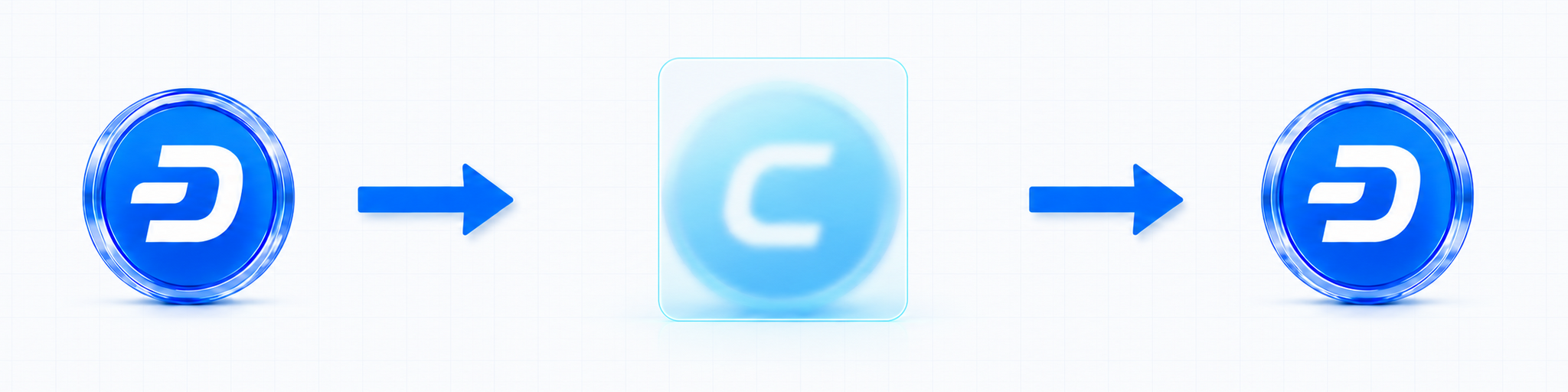
Platform Credits are the internal accounting unit of Dash Platform, linked to Dash by a fixed ratio: one Dash corresponds to 100 billion credits.

How the Privacy Works — Without Unnecessary Math

Dash did not create a new ZK-scheme from scratch. The implementation is based on Orchard, Zcash's shielded protocol built on Halo 2 without a trusted setup. Dash's engineering work involved adapting it to Platform: custom state transitions, storage in GroveDB, fees, wallet synchronization, and the route back to Core.

Shortly before the release, a critical vulnerability was discovered in Orchard, potentially allowing double spending within the pool. The Zcash team fixed the proof scheme, and the Dash Core Group updated its implementation to the revised libraries even before the release of Platform 4.0. An additional layer of control in Dash is provided by SumTree: this structure stores and verifies the pool's state, preventing hidden inflation from going unnoticed.

One of the main problems with shielded systems is wallet synchronization. To detect incoming funds, the application receives encrypted notes and locally checks which ones its key can decrypt. The server does not learn which transfers belong to the user.

In the test version of the application, we created a new wallet and started synchronization: it took about 21 seconds, which is significantly faster than synchronizing the Zodl wallet for ZCash.

The release of mobile wallets supporting the new technology is expected soon.

Currently, the pool only works with Platform Credits. However, Dash has already announced plans to add separate shielded pools for native Platform tokens.

Private user assets are not a new concept. Dash's strength lies in the specific combination of capabilities: ZK-privacy, token and NFT issuance, and the ability to exchange created assets for Dash and back. Thanks to this, each asset gains a direct link to the already established coin, and through it — to the external market.

end-content

Crypto di tendenza

Domande pertinenti

QWhat is the main news about Dash mentioned in the article?

ADash has launched ZK-privacy (shielded operations) built directly into its protocol, specifically in Dash Platform v4.0.0, based on Zcash's Orchard protocol.

QHow does the new shielded privacy model in Dash Platform differ from its previous CoinJoin method?

AThe new model uses Zero-Knowledge (ZK) proofs for privacy, making it better suited for fast mobile wallets. It is built directly into the protocol, unlike CoinJoin which is a mixing service in the main network. Both models coexist, with the new shielded pool offering optional privacy for Platform Credits.

QWhat are the two new transaction routes mentioned for DASH holders to interact with the shielded pool?

AThe two new routes are 'ShieldFromAssetLock', which sends funds into the shielded pool directly from Dash Core, and 'ShieldedWithdrawal', which withdraws funds from the shielded pool to a specified Dash Core address.

QWhat was a key security issue addressed before the launch of Dash Platform v4.0.0?

AA critical vulnerability was discovered in the Orchard protocol that could potentially allow double-spending within the shielded pool. The Zcash team fixed the proof scheme, and the Dash Core Group updated its implementation to the patched libraries before release.

QWhat future development for Dash Platform's shielded pools is announced in the article?

ADash announced plans to add separate shielded pools for native tokens on the Dash Platform, enabling private user-created assets like tokens and NFTs with a direct link to the DASH cryptocurrency and the external market.

Letture associate

Breaking: GPT-5.6 Prices Slashed Effective Today

OpenAI has announced significant price cuts for its GPT-5.6 model API, effective immediately. The entry-level **GPT-5.6 Luna** sees the most drastic reduction, with input prices dropping 80% to $0.20 per million tokens and output prices falling to $1.20 per million tokens. The mid-tier **GPT-5.6 Terra** is reduced by 20%, now costing $2.00 (input) and $12.00 (output) per million tokens. The flagship **GPT-5.6 Sol** maintains its original price but introduces a new **Fast mode**, offering speeds up to 2.5 times faster for double the cost. The company attributes these price reductions to efficiency gains achieved through **GPT-5.6 Sol's own involvement in optimizing its production systems**. The model assisted in rewriting GPU kernels and improving speculative decoding, leading to a 20% reduction in end-to-end service costs and over 15% improvement in token generation efficiency. OpenAI emphasizes this process remained human-led. A key focus of the降价 is to lower the barrier for running **AI agent workflows**. By making the capable, tool-calling Luna model significantly cheaper, OpenAI aims to enable more frequent use in cost-sensitive, high-volume tasks like code review and monitoring. This creates a potential feedback loop: model-assisted efficiency gains lead to lower costs, which enables broader agent deployment, which in turn drives further optimization. The new pricing and features will also apply to Codex and ChatGPT Work subscriptions. The changes intensify competition in the large language model market, with OpenAI directly challenging rivals like Anthropic to respond.

marsbit9 min fa

Breaking: GPT-5.6 Prices Slashed Effective Today

marsbit9 min fa

South Koreans' 'Gambling Nature' is Actually Forced by Life

This article explores how systemic pressures in South Korea, rather than inherent "gambling" tendencies, drive widespread speculative financial behavior. It begins by noting the high frequency of flights from South Korea to Macau, symbolizing the search for outlets beyond domestic restrictions. The core argument is that ordinary life goals—stable employment, home ownership, and financial security—have become increasingly tied to asset markets due to structural economic factors. South Korea's development model, historically reliant on corporate leverage (chaebols), has evolved into a society where household debt and personal leverage are normalized as pathways to social mobility. Key mechanisms discussed include: * **Housing Policy:** Government measures to improve affordability, like extending mortgage terms to 50 years and the unique *jeonse* (key money) rental system, embed high leverage into the housing market. * **Financial Products:** The recent approval and explosive popularity of single-stock 2x leveraged ETFs (e.g., on Samsung and SK Hynix), easily accessed via mobile apps, lowered barriers to high-risk trading. * **Social Pressure:** Media narratives around soaring corporate profits (e.g., SK Hynix) and employee bonuses create a fear of missing out, pushing individuals to use leverage to "catch up." The article concludes that this "leveraged life" is a product of institutional history and policy choices. When traditional paths to success feel constrained, and policy facilitates debt-based solutions for housing and investment, speculative behavior becomes a rational, if risky, strategy for many. The rapid cycle of regulatory approval for leveraged ETFs followed by a market crash and official apology in mid-2026 exemplifies the system's inherent contradictions. Ultimately, the "bet" is not just on assets, but on using future earnings to secure a place in the present society.

marsbit9 min fa

South Koreans' 'Gambling Nature' is Actually Forced by Life

marsbit9 min fa

Trading

Spot

Articoli Popolari

Come comprare DASH

Benvenuto in HTX.com! Abbiamo reso l'acquisto di DASH (DASH) semplice e conveniente. Segui la nostra guida passo passo per intraprendere il tuo viaggio nel mondo delle criptovalute.Step 1: Crea il tuo Account HTXUsa la tua email o numero di telefono per registrarti il tuo account gratuito su HTX. Vivi un'esperienza facile e sblocca tutte le funzionalità,Crea il mio accountStep 2: Vai in Acquista crypto e seleziona il tuo metodo di pagamentoCarta di credito/debito: utilizza la tua Visa o Mastercard per acquistare immediatamente DASHDASH.Bilancio: Usa i fondi dal bilancio del tuo account HTX per fare trading senza problemi.Terze parti: abbiamo aggiunto metodi di pagamento molto utilizzati come Google Pay e Apple Pay per maggiore comodità.P2P: Fai trading direttamente con altri utenti HTX.Over-the-Counter (OTC): Offriamo servizi su misura e tassi di cambio competitivi per i trader.Step 3: Conserva DASH (DASH)Dopo aver acquistato DASH (DASH), conserva nel tuo account HTX. In alternativa, puoi inviare tramite trasferimento blockchain o scambiare per altre criptovalute.Step 4: Scambia DASH (DASH)Scambia facilmente DASH (DASH) nel mercato spot di HTX. Accedi al tuo account, seleziona la tua coppia di trading, esegui le tue operazioni e monitora in tempo reale. Offriamo un'esperienza user-friendly sia per chi ha appena iniziato che per i trader più esperti.

314 Totale visualizzazioniPubblicato il 2024.12.13Aggiornato il 2026.06.02

Come comprare DASH

Discussioni

Benvenuto nella Community HTX. Qui puoi rimanere informato sugli ultimi sviluppi della piattaforma e accedere ad approfondimenti esperti sul mercato. Le opinioni degli utenti sul prezzo di DASH DASH sono presentate come di seguito.

活动图片